
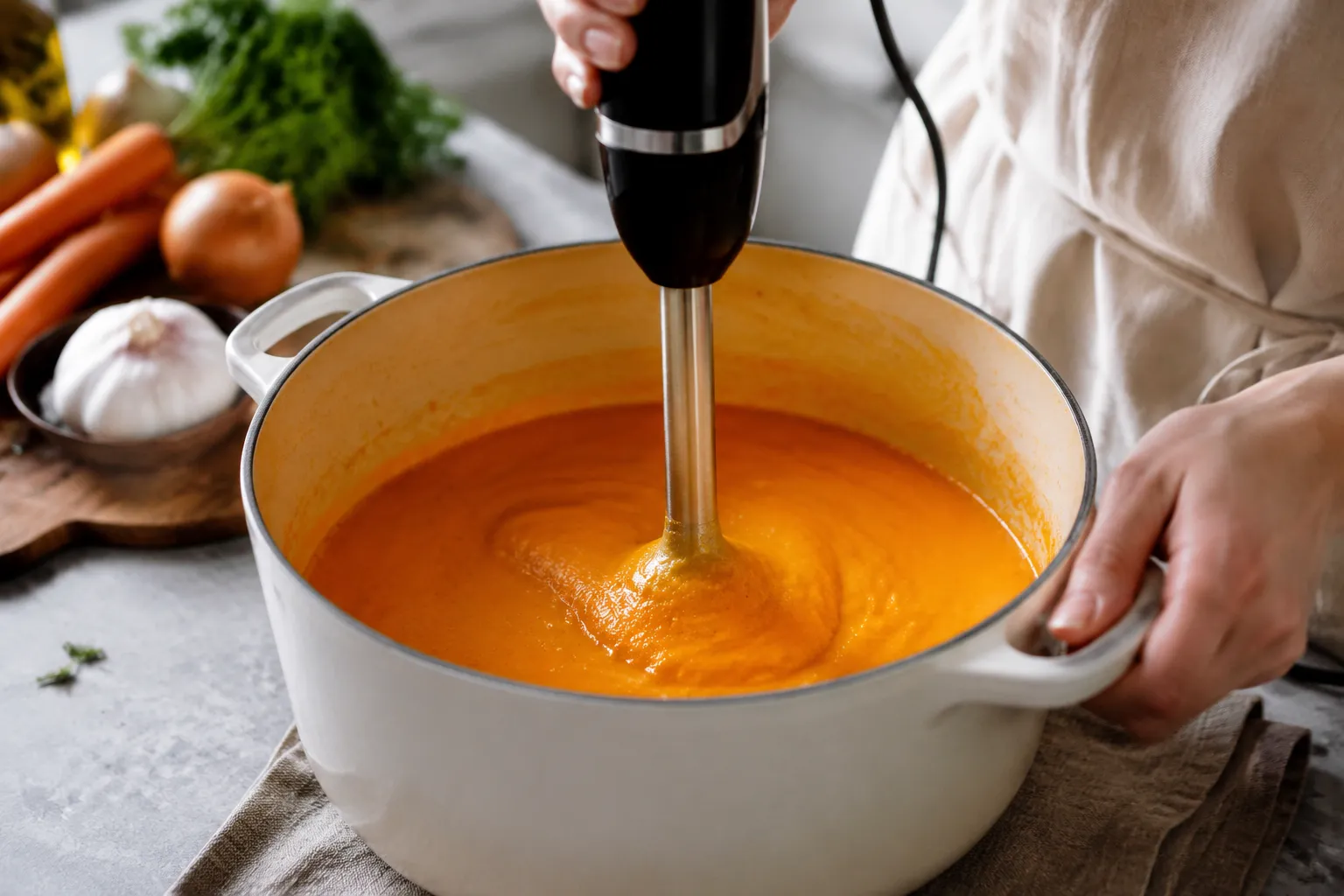
Pureed vegetable soup is the one place where the immersion blender has no rival. A countertop blender makes a smooth puree, but it also demands that hot liquid be poured into a glass jar in batches, which is a chore and a burn risk. The immersion blender goes directly into the pot, and that convenience has made it the default tool for a whole category of cooking. The problem is that most people use it badly, and the results show it. A soup that should be velvet comes out thin, or worse, it comes out with a texture that feels gritty and slightly foamy, a texture that no amount of salt can fix.
The machine is not the culprit. Almost any immersion blender, from a thirty-dollar stick to a professional model, can produce a perfectly smooth soup if the person using it understands a few physical realities about how blades work in a liquid. The mistakes are almost always the same: too much speed, too little liquid, the wrong depth, and an impatience that ends the blending process minutes too early.
The First Mistake Is Speed
An immersion blender has two speeds in most people's minds: off and full blast. That is wrong. The variable speed dial on a decent model is not a gimmick. It exists because the physics of pureeing demand a gentle start. When the blades spin at maximum speed from the first second, they create a vortex that pulls air into the soup. That air gets whipped into the liquid and creates micro-foam. The foam is not just an aesthetic problem. It changes the mouthfeel, making the soup taste less dense and slightly hollow, and it oxidizes the soup, which can dull the color of anything green.
The correct approach is to start at the lowest speed and let the blade engage the liquid fully before increasing the power. This takes about ten seconds. The initial slow spin pulls the soup into the blade housing without introducing air. After the mixture is moving in a gentle swirl, the speed can be raised, but even then, most soups do not need full power. A medium speed is almost always enough. The blade does not need to shred the vegetables; it needs to shear them into particles small enough to suspend in the liquid. High speed after the initial engagement only risks overheating the motor and over-aerating the soup.
Depth Control Determines Texture
The angle of the blender and its depth in the pot are the two adjustments that separate a professional result from a home cook's frustration. The blade housing should be fully submerged before the motor starts. Running the blade with the housing half out of the liquid is the fastest way to splatter hot soup across a stove and to suck air into the mixture. The housing should sit deep enough that the liquid covers the entire bell-shaped guard, plus a little extra. That extra inch of soup above the housing is what prevents the vortex from reaching the surface and pulling air down into the blades.
Once the motor is running, the blender should be moved in slow, deliberate circles, tilting the shaft slightly from side to side. This tilting motion is the secret to a uniform puree. If the blender stays vertical and stationary, it creates a hole in the center of the pot, and the vegetables around the edges of that hole remain coarse. The tilt pushes the blade through different planes of the liquid, catching the chunks that float to the top and the solids that sink to the bottom. A person should spend a full minute moving the blender through the pot in this manner, covering every quadrant, before assuming the job is done.
The Liquid Level Is a Hard Constraint
There is a minimum volume of liquid below which an immersion blender simply cannot function. The blade needs enough soup to surround it completely, and it needs enough liquid to keep the solids in motion. A pot with two cups of soup and a thick mass of cooked carrots at the bottom will not blend evenly. The carrots will spin around the blade in a dry clump, getting chopped into uneven bits, while the liquid stays separate. The solution is not to blend longer. The solution is to add more liquid, usually a splash of stock or water, before blending begins.
This is the point where many recipes fail. They instruct a cook to drain vegetables and then puree them with a minimal amount of liquid, the goal being a thick paste. An immersion blender is the wrong tool for that job. A food processor or a countertop blender handles a thick paste far better because their blades are designed to move solids against a wall. The immersion blender needs a liquid that is thin enough to flow freely around the blade. If the goal is a thick puree, the cook should add liquid, blend until smooth, and then simmer the soup uncovered to reduce it back to the desired thickness. That two-step process produces a silkier texture than trying to blend a dry mash.
Size the Vegetables Before the Pot Boils
The texture of the final soup is partly decided before the blender ever turns on. Vegetables cut into large, uneven chunks do not soften at the same rate. The smaller pieces turn to mush while the larger pieces remain firm in the center. When the blender runs, it turns the mush into a fine puree but leaves the firm centers as small, gritty bits. These bits are the graininess that ruins so many blended soups. They are not fat or starch; they are undercooked fragments of carrot or potato that the blade cannot fully break down without over-processing the rest of the soup.
Uniform pieces around one inch in size cook at an even rate, and they soften to the point where the blender has almost no work to do. The blade is then refining a texture rather than forcing a transformation. This is a subtle distinction, but it is the difference between a soup that tastes blended and a soup that tastes naturally smooth. The best pureed soups have a texture that suggests the ingredients melted into the liquid, not that they were mechanically shredded.
The Fat Rounds the Edges
Texture in a soup is not only about particle size. It is also about the way particles interact with the tongue. A puree with tiny solid particles suspended in water feels thin and sharp, almost acidic, even if the flavor is good. The addition of fat changes this Perception. A knob of butter, a splash of cream, or a tablespoon of olive oil added before blending introduces a silky component that coats the particles and smooths the overall mouthfeel. The fat does not need to be dairy. An extra virgin olive oil works beautifully in a tomato or red pepper soup, and a nut oil can elevate a root vegetable puree.
Timing matters here. Fat added before blending gets completely emulsified into the soup, which is what a person wants for a glossy, uniform texture. Fat swirled in after blending sits on top and creates a separate layer. Both approaches have their place, but for a smoother result, the fat should go into the pot before the blender runs. The emulsion that forms is stable and gives the soup a velvety body that no amount of post-blend stirring can replicate.
The Starch Trap and Its Simple Fix
Starchy vegetables like potatoes and winter squash present a special problem. They puree beautifully, but they also release starch that can make the soup turn gluey if the blending goes on too long. The blade's mechanical action breaks starch molecules and causes them to absorb water, creating a pasty texture that is distinctly unpleasant. The fix is to blend in short bursts rather than a continuous run. A continuous thirty-second blend is too long for a potato soup. Three bursts of ten seconds each, with a pause to let the soup settle, will produce a smooth result without the glue.
The same caution applies to any soup that contains a significant amount of starch, including those thickened with rice or bread. These soups reach their peak smoothness quickly, and further blending only degrades them. A person should taste and evaluate the texture between bursts, stopping the moment the soup feels smooth on the tongue. The difference between a perfect potato leek soup and a gummy one is about five seconds of unnecessary blending.
What the Motor Housing Tells No One
The design of the blade housing matters more than the wattage of the motor. A housing that is wide and tall creates a larger blending zone, which means it processes more soup per revolution and produces a more consistent puree. A narrow housing requires more time and causes the soup to circulate faster, which increases aeration. The best immersion blenders have a housing that flares out slightly at the bottom, like a bell. This shape creates a vacuum that pulls soup upward into the blades and pushes it out the sides, creating a continuous circulation loop that breaks down solids efficiently.
The blade itself should be sharp, but not razor sharp. Immersion blender blades are usually serrated or have a slight offset. This design is intended to chop rather than slice, and it works best when the blade is not pressed hard against the bottom of the pot. A common mistake is to push the blender all the way down and press firmly, trying to force the blade through the vegetables. This dulls the blade over time and does not improve the result. The blade should float just above the bottom of the pot, letting the liquid flow carry the solids into it.
The Hot Liquid Hazard and the Cold Soup Mistake
Blending hot soup is dangerous, but not for the reason most people think. The risk is not the blade; it is the steam. When hot liquid is blended, the blade creates a vortex that can pull steam bubbles down and cause the soup to erupt upward, splashing boiling liquid onto a hand or forearm. This is why the blender should start at a low speed and why the housing must be fully submerged. A person should also tilt the pot away from themselves slightly while blending, so that any eruption goes toward the back of the stove. This is a practical habit, not a paranoid one.
The cold soup mistake is the opposite. Some recipes suggest pureeing cold vegetables for a chilled soup, and an immersion blender will do this, but the texture will be worse. Cold vegetables are firmer, and the cold liquid is more viscous, which means the blade has to work harder and creates more friction. This friction heats the soup slightly, which is not a problem, but it also means the blending takes longer and the result is more likely to be uneven. The better approach is to blend the soup while it is warm, then chill it after. The warm puree is smoother, and the chilling process happens after the texture is already set.
The Cleanup That Changes the Habit
No one blends soup every day because the cleanup is a drag. The trick that makes the immersion blender worth it is a simple one: fill the blending pot with warm water and a drop of dish soap immediately after use, then run the blender for ten seconds. The blade cleans itself, and the shaft wipes down with a cloth. This should be done before the soup has a chance to dry onto the metal. A dried-on film of pureed soup is the reason so many immersion blenders end up in a drawer, unused, because the owner remembers the scrubbing more than the soup.
There is also a cleaning habit that ruins a blender: submerging the entire shaft in water. The motor housing at the top is not waterproof, and water that seeps past the seal will eventually corrode the motor. The shaft is only meant to be submerged up to the point where the plastic meets the metal. Washing the motor housing with a wet cloth is fine. Dunking it is not. This is a maintenance detail that people learn only after their blender dies mid-soup, and they blame the brand when they should blame the dishwasher.
A Final Pass with a Strainer for the Obsessive
For the smoothest possible result, there is one more step that separates a good soup from a restaurant-quality one: pass the blended soup through a fine mesh strainer. This takes an extra two minutes and a second pot, and it catches the fibrous bits that the blade cannot break down, like the strings from celery or the skins from chickpeas. The strained soup is not just smoother; it is also more uniform in color and has a glossy sheen that unstrained soup lacks. This step is not necessary for everyday cooking, but for a special dinner, it is the difference between a soup that is very good and a soup that is exceptional.
The strainer also serves as a diagnostic tool. The material left behind tells a person exactly what went wrong. If the strainer catches large chunks, the blending time was too short or the vegetables were too big. If it catches a fine sludge, the soup was over-blended and the starch released. If it catches nothing at all, the technique was sound, and the soup will be as smooth as the blender can make it. That last outcome is worth the extra pot. It confirms that the machine, the method, and the cook all did their jobs.