
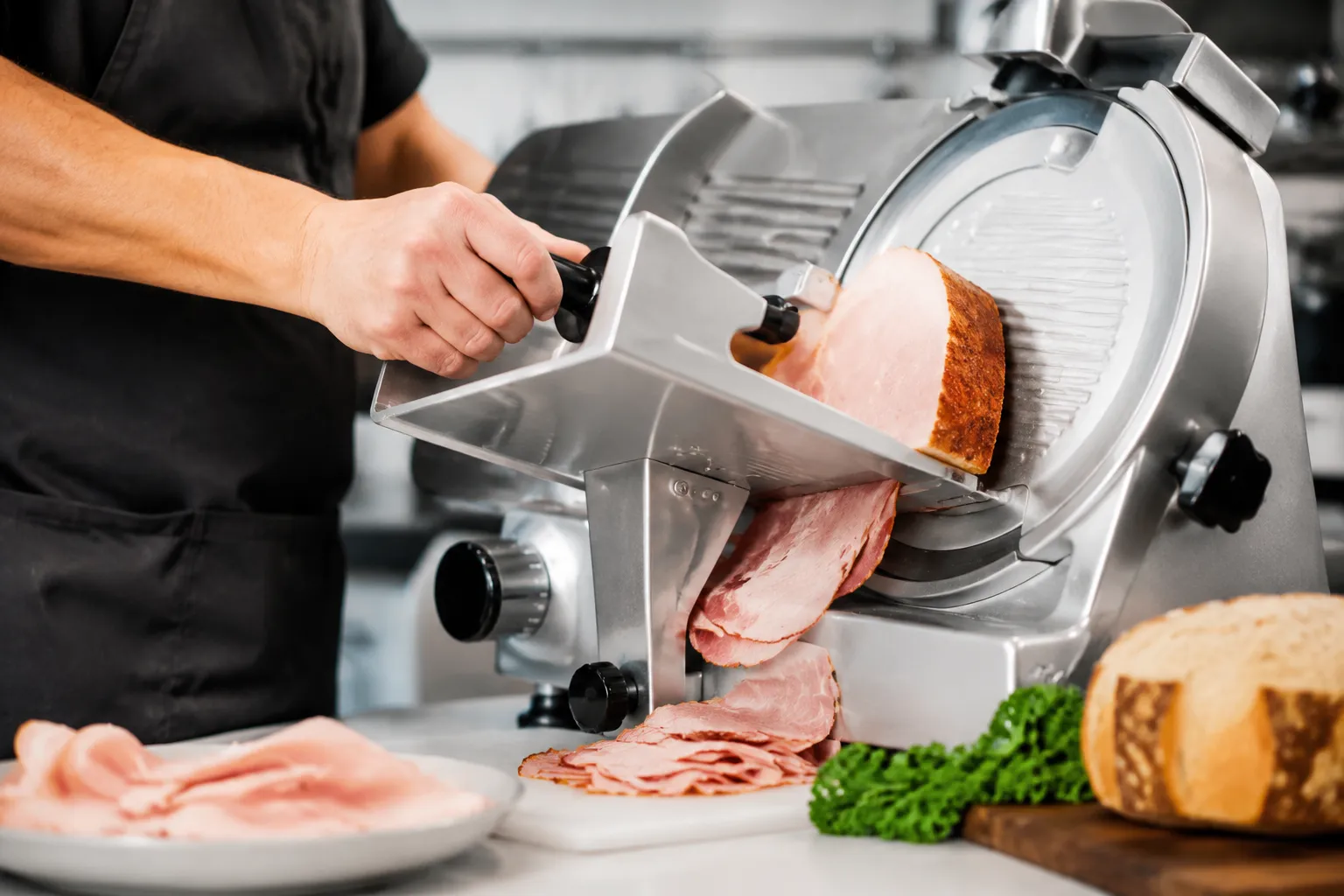
The deli case at the grocery store performs a kind of magic trick. A cook behind the counter takes a whole roast beef, slides it across a whirring blade, and produces a pile of shingles so thin they nearly fold under their own weight. That same roast beef at home, carved with a knife, comes out in slabs thick enough to stand on end. The difference is not the meat. The difference is the machine, and more precisely, the person running it. A meat slicer does not do the work by itself. It rewards a specific set of habits, and the gap between a clean cut and a mangled one is almost always a matter of a few small choices made before the blade ever touches the roast.
The first choice is the one most people skip: the meat has to be cold. Not refrigerator cold, not straight-out-of-the-fridge cold, but properly chilled, ideally firmed up in the freezer for twenty to thirty minutes before it goes on the carriage. A warm roast compresses under the blade. The outer crust stays intact while the interior smears and tears, leaving a ragged edge and a pile of shreds that look less like deli slices and more like pulled pork. Chilling the meat firms the proteins so the blade can shear through cleanly. A roast that has spent half an hour in the freezer at 20 degrees or so will still carve easily, but it will hold its shape under pressure in a way that a room-temperature roast never can.
This matters more for some cuts than others. A dense, tightly packed ham holds together reasonably well even when it is warm. A juicy, loose-textured roast chicken breast falls apart the moment a blade touches it, no matter how cold it gets. The trick for anything with a loose structure is to freeze it until it is almost solid, then slice it while it is still stiff. That is how the deli gets those perfect, uninterrupted rounds of turkey breast. The meat is essentially frozen when it hits the blade. It thaws in the time it takes to get home, but on the carriage it behaves like a block of wood instead of a heap of fibers.
Once the meat is cold, the next decision is the blade itself. Most home slicers come with a serrated blade as the default, and most people leave it that way. That is a mistake. A serrated edge works beautifully on bread, which needs a sawing action to break through a crust without crushing the crumb. On meat, serration tears. The teeth grab at the surface and rip the fibers rather than cutting them, which produces a rough, fuzzy edge and a fair amount of lost juice. A plain, straight-edged blade, the kind that comes as an optional second blade on many machines, makes a dramatically cleaner cut through any muscle meat. It shears through the fibers in one pass instead of worrying them apart.
The straight blade has a second advantage that does not get enough attention: it stays sharp longer. Serrated teeth work by concentrating force at a few points, which means those points dull faster. A straight edge distributes the wear evenly across its length, so it holds a usable edge for more sessions. A person who slices meat once a week can go several months between sharpenings with a straight blade, while a serrated blade starts tearing noticeably after a handful of uses. For anyone who bought a slicer primarily for deli-style meat, the straight blade is the one that should be installed on day one.
Sharpening deserves its own paragraph because it is the most ignored part of the whole process. A slicer blade dulls with use, and a dull blade is not just inefficient, it is dangerous. A sharp blade cuts the meat cleanly and moves on. A dull blade catches, grabs, and requires pressure to push through, and that pressure is exactly when a hand slips toward the spinning steel. The built-in sharpener on most home machines is a pair of small abrasive wheels that ride against the blade. Running it for five seconds before each session keeps the edge honest. It is not a substitute for a proper sharpening over time, but it is the difference between a clean cut and a contested one.
There is a second kind of danger that has nothing to do with sharpness, and it comes from the carriage. The carriage is the sliding platform that holds the meat against the blade, and it moves back and forth with a handle. Most home slicers have a hand guard, a small plastic piece that is supposed to sit between the fingers and the blade. It is tempting to remove it because it takes up space and makes it harder to slice the last few ounces of a small roast. Removing it is how people lose fingertips. The blade on a home slicer spins at a few hundred revolutions per minute, which is fast enough to do serious damage in a fraction of a second. The hand guard stays on, and the last piece of meat gets sliced with the guard or not at all.
Setting the thickness is the step where most home users get the result they actually want, but only if they understand how the dial works. The thickness knob on a typical slicer adjusts the distance between the blade and the carriage face. Turn it to the left for thinner, to the right for thicker. The scale on the dial is usually marked in numbers, but those numbers do not correspond to any real measurement. They are relative markers. The only way to know what a setting of three actually produces is to run a slice through and look at it. A person who wants paper-thin roast beef for a sandwich should start at the thinnest setting, slice one piece, check it, and adjust from there. It takes two minutes and saves an entire batch of ruined meat.
One detail that surprises new users is the direction of the cut. A slicer blade spins toward the operator, which means the meat feeds into the blade from the top. The carriage should be pushed forward with a smooth, steady motion, not jammed. Pushing hard against the blade does not make it cut faster. It makes the blade push back, which causes the meat to compress against the carriage face and produce uneven slices. The right motion is a gentle, even glide. The blade does the cutting. The operator just keeps the meat moving at a consistent pace. Jerky, stop-and-start feeding produces slices that vary wildly in thickness, because the meat bounces against the blade instead of meeting it at a constant angle.
The angle of the meat on the carriage also changes the result. Most people load a roast with its long axis perpendicular to the blade, which gives the widest possible slices. That is fine for a wide, flat piece of meat like a brisket. For a round roast, turning it so the long axis runs parallel to the blade gives a smaller but more uniform cross-section, which is often easier to control. The trade-off is that the slice is shorter but more consistent in shape. For sandwiches, either works. For a platter where every piece should look identical, parallel is better.
Boning and trimming comes before slicing, and it is worth doing with care. A roast with a visible seam of fat or a layer of silver skin will produce slices that separate at that seam, turning a clean cut into two ragged halves. The deli does not bother trimming much because their commercial machines are powerful enough to push through just about anything. A home machine has less torque, and a seam that catches the blade will stop the carriage dead. Trimming the obvious sinew and excess fat before chilling takes five minutes and makes the slicing session noticeably smoother. The pieces that get trimmed off are the cook's snack, which is a fair trade.
Cleanup is where slicers earn their reputation as gadgets that get used once and then live in a closet. A slicer has more parts than a knife and a cutting board, and every one of those parts needs to be washed after use. The blade is the problem. It is large, sharp, and attached to a motor, which means it cannot go in the sink. The standard advice is to wipe it down with a damp cloth while it is still mounted, then run the machine for a second to fling off any remaining moisture. That works, but it leaves a film of fat on the blade that will go rancid by the next use. The better approach is to remove the blade entirely, which most home machines allow with a single thumbscrew, and wash it by hand in warm soapy water. It takes an extra minute and keeps the machine from developing that stale smell that turns people off deli slicing for good.
The carriage and the thickness plate come off just as easily on most models. They slide out or pop off with a small lever, and they are dishwasher safe on many units. The base and the motor housing get wiped down with a damp cloth, nothing more. The whole process, done properly, takes about ten minutes. That is long enough that most people will skip it at least once, and the machine will punish them with a greasy, sticky residue that picks up dust and smells like old lunch meat. The fix is simple: clean it immediately after use, before the fat has time to set. A slicer that is clean before it is put away is a slicer that gets used again.
The last piece of the puzzle is the meat itself, and this is where home slicing can actually beat the deli. A roast that is sliced at home and eaten within a day or two has a texture and moisture that a deli slice cannot match, because the deli slice sat under fluorescent lights for hours before it was wrapped. The deli case slices to order, but the meat on the spinner has been chilling, oxidizing, and drying out since it was cooked that morning. A home slicer lets a person carve a roast at its peak, twenty minutes after it comes out of the oven, and serve it warm. That is a different product entirely. It is not an imitation of the deli. It is the thing the deli wishes it could sell.
A person who slices meat at home for the first time usually makes one of two errors. The first is slicing too thick, because a thick slice feels safer and more substantial. The second is slicing too fast, because the machine sounds like it wants to go quickly. Both produce acceptable results, but neither produces the clean, even, deli-style cut that is the whole point of owning the machine. The fix for both is the same: slow down, set the dial thin, and let the blade work. The machine does not need to be wrestled. It needs to be fed.
The best demonstration of this principle is a cold, firm roast beef, sliced thin on a straight blade, with the carriage gliding forward at a steady pace. The first slice comes off as a single, intact piece of meat, translucent at the edges and uniform from end to end. It curls slightly as it falls, the way a thin slice of a dense muscle does, and it lands on the platter without breaking. That slice is the proof that the whole exercise works. It is the reason to own a slicer, to chill the meat, to keep the blade sharp, and to clean the machine when the meal is done. Every other step is maintenance. That slice is the point.
One final note on the machine itself, because it determines whether any of this is possible. A home slicer with a 100-watt motor and a 6.5-inch blade will handle a pound of roast beef or a small ham without complaint. It will struggle with a bone-in leg of lamb or a full turkey breast. Anyone who plans to slice whole birds or large roasts on a regular basis should look for a 200-watt motor and a blade of at least 8 inches. The bigger machine costs more and takes up more counter space, but it does not bog down when the meat gets dense. A machine that stalls halfway through a roast is a machine that gets put away and never comes out again. The right size for the job is the size that finishes the job.
The rhythm of a good slicing session is quiet and mechanical. The blade hums. The carriage slides forward and back. The slices drop onto the platter in a neat stack. There is no drama, no knife skills to practice, no wrist action to master. The whole thing is preparation and patience. A person who respects the cold, the sharpness, and the pace gets clean, even, deli-style cuts every time. A person who rushes gets shreds. The machine is honest that way. It gives back exactly what it is given.