
Portable air conditioners are the only major appliance that people buy based on a lie printed on the box. The label says the unit covers 450 square feet, and the owner trusts it, and then the machine runs all day and the room still feels like a transit bus in July. The problem is not the machinery. The problem is that the BTU rating on the box assumes an empty, airtight, single-story room with standard eight-foot ceilings and no sun hitting the walls. Real rooms violate every one of those conditions.
So the first rule of sizing a portable AC has nothing to do with the unit's advertised square footage. The first rule is to understand that the industry's sizing method is a baseline for a perfect room, and no one has a perfect room. Every window, every appliance, every wall shared with a garage or an attic changes the load. A person might as well use the box number as a starting point and then spend twenty minutes walking around the room with a checklist.
The Standard Math That Everyone Gets Wrong
Conventional wisdom says to multiply the room's square footage by 20 to get the required BTUs. A 200-square-foot room needs 4,000 BTUs. A 400-square-foot room needs 8,000. This formula is not wrong, exactly, but it is incomplete in the way that a compass is incomplete. It points in the right direction and then abandons the user at the edge of a swamp.
The deeper problem is that portable air conditioners suffer a severe efficiency penalty that window units do not. A window unit recirculates heat outside through its sides. A portable unit pulls warm indoor air across the condenser and then exhausts that heat through an exhaust hose. That process creates negative pressure in the room, which sucks warm air in through cracks, under doors and around window frames. The portable unit is fighting itself, and the fight costs roughly 15 to 20 percent of its rated capacity.
This means the honest math for a portable AC should start with the 20-BTU-per-square-foot rule, then multiply by roughly 1.2 to cover the efficiency loss. A 200-square-foot bedroom that seemed to need 4,000 BTUs realistically needs about 4,800. A 400-square-foot living room needs closer to 9,600, not 8,000. Every consultant, every HVAC forum, and every honest installer on the internet has arrived at the same correction independently, and the box labels have never caught up.
Ceiling Height and the Air That Hides Up There
The square-footage math assumes an eight-foot ceiling, and a room with ten-foot ceilings holds 25 percent more air. That extra air needs to be cooled, and the unit does not know or care that the room looks larger. The BTU load follows volume, not floor area.
For rooms with ceilings over eight feet, the adjustment is straightforward but rarely performed. Multiply the square footage by the ceiling height, divide by eight, and then multiply by 20 for the base BTU figure. A 300-square-foot room with ten-foot ceilings contains the volume of a 375-square-foot room with standard ceilings, which raises the base load from 6,000 BTUs to 7,500 BTUs. Add the portable efficiency penalty, and the requirement lands near 9,000 BTUs. A person who skipped this step and bought a 7,000-BTU unit is going to spend the summer watching the temperature drop slowly and the electricity bill climb quickly.
Open staircases and pass-throughs to hallways complicate the math further. A portable unit in a loft that overlooks a two-story living area is trying to condition the entire volume of both floors. Sizing for the loft alone guarantees failure. Any connected open space, even an adjacent hallway with no door, becomes part of the conditioned envelope, whether the owner wants it to or not.
Sun Exposure Turns the Formula on Its Head
A room with two walls of west-facing windows in the late afternoon is not the same room at 8 a.m. Solar gain is the largest variable the box math ignores, and it can add 30 percent or more to the cooling load in a brightly lit room.
The practical guidance is to add 10 percent for each unusually sunny wall and subtract 10 percent for rooms that stay shaded. A south-facing living room with large windows and no curtains is a punishing environment for any air conditioner. North-facing rooms and rooms under heavy tree cover are comparatively forgiving. This is one of the few places in the sizing process where a person can trust a rough guess, as long as the guess leans toward a bigger unit when in doubt.
Curtains and blinds change the calculation in a way that surprises people. A room with reflective blinds or dense curtains on the sunny side can shed that solar load almost entirely, allowing the unit to run short cycles instead of continuously. A person who is willing to treat window coverings as part of the cooling system gets a meaningful discount on BTU requirements. The person who refuses to close the blinds gets a room that never hits the set temperature.
The Kitchen and Appliance Heat That Boxes Never Count
Every appliance in the room dumps heat into the air. A desktop computer with a mid-range graphics card rejects as much heat as a small space heater. A television running for an evening adds a noticeable load. In a typical living room, the combined heat from electronics can add several thousand BTUs to the requirement that the box math never mentions.
Kitchens are the worst offenders. An oven running at 350 degrees for an hour rejects a remarkable amount of heat into the surrounding air, and a portable air conditioner in an open kitchen is trying to offset that furnace. The standard advice is to add 4,000 BTUs for a kitchen, but that number assumes moderate use. A person who cooks daily with the oven and also runs a dishwasher creates a load that no portable unit can fully handle, regardless of size.
Lights matter more than expected. Old incandescent bulbs convert almost all their energy into heat, and a room with several fixtures full of them adds a meaningful load. LED bulbs reject a fraction of the heat. Swapping the bulbs is a cheaper and more effective cooling upgrade than buying a larger air conditioner.
The Exhaust Hose and the Single-Hose Problem
Portable air conditioners come in two configurations, and the difference is not a minor feature. Single-hose units draw air from the room, cool it, and exhaust hot air out the window through one hose. That exhaust pulls conditioned indoor air out of the room, which creates negative pressure and draws warm outdoor air in through every gap in the envelope. The unit is effectively cooling a mixture of indoor air and outside air that leaks in to replace what was exhausted.
Dual-hose units run a separate intake hose to draw outdoor air for cooling the condenser, so they do not create negative pressure in the room. The efficiency difference is substantial, often in the range of 15 to 25 percent. Two units with identical BTU ratings, one single-hose and one dual-hose, will cool the same room with measurably different results. The dual-hose model wins in nearly every real installation, and the gap grows wider in rooms with poor sealing.
The frustrating part is that dual-hose units cost more and often carry the same optimistic square-footage claim on the box. A person comparing labels sees no distinction, but the distinction is the difference between a room that reaches 72 degrees and a room that hovers at 78 while the compressor runs nonstop. Before buying any portable AC, the first question is not about BTUs. The first question is whether it has one hose or two.
Why the Biggest Unit Is Not Automatically Better
Oversizing an air conditioner creates a separate failure mode that feels counterintuitive. A unit with far more capacity than the room needs cools the air quickly, reaches the set temperature, and shuts off the compressor. That sounds ideal until the humidity rises. Air conditioners dehumidify mainly during sustained operation, and a short cycling unit never runs long enough to pull moisture out of the air. The room ends up cold and clammy, with condensation on the windows and a musty smell in the carpet.
The portable format makes this worse because the units are already less effective at dehumidification than window models. The ideal portable unit runs in long cycles, maintaining a reasonable temperature while steadily removing moisture. That balance requires sizing to the room's actual load, not to the largest unit on sale at the hardware store.
The practical upper bound is to buy a unit that is no more than 10 or 15 percent larger than the calculated need. More capacity than that introduces short-cycling problems. Less capacity than that means the unit runs forever. A person who did the full walk-through, including ceiling height, sun, appliances, and the portable efficiency penalty, will land in a sensible range without trying to compensate for a bad guess with sheer power.
Window Shape and the Sealing Reality
Window units install into a specific square or rectangular opening, but portable units exhaust through a hose that must exit somewhere. The standard kit includes an adjustable panel designed for a sliding window, and that is where the assumptions end. Casement windows, awning windows, and unusual sizes all require custom solutions. A person who cannot seal the exhaust hose properly is losing cooled air through the gaps, which adds load back into the room and undermines the entire sizing exercise.
Insulating the hose matters more than most owners realize. A metal or thin plastic hose exposed to direct sun on its path to the window absorbs heat and radiates it into the room. Wrapping the hose with insulation or using a cover reduces that gain. The difference is small, but small differences compound in a room that was already borderline on capacity.
The exhaust hose length also has a maximum. Manufacturers specify a limit, usually around five to seven feet, and exceeding it degrades performance because the unit has to work harder to push air through the longer run. A person who installs the unit far from the window and stretches the hose to its limit is throwing away capacity. The placement decision, often made for furniture layout reasons, directly changes the effective cooling power.
The Measurement Method That Actually Works
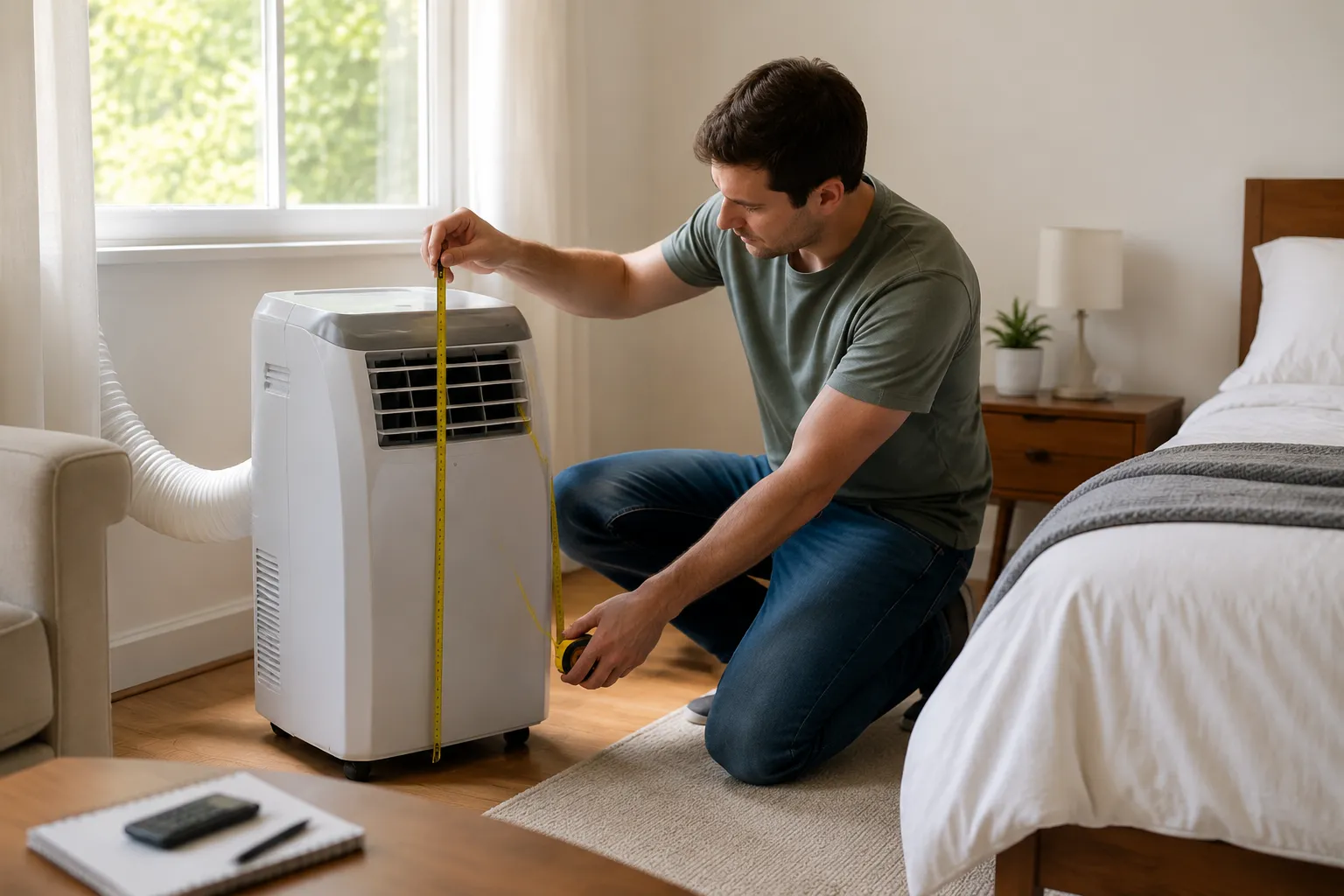
A reliable sizing process starts with a tape measure, not a calculator. Measure the floor area, the ceiling height, and the rough dimensions of every window and door. Write the numbers down. Then walk the perimeter of the room and note each wall's orientation and whether it gets direct sun. Count the electronics, the lights, and any heat-producing appliances.
The arithmetic is simple to run with those inputs. Base BTU equals square footage times ceiling height divided by eight times 20. Add 20 percent for the portable efficiency loss. Add 10 percent for each sunny wall, up to a reasonable cap. Add 500 to 1,000 BTUs for each significant heat source, more for a kitchen. Round up to the nearest available unit size, but only to the next size. This method will land a person in a unit that runs in long cycles, holds a steady temperature, and keeps the humidity under control.
The irony is that the same walk-through takes less time than reading the reviews on an e-commerce page, and it produces far more reliable guidance. The reviews are full of people describing rooms that sound identical to the buyer's room and reaching every possible conclusion. The measurement method replaces anecdotes with an actual load calculation.
What the Noise Rating Actually Tells the Buyer
Sizing affects sound levels in a way that nobody mentions in the store. A correctly sized unit cycles on and off, producing periods of quiet interrupted by compressor operation. An undersized unit runs continuously, which means the noise never stops. In a bedroom, the difference between intermittent and constant compressor noise is the difference between falling asleep and staring at the ceiling at 2 a.m.
Portable units are also just louder than window units because the compressor sits inside the room rather than outside. A 8,000 BTU portable unit often registers in the mid-50s decibels at close range, about the level of a conversation, while a comparable window unit runs slightly quieter. Someone sensitive to noise should factor that into the sizing decision and look for units with better acoustics, not simply a higher BTU count. A slightly larger unit in good condition will cycle more often, offering periods of quiet that a taxed unit never provides.
Placement near the head of a bed amplifies the annoyance. A person who positions the unit in the corner of a bedroom gets the airflow and the noise both. Moving the unit across the room and running the exhaust hose along the baseboard changes the perceived sound level significantly. Small placement choices often matter more than the difference between two adjacent BTU ratings.
When a Portable Unit Is the Wrong Choice Entirely
The sizing exercise assumes a portable unit is the right tool. Sometimes it is not. A room with a window that opens vertically, the type that cranks outward, has no easy way to mount the exhaust hose. A room with no window at all, like a basement or interior office, requires venting through a wall or a dryer vent, which is an installation project and not a plug-in solution.
For a single room in a rental with a standard sliding window, a portable unit makes sense. For a larger space or a permanent installation, the honest answer is that a window unit cools more effectively for less money per BTU. The portable unit's advantage is flexibility and the absence of a heavy unit hanging outside the window. The disadvantage is everything else: lower efficiency, louder operation, and the constant fight with negative pressure.
A person who goes through the full sizing walk-through and lands at a requirement above 12,000 BTUs should reconsider the format. At that level, a single portable unit is already straining, dual-hose or not, and the better answer might be a window unit or a second portable unit in another part of the room. The sizing math does not just choose the unit. It also exposes the limit of the category.
That limit is real, and it is the reason so many portable air conditioners end up on marketplace resale sites in August. They did not fail. They were undersized for the rooms they were installed in, because the buyer trusted the box instead of measuring the room, the windows, the sun, and the appliances. The tape measure was the missing tool all along.