
The countertop ice maker is the rare appliance that people apologize for. Guests stand in the kitchen, raise their voices over the rattle and hum, and say, "Sorry, it's just the ice machine." A refrigerator with an icemaker makes a polite thunk behind a metal door. A countertop unit sits in the open, churning and grinding while everyone pretends not to hear it. The noise is the price of admission for having unlimited ice, but that price does not have to be paid in full. Most of the racket is fixable, and a surprising amount of it is preventable before the machine even comes out of the box.
Countertop ice makers make two fundamentally different kinds of noise. The first is mechanical: the compressor cycling, the fan spinning, the water pump pushing liquid up into the ice tray. The second is impact: ice dropping out of the mold, sliding down a chute, and landing in the basket below. The two problems require different solutions, and treating them the same way is why so many people give up and just turn the TV up.
Compressor Noise Is a Placement Problem First
The compressor is the loudest component in any ice maker that uses a refrigeration cycle, and its noise is mostly vibration. The compressor sits on rubber feet inside the machine, but those feet absorb only so much. The rest of the vibration travels through the plastic housing, into the countertop, and then into the floor and the cabinets around it. The countertop becomes a sounding board, amplifying a low hum into something that fills the room.
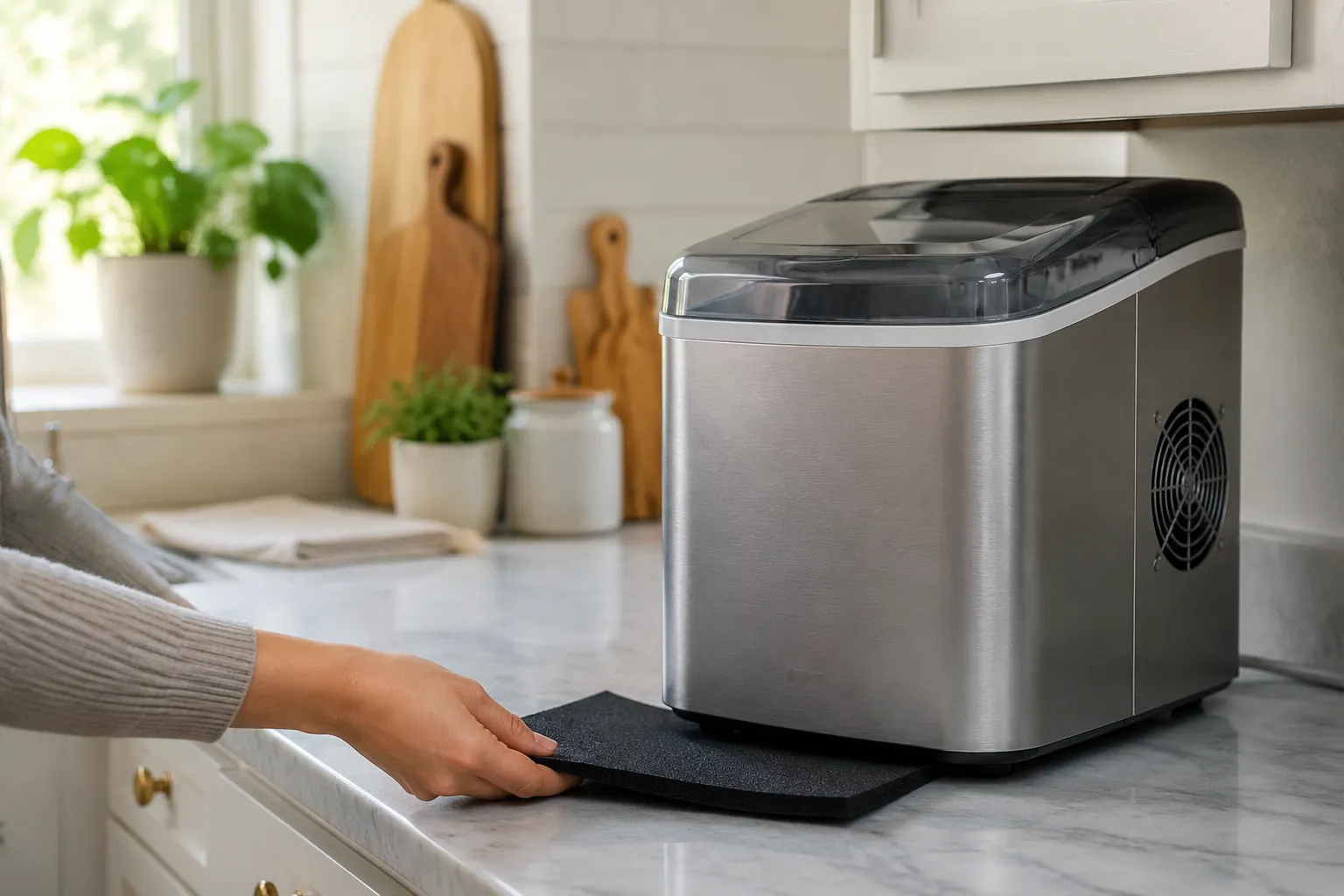
The fix is to break the physical connection between the machine and the surface it sits on. A thick silicone mat, the kind sold for sous vide machines or hot pots, does more than any other single change. A folded kitchen towel works in a pinch, though it traps heat and can make the compressor work harder. A rubber cutting board is better than nothing but worse than a purpose-made mat, since its surface is too hard to absorb much. The goal is a soft, heat-resistant barrier that lets the machine vibrate against something that gives.
Placement matters beyond the mat. A countertop ice maker pushed tight against the back wall of a kitchen shares its vibration with the wall itself, turning the whole structure into a resonator. Pulling it two inches away from the wall reduces that transfer dramatically. Setting it directly under a cabinet is worse, because the machine's top panel can vibrate against the cabinet bottom, creating a buzz that sounds like a loose screw even when nothing is loose. Leaving four to six inches of clearance above the unit solves that and also helps with airflow, which keeps the compressor from cycling as aggressively.
The Drop Noise Comes Down to Basket Position
The second kind of noise, the clatter of ice falling into the basket, is the one that wakes people up at 2 a.m. Ice makers do not respect sleep schedules. They cycle on their own timer, and when a batch completes, the mold tips and dumps a dozen cubes onto whatever is below. On most machines, that drop is from several inches, and the cubes land in a thin plastic basket that offers no cushion at all.
Some machines have a small silicone pad or a soft liner at the bottom of the basket. Many do not. For the ones that lack it, the simplest fix is to line the basket with a silicone trivet or a thin dish towel, cut to fit. This changes the sound of a drop from a sharp crack to a dull thud, which is a massive improvement for anyone sleeping in the next room. The liner does not need to be fancy, but it needs to be removable and washable, because it will get wet and it will get grimy.
The basket itself can also be repositioned. Some machines have a slot where the basket sits, and that slot is not always at the same height. If the basket has any play, wedging a small piece of foam or a folded rag between the basket and the side wall keeps it from rattling against the housing during the vibration of a drop. It sounds trivial, but half the perceived noise of these machines is the basket vibrating against the plastic shell after the ice lands.
Water Level Changes the Whole Character of the Sound
Most countertop ice makers have a water reservoir that sits below the ice basket, and the pump that pulls water from it is a constant source of whirring. The pump's noise level is directly tied to how hard it has to work, which is tied to the water level. A pump pulling from a nearly empty reservoir has to suck air and water in a churning mix, which sounds like a small washing machine struggling with a single sock. A pump pulling from a full reservoir runs smooth and quiet.
Keeping the reservoir topped up is the cheapest noise reduction available, and it costs nothing but a glance at the water line every few hours. The tradeoff is that a full reservoir means the machine can go longer between refills, which means more batches in a row, which means more total running time. For people who want ice on demand in the evening and silence at night, the solution is to run the machine during the day, fill it to the max line, and then unplug it or switch it off before bed. The residual ice in the basket stays frozen for hours, and the machine does not cycle on at 3 a.m.
The water temperature also matters more than most people expect. Warm water, above room temperature, makes the compressor run longer per batch and makes the water pump work harder during the freeze cycle. Cold water from the tap shortens the freeze time, which means fewer minutes of running. Nobody buys a countertop ice maker to save electricity, but the noise reduction is immediate: a machine that runs for ten minutes per batch instead of fourteen makes roughly 30 percent less noise per hour of use.
The Hard Countertop Makes Everything Worse
Granite and quartz are the worst surfaces for these machines. They are dense, rigid, and excellent at transmitting vibration. A machine on a butcher block countertop sounds different from the same machine on granite, not because the machine changed but because the wood absorbs more energy. People who have switched countertops often notice their ice maker sounds different, and they rarely connect the change to the surface.
The remedy is not to redo the kitchen. A thick cork trivet, the kind used under hot dishes, can be stacked with a silicone mat for a double layer of isolation. The cork catches the high-frequency buzz, and the silicone catches the low-frequency rumble. It looks slightly odd under a kitchen appliance, but it works. Some people go further and build a small platform from a piece of plywood with rubber feet, creating a mini isolation stand. That is overkill for most apartments, but it does work, and it is a legitimate solution for anyone whose machine sits on a rigid surface and who wants actual silence.
Rattling Parts Are Usually Loose Screws
A rattle that only happens during the freeze cycle, not during the drop, is almost always a loose panel or a loose screw. Countertop ice makers are assembled in factories with average quality control, and the screws that hold the plastic shell together work loose over months of vibration. A quarter turn with a screwdriver on every visible screw on the back and bottom of the unit often eliminates a rattle that has been driving a household crazy for weeks.
There is a specific rattle that comes from the ice scoop. Most machines include a plastic scoop that lives somewhere on or inside the unit. If it rests against the housing, it rattles during the compressor cycle. Moving the scoop to a drawer or a hook on the side wall removes that noise entirely. It is the single most common phantom rattle in these machines, and it is fixed in seconds.
Cheap Machines Rattle Because They Are Cheap
There is a ceiling to how quiet a budget machine can be. A unit that costs fifty dollars uses thinner plastic, a louder compressor, and a simpler mold mechanism than a unit that costs two hundred. The difference is audible side by side. The cheap machine's housing flexes and vibrates; the expensive machine's housing is stiffer and deadens sound. A person can put a silicone mat under a cheap machine, line the basket, and tighten every screw, and it will still be louder than a mid-range machine with no modifications at all.
That is not a reason to avoid cheap machines. It is a reason to buy with noise in mind. A machine with a metal housing, or at least a thick ABS plastic shell, will be quieter than one with thin polypropylene. A machine with a larger water reservoir will cycle less often, because it can run more batches before needing a refill. A machine with a removable ice basket, rather than a permanently fixed one, will be easier to line with a sound-dampening material. These features are not usually listed on the box, but they are visible in the product photos and in the weight of the unit when it arrives. Heavier usually means more soundproofing and more metal.
The Nighttime Shutdown Habit
The most reliable noise reduction for a countertop ice maker is to turn it off. Not unplug it, necessarily, but shut it down when the ice basket is full and the household is asleep. The machine does not need to run continuously. It produces a full basket in two to three hours, and that basket holds enough ice for an evening of drinks and then some. Let it run in the afternoon, fill the basket, and then hit the power button. The ice stays frozen for hours, and the kitchen goes silent.
This habit has a side benefit beyond noise. Countertop ice makers are notorious for burning out their compressors because they run 24/7. The compressor is a sealed unit, and when it fails, the machine is trash. Running the machine for six hours a day instead of twenty-four extends its life considerably. The noise reduction is immediate, and the longevity gain is a quiet bonus. Most people who adopt this habit report two things: they sleep better, and their machine lasts longer than the one it replaced.
The Ice Itself Makes a Difference
The type of ice a machine produces changes its noise profile. Bullet ice, the hollow cylinders that most countertop machines make, is louder when it drops because it is hard and dense. Nugget ice, the soft chewable kind, lands with a much softer sound because it crumbles slightly on impact. A machine that makes nugget ice is inherently quieter during the drop phase, and no modification can close that gap.
For people who care about noise more than ice texture, that is a strong argument for a nugget machine. For people who want bullet ice, the drop noise can be mitigated with a thicker basket liner, but it cannot be eliminated. The sound of a hard cube hitting a plastic basket is a sharp, percussive crack that carries through walls. The sound of a nugget hitting the same basket is a softer patter, more like loose gravel than a dropped glass.
There is also a difference based on the size of the cubes. Some machines let the user select small or large ice. Small cubes drop with less impact force, and they land in a denser pile that cushions subsequent drops. Large cubes fall harder and land on a sparser bed, so each drop is louder. Selecting the small ice setting, when available, is a free noise reduction that costs nothing and affects only the size of the ice, not its quality.
The Last Two Inches of Clearance
One final detail that people overlook is the clearance behind the machine. Most countertop ice makers vent out the back, and that vent needs space. When the machine is shoved flush against a backsplash, the hot exhaust air bounces off the wall and gets pulled back into the intake, raising the internal temperature. The compressor then runs longer and cycles more often, which means more running noise. Pulling the machine forward even two inches, so it sits clear of the backsplash, improves airflow and reduces the duty cycle. The machine runs less, so it makes less noise, and it makes ice faster because it isn't fighting its own exhaust heat.
That same two inches of clearance also reduces the vibration transfer to the wall, as mentioned earlier, but the airflow benefit is the one that compounds. A machine that runs less is a machine that fails later. The noise reduction is real, but the real win is that the machine simply does less work. Anyone who has listened to a countertop ice maker wheeze and rattle through a hot summer afternoon knows the sound of a compressor being asked to do too much with too little ventilation. Give it room to breathe, and it quiets down on its own.