The countertop is the most expensive real estate in a kitchen, and most home cooks treat it like a parking lot. Ingredients arrive in shopping bags, get set down wherever there is space, and the prep work happens in whatever order the cook remembers tasks, which usually means a lot of bending, reaching, and wiping up messes that could have been avoided. A proper workflow is not about buying more gadgets. It is about assigning a permanent job to each zone of the counter and then moving ingredients through those zones in a fixed sequence, so that nothing ever has to be picked up twice.
The first step is to admit that the refrigerator door is not a staging area. Most people pull out five ingredients, use two, and put the other three back when they realize they need a cutting board that is buried under a bag of onions. The fix is a designated landing zone, a square of bare counter directly next to the sink or the stove, where everything that comes out of the fridge or pantry goes first. This zone does not hold a knife block, a stand mixer, or a stack of plates. It holds only the raw materials for the current meal, and it stays empty the rest of the day.
That landing zone needs a physical boundary, otherwise it becomes a dumping ground for mail and car keys within a week. A large wooden cutting board, the kind with a juice groove, works perfectly as the designated receiving area. It defines the space, protects the counter, and can be carried to the sink for a quick rinse when the meal is done. A person should be able to stand at the fridge, open the door, and place items directly onto that board without taking a step. If the fridge is on the other side of the kitchen, the workflow starts to break down, and the answer is to move a small cart or table into the gap, not to accept a lifetime of cross-kitchen trips.
The Wash, Dry, and Sort Triangle
Once the ingredients are on the landing board, the next mistake appears: washing everything at once in a giant colander and letting it drip all over the counter. A sink-side triangle works better. The left side of the sink holds the dirty produce. The faucet is the middle point. The right side holds a clean dish towel laid flat, and that is where washed items land. A person works in a loop: grab from the left, rinse under the stream, set on the towel to the right. When the towel is full, it gets folded over the produce to absorb excess water, and the items move to the next zone.
This sounds like common sense, but the details matter. The towel must be a dedicated kitchen towel, not a decorative one, and it needs to be swapped out after each meal. A wet towel that sits for hours becomes a bacterial nursery, and nobody needs that lecture again. The bigger point is that washing produce immediately before cutting it, rather than an hour earlier, keeps the leaves crisp and prevents the cut pieces from turning soggy. The order of operations is wash, dry, then cut. Cutting wet produce is dangerous, slow, and leaves a film of water on the board that ruins the next item.
Sorting happens at the same time as washing, not as a separate step. Mushy tomatoes go into a small bowl for sauce. Firm ones go to the cutting board. Bruised apples get set aside for snacking later, and perfect ones get sliced for the salad. Doing this sort during the rinse step means the cook never has to touch a single item twice. The bowl for sauce sits at the back of the prep zone, out of the way, and the cutting board holds only the items that are about to be processed.
Assigning the Cutting Board a Single Job
The cutting board is not a general-purpose surface. In a real workflow, it has one job at a time, and that job changes in a deliberate order. The order goes from the least contaminating item to the most, or from the driest to the wettest, depending on what is on the menu. Vegetables first, then fruits, then proteins last if they are going to be cooked. This prevents cross-contamination without requiring a second board, and it means the board only needs one thorough wash at the end instead of a frantic mid-prep scrub.
A second, smaller board is worth the counter space for anyone who cooks meat regularly. The small board sits at the far edge of the prep zone, near the stove, and it is used exclusively for raw chicken, beef, or fish. The main board handles everything else. This is not a food safety lecture, it is an efficiency argument. Cleaning the main board between every ingredient takes thirty seconds each time, and those thirty seconds add up to several minutes of lost momentum. Two boards means the cook wipes the meat board once at the end and never has to stop the vegetable flow.
The position of the board matters more than most people think. It should sit directly in front of the cook, with the knife in the dominant hand and the bowl for finished pieces on the opposite side. Reaching across the board to drop a handful of chopped onions into a bowl that sits on the other side is wasted motion. The bowl needs to be close enough that the cook can slide the knife blade over the board and push the pile directly into the bowl with the spine of the blade, no lifting required.
Bowl Placement and the One-Hand Rule
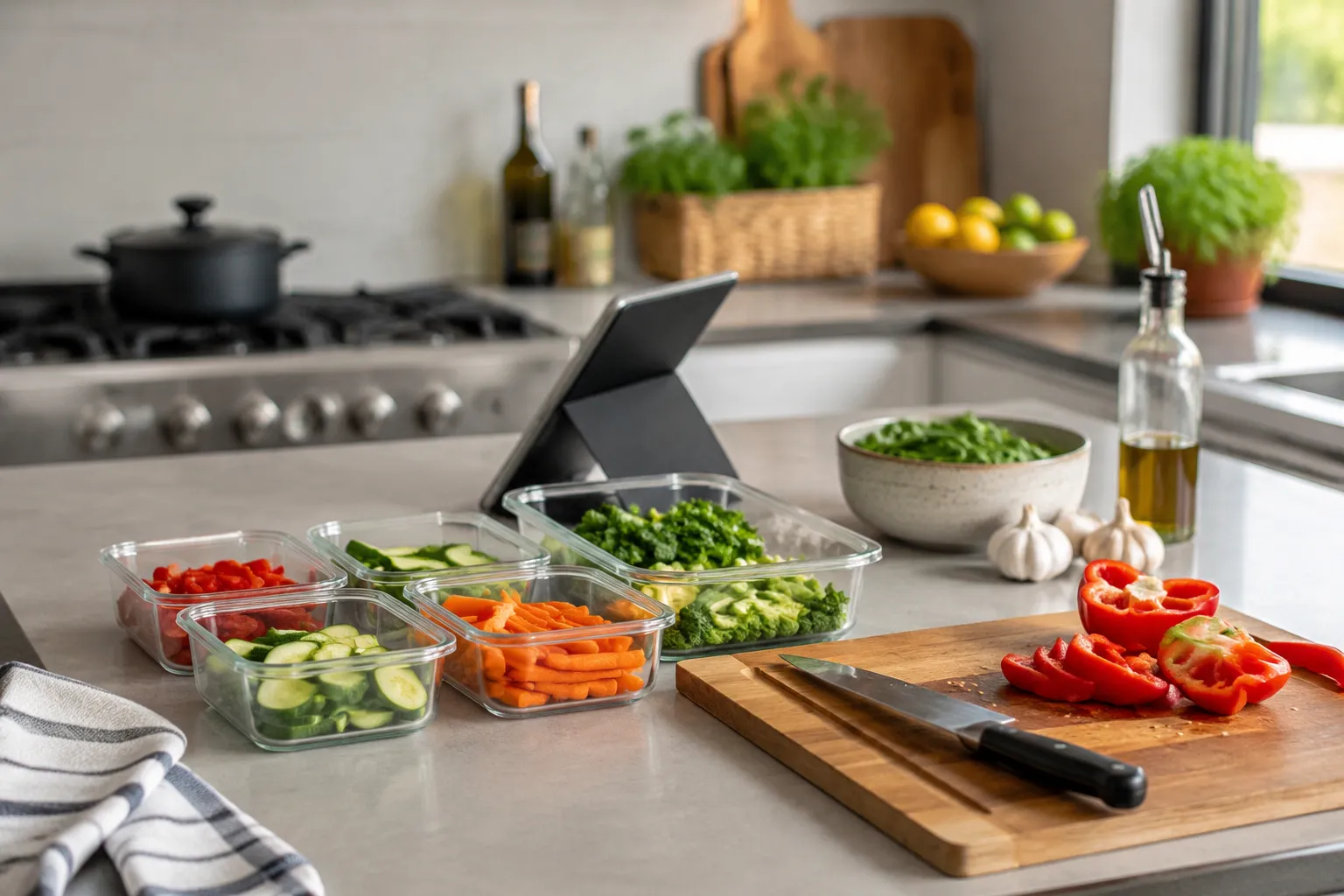
Every single thing that comes off the cutting board goes into a bowl or a pan immediately. There is no pile of chopped vegetables sitting on the bare counter, because that pile has no home and will get swept onto the floor or mixed into the wrong dish. A set of nesting mixing bowls, the kind that stack inside each other, is the backbone of this system. Three sizes cover almost everything: a small bowl for aromatics like garlic and ginger, a medium bowl for vegetables, and a large bowl for salad greens or a big batch of something.
The bowls sit in a row on the counter, in the order they will be used, and the cook fills them left to right. When a bowl is full, it moves to the stove side of the prep zone, and the empty bowl at the end of the row slides into the cutting board position. This keeps the cook in a rhythm of fill, move, fill, move, and it means the final dish comes together in the pan all at once rather than in a series of frantic additions.
There is a rule that separates a good workflow from a chaotic one: the one-hand rule. Everything needed for the current task should be reachable with one hand while the other hand stays on the knife. If the cook has to put down the knife to grab a bowl from a cabinet, the flow is broken. Bowls, oil, salt, and pepper all live on the counter during prep, within arm's reach of the cutting board. The salt and pepper stay in the same spot every single day, so the hand finds them without looking. This is the difference between cooking with intention and cooking with a scavenger hunt.
The Scrap Bowl That Saves the Counter
One more bowl belongs on the counter, and it is the most important one. A small bowl or a quart container sits right next to the cutting board, and it catches every onion skin, carrot top, eggshell, and herb stem as it is trimmed. This bowl does not go to the compost bin after each item. It stays on the counter until the prep is done, and then the whole thing gets dumped at once. A person who uses this bowl will never again spend five minutes pushing wet peels into their palm and walking them to the trash.
The scrap bowl should be opaque, not clear, because nobody wants to stare at the remains of a leek while they are trying to mince garlic. A stainless steel prep bowl works well, or a recycled plastic container with a lid. The lid is optional, but it helps if the prep is interrupted and the cook needs to take a phone call without the kitchen smelling like onion. When the bowl is full, empty it into the trash or compost and start again. The counter underneath stays clean because the scraps never touch it.
This single habit changes the feel of the whole kitchen. The counter stays clear of debris, which means the cook can see what is actually happening, and a clear surface makes the next step obvious. A cluttered counter leads to a cluttered mind, and a cluttered mind makes mistakes like adding the salt twice or forgetting the herbs entirely.
The Order of Operations That Actually Works
The sequence of prep tasks follows a logic that most recipes never spell out. Start with the items that take longest to cook, like root vegetables and onions, because they can sit in a pan on low heat while everything else gets ready. Then move to the quick-cooking vegetables like peppers and mushrooms. Then do the leafy greens and herbs last, because they wilt or bruise if they sit too long after cutting. Fruit that is part of the meal gets cut right before serving, not at the beginning of the prep session.
Garlic and ginger get minced last among the aromatics, not first. They release their oils and lose their punch within minutes of being cut, so the flavor is best when they hit the pan almost immediately after the knife leaves them. A person who minces garlic at the start of a thirty-minute prep session might as well be using the powdered stuff. The order matters for flavor, not just for cleanliness.
The pan that will receive the food needs to be on the stove, empty and dry, before the prep starts. This seems minor, but it forces the cook to commit to the menu and it eliminates the last-minute scramble to find the right pan under a pile of lids. The pan sits there waiting, and when the first batch of onions is ready, the cook slides them in and starts the heat. No time is lost searching, and no oil is wasted by heating a pan that sits empty.
Clearing as a Step, Not an Afterthought
Cleaning up during prep is a different task from cleaning up after the meal, and it deserves its own rhythm. The rule is to clear a zone as soon as that zone is finished. When the cutting board is done with vegetables, it gets a quick rinse and stands upright against the backsplash to dry. The scrap bowl gets emptied. The washing station towel gets replaced if it is damp. This takes ninety seconds, and it means the counter is mostly clear by the time the food hits the pan.
A person who cooks this way never faces the mountain of post-meal dishes that makes home cooking feel like a punishment. The tools are already washed and drying. The boards are clean. The only items left are the pan, the serving dishes, and the bowls that held the prepped ingredients. That is a manageable load, and it makes the whole evening feel lighter.
The workflow relies on a counter that is empty at the start. A cluttered counter with a toaster, a coffee maker, and a stack of unopened mail leaves no room for the zones, and the whole system collapses. The honest fix is to find another home for the small appliances or to accept that the workflow only applies to the one clear section of counter. Most home kitchens have a two-foot stretch of usable space at best, and that is enough. The zones can be compressed into a tight line: landing board, wash area, cutting board, bowls. The sequence stays the same even when the distances are short.
The final piece of the system is a mental one. The cook decides before starting what the finished meal looks like, and works backward from that image. If the meal is a stir-fry, everything gets cut into similar-sized pieces and grouped into bowls by cooking time. If the meal is a salad with a roasted vegetable component, the roasting happens first, and the salad assembly waits until the vegetables come out of the oven. The workflow is not a set of rigid rules. It is a habit of thinking about the counter as a production line with a beginning, a middle, and an end.
Once the habit takes hold, the kitchen becomes a place where the cook moves with a quiet confidence. Hands find the salt without looking. The scrap bowl catches the onion skin before it hits the floor. The garlic goes into the pan within seconds of leaving the knife. The meal comes together in the time it used to take just to get the ingredients out, and the counter is clean enough to eat on by the time the plates hit the table. That is the whole point. The workflow is not about being fast for its own sake. It is about removing the friction that makes cooking feel like a chore, so the act of making food becomes what it should be: a simple, satisfying sequence of small tasks that ends with a meal and a clear surface.