
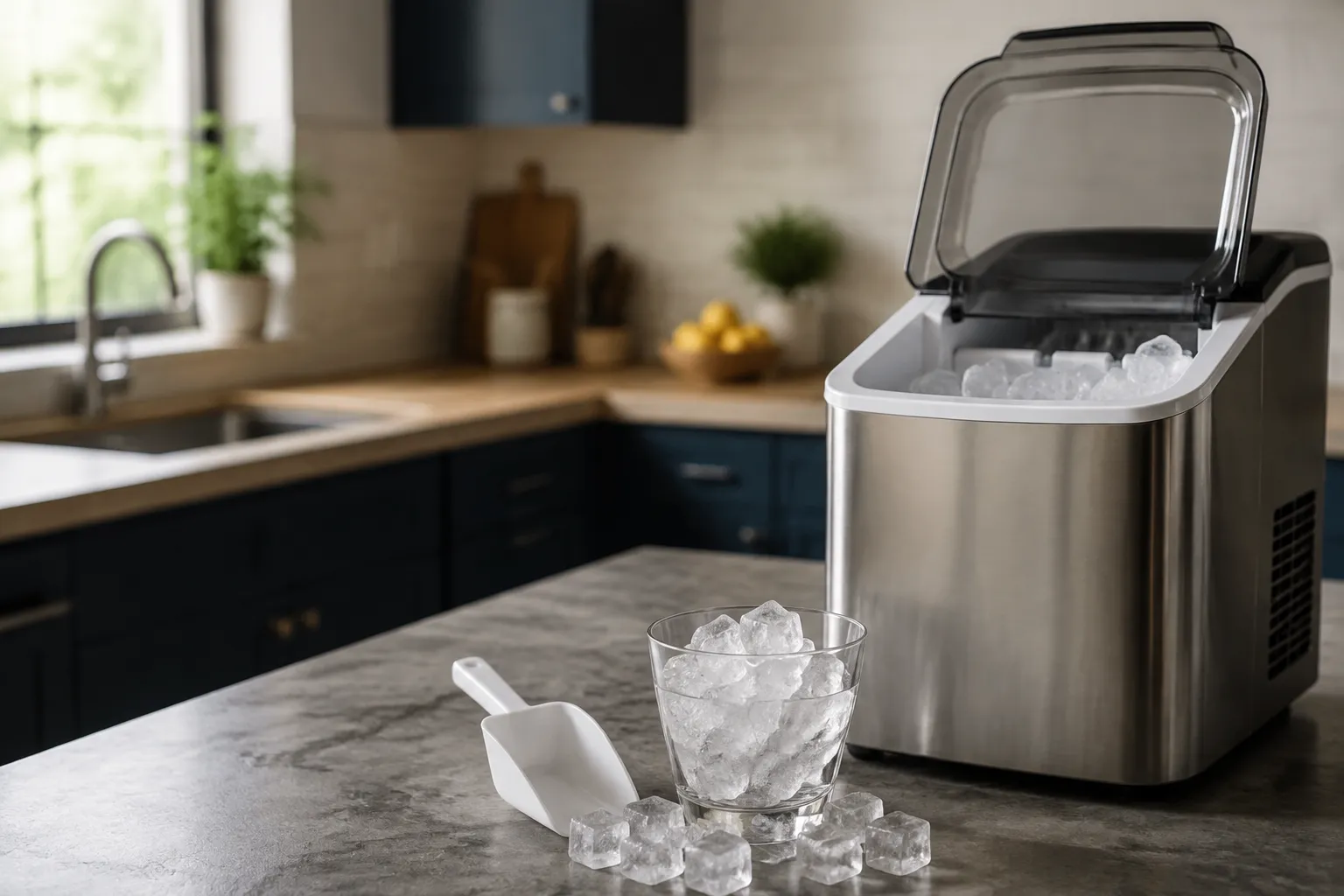
The countertop ice maker category is the only appliance space where the marketing photos and the actual user experience diverge more completely the longer the machine runs. Every catalog shot shows a crystal cube next to a sweating glass of amber liquid, and the unspoken promise is that this $150 box will produce that cube forever, on demand, with no thought required. The reality is that a home ice maker is a small chemical plant with a drain line, a water pump, a compressor, and a thermostat, and it behaves like one. It makes noise, it makes heat, it wants to be cleaned, and it will eventually break in a way that is not worth fixing. The entire purchase decision, then, comes down to how much of that reality a person can tolerate.
The first thing to understand is that there are two distinct product families hiding under the same noun. A portable countertop ice maker, the kind that drops nugget or bullet ice into a basket, is a different machine from a built-in undercounter unit that connects to a water line and makes restaurant-style cubes. The portable ones are the ones people actually buy on impulse, and they are the source of most of the confusion. They are not mini versions of a built-in unit. They are a separate invention with separate trade-offs, and the trade-offs matter more than the brand name on the front.
The Countertop Machine Works on a Cycle, Not a Stream
A portable countertop ice maker does not continuously produce ice the way a faucet produces water. It runs a batch cycle. A small pump pushes water up over a chilled metal prong grid, the water freezes in layers, and when the ice reaches a certain thickness, a sensor trips a solenoid that heats the grid and dumps the cubes into a basket below. The whole cycle takes somewhere between six and twelve minutes for a first batch, depending on the ambient temperature and the water temperature, and then the machine has to reset and start again. The production rate that the box advertises, something like 40 pounds per 24 hours, assumes the machine runs nonstop with fresh water and a human emptying the basket every time it fills. Nobody runs it that way.
In real use, a person fills the reservoir, gets a basket of ice in about 20 minutes, uses it, and waits for the next batch. The machine is not a fountain. It is a batch brewer that happens to make ice instead of coffee. The practical takeaway is that a countertop unit is excellent for a party where a steady trickle of fresh ice is fine, and it is poor for a household that wants a full ice bin every morning. A family that needs two pounds of ice for lunchboxes every day will be running that machine constantly, which means constant noise, constant heat, and constant water refills.
The noise is the detail no review captures well. A running portable ice maker sounds like a small refrigerator fighting a larger refrigerator. There is a compressor hum, a water pump whir, and then a periodic clunk when the harvest cycle drops the ice. In an open kitchen it is audible across the room. In a small apartment, it is the kind of sound that makes a person turn on the television just to cover it. The heat is worse. The machine rejects heat from its condenser into the room, and the water it pumps also warms slightly as it recirculates. A countertop unit running for an afternoon in a summer kitchen can raise the ambient temperature by a noticeable margin. The machine does not just make ice, it makes a warm, humid pocket of air around itself.
Nugget Ice Versus Cube Ice Is a Real Divide
The biggest fork in the road is the ice shape, and it is not a cosmetic choice. Nugget ice, the soft, chewable pellets that soda fountains and Sonic use, requires a different mechanism than cube ice. Nugget machines use an auger to crush and extrude the ice, which means more moving parts, more wear, and a much higher failure rate over time. The taste and texture payoff is real. Nugget ice is soft, absorbs the drink slightly, and is genuinely pleasant to chew. It also melts faster than a dense cube, which means a drink gets diluted more quickly. The trade-off is that a nugget machine is a more complex appliance, and the failures tend to be mechanical rather than electrical. A cube machine has fewer moving parts and usually lasts longer, but it produces hard, clear-ish cubes that clink and melt slowly.
There is a third category that gets less attention, the bullet or crescent shape that most small countertop units produce. Bullet ice is a compromise. It is not as soft as nugget and not as dense as a cube. It is the default shape for cheap machines because it is the easiest to eject from the mold. A person who buys a $90 countertop maker on a holiday sale will almost certainly get bullet ice, and the machine will make it at a predictable, mediocre pace. The question is whether that mediocre pace and shape are good enough.
For most people, the honest answer is that bullet ice is fine for chilling a drink and terrible for anything else. It melts reasonably fast, it does not chew well, and it looks unimpressive in a glass. The people who are happiest with a countertop unit are almost always the ones who deliberately bought a nugget machine because they wanted that specific soft texture, or the ones who bought a cube machine and just want a faster ice supply than a freezer tray can provide. The middle ground is where disappointment lives.
The Water Source Decides Everything About Placement
Portable units have a reservoir that holds between one and two quarts of water. A person fills it by hand, and the machine pumps that water until it runs low, at which point the machine stops and waits. This creates a placement constraint that most buyers never consider before the box arrives. The machine needs to sit near a sink, because refilling a two-quart reservoir by carrying a pitcher across a kitchen gets tiresome very fast. It also needs to sit on a surface that can tolerate occasional drips, because the fill port and the basket lid are not perfectly sealed. And it needs counter space that is near an outlet, because the power cord on most units is short.
The drain situation is the hidden failure point. A portable unit has a small drain plug at the bottom, and the manual says to empty the reservoir when the machine is not in use. Many people skip this step, especially if they are using the machine daily, and the standing water in the reservoir becomes a bacterial culture. The result is ice that tastes faintly of mildew, or a machine that grows a visible film inside the water tank within a week. The cleaning routine for a countertop ice maker is not optional. It is a twice-a-week chore involving vinegar or a descaling solution, and it takes about fifteen minutes. A person who will not do that chore should not buy the machine.
The alternative is a built-in undercounter unit, which connects directly to a water line and has a permanent drain. These are fundamentally different appliances. They are plumbed, they require a dedicated circuit in many cases, and they cost anywhere from $800 to well over $3,000. The production rate is higher, the ice quality is better, and the machine sits out of sight. But the installation cost and the permanent nature of the decision change the calculus entirely. A built-in unit is not a countertop appliance that makes more ice. It is a kitchen renovation line item.
The First Batch Is a Down Payment on Patience
Every countertop ice maker, without exception, produces a smaller and lower-quality first batch than subsequent batches. The machine needs to cool down its components first, and the first cycle often yields jagged, partially formed ice or a harvest that is delayed because the sensors are still calibrating. Some machines take three or four full cycles before they reach their normal output. A person who is buying this machine for a dinner party that starts in an hour should start the machine two hours before the first guest arrives. The impatient buyer is the one who writes the one-star review complaining that the machine makes "tiny broken pieces of ice," when the machine was simply not given time to settle.
The ambient temperature also matters more than most people expect. A countertop ice maker works by chilling the evaporator grid below freezing, and if the room is hot, the machine works harder and produces ice more slowly. A machine in a 90-degree garage will make ice noticeably slower than the same machine in a 70-degree kitchen. The advertised production numbers are measured in ideal conditions. The real-world numbers are often 30 to 40 percent lower.
The Filter Question Is Usually the Wrong Question
People ask about water filters, and the honest answer is that most countertop units do not have one. The reservoir is filled with tap water, and the machine freezes it as-is. If the tap water has a strong mineral taste or a high chlorine level, the ice will taste like that. Some people buy a filtered water pitcher just to fill the machine, which doubles the cost of the operation and adds another step. A few higher-end units include a small carbon filter in the reservoir, but these filters are rarely replaceable and are essentially marketing features. The practical fix is to use filtered water from a fridge dispenser or a pitcher if the local water is bad, and otherwise not to overthink it.
The mineral content of the water also affects the machine's lifespan. Hard water leaves scale on the evaporator grid and the pump, and that scale eventually blocks the water flow or insulates the cold surface so the ice takes longer to form. A person with hard water who does not descale regularly will shorten the machine's life by a significant margin. This is the single most common cause of premature failure, and it is entirely preventable.
The Repair Economics Favor Replacement by Default
The pricing structure of countertop ice makers creates an unusual situation. A decent portable unit costs between $100 and $300. The cost to repair one, if a repair technician can even be found, is usually over $80 just for the service call, before any parts. The internal components like the compressor, the pump, and the control board are not user-serviceable in most cases, and replacement parts are often hard to source. The result is that a broken countertop ice maker is almost always replaced rather than repaired. The expected lifespan of a portable unit is somewhere between one and three years with regular use, and the buyer should treat that as a feature of the product category, not a defect of a specific brand.
This is the core tension of the whole category. The machines are cheap enough to be impulse purchases, but they are also cheap enough to be disposable. A person who buys one should buy it knowing that it will not last a decade. The machine is a consumable, like a fancy toaster or a high-end drip coffee maker. It will give a couple of good years of service and then die. The question is whether the convenience is worth the recurring cost.
The Practical Threshold for Most Households
The household that genuinely benefits from a countertop ice maker is the one that currently buys bagged ice from a gas station or a grocery store. Bagged ice costs between $2 and $4 per bag, and a household that buys two bags a week is spending a couple of hundred dollars a year. A $150 countertop machine pays for itself in the first year, provided the machine lasts that long. The same math does not work for a household that gets by fine with two standard ice cube trays in a freezer. The trays produce about two pounds of ice per day, and for a family of two or three, that is enough. The countertop machine is a convenience upgrade, not a necessity.
The other practical threshold is about frequency of use. A machine that gets used three times a week for a specific purpose, like making a pitcher of iced tea or a round of cocktails, is a pleasant countertop fixture. The same machine used daily for every family member's water bottle becomes a chore. The refilling, the emptying of the basket, the descaling, and the noise all compound. The machine that seemed like a luxury becomes a nagging second job.
There is also a size threshold that most buyers miss. The basket on a typical countertop unit holds about one to one and a half pounds of ice. A single large party with 20 guests will exhaust that basket in minutes, and the machine cannot keep up with demand because each new batch takes ten minutes or more. For parties, the countertop unit needs to start running hours in advance and the basket needs to be emptied into a cooler periodically to build up a reserve. The machine is not a party rental. It is a steady-state producer for small daily use.
The Brand Landscape Is Less Important Than the Return Policy
The brands in this category are numerous and the quality differences between them are smaller than the price differences suggest. The same factory in China produces machines for several well-known names, and the internal components are similar across the board. The differences come down to the quality of the plastic, the reliability of the harvest sensor, and the customer service when a unit fails. A person is better off buying from a retailer with a generous return policy than from a brand with a great reputation. The machine will either work or it will not, and the first week of ownership reveals which case applies. The return window matters more than the warranty.
The warranty itself is worth reading carefully. Many manufacturers offer a one-year warranty on parts and labor, but the labor portion requires the buyer to ship the machine to a service center at their own expense. A 20-pound machine shipped across the country can cost $40 to $60, which is half the price of a new unit. The warranty is essentially worthless for a low-end machine. The buyer should assume the warranty is a formality and plan accordingly.
The final decision comes down to a single honest assessment of daily habits. A person who drinks cold beverages all day, lives alone or with one other person, has a sink nearby, and is willing to clean a machine twice a week will love a countertop ice maker. A person with a large family, a small kitchen, or an aversion to maintenance chores will end up with a $150 paperweight that occasionally makes a clunking sound. The machine does not meet the buyer halfway. It demands a place, a routine, and a tolerance for its quirks, and it rewards that commitment with the one thing a freezer tray cannot deliver, a steady supply of fresh ice on demand. That is the whole bargain, and it is worth making only on those terms.