
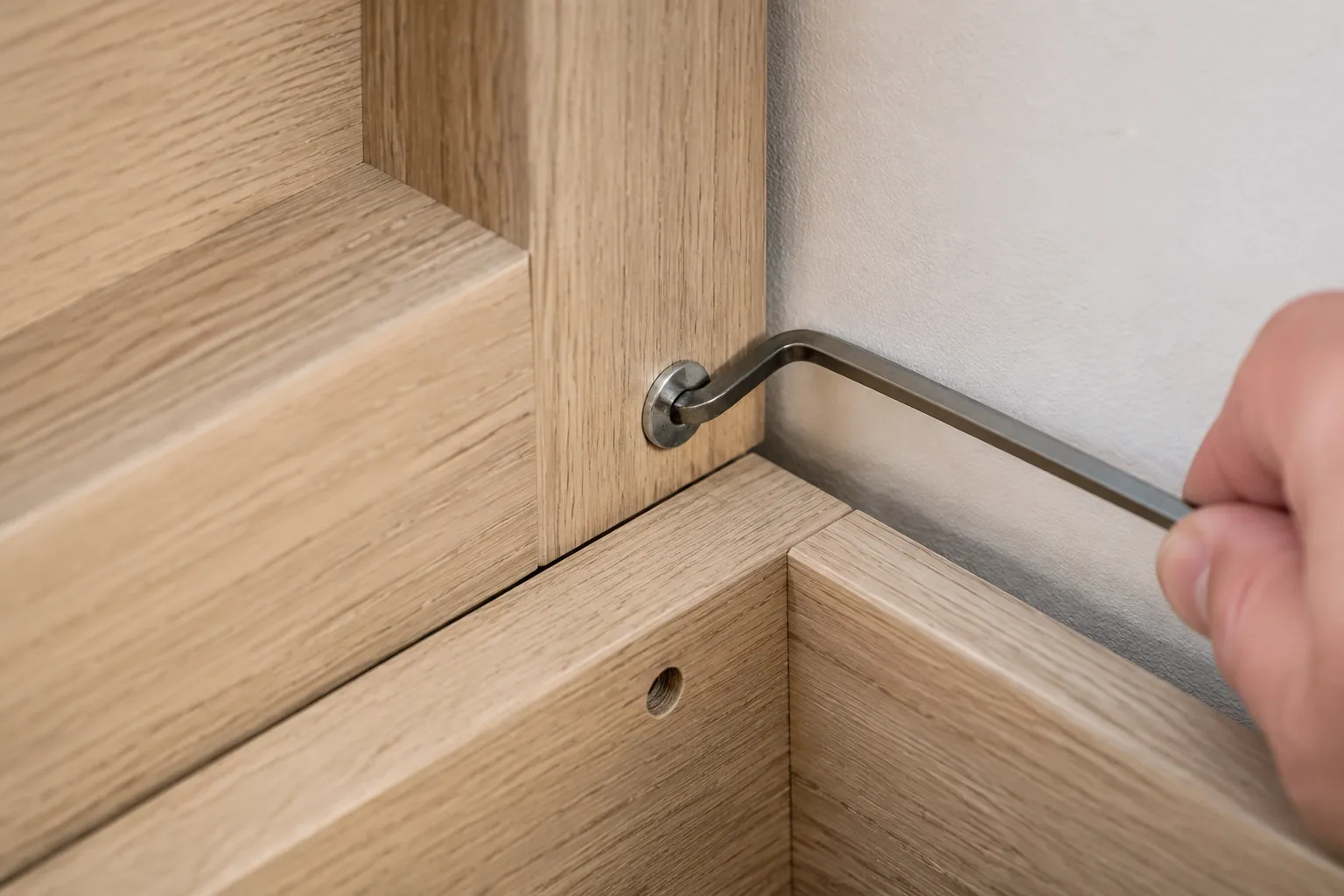
The ball-end hex key is a strange compromise. The long arm gives leverage, the ball lets a person angle the tool off-axis, and the whole arrangement works beautifully until it doesn't. At some point, every user of these tools has felt the ball slip inside a socket, rounding the very corners the tool was meant to grip. And yet, for tight furniture corners, the ball end remains the only realistic option. A straight key needs clearance; a socket wrench with a hex bit needs even more. The ball end, with its rounded tip and forgiving angle, reaches where nothing else can. The trick is knowing how to use it without destroying the fastener.
Furniture assembly is where this matters most. Cam locks, connector bolts, and the small hex screws that hold drawer slides in place all sit recessed in ways that defeat straight tools. A person assembling a flat-pack bookshelf has maybe two centimeters of vertical clearance above a bolt head. The ball end slides in at an angle, catches, and turns. This is the intended use case, and it works, provided the user understands what the ball end can and cannot do.
What the ball actually does
The ball end is a sphere ground onto the end of a hexagonal shaft. When the key is held perpendicular to the fastener, the ball engages the socket exactly as a straight hex key would. When the key is tilted, the ball still fits, but the contact area shrinks dramatically. The curved surface meets the flat walls of the socket at a tangent point, and that point carries the entire load. At shallow angles, the contact patch is small but adequate. At steep angles, the patch becomes tiny, and the steel of the ball starts to act like a cam, pushing the walls of the socket outward.
That outward push is what strips screws. The socket in a cheap furniture bolt is not hardened tool steel. It is often a soft zinc alloy or mild steel, cut with tolerances that would make a machinist wince. The ball end, pressing against a thin wall at an angle, can deform the socket in a single turn. Once the hex shape becomes rounded, the fastener is effectively welded in place. The only removal options become destructive: drilling out the head, cutting a slot for a flathead screwdriver, or using a screw extractor in a situation where there is barely room to breathe.
The angle that saves the fastener
The practical limit for a ball end is around 25 degrees off perpendicular. Beyond that, the contact patch gets too small, and the risk of slipping rises fast. Most manufacturers rate their ball ends for 25 to 30 degrees, but the honest number for furniture-grade fasteners is closer to 15. A person working in a tight corner should aim for the shallowest angle that clears the obstruction. The ball end is there to cheat past a lip or a ledge, not to turn the key into a universal joint.
The other part of the equation is the short arm. A ball-end key has two ends: the long arm with the ball, and the short arm with a straight chamfered tip. The short arm is the one to use when there is any clearance at all. It transmits torque directly, with no angular loss, and the straight tip engages the full depth of the socket. The long arm with the ball end is for the final snugging turn and for reaching into recesses where the short arm cannot fit. Using the long arm for initial loosening is a mistake. The torque applied to the long arm magnifies at the ball, and a seized bolt will slip before it breaks free.
Why cheap keys fail first
The material of the key itself matters more than most people think. Budget hex key sets are made from a chrome-vanadium steel that is hard enough for occasional use but lacks the toughness of the better alloys. The ball end, being a ground sphere, has a grain structure that follows the curve. Under repeated off-axis load, the surface can develop micro-cracks that grow into flakes. A flaked ball end is worse than useless; the rough surface acts like a file on the socket walls. The key should be inspected before each use in tight spaces. A shiny flat spot on the ball, or any visible pitting, means the tool is done.
Premium keys, such as those from Wera, Bondhus, and PB Swiss, use different steel and different grinding processes. The Wera Hex-Plus design is notable because it does not use a perfect sphere. The ball end is slightly elongated along the key's axis, which increases the contact area at working angles. Bondhus uses a proprietary alloy that resists flaking. PB Swiss grinds their ball ends with a tighter radius, which paradoxically makes them grip better because the contact patch stays more constant as the angle changes. None of these are cheap, and none of them are necessary for a single furniture build. But for someone who assembles furniture regularly, the difference between a 3 dollar key and a 12 dollar key is the difference between completing the job and hunting for a screw extractor at 10 p.m.
The push-and-turn technique
The most common failure with a ball end is not the angle, but the lack of axial pressure. The ball needs to be seated firmly into the socket before rotation starts. Many people slide the key in, tilt it to the needed angle, and twist. The ball rides up the socket wall, the contact patch vanishes, and the fastener strips. The correct motion is to push the key straight into the socket first, then tilt, then turn. The push should be deliberate, enough to compress any debris or paint in the socket. Once the ball is seated, the tilt should not exceed the working angle, and the turn should be smooth.
For stubborn fasteners, a slight reverse turn before the forward turn helps seat the ball. This is a trick borrowed from machinists removing broken taps. The reverse motion, even a quarter turn, breaks the static friction and lets the ball settle into the deepest part of the socket. Then the forward turn starts with the ball fully engaged. This matters most with cam locks, which often have a spring-loaded pin that presses against the key. The pin pushes the ball out of the socket if the user does not maintain axial pressure.
When to stop using the ball
There is a clear moment when the ball end should be abandoned. If the fastener does not move within the first two full turns, or if the key starts to wobble in the socket, the ball is not going to win. Continuing to apply torque at an angle will round the socket, and then the only option is to drill. The better move is to switch to the straight short arm, even if it means removing an adjacent panel. Furniture is designed to be disassembled in a logical order. The panel that blocks access is usually held by its own set of fasteners, and removing those takes five minutes. Trying to shortcut the order with an angled ball end is how stripped bolts happen.
Another stopping point is the torque limit of the fastener itself. Furniture bolts are not structural steel. They are designed to hold panels together under light to moderate load. The torque spec for most cam lock bolts is around 15 to 20 inch-pounds, which is barely more than a firm twist of the wrist. A long-arm ball key, held at a favorable angle, can easily deliver three times that. Over-tightening compresses the particle board, strips the threads in the pre-installed insert, or cracks the cam housing. The key should be used to snug, not to crush.
The right key set for furniture work
Most furniture uses three hex sizes: 3 mm, 4 mm, and 5 mm. The 4 mm size covers the majority of cam lock bolts and connector screws. A person assembling furniture does not need a full metric set. They need these three sizes in a quality ball-end format, plus the straight short arm for final torque. Buying a full set of 20 keys, most of which will never touch a piece of furniture, is the wrong move. The money is better spent on three individual keys from a reputable brand.
One more consideration is the handle. Many furniture-focused hex keys come with a molded plastic or rubber handle on the long arm. The handle adds diameter, which reduces the reach into tight corners. It also adds grip, which increases the torque a person can apply. For furniture work, the handle is usually a liability. The extra grip encourages over-torquing, and the diameter blocks access to recessed bolts. A bare T-handle key, or a key with a small metal handle, is the better tool. The T-handle gives the same torque as a long arm but with the force applied closer to the fastener, which reduces the angle and the leverage on the ball.
The color-coding trap
Some ball-end sets use color-coded handles to indicate size. This is a convenience, but it creates a false sense of certainty. A person grabs the red one, assumes it is the 4 mm, and tries to force it into a 3 mm socket. The ball end, being slightly smaller, will enter the socket and grip at an angle, but the fit is wrong and the torque transmission is poor. The fastener strips. The correct move is to verify the size visually before insertion. The 4 mm key should fit the socket with a light press, no wobble. If there is any slop, it is the wrong key.
The color-coding also fails under poor lighting, which is the norm inside a furniture cavity. A person tilting a key 20 degrees to see the socket is already at the edge of the working angle. The visual check should happen before the key goes in, in good light, with the key held straight. This takes ten seconds and prevents a 30 minute extraction process.
The one case where a longer arm helps
There is a legitimate use for a longer-than-standard ball-end key: reaching a bolt at the bottom of a deep slot. Adjustable bed frames and some office chairs have hex bolts recessed 50 mm or more into a steel tube. The standard key length is around 100 mm on the long arm, which just barely reaches. A longer key, 150 mm or more, provides the reach and also allows a more comfortable grip. The trade-off is that the longer arm increases the torque applied to the ball, so the user must be even more careful with the angle. This is the one situation where a ball end is not a compromise but the only sensible tool. A straight key cannot angle into the slot, and a socket wrench with an extension will not fit the narrow tube.
For this case, the technique changes slightly. The key should be inserted with a slow, straight push, then rotated while maintaining that push. The socket at the bottom of a deep slot is usually clean, so the ball seats easily. The longer arm means the user can grip higher up, which reduces the tilt angle. The turn should be short, quarter turns, with a re-seat each time. This is slower, but it is the only way to avoid stripping a bolt that is effectively unreachable by any other tool.
The final tell of a stripped socket
Every person who has stripped a hex socket knows the exact sensation. The key, which was turning with resistance, suddenly spins free for a fraction of a turn, then catches, then spins again. That partial catch is the ball riding over the rounded corners. Continuing is pointless. The socket is gone. The only honest response is to stop, evaluate, and switch to extraction mode. For a furniture bolt, extraction usually means drilling the head off with a small drill bit, then pulling the panel apart and removing the remaining threaded shaft with pliers. This is a 15 minute job that a careful ball-end technique would have avoided entirely.
The deeper truth is that the ball end is a precision tool, not a convenience gimmick. Treated with respect, it opens up access that would otherwise require complete disassembly. Treated carelessly, it creates the exact problem it claims to solve. The tool itself is not at fault. The 25 degree limit, the need for axial pressure, the preference for the short arm whenever possible, these are not arbitrary constraints. They are the physics of a sphere pressing against a flat surface. Respect them, and the ball end becomes the most useful tool in the furniture assembly kit. Ignore them, and it becomes a fastener destroyer.