
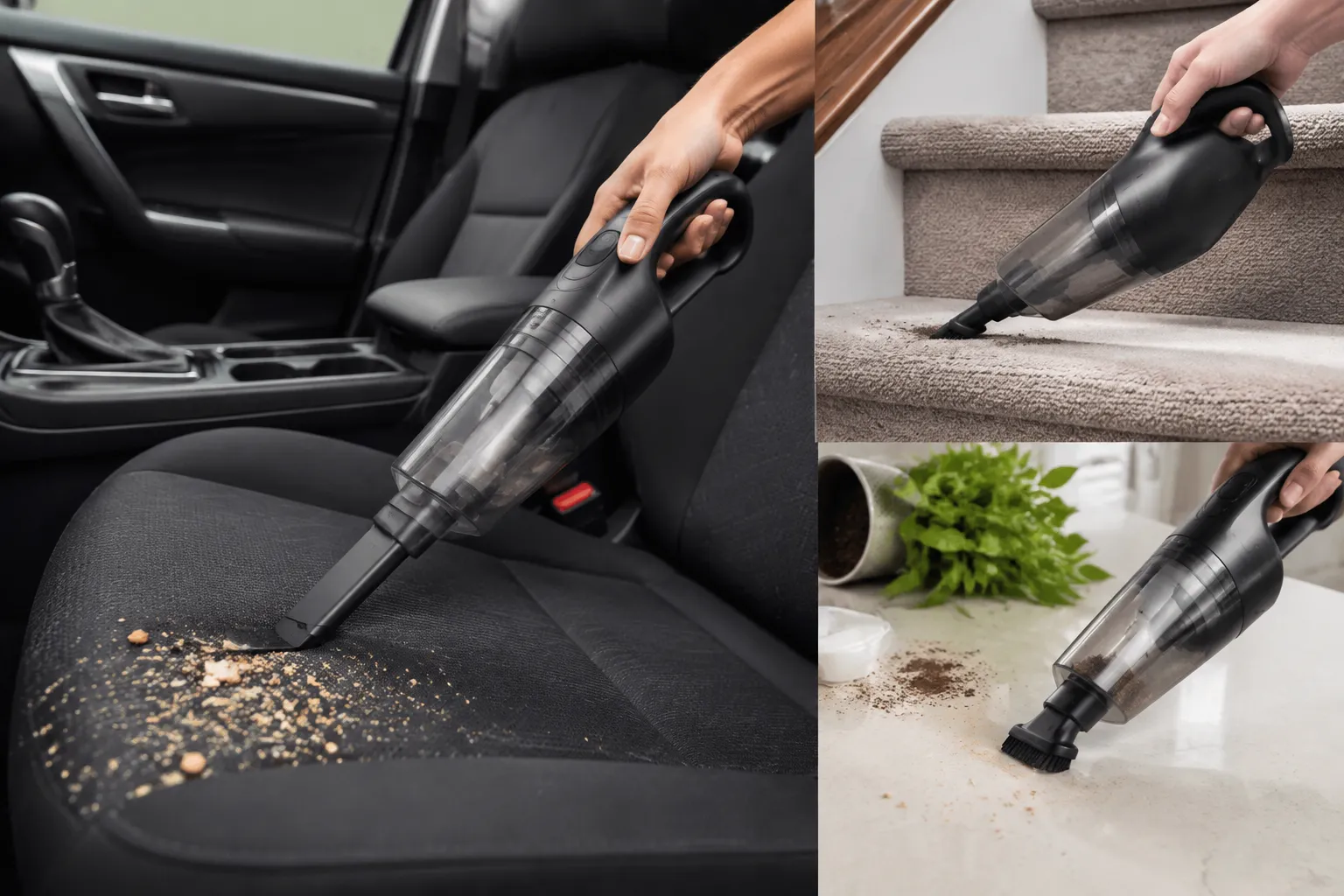
The hand vacuum occupies a strange place in the home. It is not a primary tool, not the thing a person reaches for when the house needs a real cleaning. It is the second string, the quick fix, the gadget that lives in a closet or under a sink and gets pulled out for jobs too small to justify the corded upright. But the hand vacuum has a specific domain where it outperforms everything else, and that domain is the car. The stairs are a close second. Understanding why these two locations matter more than the rest of the house changes how a person should think about buying one, using one, and maintaining one.
The car is the perfect hand vacuum environment because it is a confined space full of textures that a full-size vacuum cannot navigate. A person cannot drag a corded upright into a sedan and expect to reach under the seats or between the center console and the driver's seat. The geometry does not work. The hand vacuum, with its smaller footprint and flexible crevice tools, fits into the spaces where crumbs, dirt, and pet hair actually accumulate. This is not a marginal advantage. It is the entire point.
Why Cars Demand a Different Tool
Car interiors are not designed for cleaning. They are designed for driving, and the two priorities conflict. Seats have deep crevices where the bolsters meet the cushion. The gap between the seat and the center console collects loose change, sand, and the fine dust that seems to appear from nowhere. Floor mats trap dirt in their rubber ridges. The carpet underneath has a tight pile that holds onto debris with surprising tenacity. A full-size vacuum with a wide floor head cannot get into any of these spaces. The head is too broad, the hose too stiff, the whole apparatus too unwieldy to maneuver through a door frame and across a seat.
What the hand vacuum offers is precision. The narrow crevice tool reaches into the gap between the seat and the console. The brush attachment agitates the carpet pile and lifts embedded grit. The rubberized nozzle, on models that include one, pulls pet hair off upholstery without requiring the owner to first wet their fingers and drag the hair into clumps. These are not gimmicks. They are the difference between a car that looks clean and a car that is clean in the places a person actually touches.
The other factor is power source. A cordless hand vacuum runs on battery, which means it goes where the car goes. A person can vacuum the interior at a gas station, in a parking lot, or at the curb outside the house without running an extension cord across the driveway. The freedom is not just convenience. It changes the threshold for when a person decides to clean the car at all. A quick pass with a hand vacuum takes five minutes. Dragging out the full-size vacuum, finding an outlet, and managing the cord takes twenty. The five-minute job gets done. The twenty-minute job gets postponed until the car reaches a state that embarrasses the owner.
Battery life deserves honest scrutiny. Most cordless hand vacuums run somewhere between fifteen and twenty-five minutes on a full charge. That is enough for a full car interior, but it is not enough for a full car plus a set of stairs plus the hallway. The practical implication is that the user should charge the unit after every session, not when it runs out. A hand vacuum stored dead is a paperweight. A hand vacuum stored plugged in or on its dock is always ready for the five-minute job.
The Staircase Problem
Stairs present a different kind of challenge. The issue is not geometry, though that plays a role. The issue is posture and balance. Vacuuming a staircase with a full-size machine requires either carrying the machine while climbing, which is awkward and heavy, or leaving it at the top or bottom and working with the hose at an angle, which leaves the machine pulling against the user's grip the entire time. Neither option is good. The hand vacuum solves this by being light enough to hold in one hand while the other hand braces against the wall or railing.
The tread of each stair is a small, defined surface. A full-size vacuum head is designed for a wide expanse of floor. On a stair tread, it overhangs the edge and misses the corner where the tread meets the riser. The hand vacuum's smaller head fits the tread completely, and the crevice tool handles the corner joint where dust and pet hair collect in a continuous line. For homes with carpeted stairs, this is the single most effective cleaning method available. No upright, no canister, no robot vacuum can match it.
There is also the matter of frequency. Stairs are a high-traffic surface that gets walked on every day, often with outdoor shoes. Dirt transfers from the tread to the sock or bare foot of anyone who climbs them. A person who vacuums the stairs weekly with a hand vacuum keeps the dirt from embedding into the carpet fibers. A person who only vacuums the stairs when the full-size machine gets dragged out, which might be monthly or less, is letting the grit grind deeper each week. The hand vacuum makes the frequent pass practical.
The same logic applies to the landing at the top of the stairs, the small hallway, and the transition strip at the bottom. These are all surfaces that a person cannot easily reach with a corded machine without significant repositioning. The hand vacuum covers them in the same pass as the stairs themselves, with no change of tool and no loss of momentum.
What the Quick Cleanup Actually Means
The third use case, quick cleanups, is broader and more subjective, but it has a specific character. A quick cleanup is not a cleaning session. It is a targeted response to a specific mess that appeared recently and will not wait. A bag of chips spilled on the sofa. A child tracked sand in from the sandbox. A pet dragged in leaves on its paws and then shook them off in the entryway. These are not jobs for a full-size vacuum. They are jobs for a tool that is already close at hand and can be deployed in under a minute.
The hand vacuum earns its place in this scenario by being stored visibly and accessibly. A person who keeps the hand vacuum on a charging dock in the kitchen or mudroom will use it constantly. A person who stores it in a cabinet behind the cleaning supplies will not. The tool's effectiveness in quick cleanups is directly proportional to how easy it is to grab. This sounds obvious, but it is the most common failure mode for hand vacuum ownership. People buy them, put them away, and then forget they exist until the next time they are cleaning the car.
The quick cleanup is also where the hand vacuum's limitations become clear. It is not a substitute for a full-size vacuum in any room with significant carpet area. The dustbin is small, often emptying after a single couch cushion or a single stair tread in a home with pets. The suction drops as the bin fills, and the filter clogs steadily if the user vacuums fine dust or drywall debris. These are not design flaws. They are trade-offs inherent to the form factor. A person who understands the limitations will use the tool appropriately and be satisfied. A person who expects upright performance from a handheld machine will be disappointed and may abandon the tool altogether.
Filter Maintenance Is the Real Differentiator
Every hand vacuum on the market has a filter, and most owners never clean it. The filter sits between the dustbin and the motor. As it clogs with fine particles, the airflow drops, and the suction weakens. The user perceives this as a dying battery or a failing motor. In most cases, the battery is fine and the motor is fine. The filter is simply blocked. A person who rinses the washable filter every few weeks and lets it dry completely before reinserting it will get years of consistent performance from a unit that a neglectful owner would discard after a year.
The same applies to the dustbin. Emptying it after every use prevents odor buildup and keeps the debris from compacting into a dense mass at the bottom. Pet hair, in particular, tends to wrap around the internal cyclones or the filter pleats. A quick pull, a shake over the trash, and a wipe with a dry cloth takes thirty seconds and preserves the machine's performance. The owners who complain that hand vacuums lose suction are almost always the ones who never empty the bin until it is overflowing.
There is a secondary maintenance point that rarely appears in reviews: the crevice tool and brush attachment need their own cleaning. Crumbs lodge inside the crevice tool's narrow channel. Pet hair wraps around the brush bristles. A person who cleans the attachments once a month will find that the tools work better and last longer. This is not glamorous advice. It is the kind of practical detail that separates a tool that works from a tool that frustrates.
Battery Chemistry and Storage Habits
Modern hand vacuums use lithium-ion batteries, which have specific preferences about how they are treated. They do not like being fully drained and left empty. They do not like sitting in extreme heat, such as a car trunk in summer. They do, however, tolerate being topped off frequently. The best habit is to keep the unit on its charging dock whenever it is not in use. This keeps the battery in its comfortable mid-to-high range and ensures the tool is ready at a moment's notice.
Older models with nickel-metal hydride batteries had a memory effect and degraded when charged repeatedly without full discharge. That chemistry is largely gone from the market. A person still using a decade-old hand vacuum should not assume the new rules apply. But for anything purchased in the last five years, the lithium-ion chemistry rewards frequent topping off and punishes deep discharge. The user who drains the battery completely before recharging is slowly reducing the battery's capacity.
The other storage consideration is location. A hand vacuum stored in a garage that gets hot in summer and cold in winter will have a shorter battery life than one stored in a climate-controlled space. The garage is a convenient storage spot for a car-cleaning tool, but it is hard on the battery. A compromise is to store the unit in the mudroom or laundry room with the car-cleaning attachments in a small bag nearby. The tool stays at room temperature, and the attachments are still organized for the car session.
Choosing the Right Unit for These Three Jobs
Not every hand vacuum is suited to all three tasks. The market divides roughly into two categories. The first is the compact, lightweight unit designed for kitchens, desks, and small messes. These are often under two pounds, have modest suction, and their dustbins fill quickly. They are excellent for quick cleanups and inadequate for full car interiors. The second category is the larger, heavier unit with a longer runtime and stronger motor. These weigh closer to four or five pounds, run for twenty minutes or more, and come with a wider array of attachments. They handle car interiors and stairs well but are overkill for a small spill on a countertop.
A person who wants one unit to cover all three jobs should buy from the second category and accept the extra weight. The larger unit does not clean a countertop any better than the small one, but it does not fail at the car or the stairs. The small unit, by contrast, fails at the two most important jobs. The trade-off is clear. The bigger tool is the better investment for anyone who owns a car and a staircase.
Attachment selection matters more than brand. The most useful set includes a crevice tool, a brush tool, and a rubberized pet hair nozzle. The crevice tool addresses the car's tight spaces and the stair corners. The brush tool handles the carpet pile and fabric upholstery. The rubberized nozzle is the only thing that effectively pulls embedded pet hair from cloth seats and carpeted stairs. A unit that lacks any of these three attachments will struggle at one of the core jobs.
There is also the question of the dustbin design. A bin that empties from the top, where the user pulls the whole assembly apart, tends to scatter debris during emptying. A bin that empties from the bottom, with a latch that opens the base, is cleaner and faster. This is a small detail that does not appear in spec sheets but matters enormously in daily use. A person who empties the bin after every session, as recommended, will appreciate a bottom-release design within the first week.
The Case Against Buying a Cheap Unit
The budget end of the hand vacuum market is crowded with units that look functional and perform poorly. Their suction is weak, their batteries die quickly, and their filters clog within days. A person who buys a thirty-dollar unit to save money will likely replace it within a year, and the replacement will cost another thirty dollars or more. The total spend approaches the price of a mid-range unit that would have lasted several years. The cheap unit is not a bargain. It is a rental with an unpredictable lease term.
The mid-range market, roughly seventy to one hundred fifty dollars, contains the sweet spot. Units in this range offer adequate suction, reasonable runtime, and replaceable batteries and filters. They lack the brand cachet and some convenience features of the premium units, but they deliver the core function reliably. For most households, this is the correct price band. The premium units above two hundred dollars add little beyond longer runtime and better build quality, which matter for heavy users but are wasted on a person who vacuums the car twice a month.
One specific feature justifies a premium price: a removable, replaceable battery. Units with sealed-in batteries have a lifespan tied to the battery's chemistry. When the battery degrades, the entire unit becomes trash. Units with swappable batteries allow the owner to buy a fresh pack for twenty or thirty dollars and extend the tool's life by years. This single feature changes the long-term cost calculus and is worth seeking out even if it means paying more upfront.
The Emptying Ritual That Keeps the Tool Honest
The hand vacuum's small dustbin is both its weakness and its discipline. A full-size vacuum can go weeks between bag changes. The hand vacuum demands attention after every significant use. A person who develops the habit of emptying and wiping the bin immediately after each session will never be surprised by a clogged filter or a weak suction. The ritual takes less than a minute and becomes automatic. The person who skips it will eventually blame the tool for problems that are actually the result of neglect.
This is the real relationship a person has with a hand vacuum. It is not a passive appliance that runs on its own. It is an active tool that requires a small amount of care in exchange for a specific kind of convenience. The car interior stays presentable. The stairs stay free of embedded grit. The quick mess gets handled in the moment instead of becoming a stain or a trail of crumbs tracked through the house.
The hand vacuum will never replace the full-size machine. It should not. But for the three jobs it does well, it is the only tool that makes sense. The car, the stairs, and the quick cleanup share a common geometry and a common time pressure. They are small, awkward, and frequent. The hand vacuum matches all three conditions, provided the owner chooses the right unit, maintains the filter, and keeps the battery charged. That is the entire secret. It is not complicated, and it does not require a premium purchase. It requires paying attention to the tool's specific needs and using it for the jobs it was actually built to do.