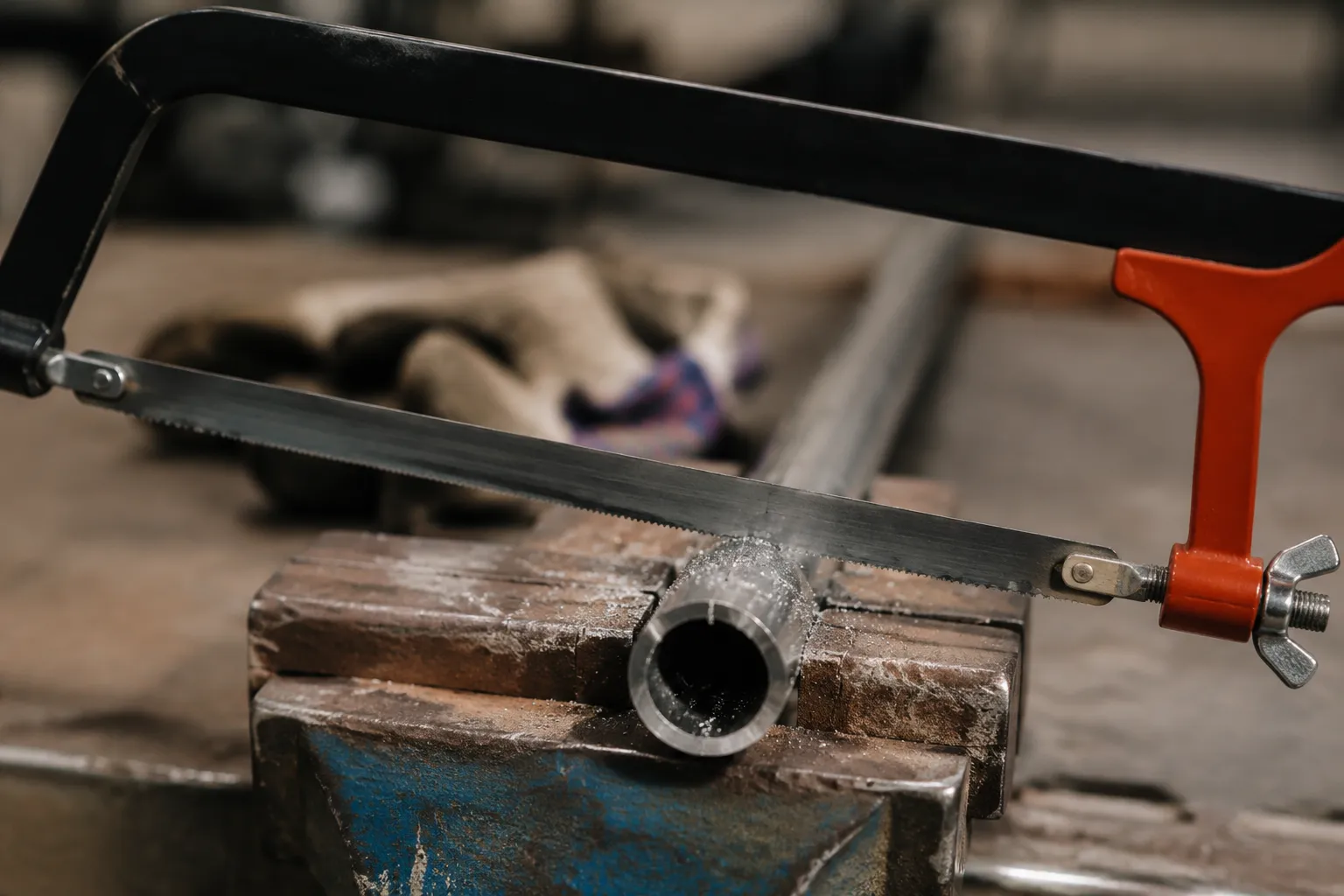
Hacksaw blades look interchangeable at a glance, but the number stamped on the blade's end tells a different story. That number is the teeth per inch, and it determines whether a cut takes thirty seconds or three minutes, whether the edge comes out clean or torn, and whether the blade grabs and jumps or glides through the work. Most hardware store shoppers grab whatever blade hangs nearest the register, and then blame the saw when it fights them. The blade is not the problem. The pitch is.
Teeth per inch, abbreviated as TPI, is exactly what it sounds like: the count of teeth in a single linear inch of blade. A coarse blade with 14 TPI has large teeth with deep gullets between them. A fine blade with 32 TPI packs small teeth close together. That spacing changes everything about how the blade behaves, because each tooth is a tiny cutting edge that removes a fixed amount of material. Big teeth take big bites. Small teeth take small bites. Matching the bite size to the material is the entire game.
The most common mistake is choosing a fine blade for thick metal out of a belief that more teeth means more cutting power. The opposite is true. Fine teeth on thick stock clog instantly, the gullets pack with chips, and the blade rides on packed swarf instead of cutting. The saw heats up, the work piece gets hot enough to burn a glove, and the cut wanders off the layout line. A coarse blade with room between the teeth clears the chips and keeps cutting.
The Rule of Three
A practical rule has served machinists for generations: at least three teeth should span the thickness of the material being cut. For a piece of 1/8 inch angle iron, that means teeth spaced so three of them fit within 0.125 inches, which works out to roughly 24 TPI. For a 1/2 inch bolt, three teeth across 0.5 inches means 6 TPI. The guideline protects two things at once. It keeps the teeth small enough to bite into the work without catching, and it keeps the gullets big enough to carry away the chips.
When fewer than three teeth contact the material, the blade tends to snatch. The tooth digs in too deep, the saw lurches, and thin stock bends or breaks before it cuts. When more than ten teeth contact the material, the blade tends to ride. The chips cannot escape the shallow gullets, the cutting action becomes a scraping action, and the edge comes out rough or work-hardened. Somewhere between three and ten teeth on the material is the sweet zone.
That rule works for the common range of workshop materials, but it breaks down at the extremes. Thin-wall tubing and sheet metal need a different approach. A 0.040 inch sheet of steel has almost no thickness to span, so even a 32 TPI blade only gets a tooth or two on the edge. The blade snatches, the sheet vibrates, and the cut looks like a child drew it with a crayon. The standard fix is to sandwich thin material between two pieces of scrap wood or thicker metal, so the blade actually cuts a composite thickness. The rule of three applies to the sandwich, not the sheet.
What the Numbers Actually Mean
Standard hacksaw blades range from 14 TPI on the coarse end to 32 TPI on the fine end. Most hardware stores stock 18, 24, and 32 TPI, and these three cover nearly every job around a house or shop. An 18 TPI blade handles general steel stock, bolts, nails, and thick-wall tubing. A 24 TPI blade handles thinner wall tubing, conduit, and most mild steel up to about 1/4 inch. A 32 TPI blade handles thin sheet, brass, copper, and any material that needs a fine edge.
Bi-metal blades add a twist: they weld a high-speed steel cutting edge onto a flexible alloy steel body. The high-speed steel edge stays sharp far longer than carbon steel, and the flexible body resists the bending and twisting that snaps cheaper blades. For anyone who cuts metal more than once a month, the bi-metal blade pays for itself in fewer broken blades and less frustration. The TPI marking works the same way regardless of the blade material, but the bi-metal version of a given TPI cuts longer and straighter.
Variable pitch blades complicate the picture slightly. Instead of a uniform tooth spacing, they alternate between two pitches, such as 18 and 24 TPI, averaged and marked as 18-24. The uneven spacing breaks up the rhythmic vibration that makes uniform-pitch blades sing and chatter. This matters most for cutting thin-wall tubing and other materials that ring like a bell. The variable pitch dampens the vibration and produces a smoother cut, at the cost of a slightly more complex edge geometry that some people find harder to control.
The Grain of the Cut
Beyond the tooth count, the set of the teeth changes the blade's character. Most blades have a wavy set, where the teeth bend alternately left and right, making the kerf wider than the blade body. That width gives the blade room to move without binding. A blade with no set cuts a kerf as thin as the blade itself, which sounds efficient until the blade sticks fast in the cut and refuses to move. Some blades use a raker set, where one straight tooth follows a pair of set teeth, which clears chips more aggressively and suits soft materials like aluminum.
The set also explains why a new blade sometimes cuts poorly through a cut started with an old blade. The old blade, worn and slightly narrower from sharpening, leaves a kerf a few thousandths narrower than the new blade needs. The fresh blade binds in the old kerf and snaps. The fix is simple: when a blade breaks mid-cut, start a new cut from a fresh position rather than trying to continue the old one. This advice appears in every shop manual ever written, and people still ignore it, because they want to finish the cut more than they want to keep the blade.
Tooth shape, not just count, separates a decent blade from a frustrating one. Every tooth has a rake angle, the angle of the tooth face relative to the vertical, and a relief angle that lets the tooth clear the freshly cut surface. A positive rake angle digs in aggressively and cuts fast but grabs. A neutral or negative rake angle pushes through with less bite and suits harder materials. Most hacksaw blades use a fairly neutral rake, but the geometry varies between manufacturers, which is why a 24 TPI blade from one brand can feel completely different from another brand's 24 TPI.
Matching the Blade to the Job
Cutting a piece of 1/2 inch steel rod calls for an 18 TPI blade. The rod's thickness spans several teeth, the gullets clear the chips, and the cut completes in a dozen strokes. Cutting the same rod with a 32 TPI blade takes four times as long, wears the teeth unevenly, and leaves a burnished, work-hardened surface on the rod. The 32 TPI blade belongs on thin sheet and small brass stock, where its fine teeth produce a clean edge without tearing.
Cutting a length of 3/4 inch EMT conduit calls for a 24 TPI blade, or a variable pitch blade around 18-24. The thin wall of the conduit would catch a coarse 14 TPI blade and deform the tube before the teeth could bite. The finer pitch keeps at least two or three teeth in contact with the wall at all times, allowing a controlled cut without crushing the tube. Electricians learn this early: cut conduit with the wrong blade and the tube collapses, leaving a jagged, elliptical end that refuses to fit the connector.
Cutting a steel door frame or a piece of 1/8 inch flat bar calls for a 24 TPI blade. The material is thin enough that a coarse blade snatches and bends the work, but thick enough that a fine blade gives up speed without gaining edge quality. The middle ground handles both. For general shop use, a 24 TPI bi-metal blade is the closest thing to a universal choice. It cuts most things acceptably, which is why it ships in most budget hacksaw kits.
Hardened steel, such as a hardened bolt or a spring, defeats standard blades regardless of pitch. The teeth skate across the surface and dull instantly. A blade with a higher TPI does not help. The material needs either annealing, a carbide abrasive blade, or a different tool entirely. Knowing when a hacksaw is the wrong tool saves more time than any blade selection.
Why Blade Counts Are Rising
Modern blades push the pitch higher than older generations ever did. A 14 TPI blade was once the default for general steel cutting, and many old shop guides recommend it for anything thicker than a pencil. Today, 18 TPI has largely replaced it. The shift comes from better blade metallurgy and geometry. Modern teeth hold their edge longer, so manufacturers can pack more of them without the blade dulling into a scraper. The finer pitch also produces a better surface finish, which matters more now that people expect a cut edge that needs minimal filing.
Another factor pushes counts upward: the rising popularity of thin-wall materials in furniture, shelving, and automotive work. Mild steel tube with 0.049 inch walls was once a specialty item, now it is everywhere. A coarse blade wrecks it. The market responded with blades in the 24 to 32 TPI range that handle thin stock without drama.
Reading the Cut Quality
The blade itself tells a person when the pitch is wrong. A cut edge with deep gouges and torn metal means the teeth are too coarse; they are ripping material out rather than shaving it. A cut edge that is burnished, shiny, and slow to advance means the teeth are too fine; they are rubbing and burnishing rather than cutting. A cut that wanders off the line means too much pressure or a blade with uneven set. A cut that squeals means the blade is dull or the pitch is too fine for the material, and the teeth are skidding instead of biting.
Some people check the cut edge and blame their technique. The blade was fine in the rack, they reason, so the problem must be the sawing motion or the pressure. But a blade with the wrong pitch cannot be fixed by technique. A person can saw perfectly, with even strokes and correct pressure, and the wrong blade still produces a bad cut. The blade selection is the first decision, and it shapes everything that follows.
Speed and Pressure Follow the Pitch
Once the blade matches the material, the cutting speed becomes a matter of feel. Hacksaw blades cut best at a moderate stroke rate, roughly one stroke per second. Pushing faster heats the blade and accelerates wear without cutting faster. The pressure should be firm on the forward stroke and relaxed on the return, since the teeth only cut in one direction. Heavy pressure on the return stroke drags the teeth backward through the cut and dulls them.
The pitch influences how much pressure a blade can take. A coarse blade with large teeth can handle aggressive pressure; the deep gullets clear the chips and the large teeth have the strength to bite. A fine blade needs lighter pressure, because the small teeth will strip or break under heavy load. This is why a 32 TPI blade feels fragile to someone used to cutting with 18 TPI. It is not fragile, it is pitched for a different job, and it needs a lighter touch.
Lubrication matters more than most hobbyists realize. A few drops of cutting oil or even light machine oil on the blade reduces friction, keeps the teeth cool, and flushes chips from the gullets. For aluminum and other soft metals, a little oil also prevents the cut from galling and sticking to the tooth faces. For a single quick cut in mild steel, oil is optional. For any extended cutting session, it is a habit that extends blade life dramatically.
The One-Blade Trap
The most efficient setup involves owning at least three blades: an 18 TPI for general steel, a 24 TPI for thin-wall and general purpose, and a 32 TPI for sheet metal and fine work. Many tool drawers contain exactly one blade, usually the one that came with the saw, and that blade is asked to do everything from cutting a fence post to trimming a brass rod. The saw limps along, producing mediocre cuts across all materials, and the owner concludes that hacksaws are crude tools. The tool is fine. The blade selection is the bottleneck.
A better arrangement is to mount one blade in the saw and keep the other two taped to the saw frame or in the tool bag. Swapping a blade takes under a minute, and the cut quality difference is immediate. The habit of swapping blades based on the material is the single highest-leverage skill in hand sawing. No technique tip compensates for using the wrong pitch.
The hacksaw frame itself matters less than people think. A cheap frame with a decent blade cuts nearly as well as an expensive frame, because the blade does the work. What matters is blade tension. A loose blade wanders, flexes, and eventually snaps. A properly tensioned blade rings like a guitar string when plucked. Cheap frames often have a simple wing nut that cannot achieve sufficient tension, while better frames use a lever mechanism or a quick-release feature that pulls the blade taut. If the frame cannot tension a new blade so it rings, the frame is the problem.
Blade installation direction also trips up newcomers. The teeth must point forward, away from the handle, so the cut happens on the push stroke. Install a blade backward and the saw cuts on the pull stroke, which feels wrong and dulls the teeth, because hacksaw teeth are designed for pushing. Most blades have an arrow on the end showing the cutting direction. A person who installs to the arrow never has to think about it.
When the Blade Snaps
Blade breakage is rarely random. A new blade snaps in the middle of a cut for one of several reasons: too much pressure, a cut that closed up and pinched the blade, torsional twisting from an angled stroke, or continuing a cut started by a worn blade. The pitch contributes in a secondary way. A blade with too fine a pitch for the material tends to grab and snatch, which sets up the twisting motion that breaks blades. A blade with too coarse a pitch digs in and stalls, which encourages heavy pressure and eventual breakage.
Pieces that move while being cut also cause fractures. A work piece held by hand, rather than clamped in a vise, shifts slightly with each stroke, flexing the blade. Hacksaw blades tolerate a little flex, but constant flexing fatigues the steel and leads to sudden snap. The fix is a solid vise or clamp, and many shop accidents trace back to someone holding work in one hand and sawing with the other.
Cutting a long piece of stock, such as a 6 foot length of rod, invites another failure mode. The cut weakens the rod, and as the saw reaches the bottom, the free end droops under its own weight, pinching the blade. The blade seizes and snaps. The fix is supporting the free end or making the final strokes with light pressure. This is less a blade pitch issue and more a physics issue, but it explains why some cuts break blades that were perfectly matched to the material.
The Final Distinction
A 18 TPI blade leaves a coarser edge, but it cuts a 6 inch length of 3/8 inch rod in forty strokes. A 32 TPI blade on the same rod takes over a hundred strokes, produces a shinier edge, and wears its teeth unevenly from the prolonged scraping. The person who chooses the fine blade for the finish is trading time for a marginal surface improvement that gets filed away anyway. The person who chooses the coarse blade is done in a third of the time with an edge that cleans up in seconds. For most workshop work, speed wins.
The exception runs in the other direction: cutting thin sheet or small tubing with a coarse blade destroys the material. The teeth catch the edge, fold the metal, and leave a ragged slot. Forcing a 14 TPI blade through 18 gauge sheet is not faster, it is impossible. The material dictates the pitch, and the cost of ignoring that is a ruined piece and a wasted hour.
The numbering system on hacksaw blades is one of the simplest to decode in all of tooling, yet it gets ignored more than any other marking. A person reads the TPI, applies the three-teeth rule, and selects accordingly. The cut comes out straight, the blade survives, and the work piece stays where it was clamped. That is the entire payoff for thirty seconds of thought before mounting a blade.