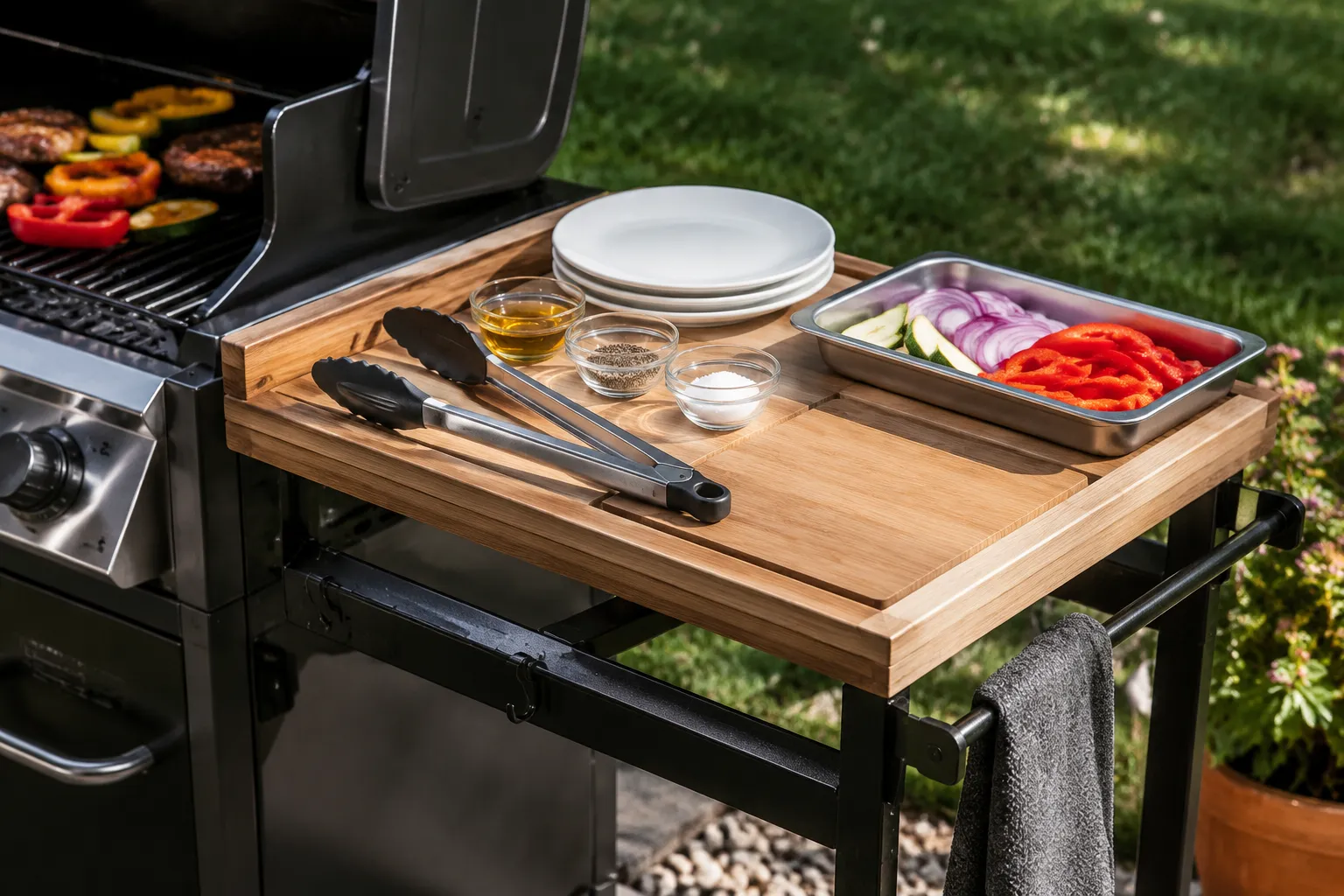
The grill is the only part of a cookout most people plan. The table beside it is an afterthought, usually a plastic folding model wobbling on uneven grass, pressed into service because something had to hold the tongs and the sauce bottle and the plate of raw chicken. That wobbling table is where cookouts get messy, not at the grate. Sauce drips onto the grass, raw meat juices find their way next to the cooked platter, and the person running the grill spends the whole afternoon walking back and forth between stations that should have been one station. A grill side table with a proper prep zone does not just add counter space. It changes the sequence of the cookout itself.
The Three-Zone Layout That Keeps Raw and Cooked Apart
The core problem with a bare table is that everything lands on the same surface. Raw meat goes down, then a hot spatula goes down beside it, then the cooked steak comes off the grill and touches the same spot where the raw juice sat. A deliberate prep zone separates those moments with physical distance, which is a more reliable system than memory or caution. The standard restaurant kitchen runs on this logic: raw proteins on one board, cooked plating on another, tools in between. A grill table can do the same thing at a smaller scale.
Three clear zones make the difference. The raw zone sits on one side of the table, usually the left for a right-handed cook, holding the platter of uncooked meat, the marinade brush, and the tongs that will only ever touch raw food. The tool zone in the middle holds the spatula, the grill brush, the thermometer, and the hot mitt. The cooked zone on the far side holds the clean platter where finished food lands. Raw never crosses into cooked because the physical layout makes it awkward to do so. The cook has to reach across the tool zone to make that mistake, and that reach is enough of a pause to redirect the motion.
Tables sold specifically for grilling often acknowledge this need with cutouts for tools and hooks for utensils, but the layout only works if the cook arranges it deliberately. A table does not enforce hygiene. It just makes it possible.
What a Real Prep Surface Needs to Do
Most folding tables have a top made of plastic slats or a thin painted metal sheet that buckles under heat and stains permanently from the first splash of marinade. A prep surface for grilling needs three properties at minimum: it has to tolerate direct heat without warping, it has to clean off with a wipe rather than a scrub session, and it has to shed liquid instead of absorbing it. Bamboo looks nice on a kitchen island but drinks up meat juice and cracks in the sun. Bare wood is worse. The top of a grill table should be either a sealed metal such as stainless steel, a heat-rated plastic composite, or a thick cutting board made of food-safe polymer that can go in the dishwasher.
Size matters more than buyers expect. A table that holds a single platter and a bottle of sauce is not a prep zone; it is a shelf. The useful width starts around 24 inches, which fits a cutting board plus the raw platter side by side. The depth should be at least 18 inches so a platter does not overhang the edge. Many compact grill tables come in at 20 by 14 inches, which looks reasonable in a product photo and proves useless in practice because the cook ends up holding things in one hand while searching for a surface with the other. A side table that cannot hold a cutting board and a platter at the same time has failed at its only job.
Weight capacity is the quiet spec. A loaded platter of ribs, a cast iron skillet, a half-gallon of marinade, and the cook leaning on the edge adds up fast. Tables rated below 50 pounds flex and wobble at the worst moment, usually when both hands are occupied with a hot grate. The stable tables start at 100 pounds of rated capacity, and that rating should be treated as a floor, not a ceiling.
The Height and Reach Problem Nobody Mentions
Grill tables are sold as accessories, so most people buy one without measuring the grill first. The result is a table that sits four inches lower than the cooking grate, forcing the cook to bend at the waist every time they set down a spatula or pick up a platter. After an hour of that, the back complains. The prep surface should sit roughly level with the grate, within an inch or two, so food can move horizontally from cutting board to grill without a vertical detour.
This is where the folding tables fail hardest. They are built to a generic patio height of around 28 inches, which matches a standard dining table, not a grill grate that usually sits at 36 to 40 inches. A purpose-built grill table with adjustable legs solves the mismatch, though the adjustment range matters. Some models only adjust over two or three inches, which is not enough. A table with legs that extend at least six inches covers the range of most common grills. The cheap fix, setting the folding table on bricks or blocks, works until someone kicks it, and then it works no longer.
Reach is the other half of the equation. The table should stand close enough to the grill that the cook can transfer food without taking a step, but far enough that the side burner or the heat radiating from the firebox does not melt the tabletop. That sweet spot is usually 2 to 4 inches of gap. Any wider and the cook starts stepping; any narrower and the plastic components of the table soften over a season.
Stability Is a Safety Feature, Not a Comfort Feature
A wobbling table is not an annoyance. It is the direct cause of the two worst cookout accidents: hot food sliding off the edge and a table tipping onto the cook's legs. The instability gets worse exactly when it matters most, because the moment the cook sets down something heavy, the table rocks, the heavy thing shifts, and the cook grabs for it, transferring all their weight onto the edge, which makes the table rock harder. A table built for grill duty has a wide stance, with legs that angle outward, and feet that grip the ground instead of sliding on it.
The material of the legs matters more than the material of the top in this case. Thin tubular steel bends at the joint where the leg meets the frame after a few seasons. Cast aluminum legs hold up longer and stay lighter for moving, though they cost more. Locking casters are a trap on a prep table: they add convenience and subtract stability, since even a locked caster rocks on its wheel. Fixed feet or adjustable rubber feet are the honest choice.
On uneven ground, which is most ground at a backyard cookout, leveling feet are the difference between a usable table and a frustrating one. A table with four independent screw-in feet can be dialed flat on a slope that would leave a fixed-leg table rocking like a porch swing. This seems like a minor detail until the whole cookout hinges on it.
The Built-In Cutting Board Is Either Useful or a Gimmick
Many mid-priced grill tables come with a recessed cutting board that slides out or flips over a section of the top. When it works, it is genuinely useful: the board sits flush with the table, so the cook can slide chopped vegetables directly toward the grill without lifting. When it fails, it fails in two specific ways. Some boards are made of thin plastic that warps in the sun and stains permanently. Others are sized so small that only a single pepper fits, which means the cook uses the big cutting board from the kitchen anyway, and the built-in board becomes a place to set the grill brush.
The good built-in boards are removable, dishwasher-safe, and sized at least 12 by 16 inches. The board should lift out for cleaning rather than staying recessed, because a board that cannot be cleaned properly becomes a hygiene problem disguised as a convenience. Flip-top boards, where the board hinges up to reveal a storage bin underneath, add moving parts that collect grease and fail over time. A simple drop-in board with a clean-out hole is the design that survives real use.
Tool Storage That Keeps the Top Clear
A prep zone loses its purpose if the surface is covered with tools. The most useful tables include a rail along the back edge or a set of hooks on the side, so the spatula, the tongs, and the grill brush hang off the table instead of lying on it. The rail needs to be at least 18 inches long to hold the essential tools without crowding. Hooks should be spaced wide enough that the tongs do not tangle with the spatula. This sounds trivial until the cook reaches for the tongs and accidentally knocks the spatula onto the grass.
Shelves below the tabletop are more ambiguous. A lower shelf can hold the charcoal bag, the rubs, or the empty platters, which keeps the top clear. But a low shelf on a folding table often becomes a catch-all that fills with junk and makes the whole unit harder to move. The better designs use a narrow shelf set high enough to clear the ground but low enough not to interfere with the cook's legs. A shelf that sits at shin height catches knees all afternoon.
The Best Table for a Gas Grill Is Not the Best for a Charcoal Grill
Gas grills run cooler at the sides, so a table can sit close with minimal risk of heat damage. Charcoal grills radiate heat from the entire firebox, and the side closest to the table can reach temperatures that soften plastic or scorch a painted finish. For charcoal, the table needs either a heat shield on the side facing the grill or enough distance that the heat dissipates before reaching the surface. Some manufacturers rate their tables for gas grills only, and the manual says so in fine print. A table rated for a gas grill next to a kettle grill is a table that will look melted by August.
The other difference is weight. A loaded charcoal grill is heavier than a gas grill, and the cook tends to set ash pans and chimney starters on the side table during the lighting process. Those items are hot, sooty, and heavy. The side table next to a charcoal grill gets a harder life than the one next to a gas grill, which argues for a metal top and a welded frame rather than a plastic laminate over particleboard.
Weather Exposure Decides the Materials
A grill table lives outside all year or it lives in a garage and comes out for cookouts. That single decision determines which materials are appropriate. A table left on the patio needs a top that tolerates UV exposure without fading or becoming brittle, which rules out most dark plastics. Stainless steel holds up well, though it needs an occasional wipe to prevent rust pitting in coastal or snowy climates where salt is present. Powder-coated steel is the pragmatic middle ground: it resists rust while costing less than stainless, but the coating chips when a cast iron skillet lands hard on the edge, and the chip rusts from the inside out.
The table that gets stored between uses has more freedom. It can use a wood top, a lighter frame, and cheaper materials, since it will not face a whole season of rain and afternoon sun. The trade-off is that stowing a table requires the will to actually put it away, and the tables that fold down to a compact shape are often the least stable when unfolded. A rigid, heavy table that stays outside might serve better than a foldable one that gets left out anyway because folding it is a chore.
The Two-Tier Setup for Serious Cooks
A single table works for a standard cookout, but a long smoke or a meal with multiple courses outgrows one surface. The solution is not a bigger table but a second smaller one on the other side of the grill. The right side holds the raw prep and the tools; the left side holds the cooked platters, the sauce station, and the serving utensils. This layout gives each side a single job, which is easier to keep clean than one crowded surface trying to do everything. The cook moves food from right to left across the grill, and nothing travels backward.
The second table can be smaller and cheaper than the main prep table, because it only holds finished food and serving pieces. A simple folding table at the right height is enough. The key is matching the heights of both tables to the grate, so the cook does not lift food up or down at either end of the workflow. Two tables at the wrong height are worse than one table at the right height, because the cook ends up doing twice as much bending.
Cleaning Routines That Keep the Table Cookout-Ready
The prep zone only stays useful if it gets cleaned between uses. A table with dried marinade crusted into the seams and sticking to the surface becomes the place where food goes to pick up last week's flavors. The wipe-down routine takes two minutes if the table was designed for it: a smooth top with minimal seams, no recessed hinges, and a surface that does not absorb. Tables with routed grooves for tool storage look organized and clean terribly, because the grooves trap liquid and the absorbent edge of the groove stains.
A grill table is a prep surface, which means it should be cleaned like one: hot soapy water, a quick rinse, and a dry cloth. The cook should not need a scrub brush or a degreaser for routine maintenance. If the table requires heavy cleaning after every cookout, it is the wrong table. The right table wipes clean in the same time it takes the grill to cool down, and then it is ready for the next round.
The tables that survive years of use share one trait: they are boring. No folding wings that trap grease, no built-in lights that fail, no electronic thermometers that short out. Just a flat, stable surface at the right height, with enough room for a cutting board and a platter, and a place to hang the tools. That is the whole spec. Everything else is decoration that gets in the way of the actual job, which is letting the cook move food from raw to cooked without a single detour through the mess.