
The grinding mechanism in a garbage disposal is a blunt instrument, and most people treat it like one. They shove food down with the water running, listen to the brief mechanical scream, and move on. Then one evening the unit hums, or clicks, or simply stops, and the sink fills with cloudy water. The common response is to reach for the reset button, which sometimes works, and sometimes just produces another hum. The less common response is to call a plumber, which works but costs a hundred and fifty dollars for what is often a fifteen-minute job. The truth sits somewhere in between: most jams are simple, most jams are safe to clear at home, and a good number of them are caused by how the disposal was used in the first place.
There is a specific sound that gives a jam away. It is not the normal grinding, which has a loose, gravelly quality. A jam is a metallic clatter, or a low hum with no rotation at all, or a click that repeats every second or two like a metronome. Each of those sounds means something slightly different, and knowing which one is coming out of the sink saves time. The clatter usually means a hard object is bouncing around the chamber, something like a chicken bone or an olive pit that got wedged between the impeller and the wall. The hum means the motor is getting power but the flywheel underneath is not turning, which is the classic stall. The repeating click is often the overload protector cycling, trying to restart the motor and failing each time. All three are jams, but the fix for each starts the same way: kill the power before doing anything else.
Going under the sink to unplug the disposal is not enough. The switch on the wall should also be turned off, and if the disposal is hardwired, the breaker at the panel should be flipped. There is a reason for this beyond the obvious. Many disposals have a reset button on the bottom, and that button is a common point of failure. A reset button that is tripped can sit partway, making the unit appear dead when it is actually live. Pulling the plug and flipping the switch removes the variable entirely. The motor cannot start while a person has a wrench in the chamber, and that is the whole point of the exercise.
The Hex Wrench That Comes With the Unit
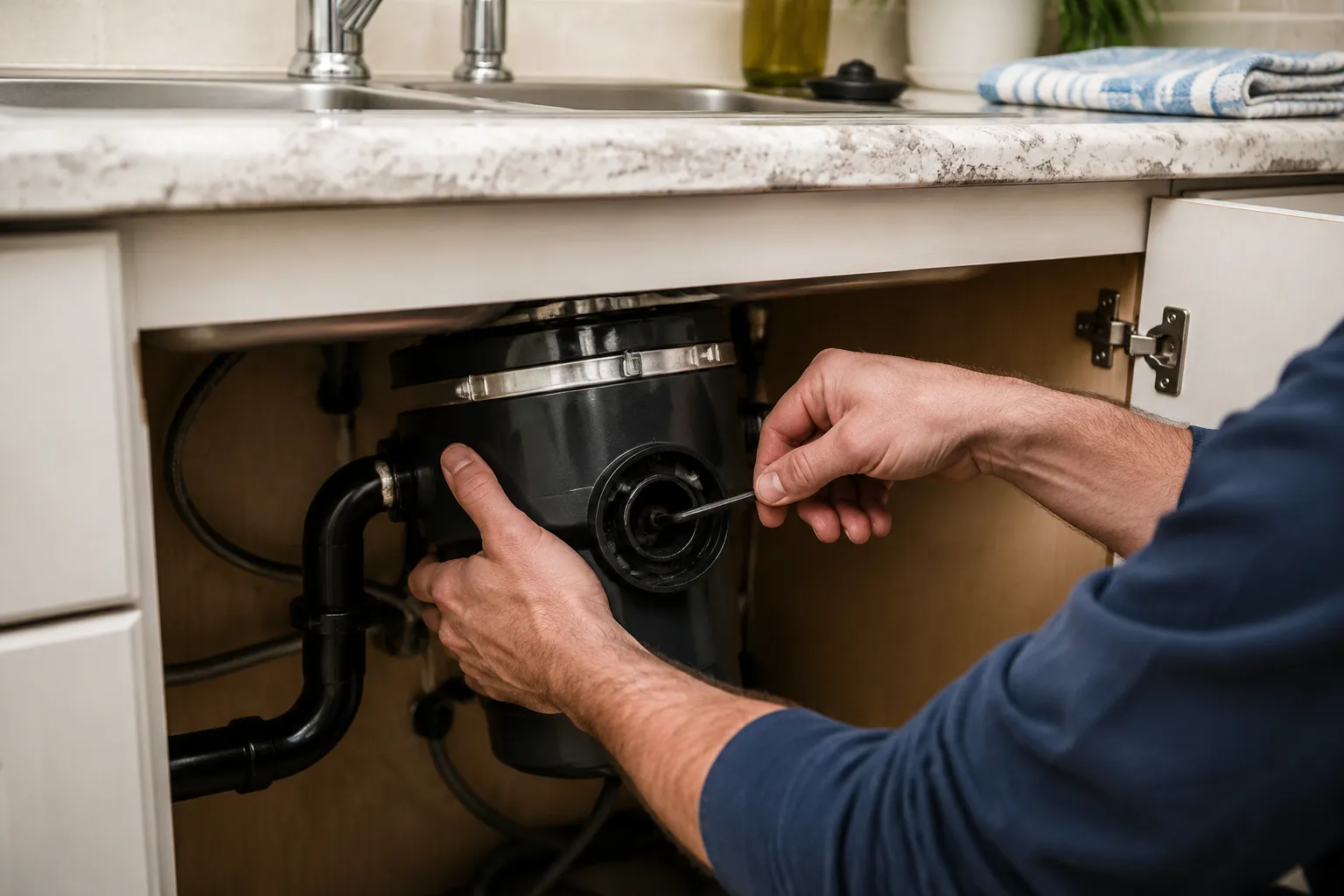
Most disposals ship with a hex wrench, sometimes called an Allen wrench, and most people lose it within a month of moving into a house. The wrench fits into a hexagonal hole on the underside of the motor housing, right in the center, and it is the single most useful tool for a jam. The hole looks like it should not be there, a small dark socket in the middle of a metal disc, and a person might mistake it for a drain plug. It is not a drain plug. It is the manual rotation point for the flywheel.
With the power off, insert the wrench and rock it back and forth. The flywheel will resist at first, then give with a gritty shudder as whatever is stuck breaks loose. Work it both directions, a quarter turn at a time, until it spins freely. This is the fix for the hum, the stall, the jam that will not clear itself. It is also the fix for a disposal that has been sitting unused for weeks and has a layer of rust on the flywheel, which can make the motor struggle to start even with nothing stuck in the chamber. A few turns of the wrench break that rust loose, and the motor spins up fine.
A person who lost the wrench can buy a replacement for a few dollars at any hardware store, and it is worth having a second one stored somewhere other than under the sink. The under-sink storage is where the original went to die, usually in a drawer full of bottle brushes and spare sponges. A magnetic tray on the side of the cabinet or a small hook inside the cabinet door keeps it visible. This is not a suggestion born of neatness. It is a practical matter: when the sink is full of standing water and the disposal is humming, the last thing a person wants to do is dig through a drawer of wet cleaning supplies.
When the Wrench Won't Budge the Flywheel
The wrench handles most jams, but not all of them. Sometimes the flywheel will not move at all, even with significant force, and that is a sign of something harder than a stray bone. Small metal objects, like a twist tie or a bottle cap that slipped past the sink strainer, can wedge themselves between the flywheel and the housing with enough force to resist manual turning. In that case, the wrench alone will not do it. The chamber needs to be cleared by hand.
This is the point where a lot of people call a plumber, and it is also the point where a lot of people make a serious mistake. Reaching into the drain opening while the disposal is connected, even with the power off, is asking for a cut. The impellers inside are not razor sharp like a blender blade, but they are cast metal with rough edges, and they will slice a finger open. The safe method requires a flashlight, a pair of long needle-nose pliers, and patience. Shine the light down the drain, find the obstruction, and pull it out with the pliers. The metal object is usually visible near the top of the chamber, sitting on the flywheel like a coin on a table.
If the pliers cannot reach it, and the object is small enough to have passed the sink strainer, there is another option. A shop vacuum with a narrow hose attachment can often suck the object out of the chamber. The vacuum should be set to wet mode, and the hose should be pressed against the drain opening to create a seal. This is not a guaranteed fix, but it works more often than expected for small items like twist ties and the pull rings from bottle caps. It also has the benefit of removing any standing water, which makes the next step easier to see.
The Reset Button Is Not Always the Answer
After clearing the jam with the wrench or the pliers, the natural impulse is to hit the reset button and flip the switch. That works, but only if the actual jam was cleared. A disposal that was stalled for more than a few seconds has likely tripped the overload protector, and the button needs to be pressed before the motor will start again. The button is on the bottom of the unit, a small red or black square that sits flush with the housing. Press it until it clicks. If it does not click, it was not tripped, and pressing it does nothing.
There is a common myth that the reset button is a magic fix, that pressing it restarts a disposal the way a breaker resets a circuit. The button is a safety device, not a power switch. It trips when the motor draws too much current, which happens during a stall. Pressing it before clearing the jam just trips it again, sometimes with a loud snap and a brief smell of hot metal. That smell is the motor winding heating up, and it is a warning. Repeated resets without clearing the obstruction can damage the motor, turning a five-minute fix into a replacement job.
The correct sequence after any jam is: power off, clear the chamber with the wrench, check by hand with pliers if needed, power on, press reset if the button is popped, then run cold water and test. The test should be short, just a few seconds of grinding with a small amount of food or a few ice cubes. Ice cubes are a good test material because they grind cleanly and also knock loose any remaining debris from the impellers. If the unit runs smooth and quiet, the jam is cleared. If it hums again, the obstruction is still there, and the process repeats.
The Long-Nose Pliers Trick for Fibrous Jams
Not every jam is a hard object. Some of the most stubborn jams come from fibrous material, and these are the ones that confuse people because the disposal sounds like it is working but the drain keeps backing up. Corn husks, celery strings, artichoke leaves, and onion skins wrap around the impeller shaft like thread on a spool. The motor runs, the flywheel turns, but the material tangles and eventually binds the shaft. The result is a slow drain that gets worse over a few days, followed by a sudden stall.
The wrench will not fix this one. Turning the flywheel with the wrench just winds the fiber tighter. The fix is to pull the fiber out from the top using the pliers, working in a circle around the impeller. A person can feel the resistance when the pliers grab a strand, and the strand will come out in a long, wet ribbon. It takes patience and a few trips back and forth, but it works. The alternative, pouring drain cleaner down the disposal, is a waste of money and a genuine hazard. The chemicals do not dissolve the fiber, and they sit in the standing water where they can splatter when the disposal eventually starts.
The better fix is preventive. Fibrous material belongs in the compost bin or the trash, not in the sink. A disposal is a grinder, not a garbage can, and treating it like one is the root cause of most jams. The impellers are designed to shred soft food waste, not to process the outer layers of a corn cob or the strings from a celery bunch. Feeding those items in small amounts, mixed with plenty of water and other food, is the difference between a disposal that lasts a decade and one that jams monthly.
Glass, Metal, and Things That Should Never Go Down
A garbage disposal cannot grind glass. It can shatter a small piece of glass into fragments small enough to pass through the drain, but the fragments are still glass, and they will settle in the trap or, worse, score the inside of the drain pipe. The same applies to metal. A twist tie is small enough to go down, but it will wrap around the impeller shaft and stall the motor. A bottle cap is too large to pass the strainer, but a person who drops one while washing dishes and fishes it out of the sink with the disposal running is asking for a jam and a potential chip in the impeller.
The list of items that should never go into a disposal is short and worth memorizing: bones larger than a chicken wing, fruit pits, coffee grounds in large quantities (they pack into the drain pipe, not the disposal), grease of any kind, pasta and rice in bulk (they swell with water and create a paste), and any fibrous vegetable matter. The common thread is that these items either do not break down in the grinding chamber, or they break down into something that clogs the pipe downstream. A jam in the disposal is a problem a person can fix. A clog in the pipe is a problem that requires a plumber and a drain snake.
There is also the matter of what happens when a spoon or a fork falls into the disposal while it is running. The sound is unmistakable, a violent metallic ringing that stops as abruptly as it started. The utensil will be dented, and the disposal will keep running, but the impeller may be chipped. A chipped impeller makes a clicking sound on every rotation, and it will not grind as efficiently. The only fix is replacement, which is a bigger job than any jam. This is why the sink strainer exists, and why it should be in place whenever the disposal is not actively in use.
Cold Water and the Right Grinding Rhythm
The single most effective way to avoid jams is also the most boring: run cold water before, during, and after grinding. Cold water keeps any grease or fat in a solid state, which means it moves through the drain pipe as a solid rather than coating the pipe as a liquid that cools and hardens downstream. Hot water melts the grease, which then re-solidifies in the trap and creates a blockage that has nothing to do with the disposal itself. The water should be running at full flow before the disposal turns on, and it should stay on for at least fifteen seconds after the grinding noise stops.
The rhythm of feeding is equally important. Shoving a full plate of scraps into the disposal at once is a jam in the making. The chamber holds a limited volume, maybe a cup and a half of material, and overloading it means the impellers can not get enough leverage to break down the food. Small handfuls, fed slowly, with each batch ground completely before the next is added, is the correct method. It takes an extra thirty seconds per meal, and it eliminates the vast majority of jams entirely.
There is a reason plumbers call disposals "self-cleaning" in one breath and then charge for clearing them in the next. The unit does clean itself, but only under the right conditions. A handful of ice cubes and a slice of lemon, ground together with cold water, scours the impeller and deodorizes the chamber in one pass. Doing this once a week is cheaper than any cleaning product, and it keeps the moving parts free of the gummy residue that builds up and eventually contributes to a stall.
When to Stop and Call a Plumber
The wrench will not move. The pliers cannot reach the obstruction. The reset button trips the moment the disposal starts. These are the signs that the jam is not in the chamber but in the motor itself, and that is the point where home repair ends. A disposal with a seized motor bearing, a burned-out winding, or a broken flywheel is not fixable with hand tools. Continuing to force the wrench or repeatedly resetting the button will only damage the unit further, and a damaged motor can overheat and trip the breaker repeatedly, which is a fire hazard in the making.
The other sign that a professional is needed is water where it should not be. If the disposal leaks from the bottom, the seal around the motor shaft has failed, and no amount of wrench work will fix that. A leaking disposal should be replaced, not repaired. The cost of a new unit is modest, and the installation is a straightforward job for a plumber that takes under an hour. Living with a leak under the sink invites cabinet rot and mold, which is a more expensive problem than any jam.
Knowing the difference between a jam and a failure is the real skill. A jam is a mechanical obstruction, and it yields to the wrench and the pliers. A failure is an electrical or mechanical breakdown, and it does not. The person who can tell the two apart saves money and avoids frustration. The person who cannot ends up replacing a perfectly good disposal that just needed a twist of the wrench.