
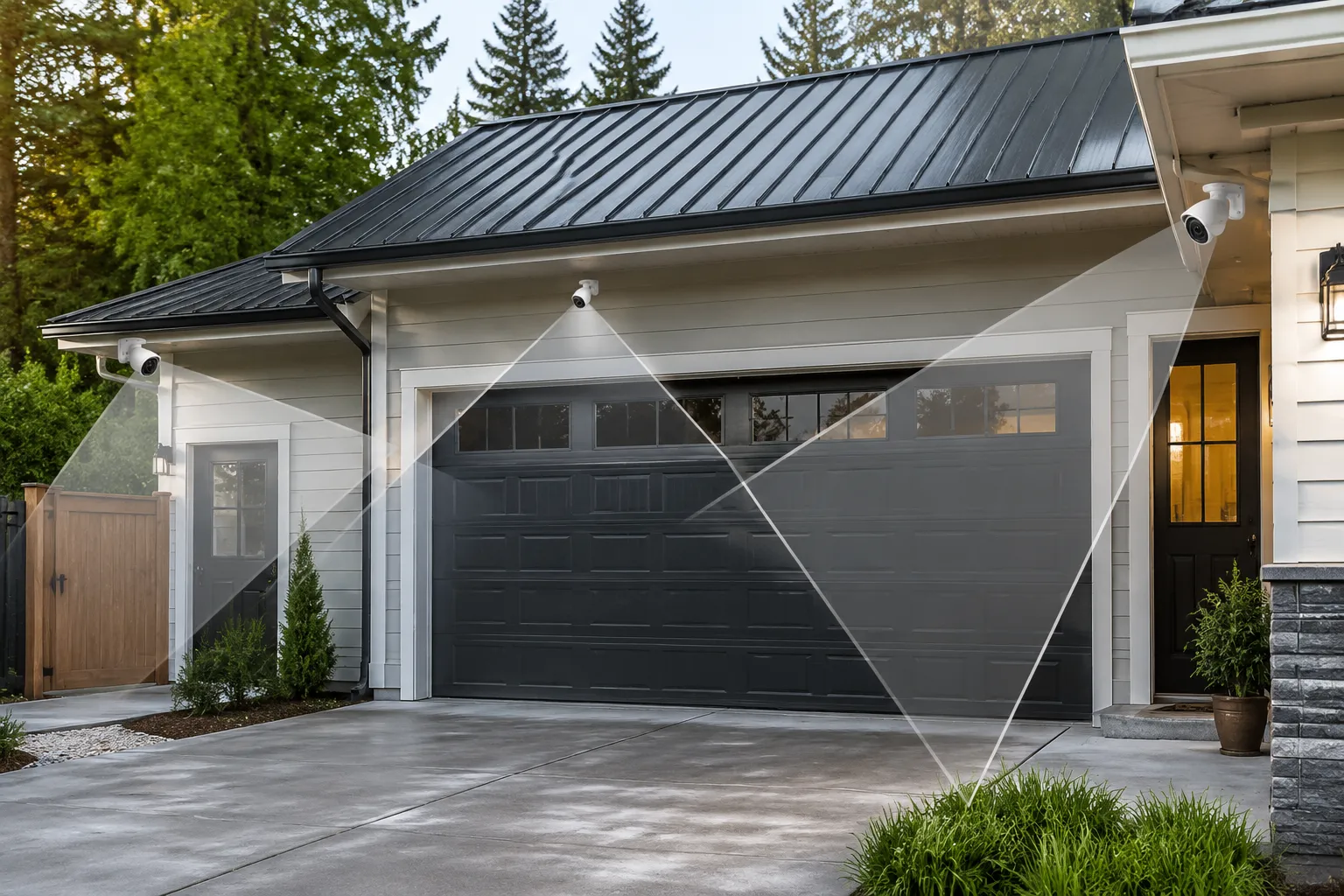
Most garage security camera advice reads like it was written by someone who has never parked a car. The recommendations focus on covering the obvious spots, the door and the window, and then stop there. That misses the entire point of a garage, which is that it is a room built around a moving vehicle, a place where sight lines change every time the door goes up. A camera angle that works for a storage room fails for a garage, because a garage has a giant hole in the wall that opens and closes on command.
The real problem is that garage entry points are not just physical openings. A person can enter a garage through the main vehicle door, the pedestrian door, a window, or by cutting through the wall itself. But they can also enter through the camera's blind spots, through the gap between the camera's field of view and the roofline, or through the space behind a parked car that the camera never sees. The angles have to account for the car itself, which is the largest object in the room and the one thing most people never think to plan around.
The Car Is the Obstacle, Not the Target
A parked car is a wall of metal and glass that blocks roughly a third of the floor space in a typical two-car garage. It creates blind zones behind the bumper, along the driver's side, and in the narrow strip between the car and the wall. A camera mounted in the corner near the ceiling sees the hood and the roof, but it cannot see the ground beside the rear wheel, which is exactly where a person would crouch to hide or to cut a lock.
The fix is not to mount the camera higher. Higher mounting makes the blind zone larger, because the angle gets steeper and the car blocks more of the view. The fix is to mount the camera lower, around five to six feet off the floor, and angle it across the car rather than down at it. A camera at that height sees over the hood, under the side mirrors, and across the gap between the car and the wall. It catches a person's face and torso instead of just the top of their head.
There is a tradeoff. A lower camera is easier to reach and disable. A person with a screwdriver or a can of spray paint can blind it in seconds. That is a real risk, but it is a manageable one. The solution is to pair a low camera near the car with a second camera mounted high in the opposite corner. The low one gets the identification shot. The high one gets the backup view if the low one goes dark.
The Vehicle Door Needs a Camera That Looks Out, Not Down
The biggest mistake in garage camera placement is aiming the camera at the vehicle door from inside the garage. That angle shows the door itself, the back of the door, and whatever is directly in front of it. It does not show who is on the other side. When the door opens, the camera sees the underside of the door panel and then a wall of daylight. The person who walked in is already inside the frame, but the camera was looking at the door, not at them.
A better approach is to mount a camera above the door, on the inside wall, angled downward and outward so it catches the floor area just inside the threshold. That way, the moment the door lifts, the camera sees the person's feet, then their legs, then their face as they step in. The angle is not glamorous, but it produces the one thing a security camera is supposed to produce: a clear shot of a face looking into the room.
For the outside view, the camera should be mounted on the exterior wall beside the door, not above it. A camera above the exterior door sees the top of a person's head and their shoulders, which is the least useful angle for identification. A camera mounted at chest height on the wall to the side catches the full profile of the face. It also catches the license plate of a car pulling into the driveway, which is a detail that matters when the police ask for footage.
The Pedestrian Door Is a Corridor Problem
The pedestrian door, the one that leads into the house or into the yard, is where most actual entry happens. Burglars do not drive through the big door. They walk through the small one, often after prying the lock or kicking the frame. The camera angle for this door has to cover the approach, not just the door itself.
Mount the camera on the wall opposite the door, about seven feet up, angled so it catches the full length of the approach path. If the door opens inward, the camera should be positioned to see the person's face as they reach for the handle. If the door opens outward, the camera needs to be on the hinge side, so it can see the person as they push the door open rather than being blocked by the door panel itself.
The corridor problem shows up when the camera is placed too close to the door. A wide-angle lens at close range creates a distorted image where the person's face is a blur at the edge of the frame. Moving the camera back, even two feet, dramatically improves the image quality. The extra distance lets the lens compress the scene and keeps the face in the sharper center of the frame.
Windows Are the Most Ignored Entry Point
Garage windows are usually small, high up, and covered with dust and cobwebs. They are also the easiest way in for someone who wants to avoid the noise of a door. A brick through a window makes less sound than a crowbar on a door frame, and the broken glass is easily brushed aside.
The camera for a window should be mounted on the opposite wall, not directly above the window. A camera above the window sees the top of the sill and the ceiling, not the person climbing through. A camera on the far wall sees the whole window frame and the person's upper body as they hoist themselves over the sill. It also catches the glass shards on the floor, which is the detail that confirms the entry method.
For a garage with multiple windows, one camera on the far wall can cover two windows if the angle is wide enough. That requires testing the field of view with the camera in place, not just trusting the spec sheet. The lens distortion at the edges of a wide-angle view can make a face unrecognizable, so the camera should be positioned so both windows fall within the middle third of the frame.
The Gap Between the Door and the Roofline
Every garage has a gap between the top of the vehicle door and the ceiling. It is usually six to twelve inches, and it is almost never covered by a camera. A person who knows what they are doing can slide through that gap, drop down onto the top of the car, and then step off the hood onto the floor. The whole move takes seconds, and a camera mounted at eye level will not see it.
One camera mounted near the ceiling, in the corner behind the vehicle door, angled down toward the top of the car's windshield, covers this gap. The angle is steep, so the image will not be useful for face identification, but it will show the body dropping onto the car. That is enough to alert a homeowner who checks the footage, and it is enough to give police a timeline of the entry.
The same camera can cover the interior of the garage door's track system. A person who wants to disable the door manually will often reach up and pull the release cord on the opener. That cord is right there, next to the gap, and a camera that covers the gap will catch the hand reaching for it.
The Space Behind a Parked Car Is a Dead Zone
The rear of a parked car, the space between the bumper and the back wall, is the single largest dead zone in most garages. A person can stand there, completely hidden from a camera mounted on the front wall, and have all the time in the world to work on a lock or a window. The car blocks the view, and the wall blocks the other side.
To cover this zone, a camera needs to be mounted on the side wall, near the back corner, angled across the rear of the car. The angle should be shallow, almost parallel to the back wall, so it catches the space between the bumper and the wall. A wide-angle lens with a horizontal field of view of at least 100 degrees will cover the full width of the rear zone.
There is a second dead zone on the driver's side of the car, the strip between the car door and the wall. This zone is narrow, usually less than two feet, but it is a natural hiding spot. A camera mounted on the front wall, near the pedestrian door, angled down the side of the car, covers this strip. The angle is tight, but it does not need to be wide. It just needs to catch a person who is pressed against the wall.
The Overhead Storage Blind Spot
Most garages have shelves, cabinets, or ceiling-mounted storage racks. These are not just storage. They are visual barriers. A tall cabinet blocks the view of a camera mounted on the opposite wall. A ceiling rack creates a shadowed zone underneath it where a person can stand without being seen.
The rule is simple: any object taller than three feet creates a blind spot on the far side. The camera placement has to account for every shelf and cabinet, not just the walls and the car. A camera mounted on a wall that is blocked by a workbench is useless for the area behind the workbench. The camera needs to be mounted on the opposite wall, looking over the workbench, or it needs to be mounted on the ceiling, looking down.
Ceiling mounting gets a bad reputation because the image is a top-down view, which is not great for face identification. But for covering storage racks, it is the only angle that works. A ceiling-mounted camera in the center of the garage, angled toward the back corner, covers the aisles between the shelving units and the space behind the car.
The Temperature Problem Nobody Talks About
Garages are not climate controlled. In the summer, the interior can hit 120 degrees. In the winter, it can drop below freezing. Most consumer security cameras are rated for outdoor use, which means they can handle the temperature, but the image quality degrades at the extremes. The lens fogs up in the humidity, and the infrared LEDs wash out in the cold.
The camera placement has to account for airflow. A camera mounted directly above a hot water heater or a furnace vent will have a shorter lifespan and dirtier images. A camera mounted in the corner, away from vents and direct sunlight, will stay clearer for longer. The best corner is the one that gets the least direct sunlight through the windows, since the sun can create glare that washes out the image for hours at a time.
There is also the condensation problem. A cold garage with a warm car parked in it creates moisture on every surface, including the camera lens. A camera mounted high, near the roofline, avoids most of this condensation because the air is warmer near the ceiling. A camera mounted low, at the five-foot height recommended earlier, will need periodic wiping. That is the price of a good identification angle.
The Two-Camera Minimum That Actually Works
One camera cannot cover a garage. The geometry does not allow it. A single wide-angle lens in a corner sees the car and the front wall, but it cannot see the back wall, the side wall, and the ceiling gap at the same time. The minimum viable setup for a single-car garage is two cameras: one in the front corner, angled toward the back, and one in the back corner, angled toward the front.
For a two-car garage, the minimum is three. Two cameras on the front wall, one in each corner, angled inward and across the two parking spaces. One camera on the back wall, centered, angled toward the pedestrian door and the window. This setup covers the car blind zones, the windows, the pedestrian door, and most of the floor area.
A fourth camera, placed outside, covering the driveway and the exterior of the vehicle door, completes the system. This outside camera is the one that catches the license plate, the approach on foot, and the face of anyone who walks up to the door before they enter. The inside cameras catch the entry itself. The outside camera catches the intent.
The order of priority is simple. First camera goes on the pedestrian door. Second camera goes on the vehicle door, looking at the interior floor. Third camera goes on the back wall, covering the car's rear blind zone. Fourth camera goes outside. Anyone who has to choose between cameras should follow that order, because the pedestrian door is where most entries happen, and the identification shot is the one that matters when the footage ends up in front of a detective.