
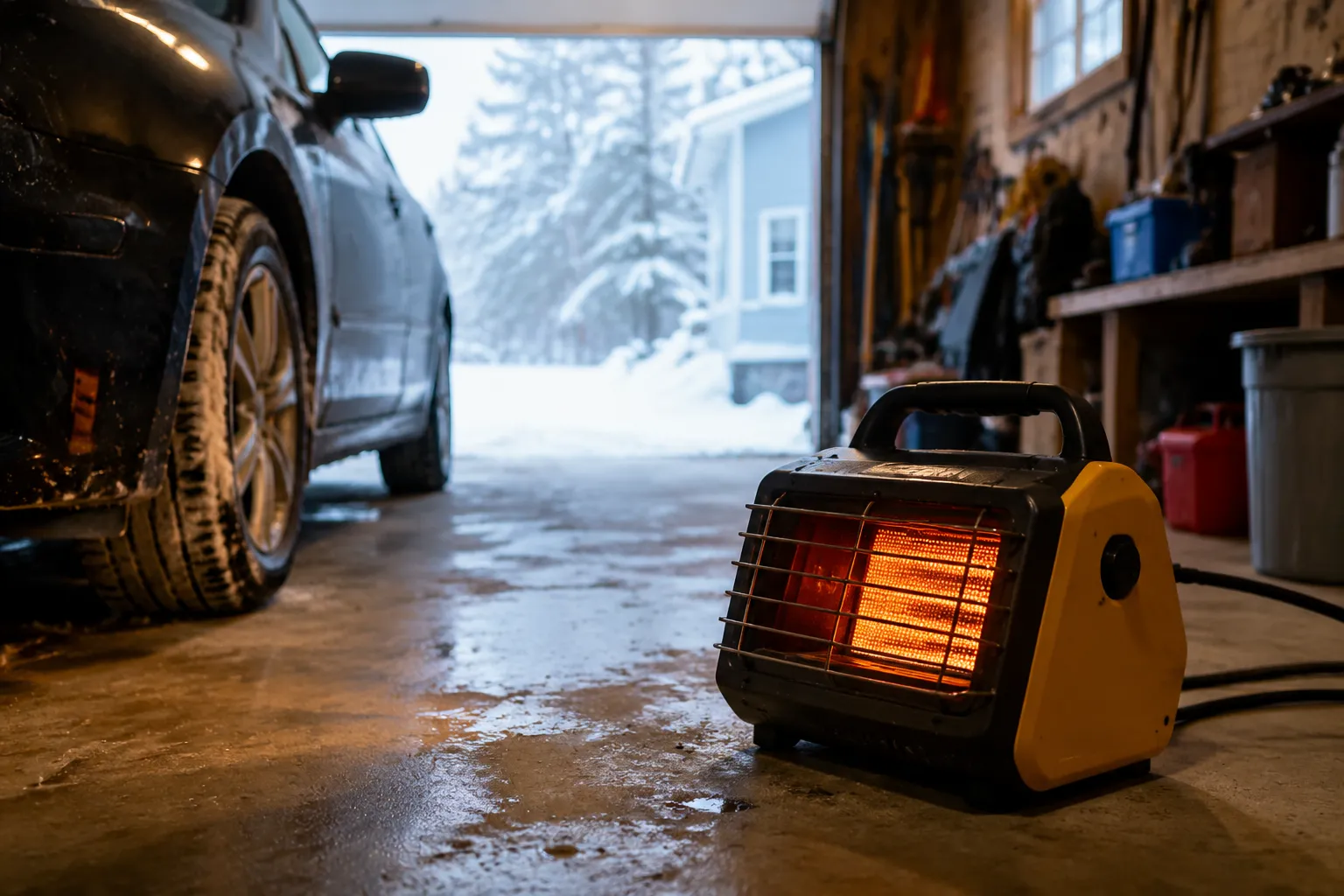
Cold-starting a car is a mechanical argument between the engine and the chemistry of its own oil. The battery has to spin the starter, the starter has to turn the crank, and the crank has to push pistons through oil that has thickened overnight into something closer to cold honey. Every part of that chain gets harder when the temperature drops below freezing, and the person who wins the argument is usually the one who changed the garage, not the car.
A garage heater is not a luxury item. It is a maintenance tool with a thermostat. The real question is which kind belongs in a specific space, because the difference between a radiant unit and a forced-air unit is not a marketing detail. It is the difference between warming a person and warming a block of aluminum.
This is the part where most advice turns generic. The standard list says to buy a heater with the right BTU rating, hang it from the ceiling, and call it done. That list skips the hard part, which is figuring out what the heater is actually trying to do. A garage that needs a car to start at 6:00 AM has a different problem than a garage where someone wants to stand comfortably while changing brakes at noon.
The Difference Between Warm Air and Warm Metal
Forced-air heaters, usually gas or electric, raise the air temperature of the whole space. They work like a house furnace. The air moves around, the garage gets warmer, and after an hour or two the engine block is sitting in a pool of air that is no longer trying to freeze it. This is the most common setup and it works fine, but it comes with a hidden cost: the whole garage has to be heated, including the empty corners and the rafters.
Radiant heaters, by contrast, emit infrared energy that warms objects directly. The air stays cold, but the metal of the car absorbs the radiation and warms up. A person standing near a radiant heater feels the heat on their skin while the air around their back stays chilly. In a garage, this means the engine block gets warmer while the walls stay cold, which is exactly what a cold start needs.
The honest comparison comes down to time. A forced-air unit needs to run for a long time before a cold-soaked engine block notices any difference. The air warms, then the metal slowly catches up. A radiant heater starts transferring energy to the metal the moment it turns on. For a car that needs to start in an hour, radiant heat is the better tool. For a garage that people use as a workshop, forced air is more comfortable.
Most garages end up with forced air because it is easier to install and cheaper per BTU. That is a reasonable choice, but it should be a deliberate one. Choosing a heater because it was on sale is how a person ends up with a garage that is warm at noon and useless at 5:30 AM.
Reading the BTU Rating Honestly
The BTU rating is the number that everyone quotes and almost no one understands. It is a measure of heat output, not a measure of effectiveness. A 30,000 BTU heater will eventually warm a two-car garage, but it will take twice as long as a 60,000 BTU unit. The math is straightforward, but the application is not.
Garage insulation changes the calculation completely. A well-insulated garage with sealed doors and insulated walls can hold heat for hours after the heater shuts off. A drafty garage with a thin metal door loses heat as fast as the heater makes it. A person with a tight garage can buy a smaller heater and set it on a timer to run for a few hours before the morning commute. A person with a drafty garage needs a bigger unit running all night, which costs money and still might not catch up.
The rule of thumb that circulates online suggests roughly 10 watts per square foot for electric heat, or about 25 to 30 BTU per square foot for gas. Those numbers are a starting point, not a final answer. A 20-by-20 garage comes out to around 12,000 to 15,000 BTU, which sounds small until a person realizes that a typical electric space heater puts out about 5,100 BTU. Most garages are undersized on heating because people buy based on the size of the room instead of the condition of the room.
One honest way to check the math is to look at the temperature rise a heater can manage. A 45,000 BTU unit in a 400-square-foot garage with poor insulation might manage a 20-degree rise above outside temperature. That is enough to keep a car above freezing on a mild winter night, but it will not keep the garage at 60 degrees when it is 10 degrees outside.
Tight Garages and the Carbon Monoxide Question
Gas heaters, whether natural gas or propane, are popular because they are cheap to run and put out serious heat. They also produce carbon monoxide, and a garage is one of the worst possible places for that gas to accumulate. The same tight insulation that makes a garage efficient at holding heat also makes it efficient at holding poison.
The safe installation for a gas unit requires either a vent pipe through the wall or a sealed combustion design that pulls air from outside. Units without these features should be used only in garages with enough fresh air leakage to keep the space safe, and that requirement fights against the whole point of heating the space efficiently. A person can buy a vented gas heater and install it properly, but that is a project with real consequences for getting it wrong.
Electric heaters avoid the entire problem. No combustion, no exhaust, no fresh air requirement. The tradeoff is operating cost, because electricity is almost always more expensive per unit of heat than gas. For a person who only needs the garage warm for an hour before work, the extra cost is a few dollars a day. For a person who wants a warm garage all winter, the difference adds up.
There is also the middle path, which is a diesel or kerosene heater used for short bursts. These are not for overnight operation. They are for the person who needs the garage warm for an hour while working on a car, and they work well for that narrow purpose. Letting one run all night is a fire risk and a respiratory hazard.
Positioning the Heater for the Car, Not the Ceiling
Most garage heaters hang from the ceiling because that keeps them out of the way. Ceiling mounting is good for safety and space, but it works against the goal of warming a car. Heat rises, and a ceiling-mounted unit pushes warm air to the highest point in the room. The engine block sits near the floor, in the coldest layer of air.
The better placement for a car-warming setup is low and aimed at the front of the vehicle. A radiant heater mounted on a wall at bumper height, pointed at the engine bay, delivers heat directly to the metal that needs it. This is not a common installation because it takes up wall space and looks less tidy, but it works better for the specific job.
A forced-air unit benefits from a circulation fan. The heater warms the air, and the fan moves that air down to the floor level. Without circulation, a garage can have a 20-degree temperature difference between the ceiling and the floor. That temperature split is the difference between a car that starts and a car that cranks slowly and complains.
The angle of the heater matters more than most people expect. A unit tilted slightly downward, aimed at the concrete floor, will heat the slab. The concrete then radiates warmth upward, acting like a low-temperature radiant panel. This is a slow process, but it is effective over the course of several hours, and it is free once the heater is already running.
Timers and Thermostats Do the Morning Thinking
The single best upgrade for a garage heater is a 24-hour timer. It costs about twenty dollars and converts a manually operated heater into a device that does the thinking before a person is awake. For someone who leaves for work at 7:00, the timer should kick the heater on at 5:30. That gives the heater ninety minutes to bring the garage up to temperature and start warming the engine block.
Running the heater all night is wasteful. The car does not need the garage at 60 degrees at 2:00 AM. It needs the garage at 40 degrees at 6:30 AM. A timer makes that distinction possible, and the cost difference is substantial. A 5,000-watt heater running for ten hours uses 50 kilowatt-hours. Running it for ninety minutes uses 7.5. The timer pays for itself in a week.
Thermostats add another layer of control. A heater with a thermostat set to 40 degrees will run only as needed to keep the garage above freezing. This protects against the coldest nights without burning power all the time. For a car that needs to start in extreme cold, the thermostat should be set higher, around 50 degrees, to give the engine block a real head start.
Combining a timer with a thermostat creates the ideal setup: the thermostat manages the overnight baseline, and the timer pushes the temperature up for the final two hours before the morning start. This is the setup that makes a car start like it is parked in a mild spring day, even when the snow is piled against the garage door.
The Battery Is Still the Weak Link
A warm engine block does not help if the battery cannot deliver enough current to spin the starter. Cold batteries lose capacity, and the chemical reaction inside a lead-acid battery slows dramatically in freezing temperatures. Even with a warm engine, a weak battery will produce a slow, reluctant start.
A battery heater or a battery blanket is a cheap addition to the garage heater setup. These are simple electric pads that wrap around the battery and keep it warm. For a car that sits through a deep freeze, a battery blanket is often the single most effective cold-start tool a person can buy. It does not take much power, and it keeps the battery chemistry active enough to deliver full cranking current.
The garage heater warms the engine block, the battery blanket warms the battery, and together they take the two hardest parts of a cold start out of the equation. The starter no longer fights thick oil, and the battery no longer struggles with sluggish chemistry. The engine turns over like it is a summer afternoon, and the whole system feels like cheating.
There is a limit to what a garage heater can do for a car parked outside. Some people use the garage as a staging area, heating it up and then pulling the car out after a few minutes of idling. That works, but it means the car spends most of the night in the cold and only gets a brief warm-up before departure. The battery blanket does not care where the car is parked, which makes it the better investment for people without a heated garage.
Oil Viscosity Is a Silent Partner
The garage heater does its work before the engine turns over. After that, the oil takes over. Cold oil is thick oil, and thick oil resists flow. A car with 5W-30 oil will crank easier at 20 degrees than the same car with 10W-30, and the difference is noticeable in how fast the engine reaches idle speed.
Switching to a winter-grade oil is a separate decision from installing a heater, but the two work together. A warmer garage allows the use of a slightly thicker oil without penalty. A cold garage pushes a person toward thinner oil to compensate. The heater buys flexibility on the oil choice, and the oil choice buys reliability on the cold start.
Synthetic oil is the other half of this equation. Synthetic oils flow better at low temperatures than conventional oils, and they maintain their viscosity as they warm up. For a car that sits in a cold garage all winter, synthetic oil is a meaningful upgrade that shows up in the first cranks of the morning. It costs more per quart, but it is cheaper than a tow truck.
The combination of a warm garage, a battery blanket, and synthetic oil effectively removes winter from the starting equation. The car starts like it is June, even when the calendar says January.
Reality Check on Installation and Power
Every garage heater has an installation requirement, and ignoring that requirement is how garage fires start. A 240-volt electric heater needs a dedicated circuit with the right breaker size. A gas heater needs a vent and a gas line. A propane heater needs an open window or a carbon monoxide detector. These are not suggestions, they are the difference between a warm garage and a visit from the fire department.
The electrical question is the one that stops most people. A standard garage outlet is usually a 15-amp or 20-amp branch circuit. A 5,000-watt heater at 240 volts draws about 21 amps, which exceeds that circuit. Putting a large heater on a small circuit trips the breaker, and using an extension cord to get around the problem is how wires melt.
For a person renting a house or apartment, the permanent installation may not be an option. The practical workaround is a smaller heater. A 1,500-watt unit running on a 120-volt outlet will not heat a whole garage well, but it will keep a small space above freezing. It may be enough to take the edge off the cold, which is often all a car needs to start more reliably.
The other workaround is a diesel heater, the small units originally made for truck cabs and boat cabins. These run on 12 volts, burn a tiny amount of fuel, and put out surprising heat for their size. They are not a full garage solution, but they can keep the area around the engine bay warm for a fraction of the cost of a full electric installation. They are also portable, which makes them useful for a car parked outside or in a detached garage without power.
Measuring Success in Cranking Speed
The success of any garage heater setup shows up in the sound of the starter. A cold battery and thick oil make the starter groan, each revolution slower than the last. A warm engine block and a warm battery make the starter sound crisp, the engine catching within two or three revolutions.
There is no need for a thermometer in the garage to know if the setup works. The car tells the truth. If the engine turns over sharply on the first attempt, the heater is doing its job. If the first crank is slow and the engine catches for a moment before dying, the setup needs more time, more heat, or both.
A garage heater is a tool with one real job: removing the cold from the starting equation. It does not need to make the garage comfortable for standing around in a t-shirt. It needs to make the metal warm enough, the battery active enough, and the oil thin enough that the car acts like winter is not happening. Get those three things right, and the morning commute starts with the simple turn of a key instead of a prayer.