
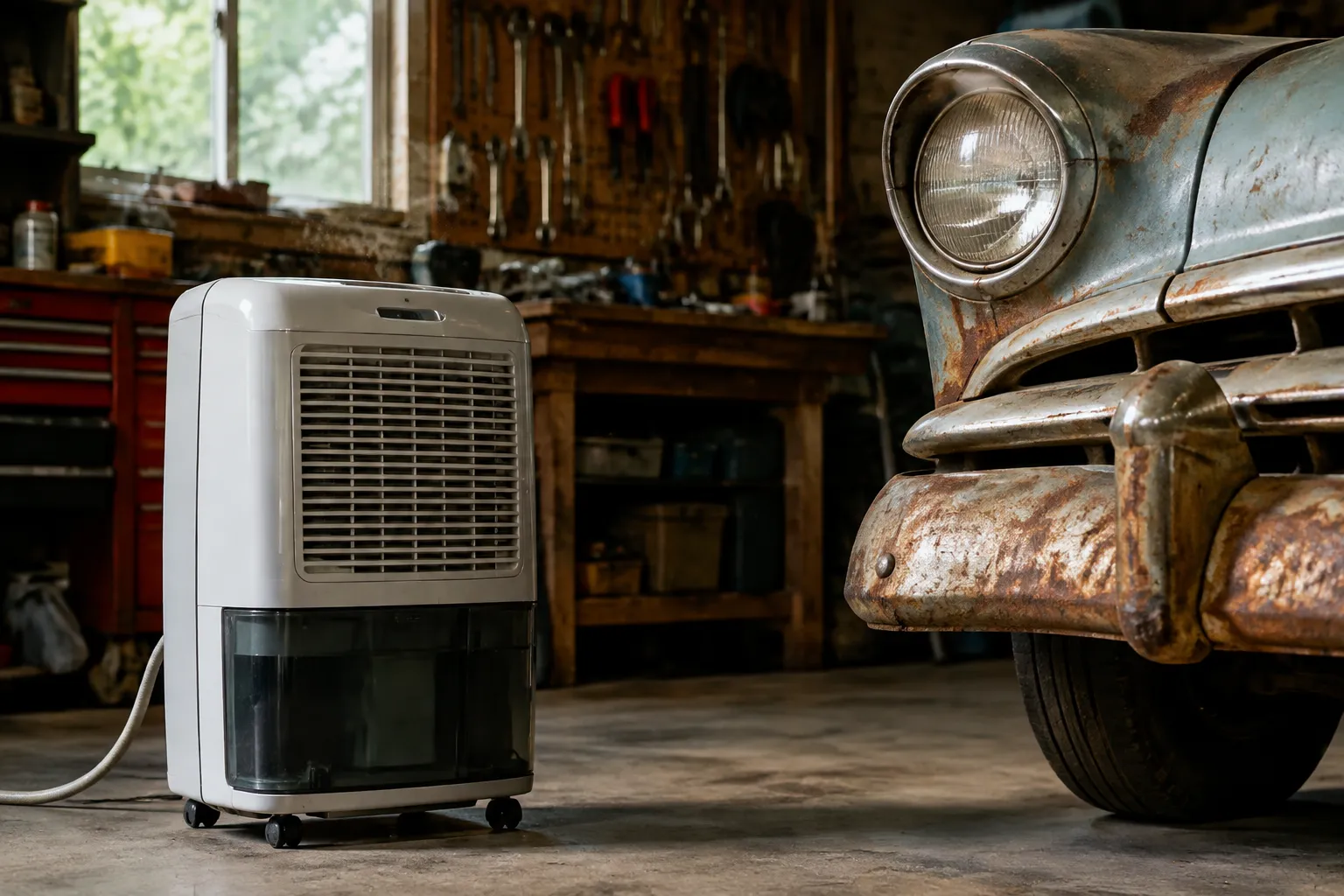
Walk into any older garage in a humid climate and the first thing a person notices is the smell. It is not the smell of gasoline or oil, though those are present. It is the smell of damp concrete, of cardboard boxes gone soft, of a tool chest that feels cool and slightly sticky to the touch. That moisture is not just unpleasant. It is actively pulling the finish off a cast-iron table saw top, flaking the chrome on a floor jack, and pitting the face of a chisel that was sharp three weeks ago. A garage dehumidifier is the single most effective tool for slowing that rust, but only when it is sized, placed, and maintained like the piece of machinery it is.
Most people treat a garage dehumidifier as an afterthought. They buy the smallest unit on sale, set it near the door, and expect miracles. Then they complain that it never keeps up. The problem is rarely the machine itself. It is the fundamental mismatch between what a garage demands and what a living-room dehumidifier can deliver.
The Garage Is a Different Animal Than a Basement
A basement is a sealed box. The walls are poured concrete or block, the windows are few, and the door is closed most of the time. A dehumidifier in that environment works on a small, stable volume of air. A garage is the opposite. An attached garage shares framing and drywall with the house but also has a massive overhead door that leaks at every seam. The weatherstrip at the bottom drags across the floor but does not seal. The panels themselves expand and contract with temperature. Every time a car drives in, it brings heat, moisture, and road spray. Every time the door opens for thirty seconds, the entire air volume exchanges.
This means the dehumidifier is not fighting a steady state. It is fighting a recurring flood of humid air. A unit rated for a 1,500-square-foot basement is often undersized for a two-car garage half that size. The sizing guides on the boxes assume a closed, insulated space with minimal air exchange. A garage violates every assumption. The practical rule for most attached garages is to buy one size category larger than the square footage suggests. If the box says it covers 1,000 square feet, a 600-square-foot garage will still keep it running constantly, and constant running is what wears the compressor out first.
Temperature, Not Just Humidity, Determines the Machine's Output
Dehumidifiers use a compressor and refrigerant coils, the same basic physics as an air conditioner. The air gets pulled over cold coils, moisture condenses out, and the dry air gets blown back. That process works beautifully when the air is warm. At 80 degrees and 70 percent relative humidity, even a modest unit pulls gallons of water a day. Drop the temperature to 55 degrees, which is a comfortable spring day in an unheated garage, and the same unit's capacity falls off a cliff.
Most manufacturers rate capacity at 80 degrees and 60 percent relative humidity. At 65 degrees, that same compressor is moving maybe 60 percent of the rated water. At 50 degrees, the coils start to ice over. Frost builds on the fins, air stops flowing through them, and the unit cycles into defrost mode more often than it actually dehumidifies. The result is a machine that runs for hours and produces a trickle of water. This is why a garage dehumidifier needs to be oversized in real terms, not just on paper. The extra capacity is not a luxury. It is the margin that keeps the coils above freezing when the garage sits at 60 degrees for weeks at a time.
There is a secondary consequence of cold garages that catches people off guard. The metal tools themselves act as a dehumidifier of sorts. On a warm, humid day, a cold cast-iron table saw body sits below the dew point of the air in the garage. Moisture condenses directly onto the metal surface, even while the air around it shows a reasonable relative humidity reading. A dehumidifier that is merely adequate for the air will not prevent this condensation. The room needs to be dry enough, and the metal needs to warm to the air temperature, which takes hours. Running the dehumidifier continuously after a warm rain is not wasteful. It is the only way to keep the metal above the dew point.
Placement Is the Difference Between Working and Wasting Electricity
People tend to put the dehumidifier in a corner, behind a storage shelf, or right next to the workbench because that is where the cord reaches. The machine then pulls air from a dead zone while the rest of the garage stays damp. For a garage, the machine needs to sit in the path of the biggest air movement. That usually means near the overhead door, because that is where the humid air enters and where the door's poor seal creates constant infiltration. The intake side of the unit should face the door, not the wall.
Clearance matters more than people think. The manufacturer's manual will say something about 12 to 18 inches of space on all sides. That is not a suggestion. The unit pulls air in one side and blows dry air out the other. If a stack of totes sits within a foot of the intake, the machine just recycles the same pocket of air. The rest of the garage remains untouched. A person should be able to walk a full circle around the unit. If that is not possible, the placement is wrong.
Elevation is another factor. A dehumidifier on the floor is pulling from the lowest, coldest, most humid layer of air in the garage. That is actually a good thing for a garage, because the floor is where the moisture lives. But the unit should not sit directly on bare concrete. A small plywood platform, even just a 2x4 frame, lifts the machine above the coldest surface layer and keeps the case from sweating. It also makes the condensate pump or bucket easier to access. A cheap furniture dolly under that platform makes the whole setup movable, which is valuable in a space where parking a car occasionally means everything has to shift.
The Drain Hose Is the Real Maintenance Issue
Every garage dehumidifier comes with a bucket. The bucket fills, the unit shuts off, and somebody has to walk over and empty it. In a finished basement, that is a minor chore. In a garage, it becomes a death sentence for the whole project. The machine sits in a corner, the bucket fills after a day and a half, the unit stops, and the garage returns to full humidity. If the owner is busy, which every owner is, days go by. The rust comes back. The machine gets blamed.
The fix is a gravity drain hose. Most units have a threaded port on the side or back for one. A garden hose adapter or a length of vinyl tubing runs from that port to a floor drain or to a bucket that the owner is willing to check once a week. The hose must run downhill with no low spots where water can pool. A sag in the middle of the hose collects water, grows algae, and eventually blocks the flow. The unit then overflows internally or shuts off for no visible reason. The homeowner opens the machine, finds a clogged hose, and spends an afternoon cleaning it with a wire.
For garages without a floor drain, the alternative is a condensate pump. These small pumps attach to the dehumidifier's drain port and push the water up and over to a sink or laundry drain, sometimes 10 or 15 feet away. They cost about as much as a cheap dehumidifier, but they convert the machine from a part-time appliance into a set-and-forget system. A garage that gets a condensate pump and a hose to a drain runs continuously through the worst of the summer. That is the difference between a rust control strategy and a hobby.
Setting the Humidity Target for Metal, Not for People
A comfortable indoor humidity for humans is around 40 to 50 percent. A garage is not a living space. The target should be lower if the goal is protecting bare steel. Rust formation slows dramatically below 45 percent relative humidity and nearly stops below 35 percent. There is no reason to run a garage at 30 percent, which wastes electricity and dries out wooden tool handles, but a setting of 35 to 40 percent on the machine's hygrometer is a reasonable middle ground.
The built-in hygrometer on most dehumidifiers is not accurate. It reads somewhere within 5 to 10 percent of reality, which is fine for a basement but frustrating for rust control. A person who wants certainty should buy a separate digital hygrometer and place it near the most vulnerable metal, usually the drill press table or the lathe bed. If that hygrometer reads above 45 percent while the dehumidifier's display says 35, the machine is undersized, the placement is wrong, or the door is being opened too often. The separate meter removes the guesswork.
One caution about very low settings: a dehumidifier running at 30 percent on a cold garage floor will frost up fast. The unit will spend half its time defrosting and move very little water. It is better to set the machine to 40 percent and accept that the garage stays a bit more humid than ideal than to run it hard into frost territory. A consistent 40 percent is vastly better for tools than a wild swing between 30 and 70 percent.
The Hidden Load of Cars, Concrete, and Seasonal Swings
An attached garage stores more than tools. It holds the family car after a drive through rain, a snow-covered SUV that drips for hours, and wet boots and bicycles and a lawn mower that just came back from cutting wet grass. Every one of those items dumps water into the air. A car with wet carpets and a damp trunk liner can release a gallon of water over the course of a day inside the garage. The dehumidifier has to pull that out on top of the ambient humidity.
Concrete is the other silent contributor. A concrete slab is porous. It wicks moisture from the ground below, especially in regions with a high water table or poor exterior drainage. On a hot, humid day, that slab sweats. The moisture evaporates into the garage air for hours after the sun goes down. A dehumidifier running overnight is not just correcting for the weather. It is drying out the slab, which takes weeks of continuous operation. A new garage, or a garage that has sat damp for years, will need a month of steady dehumidification before the concrete reaches equilibrium.
Seasonal use changes the calculus. In the spring and fall, when the temperature swings between warm days and cool nights, the garage is at its most dangerous. Warm, humid air meets cold metal and condenses. This is the period when a dehumidifier earns its keep. In the dead of winter, when the air is naturally dry, the machine can be unplugged. Running it at 20 degrees outside just frosts the coils and wastes power. The smart approach is to run the unit hard from late spring through early fall, and to turn it off when the outdoor temperature stays below 40 degrees for weeks at a time.
The Filter and Coil Cleaning Schedule That Actually Matters
Garage air is dirty. It contains sawdust, metal grinding dust, pollen, and the fine particulate from every leaf blower and lawn mower that has ever run inside. The dehumidifier's intake filter catches some of this, but the filter becomes clogged in weeks, not months. A clogged filter starves the unit of air, drops its capacity, and makes the compressor work harder. Cleaning it is a five-minute job. The filter slides out, gets rinsed under a tap, dries on a towel, and goes back in. Doing this every two weeks during heavy use is not excessive. It is the difference between a unit that lasts five years and one that dies after two.
The coils need attention too, though less often. Every few months, a person should remove the front grille and inspect the fins on the evaporator coil. Dust and grime build up between the fins, and once that layer forms, water cannot condense efficiently. A soft brush and a can of coil cleaner handle the job. This is the maintenance that nobody does, and it is the reason so many garage dehumidifiers end up at the curb after a couple of seasons.
There is also the matter of the condensate pump, if one is installed. The pump's reservoir collects sediment and the occasional bit of mold. Once a year, the reservoir should be pulled, washed with mild soap, and dried. The check valve on the pump's discharge line also needs a look. If it sticks, water siphons back into the pump and overflows. A few minutes of preventive attention saves a puddle and a ruined extension cord.
Rust Control Beyond the Dehumidifier
The dehumidifier is the backbone of garage rust control, but it works best in combination with a few other practices. A coat of paste wax on bare cast-iron surfaces, reapplied twice a year, adds a sacrificial barrier that the dehumidifier does not have to manage alone. Silica gel packs in closed tool chests absorb localized moisture in drawers where air barely circulates. A box fan running on low for an hour after the garage door closes mixes the air and prevents the cold spots that cause condensation.
The water the dehumidifier removes has to go somewhere. The machine will produce several gallons a day in peak season. A floor drain handles it silently, but a garage without one requires a plan. The condensate pump is the best answer, but a five-gallon bucket that gets emptied every other day works if the owner actually does it. The bucket will overflow eventually. Everyone who has run a garage dehumidifier knows this. The trick is to make the emptying routine, tied to something the owner already does, like taking out the trash or closing the garage for the night.
The last piece of the system is the simplest. A cheap digital hygrometer on the wall, readable from the doorway, tells the owner at a glance whether the machine is keeping up. If the number creeps above 50 percent in the middle of a dry week, something is wrong. The filter is dirty, the drain hose is kinked, or the slab is re-wetting. The meter does not lie. It turns a vague sense of dampness into a number that can be acted on.
A garage dehumidifier is not a glamorous tool. It sits in the corner, hums quietly, and asks for regular attention in exchange for doing its job. But a person who sizes it generously, places it where the air moves, drains it properly, and cleans it on a schedule will walk into a garage that smells like dry concrete and sawdust instead of damp metal. The table saw stays bright. The chisels stay sharp. The rust stops winning.