
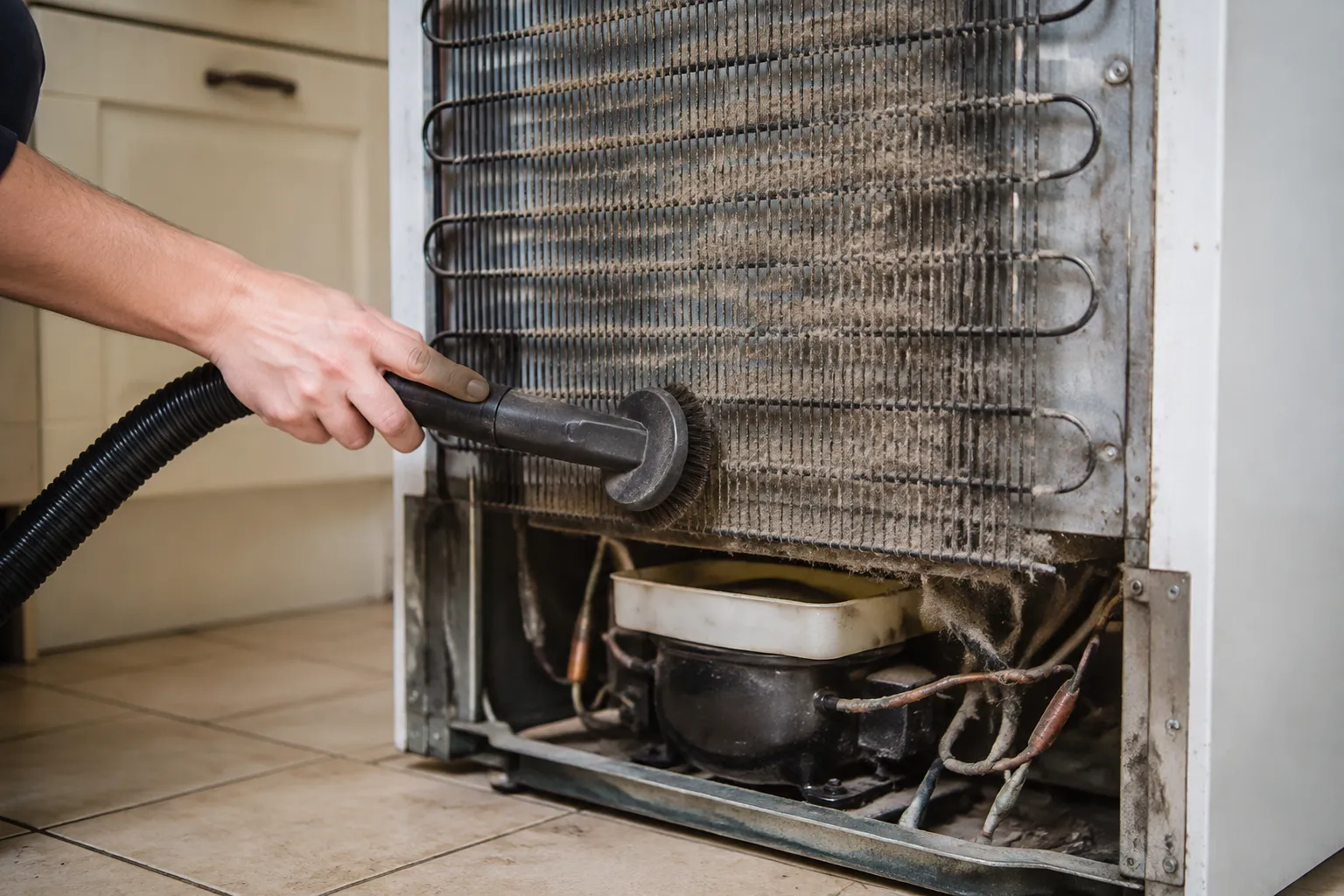
The condenser coil on the back of a refrigerator is a piece of equipment that people refuse to think about. It sits there, usually behind a grille that was designed to be ignored, collecting dust and pet hair and the general airborne filth of a kitchen. Most owners will go the entire lifespan of the appliance without once pulling the unit away from the wall to look at it. When they finally do, usually because the fridge is making a sound like a small airplane taking off, the coil looks like a fuzzy gray carpet that has been glued to metal tubing.
The standard advice, when a person finally notices this mess, is to clean the coil twice a year. This number gets repeated on appliance manufacturer websites, in home maintenance checklists, and by well-meaning relatives who own a long vacuum attachment. It is a comfortable, round number that sounds like it was chosen for convenience rather than for any technical reason. The truth is that twice a year is a minimum for a household that has no pets and an unusually clean kitchen. For a lot of people, it is nowhere near enough.
The coil exists to shed heat. The refrigeration cycle pumps hot refrigerant gas into those loops of tubing, and the coil's job is to transfer that heat into the air of the room. A layer of dust acts as an insulator. It traps the heat against the metal and prevents it from escaping. When the heat cannot escape, the compressor has to run longer and work harder to maintain the set temperature inside the box. The fridge gets colder on the outside, the compressor cycles more frequently, and the electric meter spins a little faster.
It is worth understanding what a dirty coil actually costs, because the vague promise of "saving energy" is not enough to motivate a person to move a refrigerator. A refrigerator with a badly fouled coil can consume 10 to 15 percent more electricity than the same unit with a clean one. On a modern, efficient fridge that draws perhaps 400 kilowatt-hours a year, that works out to roughly 50 extra kilowatt-hours. At national average electricity rates, that is somewhere in the neighborhood of eight to ten dollars a year. It is not a staggering sum. It will not bankrupt a household.
But the energy consumption is only part of the story, and it is possibly the least important part.
What the Dust Actually Does to the Machine
The compressor is the heart of the refrigerator, and it is the most expensive component in the entire appliance. A service call to replace a failed compressor frequently costs more than the value of the refrigerator itself, which is why so many people just buy a new unit when the old one dies. The compressor works harder when the coil is dirty, and a compressor that works harder runs hotter. Heat is the enemy of every moving part inside that sealed metal can. The windings in the motor degrade faster, the lubricating oil thins out, and the internal valves wear at an accelerated rate.
There is a reason repair technicians talk about dirty coils as a leading cause of premature compressor failure. They see it constantly. A unit that should have run for fifteen years quietly dies at eight because nobody ever pulled it out from under the cabinets. The compressor eventually trips its internal thermal overload, and the fridge goes warm. The food spoils. The owner calls a repair company, gets a quote that makes them wince, and ends up buying a new refrigerator that costs fifteen hundred dollars.
All of that starts with a layer of dust that was maybe three millimeters thick. Nobody notices it because it accumulates so slowly. It builds up over months, each day adding a tiny bit of fuzz, until the airflow through the coil is almost completely blocked. The fridge still keeps food cold, because the compressor just works harder and longer to compensate. There is no alarm, no warning light, no obvious sign that anything is wrong. The only clue, if a person is paying attention, is that the fridge runs more often than it used to and the exterior feels warmer to the touch.
The Six-Week Rule for Problem Homes
A realistic schedule depends on the environment the refrigerator lives in, and most people are unwilling to admit how dirty their kitchen air actually is. A household with a dog and a cat, or a home with forced-air heating and no filter upgrades, or a kitchen that does a lot of frying, will load a condenser coil with debris in a matter of weeks. A house on a gravel road, or a home near a construction site, will see even faster accumulation. The notion of waiting six full months is almost laughable in those conditions.
For those situations, a cleaning interval of every six to eight weeks is more honest. That sounds obsessive, but the actual work takes less than ten minutes and requires no specialty tools. It is not a project. It is a maintenance task on the same level as changing a furnace filter.
The majority of refrigerators built in the last two decades have the coil located in the back, behind a removable grille at the bottom. There are exceptions, mostly on some older models where the coil is fully exposed on the rear of the cabinet, and on a few French-door units that route the coil through the base. For the grille-mounted design, the process is straightforward. Pull the grille straight off, which usually requires nothing more than a firm tug or a flathead screwdriver to pop a clip. The coil sits right there, exposed and waiting.
A vacuum cleaner with a brush attachment handles most of the loose dust. For the stubborn stuff, the compressed air in a can, or a dedicated coil brush that costs about ten dollars, will reach between the fins and the tubing. The objective is not to make the coil shine. It is to restore airflow between the fins and to remove any matted debris that is blocking the surface area.
Reading the Signs Instead of the Calendar
Rather than counting weeks on a calendar, a person can learn to read what the refrigerator is telling them. The first sign that the coil needs attention is a change in the compressor run time. A fridge that used to cycle on for maybe ten minutes every hour or two, then holds at forty degrees, will start cycling more frequently. The compressor comes on for fifteen minutes, shuts off for twenty, then kicks back on. The kitchen gets slightly warmer around the fridge, and the side panels feel warm to the touch even when the compressor has been off for a while.
The second sign is noise. A clean coil allows the compressor to push high-pressure gas into the condenser with relative ease. A dirty coil increases the pressure in the system, which makes the compressor work harder and often produces a low, continuous hum that sounds different from the normal cycling. Some people describe it as a drone. Others just notice that the fridge sounds "tired." That tired sound is the compressor straining.
The third sign, the most obvious one, is visible. A person who pulls the grille off and sees the coil covered in a layer of fuzz that hides the metal tubing entirely has waited too long. The coil should show bare metal between the fins. If a person cannot see the aluminum fins because the surface is a solid carpet of gray dust, the cleaning interval needs to be cut in half.
The visual inspection is the most reliable gauge. It takes five seconds to pop the grille and glance at the coil. A person who glances at the coil every time they mop the kitchen floor, which is probably every two weeks for most households, will quickly build a sense of how fast the dust accumulates in their specific environment. Some people will look at that grille and see a perfectly clean coil month after month, and those people can stretch the interval out to a full season. Others will see a thin film of dust after three weeks, and those people need to be aggressive.
The Tools That Actually Work
There is a small industry of specialized cleaning tools for condenser coils, and most of them are unnecessary. The simple approach works fine. A vacuum with a brush attachment, or a narrow crevice tool, removes the bulk of the loose dust. For the compressed and matted material that the vacuum cannot pull loose, a stiff nylon brush is effective. Some people use a dry paintbrush, which works well because the bristles can reach between the fins without bending them.
The one thing to avoid is a pressure washer, which seems absurd but has been attempted. Water at high pressure will flatten the aluminum fins, destroying the coil's ability to transfer heat, and it will drive water into the electrical compartment. The same logic applies to handheld steam cleaners. The coil is a dry component, and it should be cleaned dry.
For households with heavy dust accumulation, a compressor and an air nozzle make the job faster. The blast of air blows the dust out from between the fins, and a person can do the whole coil in under two minutes. The downside is that the dust goes everywhere, so the kitchen ends up with a fine gray film on every surface within three feet of the refrigerator. The brush and vacuum method contains the mess, which matters in a finished kitchen.
Why the Back of the Unit Gets Forgotten
Some refrigerators have the coil mounted on the rear of the cabinet, fully exposed. This is an older design, mostly found on units built before the mid-2000s and on a few budget models that still use it today. These coils are even easier to clean because there is no grille to remove. They are also easier to damage, because they sit flush against the wall and a person who shoves the fridge backward can crush the tubing against the drywall, causing a refrigerant leak. The clearances on these older units are something to respect.
For these rear-mounted units, the cleaning procedure is the same, but the access is worse. The fridge has to be pulled away from the wall, which means disconnecting the water line for the ice maker if one is installed. That is a nuisance, so people avoid it, so the coil gets even dirtier. The alternative is to use a long brush or a flexible vacuum attachment and work blind, reaching up behind the fridge without moving it. This works, but it is not thorough.
The people who own these older units should consider a seasonal schedule: spring, summer, fall, and winter. Four cleanings a year, done properly with the fridge pulled out, will keep the coil functional. It is a heavier task than the grille-type units, which is exactly why the grille-type design became standard. The engineers who design appliances know that if a component is hard to reach, nobody will maintain it.
The Real Cost of Ignoring It
The energy savings from a clean coil are real but modest. The cost avoidance is the actual payoff. A refrigerator compressor replacement runs anywhere from four hundred to eight hundred dollars in parts and labor, and a new fridge costs well over a thousand. A ten-minute cleaning session every couple of months, done with a vacuum attachment that costs twenty dollars, is the cheapest insurance available for a major appliance.
There is also the matter of the food. A fridge that loses cooling because the compressor has failed will ruin a freezer full of meat and a fridge full of leftovers. The cost of that spoiled food, at current grocery prices, can easily reach three hundred dollars for a well-stocked household. People rarely factor that into the equation when they look at a dusty coil and decide to deal with it later.
The best schedule is the one that matches the actual condition of the coil. A person who checks it every month, visually, will know exactly how fast their environment fouls the fins. A person who lives alone, eats out most nights, and has no pets might get away with two cleanings a year. A family of five with a golden retriever and a kitchen that produces three cooked meals a day needs to be on the six-week cycle. There is no universal number because there is no universal kitchen.
Anyone who has never cleaned their coil should do it this weekend. The first cleaning will be the most dramatic, because the dust layer has been building for years. The compressor will run less frequently within a day, and the fridge will sound noticeably quieter. The second cleaning, six weeks later, will be anticlimactic. That is the point. The maintenance routine is supposed to be boring. The boring routine is what keeps a fifteen-hundred-dollar machine running for fifteen years instead of dying at eight.