
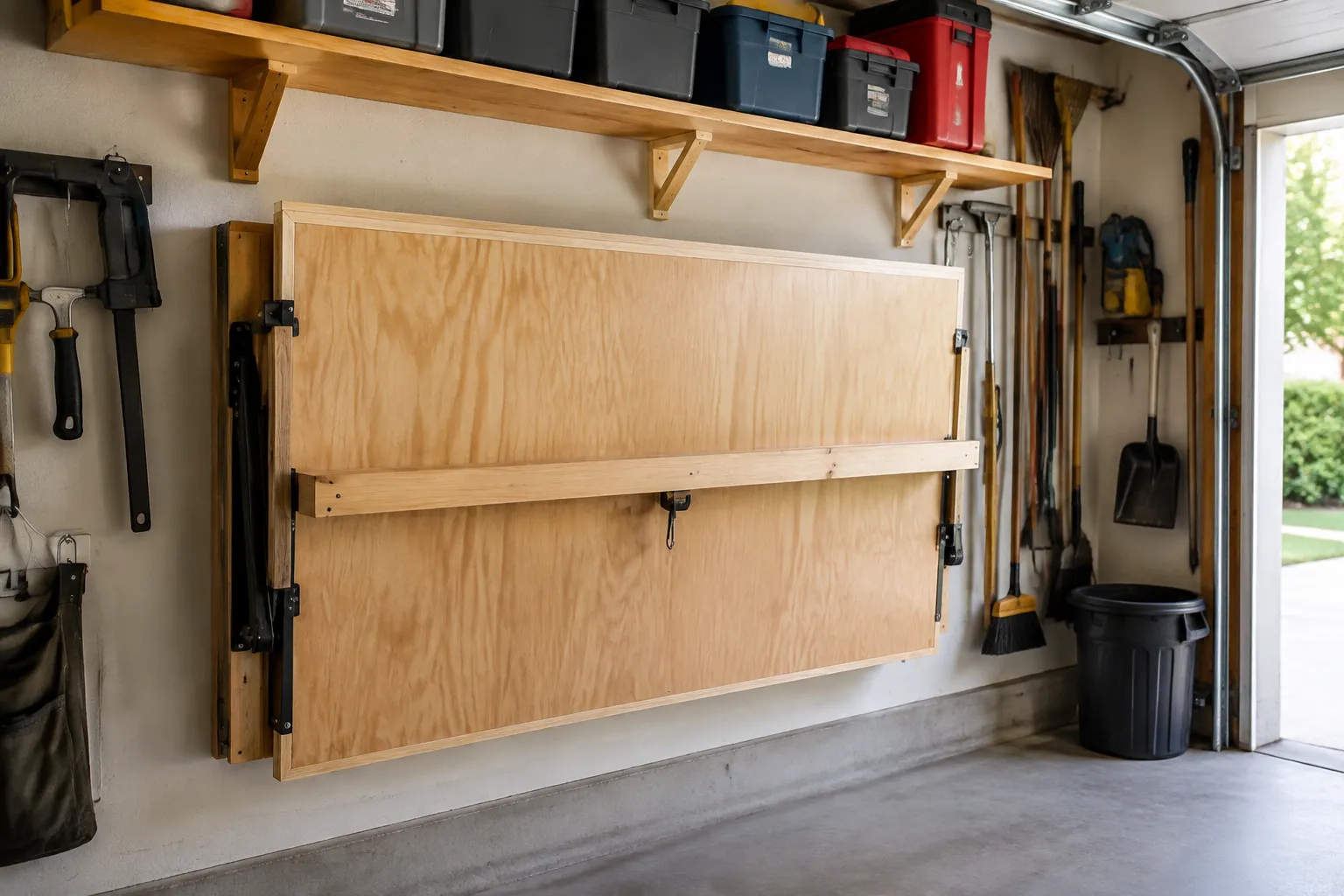
Three hundred dollars and a Saturday morning. That is roughly what it costs to make the single most useful change a small garage can get: a workbench that folds flat against the wall. Not a rolling cart, not a portable table saw stand, not a heavy outfeed table on casters. A hinged slab of plywood, some good hardware, and the willingness to accept that the work surface will never be as rock-solid as a permanent bench. For most home garages, that trade is worth it, because a folding bench solves the problem that actually matters: the floor.
The floor of a small garage is where everything goes to die. Bicycles lean against it. The lawnmower occupies it. Boxes of Christmas decorations sit on it from December to March. A permanent workbench, even a modest one at 24 inches deep and 6 feet long, eats up roughly 12 square feet of that precious real estate forever. A folding bench gives that space back the moment the clamps come off. The challenge is that most folding bench designs are flimsy, ugly, or both. They wobble when a person leans on them, they sag in the middle, and the folding mechanism eventually tears out of the wall. The good news is that none of those problems are hard to solve.
The Wall-Mounted Hinge Table Is the Baseline
The simplest folding work surface is a plywood top attached to the wall with heavy-duty hinges. The front edge rests on two folding legs, or it swings up and locks against the wall when not in use. This design has been around for decades, and it keeps getting recommended because it works. A 3/4-inch sheet of birch plywood, cut to 30 inches deep and 8 feet long, will hold a surprising amount of weight when supported by a 2x4 frame underneath it. The hinges need to be rated for the load, and they need to be mounted through the plywood into solid wall studs, not just into drywall anchors.
The fatal flaw in most homemade versions is the locking mechanism. A simple hook-and-eye latch on the front edge does not hold the bench flat against the wall securely. It rattles, it swings open at the worst moments, and it puts all the stress on a single small point. A better approach uses two barrel bolts, one near each end, or a pair of heavy-duty cabinet latches designed for drop-leaf tables. On the folding legs, the weak point is almost always the hinge joint where the leg meets the bench. A standard butt hinge with short screws will pull out after a few months of use. The fix is to use a longer hinge, at least 4 inches, and to bolt it through the leg into a steel bracket on the underside of the bench.
For a person who wants the most surface area for the least money, this design wins. The materials cost under a hundred dollars if a person already owns a circular saw and a drill. The downside is that the bench, when folded down, still has legs that stick out into the room. Many builders solve this by making the legs fold inward against the underside of the top, which works but adds complexity. A simpler trick is to make the front edge of the bench sit on a pair of folding saw horses that store separately. This turns the wall-mounted top into a shelf when folded up, and the saw horses do the heavy lifting.
The Drop-Leaf Design That Keeps Tools Out on Top
There is a middle ground between a full folding bench and a permanent one. It is the drop-leaf work table, where a narrow fixed section stays mounted to the wall, and one or two hinged leaves fold down from it. This design works brilliantly in a garage that has a shallow wall space, say 16 to 20 inches deep, because the fixed section holds a power strip, a vise, and a few frequently used tools without intruding far into the room. The folding leaf extends the work surface only when needed.
The clever part of this system is that the fixed section becomes a storage shelf when the leaves are up. A person can keep a drill charger, a coffee mug, and a small parts organizer on it permanently. The folding leaf, when lowered, is essentially a bonus surface. The hinge hardware for drop-leaf tables is available in two flavors: the simple butt hinge and the more complex self-locking hinge. The self-locking version, often called a drop-leaf table hinge, has a mechanism that keeps the leaf level with the fixed section and prevents it from sagging. These hinges are worth the extra money. They are commonly used in kitchen counter extensions and small apartment tables, and they handle repeated folding without wearing out.
The biggest mistake with this style is making the leaf too long. A 4-foot leaf is fine. A 6-foot leaf, supported only by hinges at one edge, will develop a noticeable droop at the far end within a year. The plywood itself does not bend, but the hinge screws loosen and the leaf tips forward. The solution is to add a folding support arm near the outer edge of the leaf, or to keep the leaf short enough that the hinge has sufficient leverage. For most small garages, a 4-foot drop leaf, combined with a 3-foot fixed section, gives a 7-foot continuous bench that folds into a 3-foot wall cabinet.
The Folding Leg System That Actually Stays Rigid
Any folding bench is only as good as its legs. The classic pivoting leg, which swings out from the underside of the bench top, works well when it is built with a locking mechanism. The best version uses a pair of legs connected by a crossbar, with a locking latch at the crossbar that hooks into a strike plate on the wall or on the bench frame. This design is common on commercial folding tables, and it is far more rigid than two independent legs.
For a home garage, a simpler and more reliable option is the removable leg. The bench top folds up against the wall, and the legs are stored separately, either hanging on a nearby wall hook or tucked into a corner. When the bench comes down, the legs are inserted into steel mounting brackets that are bolted to the bench frame. These brackets, often called table leg brackets or furniture leg plates, are sold at any hardware store and cost a few dollars each. They accept a standard 2x2 or 2x4 leg. The connection is rock-solid because the entire load is transferred through the bracket into the bench frame, not through a hinge pin.
The removable leg approach has one serious advantage over pivoting legs: it eliminates the single most common failure point. A pivoting leg relies on a hinge bolt that takes the full shear load of the bench. Over time, that bolt loosens, the hinge slops, and the bench wobbles. A removable leg in a bracket has no moving parts. It either fits or it does not. The only downside is that a person has to store the legs somewhere, and they have to carry them to the bench each time. For a small garage, that is a minor hassle compared to the stability gained.
The Pegboard Cover-Up That Doubles as a Tool Wall
A folding bench does not have to look like a utility shelf. With a sheet of pegboard and a little planning, the folded-up bench can become the most functional wall surface in the garage. The trick is to mount the pegboard on the front face of the folding top, so that when the bench is up, the pegboard faces the room. Tools hang on the pegboard, and the whole assembly looks like a well-organized tool wall. When the bench comes down, the pegboard and tools swing away, revealing the bare work surface.
This configuration is surprisingly practical. The pegboard adds very little weight, about 5 pounds for a standard 4x8 sheet, and it does not interfere with the folding mechanism. The tools stay put because the pegboard is oriented vertically when the bench is up, and the hooks hold the tools against the board. The only consideration is that the tools add weight to the top, so the hinges and the locking mechanism need to be rated for the combined load. A bench with a full pegboard of hand tools, maybe 40 to 60 pounds of weight, needs hinges rated at 150 pounds or more per pair.
The visual result is worth the effort. Instead of a bare plywood rectangle on the wall, the garage gets a neat tool display that hides the fact that there is a full workbench folded away. This is the single best approach for a garage that doubles as a home gym or a hobby space, where the aesthetics matter. It also keeps frequently used tools within arm's reach of the bench when it is down. A person does not have to walk to a separate tool cabinet; the hammer and the tape measure are right there on the wall that just became the bench.
The Murphy-Bed-Style Bench for Deep Storage
For garages where floor space is absolutely critical, the wall-mounted folding bench can go one step further: it can fold into a shallow cabinet that holds the tools and supplies a person uses most. This is the Murphy-bed approach, where the bench top is hinged at the bottom and swings down into the room, while the space behind it, the wall cavity, becomes a storage niche. When the bench is up, it closes against the front of the niche, hiding the contents and acting as a flush door.
Building this version requires a recessed wall or a framed-out shallow cabinet attached to the wall. The cabinet can be as shallow as 12 inches, which is enough for shelving, small parts bins, and a power strip. The bench top, when folded down, rests on folding legs or a swing-arm support. The beauty of this system is that the bench itself is the cabinet door. A person does not lose any wall space to a separate cabinet; the bench becomes the cabinet face.
The engineering challenge is in the hinge. A standard cabinet hinge is too light. The bench top needs heavy-duty continuous hinges, often called piano hinges, running the full width of the bench. A 6-foot piano hinge, properly screwed into both the cabinet frame and the bench top, distributes the load evenly and prevents sagging. The bench top also needs a strong latch at the top edge to keep it closed against the cabinet, since it will be holding the weight of whatever is on the cabinet shelves.
This design is not for a beginner woodworker. It requires accurate framing, careful hinge alignment, and a way to ensure the bench top closes flush against the cabinet. But for a person who wants maximum storage density in a tiny garage, it is the best option. The finished result looks like a built-in wall cabinet, and the workbench appears out of thin air when needed.
The Wall-Mounted Shelf That Becomes a Bench
There is an even simpler variation that many garage owners overlook: a fixed shelf mounted at workbench height, with a folding panel attached to its front edge. The shelf, perhaps 12 to 16 inches deep, holds tools and supplies permanently. The folding panel, when lowered, extends the shelf into a full-depth bench. When raised, it acts as a backsplash and keeps the shelf contents from rolling off.
This design is a hybrid of the drop-leaf and the Murphy-bed styles, but it is easier to build because the shelf takes most of the load. The shelf is anchored directly to the wall studs, so it can hold a lot of weight. The folding panel only needs to support the work piece, not the tools. A person can make the panel from a lighter material, such as 1/2-inch plywood or even a hollow-core door cut to size. The hinges are the same heavy-duty drop-leaf hinges used in the earlier design.
The clever detail is the storage that the shelf provides. A power strip mounts under the shelf, out of the way. A small parts cabinet sits on top of the shelf, above the work surface. The folding panel, when up, hides the clutter. When down, it creates a clean, uncluttered work area. This is the design that most closely resembles the "folding work table" that furniture stores sell for apartments, but it is far more robust because it is built into the wall.
Hardware That Will Not Let a Person Down
No matter which design a person chooses, the hardware determines whether the bench will still be folding smoothly in five years or whether it will be a wobbly mess. The hinges matter most. Standard door hinges, even heavy-duty ones rated at 100 pounds, are designed for vertical loads, not for the twisting forces a workbench exerts. The correct choice is a continuous hinge, also called a piano hinge, or a pair of heavy-duty strap hinges. Continuous hinges distribute the load across the entire edge, which prevents the screws from pulling out of the plywood. Strap hinges, with their long mounting plates, do the same thing at two points.
The locking mechanism is the second most important component. A bench that folds up against the wall needs a positive latch that holds it firmly. A simple hook-and-eye latch works, but it rattles. A better choice is a draw latch, the kind used on tool chests and truck caps. A draw latch pulls the bench tight against the wall and stays silent. For benches with folding legs, the latch on the legs is equally important. A spring-loaded locking pin, or a simple bolt latch, keeps the legs from folding inward while a person is working.
All screws should be exterior-grade or coated with a rust-resistant finish. A garage is not climate-controlled, and the humidity fluctuations will corrode plain steel hardware within a season. Stainless steel is the safest choice for hinges and latches, even though it costs a bit more. The few extra dollars buy years of smooth operation and no rust streaks on the wood.
The Real Cost of a Folding Bench
Most of the designs in this article can be built for under $150 in materials. That figure assumes a person already owns basic tools, a drill and a saw at minimum, and that they use standard plywood rather than exotic hardwood. The cost of the hardware, hinges, latches, and brackets, usually runs between $40 and $70. The plywood for the top, a 4x8 sheet of 3/4-inch birch or sanded pine, costs about $60 at a big-box store. A 2x4 frame adds another $20.
The price of a pre-made folding workbench, the kind sold at hardware stores and online, starts around $200 and goes up to $600 for a model with a built-in vise and a pegboard. These commercial units are fine, and they save a person a weekend of work. But they are almost always narrower, typically 24 inches deep versus 30 inches for a custom build, and they use thinner materials. A person who builds their own bench gets a deeper surface, a sturdier frame, and the satisfaction of having it fit their exact wall space.
The value of a folding bench is not in the materials. It is in the floor space it returns to the garage. A 6-foot bench that folds flat against the wall frees up enough room to park a small car or to set up a second work area. For a garage that has to hold a car, a workbench, and a shelving unit, that reclaimed space is worth more than the price of the bench itself. The hinge that lets a person fold the bench up after a project is the hinge that lets them park inside when it rains.