
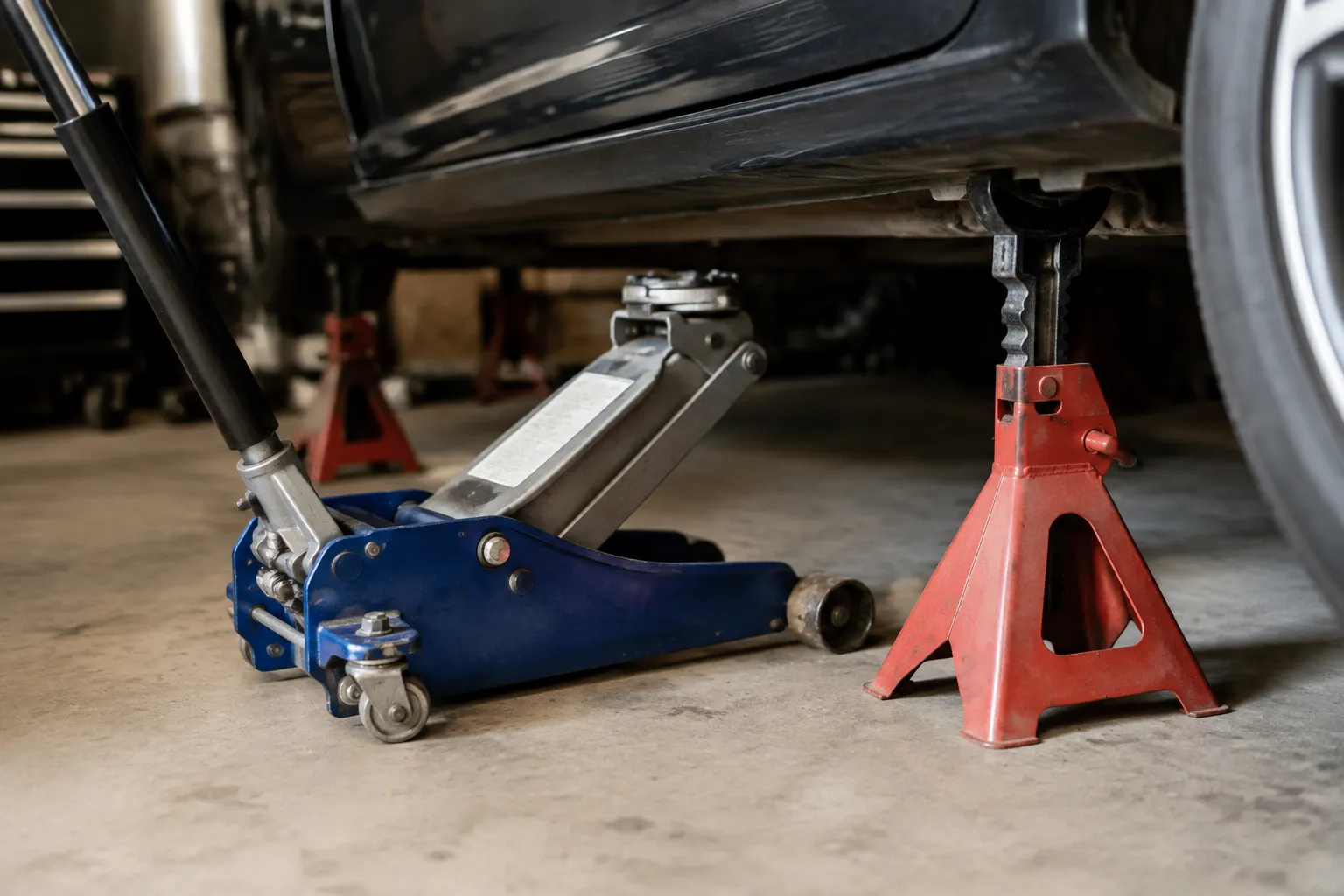
The jacking point on a modern car is a small, stamped piece of metal tucked behind a plastic cover, and it was never designed to hold the vehicle's weight for more than a few minutes. The floor jack itself has a saddle that moves in a wide arc as the hydraulic cylinder extends, and that saddle drifts. Anyone who has watched a car come off a jack stand at the wrong angle knows the sound: a low metallic groan, then a sharp crack, then a thud that shakes the concrete. The rules for using these tools exist because a car is a two-ton object that wants to return to the ground, and the ground always wins.
The most common failure is not the jack failing. It is the person using it failing to understand where the stand is actually contacting the car. A stand placed under a pinch weld that looks correct from kneeling height can be sitting on the edge of the weld, or on a seam that was never meant to carry load. The stand tips, the car shifts, and the whole assembly comes down on the floor pan. This is why the first rule is visual: get low enough to see the stand's saddle meet the metal, then push the car sideways at the roofline before getting underneath. If the car moves on the stand, the stand was not on the load path.
A floor jack has its own set of rules that people skip because the tool feels sturdy. The jack's front wheels pivot, and the rear wheels do not, which means the jack only tracks straight when the handle is pointed correctly. Dragging a loaded jack sideways puts stress on the hydraulic cylinder's mounting pins, and those pins are not indestructible. The other overlooked detail is the oil level inside the jack. A jack that has been used for years without a top-up will slowly lose lifting height, and a person chasing a few more inches of lift will often over-extend the ram. The ram should never be extended to its absolute maximum stroke while under load. The last half-inch of travel is where the internal seals are most vulnerable, and a failed seal at that point drops the car without warning.
Surface conditions matter more than most people admit. A floor jack on a smooth, clean epoxy floor is a different tool than a floor jack on cracked, oily concrete. Even a small piece of gravel under a rear caster will cause the jack to shift as the load comes on, and that shift is enough to misalign the saddle from the jacking point. The car then slides off the saddle, and the first sign of trouble is a scraping sound as the pinch weld drags across the saddle's edge. The rule is simple: sweep the floor before every use, and put a piece of plywood under the jack if the concrete is pitted or oil-stained.
What the Jack Stand Ratings Actually Mean
The number stamped on a jack stand is the capacity per pair, not per stand. This is the single most misunderstood rating in the entire tool world. A set of stands rated at 3 tons means each stand is rated for 1.5 tons, and the pair is rated for 3 tons in total. Many people read "3-ton" and assume each stand can hold a 3-ton car. It cannot.
The rating also assumes the load is centered on the saddle. A car's corner weight is rarely distributed evenly across the saddle's surface, especially on cars with soft engine mounts or worn suspension bushings. The load shifts as the suspension settles, and a stand that was bearing weight across its full saddle can end up bearing it on one edge. The stamped rating does not account for off-center loading. It is a best-case number, not a worst-case one.
Buying a set of 6-ton stands for a sedan is not overkill. The safety margin is the point. A 3-ton pair rated for a 3-ton car leaves almost no room for error if the load shifts, if the stand is on a slight angle, or if the floor gives a fraction of an inch. A 6-ton pair gives the same geometry a generous margin, and the cost difference is small. The heavier stands are also built with thicker posts and wider bases, which reduces the chance of tipping.
The Pinch Weld Problem and the Right Adapter
Modern cars have pinch welds that are thin, sometimes less than a quarter-inch wide, and the factory jacking point is often a reinforced section of that weld. The floor jack's saddle is typically two or three inches wide, so it contacts the weld at multiple points, some of which are not reinforced. This is why so many cars have bent or crushed pinch welds after a few years of DIY service. The saddle crushes the unreinforced section, and the damage is permanent.
The fix is a rubber or polyurethane jack pad adapter that fits into the saddle and wraps around the pinch weld. These adapters cost a few dollars and take ten seconds to install. They spread the load across a wider area and prevent the saddle's hard steel edge from cutting into the weld. The same adapter works for jack stands, though the stand's saddle is usually flat, so a different style of adapter is needed. A flat rubber pad with a slot cut into it is the standard solution.
Some cars, particularly older trucks and body-on-frame SUVs, have proper frame rails instead of pinch welds. These are easier to lift, but they introduce a different problem: the frame rail is often coated in rust, and a jack stand placed on rusted metal will crush through it. The rust looks solid from the outside but has the structural integrity of a biscuit underneath. Before placing a stand on a frame rail, poke the metal with a screwdriver. If the screwdriver penetrates, the frame needs repair, not a jack stand.
Chocking, Parking Brakes, and the Hand That Should Never Be There
A car on jack stands is not a car at rest. It is a car being held up by metal posts that are narrower than the suspension components they are replacing. If the car rolls even a few inches, the stands can tip. The parking brake holds the rear wheels, but if the front wheels are off the ground, the parking brake does nothing to stop the car from rolling forward. Wheel chocks on the rear wheels are the only thing preventing a roll, and they need to be placed on both sides of both rear wheels.
There is also the matter of the transmission. A car in park with the engine off has no load on the parking pawl, but the pawl is a small piece of metal that can shear under a heavy roll. Chocks are cheap. Replacing a transmission is not.
The other rule involves the hand that lowers the jack. When the car is on stands and the jack is being lowered, the natural instinct is to keep one hand on the jack handle and the other on the car to feel for movement. That hand on the car is a terrible idea. If the car shifts off the stands, the hand is in the way of a two-ton object moving downward. The hand should be on the jack handle only, and the eyes should be on the car's contact point with the stands. The body should be positioned to the side, never under the car, until the jack is fully lowered and the car is fully settled on the stands.
The Settling Test Before Any Work Begins
Once the car is on the stands and the jack is lowered, a person needs to shake the car before crawling underneath. This is not a formality. It is the single most effective check for a poorly placed stand. Grabbing the car at the bumper or the rocker panel and pushing hard, side to side and front to back, will reveal any instability. A car that rocks slightly and then settles is fine. A car that shifts, clicks, or drops even a quarter of an inch is not fine, and the stands need to be repositioned before anything else happens.
The settling test also catches the problem of a stand placed on a suspension component that moves. On some cars, the lower control arm looks like a solid place to put a stand, but it is attached to the hub, which is attached to the wheel, which is off the ground. The control arm can rotate slightly as the suspension dangles, and a stand placed on it can pop out of position when the suspension settles. The shake test will usually catch this, but only if it is done with real force.
There is a reason professional shops use drive-on lifts and not jack stands. The lift contacts the car at four or more points simultaneously, and the car's weight is distributed evenly. A pair of jack stands creates a three-point or two-point contact patch that is inherently less stable. The shake test is a poor substitute for a lift, but it is the best available check for a home garage.
The Floor Jack Is Not a Stand, Ever
A hydraulic floor jack holds the car on a column of fluid, and fluid leaks. The seals degrade with heat, with age, and with contamination from the oil that was topped up with the wrong viscosity. A jack can hold a car steady for an hour and then slowly lower it over the next hour as the internal pressure bleeds past a worn seal. This is why the floor jack is never a substitute for a jack stand. It is a lifting device, not a holding device. The distinction is not semantic. It is the difference between a car that stays up and a car that comes down slowly enough to crush a person without them hearing it.
Even a brand-new jack from a reputable brand can have a slow leak. The seals are not precision components; they are rubber rings under pressure. A person who has owned a jack for ten years and never replaced the seals is relying on rubber that has been cycled through thousands of heat cycles and exposed to the oils and solvents of a garage floor. The honest way to think about it is that the jack is a temporary tool. Its job is to lift the car. Its job ends the moment the car is on the stands.
Concrete That Cracks and Stands That Sink
A jack stand's base is stamped steel, and it is designed to spread the load across its footprint. That assumption breaks down on cracked concrete. A stand placed so that one corner of its base is over a crack will, under load, cause the concrete to flex and crumble. The stand tips, and the car comes down at an angle. The floor does not need to look like a construction site for this to happen. A hairline crack in a garage slab is enough to compromise the base of a loaded stand.
The fix is a load-spreading plate. A 12-inch square of 3/4-inch plywood, or a steel plate from a hardware store, placed under the stand's base will distribute the load across a wider area and bridge small cracks. It is a cheap, ugly solution that costs less than a single trip to a coffee shop. It is also the difference between a stand that holds and a stand that sinks. The same plate should be used under the floor jack's rear wheels, which are small and concentrate load on a tiny footprint.
Outdoor concrete is worse. A driveway slab that has been through freeze-thaw cycles has micro-cracks that are invisible from above but weak under load. The stand sinks a quarter-inch over the course of an hour, and the car settles with it. A person under the car might not notice the shift, but the suspension components are now under a different load, and the whole setup is less stable than it was. The rule is to never use jack stands on outdoor concrete without a spreader plate, and to re-do the shake test after the first ten minutes of any job.
The Last Rule Is About the Next Person
Every garage has a set of jack stands that has been borrowed, loaned, dropped, and abused for decades. The stands have paint chips in odd places, a slight bend in one of the posts, or a missing locking pin. They look fine. They get used because they are there. The person who owns them knows they are marginal but does not want to spend money on new ones. That person is making a decision for the next person who uses them, because a stand that fails does not care who is under the car.
The honest rule is to buy new stands when there is any doubt, and to write the date of purchase on the base with a permanent marker. A stand that has been in service for fifteen years has been through thousands of heating and cooling cycles, and the welds on the base are not guaranteed forever. The cost of a new set of stands is less than the cost of a single emergency room visit, and the peace of mind is worth the price of the ticket.
When the car is up, the stands are set, the wheels are chocked, and the shake test is done, a person can lie under the car and work in peace. That peace is earned by following rules that seem tedious but exist to prevent a specific, violent outcome. The car will stay up. The job will get done. And the next time a person crawls under a car, they will do it again, because the rules are not suggestions. They are the difference between a day in the garage and a day in the hospital.