
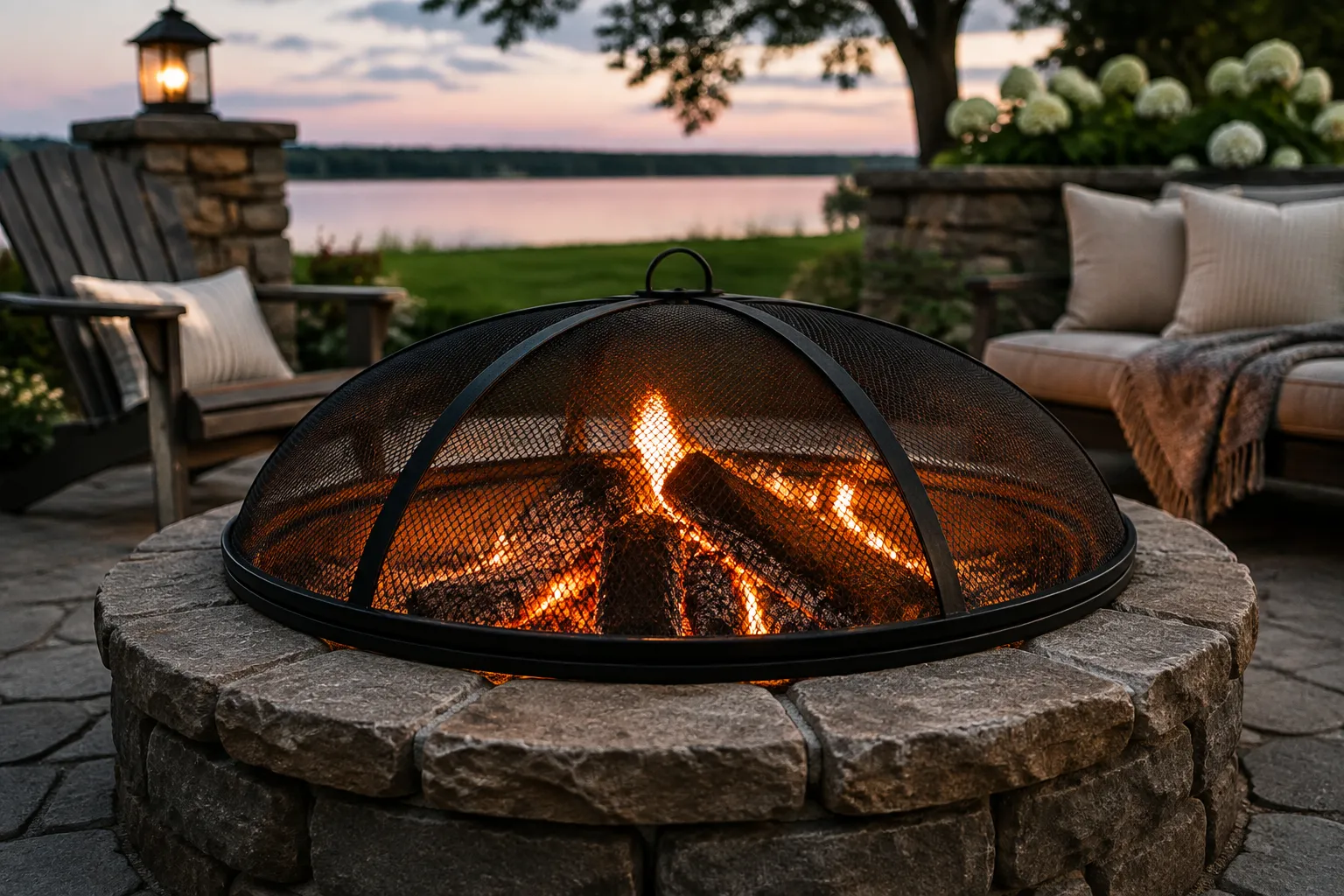
The first time a fire pit spark screen pays for itself, it does so quietly, usually with a soft hiss and a thin wisp of smoke rising from a wool blanket. A single ember, carried up on a column of heated air, lands, smolders for a moment, and then blooms into a hole the size of a quarter. No one notices until the next morning, when the cold air finds the singed threads. That is the gentle version. The less gentle version involves a deck board, a dry patch of ornamental grass, or a pair of synthetic joggers that melt against the skin. Spark screens exist because fire is not tidy. It throws off debris, and that debris travels further than most people assume.
There is a tendency to treat the spark screen as an accessory, something bought at the same time as the fire pit because the store shelves them next to each other. It gets bolted on, used for a season, and then slowly corrodes into a rust-colored relic that no one wants to touch. The better framing is simpler: the screen is a piece of safety equipment with a specific set of engineering constraints, and most of the rules around it exist because someone ignored those constraints and paid for it with a scorched patio or a near-miss on a roof line.
The Mesh Size Question Is a Physics Question
Mesh density determines what gets through. A screen with openings that are too large stops the big sparks but lets the small ones fly, and small sparks are exactly the ones that land unnoticed in dry grass or on a wooden railing. A screen with mesh that is too fine chokes off the airflow, the fire starves, and the whole gathering turns into a smoky, underperforming mess. The sweet spot, for most residential setups, is a mesh opening somewhere between one-eighth and one-quarter of an inch. That range blocks the embers that carry enough heat to ignite something while still allowing the draft the fire needs to burn cleanly.
Stainless steel mesh holds up better than the painted steel mesh found on cheaper screens. The painted kind looks fine in the store and then flakes within two seasons, leaving bare metal that rusts through. People who buy based on price alone often replace their screen twice in the time a good stainless one lasts. The material matters because the screen sits directly in the path of radiant heat and occasional flame contact. It is not a decorative element. It is a heat shield with holes in it.
Diameter and Dome Height Affect Coverage
A spark screen that does not cover the full width of the fire pit opening is a screen for a smaller fire pit. The rule here is blunt: the screen must overlap the fire bowl's rim on all sides, with no gaps. A screen that sits inside the rim leaves a crescent-shaped opening on one side, and that is where the wind pushes the sparks. The fit should be intentional, not approximate.
Dome height matters almost as much as diameter. A low, flat screen sits too close to the flames. Wood that crackles and pops throws embers upward with enough force that they hit the mesh and bounce sideways, escaping through the gap between the screen and the rim. A taller dome gives the embers room to lose their upward momentum before they reach the mesh. When an ember hits a dome-shaped screen at an angle, it tends to fall back into the pit. When it hits a flat screen directly below, it ricochets outward. The geometry is simple, but it is the difference between a screen that contains sparks and one that merely redirects them.
The Gap Between Screen and Rim Is Where Trouble Starts
Even a perfectly sized screen leaves a gap if the rim of the fire pit is not level or if the screen's legs sit unevenly on the edge. A person who has spent an evening watching a fire knows the pattern: the screen sits flat for an hour, then someone bumps the table next to the pit, the screen shifts a half-inch, and suddenly there is a wedge of open air on the windward side. The fix is not complicated. Some screens have tabs or clips that secure them to the rim. Others rely on their own weight. The weight-based approach works until it does not, and the first time it fails is usually the only warning.
For fire pits with a raised lip, a screen with a slight skirt or flange that hooks over the edge is worth seeking out. It prevents the sideways sliding that happens when someone leans over the fire to poke the logs. And poking the logs is inevitable. Every gathering has at least one person who cannot leave the fire alone, who must rearrange the wood every twenty minutes. That person will bump the screen. The screen should be built to take it.
Clearing Ash Buildup Keeps the Screen Honest
A spark screen accumulates a fine layer of ash and soot within a single burn. After three or four fires, that layer becomes thick enough to restrict airflow noticeably. The fire gets lazier, the smoke gets heavier, and the screen starts to glow in patches because the heat has nowhere to go. A glowing section of mesh is a warning sign. It means the metal is being stressed beyond its intended range, and over time, that stress causes the mesh to weaken and eventually tear.
Brushing the screen with a stiff wire brush before each use, while it is still cool, takes about ninety seconds. It is the kind of maintenance that people skip because the results are invisible until the moment they are not. A screen that is kept clean runs cooler, lets the fire breathe, and lasts several seasons longer than one that is ignored. The trade-off is trivial. The alternative is buying a new screen in the middle of summer and standing in the aisle of a hardware store trying to remember the diameter of the fire pit at home.
Wind Rules Change the Whole Calculation
Wind is the variable that turns a manageable fire into a hazard. A spark screen rated for a calm evening is a different object in a gust of twenty miles per hour. The wind does two things: it bends the flames sideways, pushing them against the mesh, and it carries embers horizontally out of the pit before they even reach the screen's height. The second effect is the one people miss. They assume the screen catches everything, and then a spark sails out of the side of the fire pit at ankle height and lands in a flower bed.
The practical rule is to position the fire pit so the prevailing wind hits the screen's seam or handle side, not the open view side. Some screens have a small handle on one edge for lifting when the fire needs tending. That handle side is also the side where the screen does not sit perfectly flush. Facing that side into the wind turns a small flaw into a non-issue. It takes ten seconds to rotate the screen, and it prevents the most common type of wind-driven spark escape.
Wood Selection Does More Than the Screen Does
No screen compensates for bad firewood. Green wood, wood with bark still attached, and wood that has been sitting in a damp pile all share one trait: they produce explosive popping. Moisture trapped inside the wood turns to steam, builds pressure, and then vents suddenly, sending a shower of sparks and small chunks of burning material upward. A spark screen catches some of that, but a violent pop can throw embers over a tall dome or through a gap at the rim.
Seasoned, split hardwood with the bark removed pops far less. It burns with a steady flame and produces embers that rise gently rather than exploding outward. The difference is noticeable within the first ten minutes of a fire. A person who burns properly seasoned wood and uses a decent screen will rarely see a spark escape. A person who burns whatever is left over from last winter's storms will test the screen's limits every single time. The screen is a backup, not a primary defense. The primary defense is fuel choice.
Screens That Double as Cooking Grates Are a Compromise
Some fire pit models sell a combined screen-and-grate attachment that promises both spark protection and a surface for grilling. The design usually involves a flat or slightly domed section of mesh that can support a pan or a small grate. In practice, these hybrids rarely do either job well. The mesh is too fine for direct grilling, so food drippings burn and smoke onto the metal. And the grate attachment blocks too much of the opening, starving the fire of oxygen and producing a smoky, low-heat burn.
For people who actually cook over their fire pit, the better setup is a separate cooking grate that lifts off completely when the fire is just for sitting around. The spark screen goes on when the cooking is done and the fire is being left to burn down. Trying to do both at once means doing neither safely. The screen is not a grill. The grill is not a screen. They are separate tools for separate moments of the evening.
When to Replace a Screen Instead of Patching It
Rust is not cosmetic. A screen with rust spots has lost its structural integrity in those spots, and the mesh will eventually break there under heat stress. A single broken wire in a mesh screen is a gap that grows. The wire next to the break takes on more load, and within a few fires, the gap has doubled or tripled in size. People often try to patch these with a piece of wire or a hose clamp, but the patch creates a hard point that transfers stress to the surrounding mesh.
The honest rule is to replace a spark screen when it shows any significant rust-through, when the mesh has a tear larger than a quarter-inch, or when the frame has bent out of round. A bent frame means the screen no longer sits flush on the rim, and no amount of adjustment will make it seal properly again. These screens are not expensive relative to the alternative. A replacement runs anywhere from thirty to a hundred dollars depending on size and material. The cost of a deck fire or a roof fire is measured in thousands, and that is before anyone considers the part where the house burns.
The Screen Only Works When It Is On
There is a specific moment, usually around ten at night, when the fire has burned down to coals and the gathering is winding up. Someone declares the fire is basically out and reaches for the screen to set it aside, or off to the grass, "so the pit can cool faster." That person is wrong in a way that matters. A bed of coals can stay hot enough to ignite dry material for hours after the flames are gone. The coals are not visible. They are covered in ash, but they are still at several hundred degrees, and a gust of wind can expose a glowing pocket that catches a nearby leaf or a piece of pine needle debris.
The screen goes back on when the fire is done, and it stays on until the pit is cold enough to touch. That means the next morning. A fire pit left with its screen off overnight is a fire pit that has been left with its guard down. The rule is not complicated. It just requires the last person to leave the circle to do one more small task before walking inside. The people who skip that task are the ones who wake up to the smell of smoke and a blackened spot on the lawn where a coal rolled out of the pit and sat against a tuft of dry grass. The screen cannot enforce this rule. It is a piece of metal. But the person who uses it correctly, every time, never has to learn the lesson the hard way.