
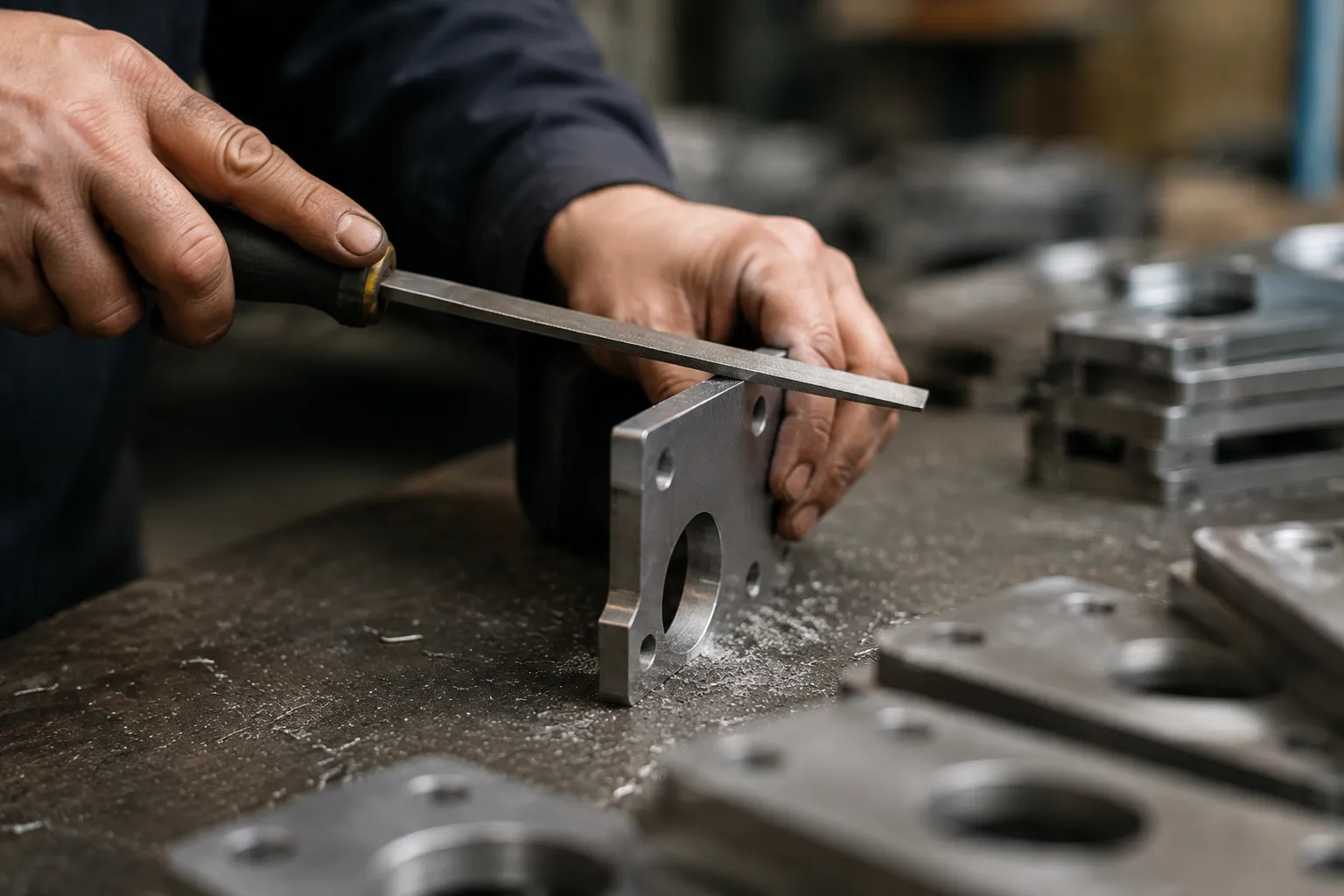
The sound of a file dragging across burred steel is the sound of patience applied to metal. For anyone who works in a machine shop or fabrication shop, deburring is the least glamorous task on the floor, the one that gets handed to the newest apprentice along with a coffee run. But the habits that separate a clean deburring job from a hack job are the same habits that separate a machinist from someone who merely operates a machine. These habits are learnable, and they matter more than the brand of file in the drawer.
Deburring with a file is older than any electric tool, and it remains the baseline for a reason. A file gives a person tactile feedback that a rotary burr or a sanding disc simply cannot match. The hand can feel a burr collapse, can sense the transition from rough edge to smooth break, can detect a high spot that the eye missed. That feedback loop, hand to metal to eye, is the entire foundation of good filing habits. Everything else is technique built on top of that sensory connection.
Reading the Burr Before Touching It
The first habit is looking at the edge before filing it. Most people grab a file and start stroking immediately, working against burrs they have not actually examined. A burr can be a thin feather, a rolled edge, a jagged tear, or a hardened lump of welded material. Each responds differently to a file.
A feather burr, common on sheared sheet metal, collapses easily and only needs a few light passes. A rolled edge, often found on drilled holes, has a lip that folds over and can hide a sharp notch underneath. A wire edge from a lathe can be tough and springy, deflecting under the file instead of cutting cleanly. Taking ten seconds to inspect the edge, running a fingertip along it to feel the direction and hardness of the burr, changes the approach entirely. The fingertip is the best inspection tool in the shop, and it costs nothing.
The direction of the burr matters too. A burr has a root where it attaches to the parent metal and a free edge where it waves in the air. Filing toward the root, pushing the file into the base of the burr, cuts it off quickly. Filing away from the root, along the direction of the burr, just bends it over and makes the problem worse. Looking at the edge under a bright light reveals this direction clearly, since the burr catches light differently than the main surface. A person who reads the burr first never wastes strokes fighting the wrong way.
File Selection as a Decision, Not a Default
The drawer full of rusty files is a familiar sight in any shop, and it is a confession of bad habits. A file is a cutting tool with hundreds of tiny teeth, and like any cutting tool, it needs to be sharp, clean, and appropriate for the material. Grabbing whatever file happens to be on top is not a habit, it is a lack of one.
Cut type matters first. A single-cut file has teeth in one direction and produces a smoother finish, while a double-cut file has crossed teeth and removes material faster with a rougher result. For deburring, a single-cut file is usually the right choice because the goal is to break the edge, not hog off material. A double-cut file on a delicate burr can gouge the parent metal and create a new, worse edge.
File shape follows the workpiece geometry. A flat file handles straight edges and outside corners. A half-round file reaches inside curves and concave surfaces. A round file, often called a rat-tail, cleans holes and internal radii. A triangular file reaches into corners where nothing else fits. Each shape exists for a reason, and using the wrong one is like using a screwdriver as a chisel. It works until it does not, and the work suffers.
Coarseness, or cut grade, should match the burr size. A heavy burr from a bandsaw needs a bastard or coarse file to knock it down. A fine burr from a milling pass only needs a smooth or second-cut file. Filing a fine edge with a coarse file removes too much material and leaves grooves that require additional finishing. Filing a heavy burr with a fine file wears out the file and takes forever. The matching of file grade to burr size is a judgment call that improves with practice, but it starts with paying attention.
The Two-Handed Grip and the Push Stroke
A file cuts on the push stroke, not the pull. This is the first thing anyone learns, and it is also the first thing people forget when they are tired or in a hurry. Dragging a file backward across the work with pressure does nothing but dull the teeth and round over the edge. The pull stroke should be a light return, just lifting the file clear of the surface.
The grip has to distribute pressure evenly. One hand holds the handle, the other hand presses down on the tip of the file, and both hands work together to keep the file flat against the surface. A file tipped to one side cuts a bevel instead of a break, changing the geometry of the edge. For a long workpiece, the file should be angled slightly across the edge so the stroke covers more length and the pressure spreads across more teeth.
Body position matters more than people expect. The person should stand so the work is at elbow height, with the file stroke moving across the body rather than straight ahead. This allows the shoulders and back to do the work instead of just the arms, which reduces fatigue and keeps the stroke steady. A wobbly stroke from a tired arm produces a wavy edge, and a wavy edge is a new defect created by the repair process.
The stroke length should use nearly the full length of the file. Short strokes in the middle of the file wear the center teeth faster than the ends, creating a file that cuts unevenly. A file is a consumable tool, but a properly used one lasts many times longer than one that gets abused with short, concentrated strokes.
Chips and Pinning: The Two File Killers
Every file has teeth, and every tooth is a tiny hook that can catch a chip of metal. When chips pack into the teeth, the file stops cutting and starts skating across the surface. This condition is called pinning, and it is the most common reason people throw files away. The habit that prevents pinning is simple: use a file card, a stiff brush with short wire bristles, after every few strokes. Run the card along the teeth in the direction of the cut, and the chips fall out.
A file card costs a few dollars and takes ten seconds to use. Shops that keep a card next to every vise get more life out of their files than shops where the card is buried in a drawer somewhere. The habit of brushing a file after every pass, or at least every few passes, keeps the teeth exposed and cutting at full efficiency.
Chalk is an older trick that still works. Rubbing chalk into the teeth before starting reduces pinning, especially on soft metals like aluminum or brass that tend to smear into the file. The chalk fills the gullets slightly, giving the chips less surface to stick to. It is not a substitute for brushing, but it helps in the same way that a little oil helps a saw blade.
Soft metals are the worst offenders for pinning. Aluminum, copper, and plastics load up a file almost immediately. One habit that helps is to use a separate file for soft metals and never mix it with steel files. A file that cuts aluminum will carry aluminum into the next steel job, and the aluminum will embed in the steel surface as a smeared contaminant. Separate files for separate materials is not fussiness, it is basic hygiene.
Breaking the Edge Without Changing the Geometry
The goal of deburring is to remove the burr and leave a consistent, slightly rounded edge. The goal is not to remove material until the part shrinks or the edge becomes a chamfer. Many beginners over-file, turning a simple edge break into a visible bevel that changes the part's fit or appearance. The habit that prevents this is counting strokes and checking constantly.
One or two light passes per edge is often enough for a small burr. Three or four passes for a heavier one. Filing, then checking with a fingertip, then filing again is the rhythm. The fingertip can feel a burr that the eye cannot see, and it can feel when the edge is smooth and consistent. Checking after every two or three strokes prevents the over-filing that ruins parts.
The angle of the file matters too. Holding the file flat against the surface removes material from the face, not the edge. Holding it at forty-five degrees creates a chamfer. The correct angle for deburring is a slight tilt, just enough to engage the edge without cutting into the face. This is a feel thing, and it comes with practice. The habit of starting with a shallow angle and adjusting based on the feedback from the edge is what separates a controlled deburr from a hack job.
The Stroke Pattern That Avoids Rocking
A file can act like a see-saw if the pressure is unbalanced. When the push starts, the handle end tends to dip. When the push ends, the tip end tends to dip. This rocking motion rounds over the edge of the workpiece, removing more material at the beginning and end of each stroke than in the middle. The result is an edge that is not straight, and on a long part, the middle of the edge remains burred while the ends wear down.
The fix is a rocking compensation in the hands, not in the file. The hand on the handle starts the stroke with the handle slightly raised, then levels out through the middle, then lets the tip dip slightly at the end. This keeps the file flat against the work surface throughout the entire stroke. It is a subtle motion, almost imperceptible, but it is the difference between a straight edge and a banana-shaped one.
For long edges, the stroke should be broken into overlapping segments. Start at one end, file a section, then move along and overlap the previous section by a third of the file length. This creates a continuous, even break instead of a series of distinct sections. Overlapping strokes are the habit that makes a long edge look like one continuous cut rather than a patchwork of passes.
Holes and Internal Edges Need Their Own Approach
Drilled holes leave burrs on both sides, and the burr on the exit side is usually worse than the entry side. The entry side burr is pushed inward by the drill; the exit side burr is peeled outward and can be quite large. A round file is the right tool, and the habit is to work from both sides rather than trying to reach through from one side only.
For small holes, a round file with a slightly smaller diameter than the hole works best. The file goes in at an angle, engages the edge, and takes short strokes while rotating the file slightly between strokes. This distributes the cutting around the entire circumference. Rotating the file is the habit that prevents flat spots. A flat spot on a hole edge can cause a fastener to catch or a seal to leak.
Internal corners, like those in a milled pocket or a keyway, need a triangular file or a knife file. These corners accumulate burrs that are hard to see and harder to reach. The habit is to use the file edge that matches the corner angle and to stroke away from the corner, not into it. Stroking into the corner packs the burr deeper into the intersection and makes it worse.
For blind holes that cannot be reached with a file, a small scraper or a deburring tool is the practical alternative. The habit of reaching for the right tool instead of forcing a file into a space it does not fit is a sign of maturity in a machinist. Forcing tools damages both the tool and the part.
Cleaning and Storing Files Like Precision Tools
A file is a precision tool, even though it looks like a simple bar of steel. It has thousands of carefully cut teeth, and once those teeth are dull or chipped, the file is worthless. The habit of treating a file with respect is what keeps it useful for years instead of months.
Storage is the most common failure point. Files thrown loose into a drawer bang against each other, and the teeth chip. A single chip can ruin a file's cutting action, because the chipped tooth catches and gouges the work surface. Files should hang on a rack, held in individual slots, or at least be separated by a divider so they never touch each other.
Rust is the second killer. A file with rusted teeth cuts poorly and leaves rust stains on the work. Keeping files in a dry area, wiping them with a light oil after use, and brushing them clean before putting them away are the habits that prevent rust. A file that goes into the drawer dirty and wet will be a rusted file when it comes out next week.
One habit that saves money is keeping a designated beater file for rough work. This is an old file, maybe with a few chips, used for knocking down heavy welds or cleaning up stock that would dull a good file. The good files stay sharp for finishing work, and the beater takes the abuse. Shops that do this buy fewer files overall, because the good files never get destroyed on tasks they were never meant for.
The Finish Pass That Everyone Skips
After the burr is gone, the edge needs a final pass with a smooth file or a fine stone. This finish pass removes the tiny serrations left by the coarser file and leaves an edge that is not just burr-free but actually smooth to the touch. Most people skip this pass because the edge looks clean and feels acceptable. The difference is in how the part handles and how it wears.
A rough finish pass leaves micro-teeth on the edge, and those micro-teeth catch on everything. They snag on gloves, scratch adjacent surfaces, and collect debris. A smooth finish pass eliminates them. Running a smooth file or a fine hone along the edge for two or three light strokes takes thirty seconds and changes the part from functional to professional.
The finish pass is also the time to check for uniformity. Running a fingertip along the entire edge, feeling for any high or low spots, is the final quality check. A part that passes the fingertip test along every edge is ready to go. A part that fails it goes back for a couple more strokes. This check is the habit that catches defects before the part ships, and it is the habit that separates a meticulous shop from a sloppy one.
The last habit is the simplest one: put the file down when the edge is done. Over-working an edge is a real problem, and it happens when a person keeps filing for the sake of filing. The edge is smooth, the burr is gone, the geometry is intact. Stop. Pick up the next part and do it again. The discipline to stop at the right moment is what makes a file last longer, a part come out right, and a day in the shop end without rework.