
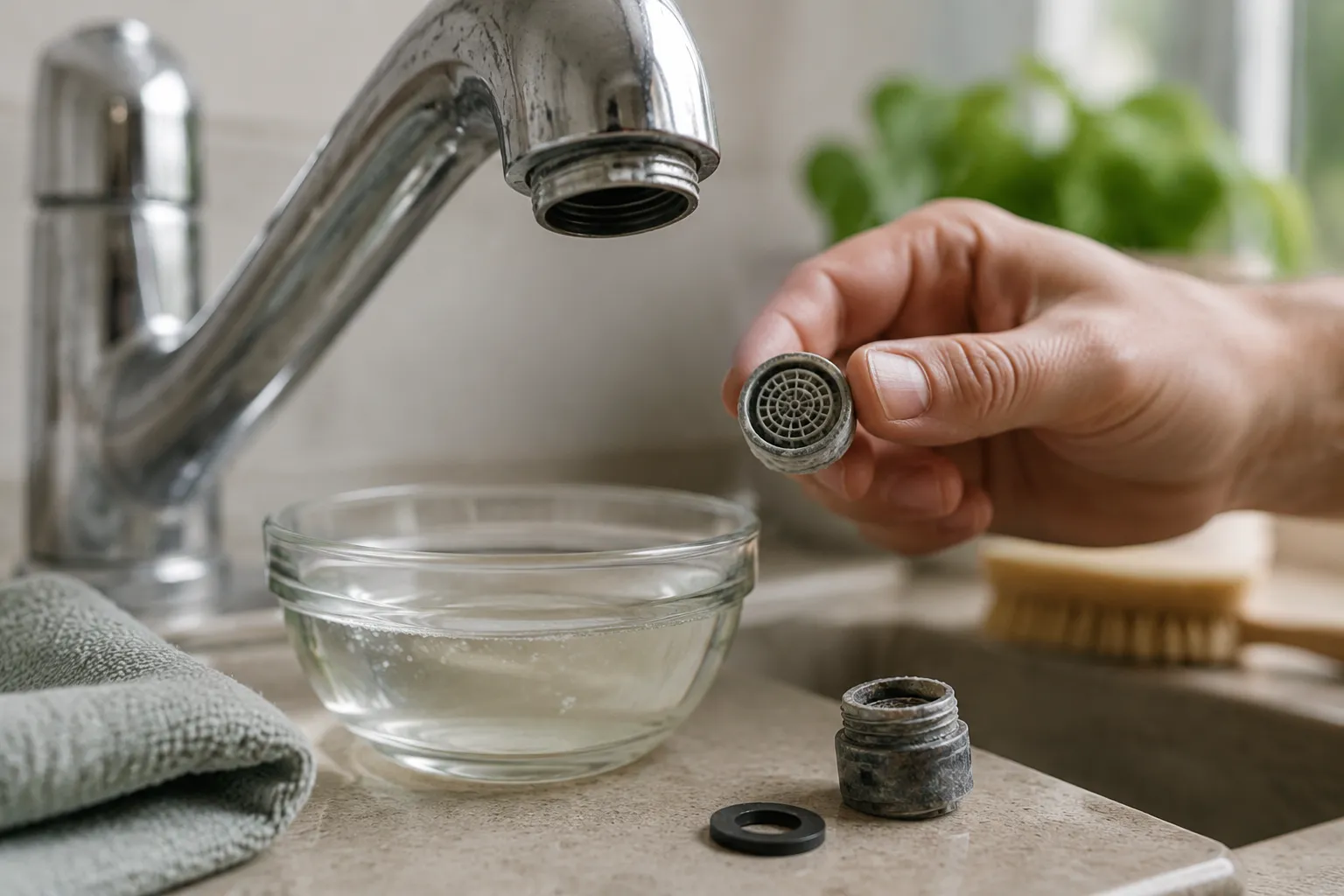
The moment arrives at the kitchen sink, usually during the morning rush. The water that once poured with authority now trickles out in a lazy, split stream that splashes off the back of a hand and misses the kettle entirely. The first suspect is always the water pressure in the house, or the municipal supply, or some valve that requires a plumber. The actual culprit, more often than not, is a small brass cylinder hiding inside the faucet spout, collecting mineral scale like a tiny, inconvenient stalactite.
An aerator is a simple device. It threads into the end of the faucet and mixes air into the water stream, which cuts down on splashing and gives the flow a soft, even consistency. When that stream narrows or forks into odd directions, it usually means the screen inside is clogged with calcium carbonate, the residue left behind by hard water. This is not a plumbing emergency. It is a maintenance task that takes about ten minutes and costs nothing, assuming the aerator is not already corroded beyond salvation.
Why a Clogged Aerator Feels Like a Bigger Problem
The deceitful part is that scale buildup happens invisibly. There is no warning light, no gradual dimming of the flow that registers consciously. The decline happens over weeks and months, so slowly that the change is only noticed when the faucet is asked to do something specific, like fill a stockpot or rinse a stubborn blender. Then the trickle is unmistakable, and the immediate assumption is that the house has a serious plumbing defect.
Hard water is the usual driver. When water high in dissolved minerals evaporates or sits, it leaves behind a chalky film. Inside the aerator, that film builds up on the mesh screens and the small plastic or brass components, eventually restricting the passage of water. The restriction is not a complete blockage, which is why the faucet still works, just badly. The flow drops by half, the spray pattern becomes erratic, and the kitchen routine adjusts to accommodate a weaker stream, which is a small but genuine annoyance.
There is a temptation to treat a weak stream as a sign that the whole fixture needs replacing. That is an expensive conclusion and usually a wrong one. The faucet itself is often perfectly healthy. The aerator is a sacrificial component, designed to catch debris and take the brunt of mineral buildup so the rest of the faucet does not. It is replaceable, cleanable, and inexpensive. The problem is that most people never look at it, let alone remove it.
Getting the Aerator Off Without a Fight
The first hurdle is physical removal. Aerators are threaded into the faucet spout, and over time, mineral scale can cement them in place. A bare hand will often fail. The outer shell is usually metal, and the grip is poor when wet. A pair of pliers will work, but bare metal jaws will chew up the finish on a nice faucet. A better approach is to wrap the aerator in a thick cloth, or use a strap wrench if one is available, which distributes the grip evenly and avoids marring the surface.
It is worth remembering that the aerator unscrews counterclockwise, which seems obvious until a person is standing under a cabinet with a flashlight trying to turn it the wrong way. If it will not budge, soak a rag in white vinegar and wrap it around the aerator for fifteen minutes. The acid breaks down the scale that is binding the threads. Patience here is cheaper than a new faucet. A rubber band stretched over the outer rim of the aerator also provides surprising grip for a stubborn twist.
Once the aerator is off, it pays to look at it before doing anything else. The visual confirmation is satisfying. The screen that was once a fine grid is now a crusty, pale disk that looks like it was dredged from a tide pool. The tiny holes are plugged with sediment. This is the moment when the diagnosis becomes concrete, and the fix becomes straightforward.
The Vinegar Soak and the Toothbrush Pass
The cleaning method is almost laughably simple. Drop the disassembled aerator into a small bowl or jar filled with white vinegar. The vinegar should cover the parts completely. Leave it for at least thirty minutes, though an hour is better. The acetic acid dissolves the calcium carbonate. Bubbles may form as the reaction happens, which is a small, satisfying sign that the process is working.
After the soak, the scale has softened but may not be fully gone. This is where an old toothbrush earns its keep. A gentle scrubbing under running water will dislodge the remaining grit from the mesh screens and the internal flow straightener. The parts should be rinsed thoroughly, because no one wants vinegar tasting their morning glass of water. The result is a set of components that look nearly new, with the fine mesh visible again and the passageways clear.
There are commercial descaling products, and they work, but vinegar is cheaper, already in the pantry, and perfectly adequate for this scale of job. The same vinegar can be reused for a second aerator or a showerhead. The smell fades quickly once rinsed. It is hard to justify spending money on a specialty cleaner when the generic kitchen staple does the same thing in the same amount of time.
When the Aerator Is Beyond Saving
Occasionally, the soak and scrub are not enough. If the aerator has been neglected for years, the scale can pit the metal or corrode the internal parts to the point where they crumble. The mesh might tear, or the plastic housing might crack during removal. In those cases, cleaning is a waste of effort. The aerator should be replaced.
Replacement is not a difficult task. The standard size is almost always a 15/16 inch or 55/64 inch thread, which fits most residential faucets. A trip to a hardware store with the old unit in hand makes the match simple. The cost is a few dollars. It is one of the cheapest plumbing repairs a homeowner can make, and it restores the faucet to full function instantly.
There is a notable difference between a cheap generic aerator and a slightly better one. The cheap versions often have plastic threads that strip easily and a single thin screen. Slightly better models use brass bodies and multiple mesh layers, which distribute the water more evenly and last longer. The price difference is small enough that it makes little sense to buy the flimsiest option, especially since the whole point is to avoid dealing with this again soon.
The Water Heater Connection Most People Miss
A slow-flowing aerator is not always a standalone problem. It can be a symptom that the entire hot water system has scale buildup. If the hot water side of the faucet trickles while the cold side flows fine, the clog is likely not in the aerator alone, but further back in the pipes or the water heater itself. The aerator is just the final filter where the loosened scale collects.
In that case, cleaning the aerator provides a temporary fix. The flow improves for a few weeks, then drops again as more scale migrates down the line. The long-term answer involves flushing the water heater, which is a bigger job but a necessary one. Neglecting it means repeating the aerator cleaning every month, which gets old quickly.
The cold water side clogging on its own usually points to sediment from the municipal supply or a well, rather than internal pipe scale. The aerator catches that too, which is another reason it exists. The device is doing its job by clogging. It is the canary in the coal mine, and ignoring it means letting the debris travel deeper into the fixture where it can damage the valve cartridge.
A Routine That Prevents the Trickle
Prevention is a matter of a few minutes every couple of months. The aerator can be removed, inspected, and given a quick vinegar soak before it ever reaches the point of reduced flow. This is the sort of task that feels unnecessary when the water is running fine, but it is far easier to clean a lightly coated screen than one that is fully sealed with crust.
Homes with very hard water might need this monthly. Homes with soft water might go a year or more without issue. The texture of the water stream is the indicator. When the flow starts to look uneven, or the water spits a little, that is the cue to act. Catching it early means the cleaning takes five minutes instead of fighting a seized component with pliers and vinegar-soaked rags.
It is also worth checking the aerator after any plumbing work, even a small repair. Disturbing old pipes shakes loose sediment that will settle in the nearest screen. A quick cleaning after a plumber visits is a small courtesy that keeps the system running at full strength. The same logic applies after a water heater replacement, which tends to send a wave of debris through the lines.
The Small Victory of Restored Flow
Reassembling the cleaned aerator and threading it back into the faucet is the final, satisfying step. The water comes back on, and the stream is full, clear, and even again. The kettle fills in seconds. The sink spray no longer mists the counter. The routine of the morning resumes without the extra ten seconds of waiting that had been silently added to the day.
This is a minor repair in the grand scheme of household maintenance, but it has an outsized effect on daily comfort. A weak stream is a constant, low-grade friction in the kitchen, an irritation that gets blamed on the house or the plumbing or the water company. The truth is that a five-cent amount of vinegar and an old toothbrush restores the whole experience. It is hard to think of another household task with a better effort-to-satisfaction ratio.
The next time the faucet seems to be losing spirit, the answer is not a new fixture or a call to a plumber. It is a quick look at the tiny brass cylinder at the end of the spout. It will probably be ugly, crusted, and clearly guilty. A soak, a scrub, and a twist later, the water flows like it did on day one, and the kitchen feels right again until next season when the minerals quietly start building their little dam once more.