
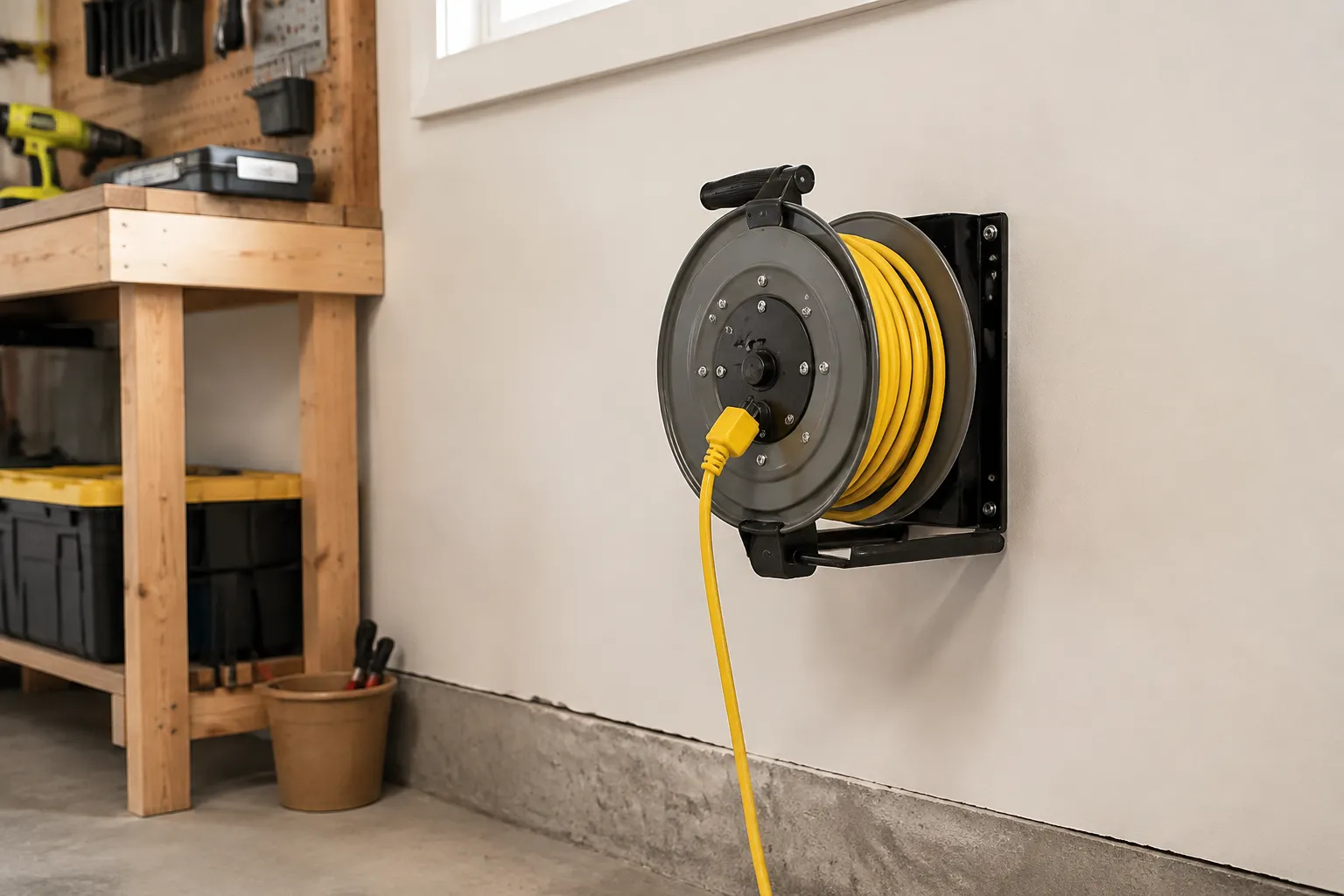
An extension cord lying across a floor is a trip hazard, a dust trap, and a statement that nobody in the room cares about how things look. The coiled heap next to a baseboard is worse, because it signals that the cord was considered and then abandoned. Wall-mounted reels solve the floor problem, but they create a second problem on the wall: an industrial plastic spool that looks like it belongs in a garage, not a living room, office, or workshop that a person actually uses daily. The mounting hardware and the reel itself need as much thought as the cord management they provide.
The common assumption is that any reel will do, since the cord is the functional part and the reel is just a hanger. That assumption produces walls with sagging plastic, exposed brackets, and cords that still tangle because the reel rotates poorly under load. A reel is a mechanical device, not a hook. It has a drum, a bearing, a ratchet, and a mounting plate, and each of those parts has a quality range that becomes obvious within the first month of use.
Why the Wall Takes the Abuse First
The wall is the least forgiving part of the whole setup. A floor reel can wobble on uneven concrete and nobody cares. A wall reel that wobbles is a visible failure, and it gets worse every time the cord is pulled. The mounting plate transfers all the torque from cord tension into the wall structure. If that transfer is sloppy, the screws loosen, the plate tilts, and the drywall around the anchors starts to crumble.
Drywall is the default wall surface in most homes and many workshops, and it has terrible holding power for anything that gets pulled sideways. A cord reel mounted to drywall alone, even with good anchors, will eventually work the holes loose because the reel's weight and the cord's tension create a lever arm. The fix is to mount into a stud, or to use a plywood backer plate that spreads the load across a wider area. A person who skips this step is mounting a mechanical device to a material that is essentially compressed gypsum dust between two sheets of paper.
The mounting height matters as much as the anchor. A reel mounted too high forces the user to pull the cord upward at a sharp angle, which strains the ratchet and makes the cord bind inside the drum. A reel mounted too low puts the cord within reach of children and pets, and it collects floor dust on the lower wrap. The practical height is around chest level, so the cord pulls roughly horizontally. That simple detail extends the life of the reel and keeps the cord from developing permanent kinks at the same point every time.
The Hardware That Decides Everything
The mounting plate is where manufacturers cut corners. Cheap reels come with a thin stamped steel plate and four short screws that are barely long enough to bite into a stud. The plate flexes when the cord is under tension, and that flex transfers directly to the wall anchors. A quality reel has a thicker plate, sometimes with a reinforcing rib across the middle, and it uses longer screws with a larger head. The difference is visible before installation: hold two reels side by side and press on the plates. The cheap one bends. The good one does not.
Anchors are the other weak point. The plastic expansion anchors sold in hardware stores work fine for a picture frame, but they are marginal for a reel holding 50 feet of 12-gauge cord. The cord alone weighs several pounds, and the tension from pulling it adds more. A toggle bolt is the better choice for drywall, because it spreads the load over a larger area on the back side of the wall. For a stud mount, a 3-inch lag screw or a structural screw with a coarse thread will hold far better than the screws that ship with most reels.
The orientation of the plate matters too. Some reels mount with the drum axis horizontal, so the cord spools off the side. Others mount with the drum axis vertical, so the cord unrolls downward. The horizontal orientation is better for most rooms, because the cord pulls straight off the drum without rubbing against the reel's frame. The vertical orientation works in tight spaces like a closet, but it puts more stress on the ratchet mechanism because the cord weight hangs directly on it.
A Reel Is Only as Good as Its Ratchet
The ratchet is the part that fails first on a wall-mounted reel. It locks the drum in place when the cord is pulled out, and it releases when the user gives a short tug to retract. Cheap ratchets have plastic teeth that wear down within a few hundred cycles. The reel then slips, the cord retracts halfway, and the user ends up pulling it out again, creating a loop of frustration that ends with the cord draped over the reel in a heap.
Steel ratchets last longer, but they are noisier. A well-made steel ratchet clicks with a solid, mechanical sound. A cheap one rattles. The noise is not just cosmetic: a rattling ratchet indicates loose tolerances between the pawl and the gear, which means the locking mechanism is wearing unevenly. The reel will fail sooner than a quieter one with tighter tolerances.
The retraction spring is the second failure point. A strong spring retracts the cord quickly, which is good for convenience but bad for control. The cord whips across the floor and can knock things over. A weak spring retracts slowly, which is safer but annoying when the user wants to move on. The best reels have a spring that retracts at a moderate speed with a smooth, steady pull. That feel is hard to describe but immediately recognizable when the cord is let go.
The cord itself is the third consideration. Many reels come with a cord already attached, and that cord is often the cheapest possible PVC jacket. It gets stiff in cold weather, develops cracks at the stress points near the reel, and tangles inside the drum. Buying a bare reel and attaching a better cord is a legitimate upgrade, especially for a workshop where the cord gets dragged across concrete and sharp edges.
The Wall Behind the Reel Also Needs a Plan
A wall-mounted reel makes the wall cleaner only if the surrounding area is clean too. The cord has to go somewhere when it is in use, and the path from the reel to the outlet or tool determines whether the setup looks intentional or improvised. A person who mounts the reel but leaves the cord draping over a shelf, a doorknob, and a chair has not solved the problem; they have just moved the clutter from the floor to the air.
Cable clips or a simple cord guide on the wall can route the cord along a baseboard or door frame. These clips are cheap, but they need to be mounted at the right interval, roughly every 18 inches, to keep the cord from sagging. A sagging cord between clips looks worse than a cord on the floor, because it draws the eye upward and makes the wall look messy.
For a workbench or a desk setup, a short cord guide that directs the cord downward from the reel to the work surface is a small detail that makes a big difference. Without it, the cord hangs at an angle and rubs against the edge of the workbench, wearing through the jacket over time. With it, the cord drops straight down and stays out of the way.
Where a Wall Reel Does Not Belong
Some spaces should never have a wall-mounted reel. A kitchen counter, for example, is the wrong place for a retractable cord because the reel collects grease and steam damage over time, and the cord itself becomes a contamination risk when it drags across food-prep surfaces. A bathroom is wrong for the same reason, plus the humidity attacks the metal parts. A wall reel belongs in a space where the cord is used for power tools, lamps, electronics, or appliances that do not involve water or food.
Outdoor mounting is a separate category. A reel rated for indoor use will not survive a season of rain and UV exposure. The plastic becomes brittle, the spring rusts, and the cord jacket degrades. Outdoor reels have sealed housings and corrosion-resistant hardware, and they cost more for that reason. A person who mounts an indoor reel on an exterior wall is creating a maintenance problem that will need solving within a year.
The cord length is another factor that determines the reel's place. A 25-foot cord on a wall reel is fine for a small office or a reading nook. A 50-foot cord is the practical maximum for most residential walls, because a longer cord adds weight that stresses the mounting plate and the ratchet. A 100-foot cord on a wall reel is a bad idea; the weight of the fully extended cord pulls hard on the drum and makes the reel sag over time. That length belongs on a floor dolly or a ceiling mount, not a wall plate.
The Installation Sequence That Gets It Right
The order of installation matters more than people expect. Mounting the reel first and then trying to align the cord path leads to a compromised setup. The correct sequence starts with locating the stud, then marking the desired height, then holding the reel in place to check the cord's exit angle. That angle determines whether the reel needs to be shifted left or right by an inch or two. A slight lateral offset can make the difference between a cord that spools neatly and one that rubs against the reel's side frame on every retraction.
The mounting screws should be tightened in a crisscross pattern, not one at a time in a circle. Tightening one screw fully before the others pulls the plate out of square, and the reel then sits at a slight tilt. That tilt makes the cord spool unevenly, which causes the drum to bind over time. A person who takes the extra minute to tighten the screws gradually will never have to redo the job.
The cord should be fully extended and then retracted three or four times immediately after mounting, before any load is plugged in. This seating process lets the spring and the ratchet find their natural alignment. Skipping it means the first real use is also the first time the mechanism works under load, which is when binding and jamming occur.
Matching the Reel to the Room's Style
The visual side of a wall reel is not trivial. A bright red or yellow reel in a living room looks like a safety device, not a piece of furniture. The same reel in a garage looks right. Some manufacturers now offer reels in neutral colors like matte black, gray, and white, and these blend into a wall far better than the industrial colors. A white reel against a white wall disappears almost entirely, which is the goal for a room where the cord is a utility, not a design statement.
The mounting plate is visible even when the reel is not in use, so its finish matters. A shiny chrome plate reflects light and draws attention. A matte or powder-coated plate sits flat against the wall and does not compete with the room. The small difference in appearance is worth paying for, because the plate is the one part that is never hidden by the cord.
For a workshop, the utilitarian look is fine, but the mounting still deserves care. A plywood backer painted to match the wall not only spreads the load, it also gives the reel a clean visual base. That backer can be cut to fit the reel's footprint exactly, so it looks like a deliberate part of the wall rather than a patch job.
When to Replace the Reel Rather Than Repair It
A reel that has been mounted for years will eventually wear out. The spring loses tension, the ratchet teeth round off, and the cord jacket cracks. Replacing the cord on an old reel is possible, but it is rarely worth the effort. The internal parts are worn too, and a new cord on a worn mechanism will fail quickly. The reel itself should be treated as a consumable item with a service life of roughly five to ten years, depending on how often it is used.
The warning signs are specific: a cord that does not fully retract, a ratchet that slips under light tension, a reel that wobbles on its plate even though the screws are tight. Any one of these signals that the mechanism is done. Continuing to use a failing reel puts stress on the wall mount, and a reel that pulls out of the wall is a bigger problem than a worn-out cord.
A wall-mounted reel is one of those purchases where the difference between a good one and a bad one is not obvious in the store. The good one mounts flat, spools evenly, and retracts smoothly for years. The bad one tilts, binds, and gets left with the cord half out. The extra money for a thicker plate, a steel ratchet, and a decent spring is spent once and forgotten. The cheap one is remembered every time it jams.