
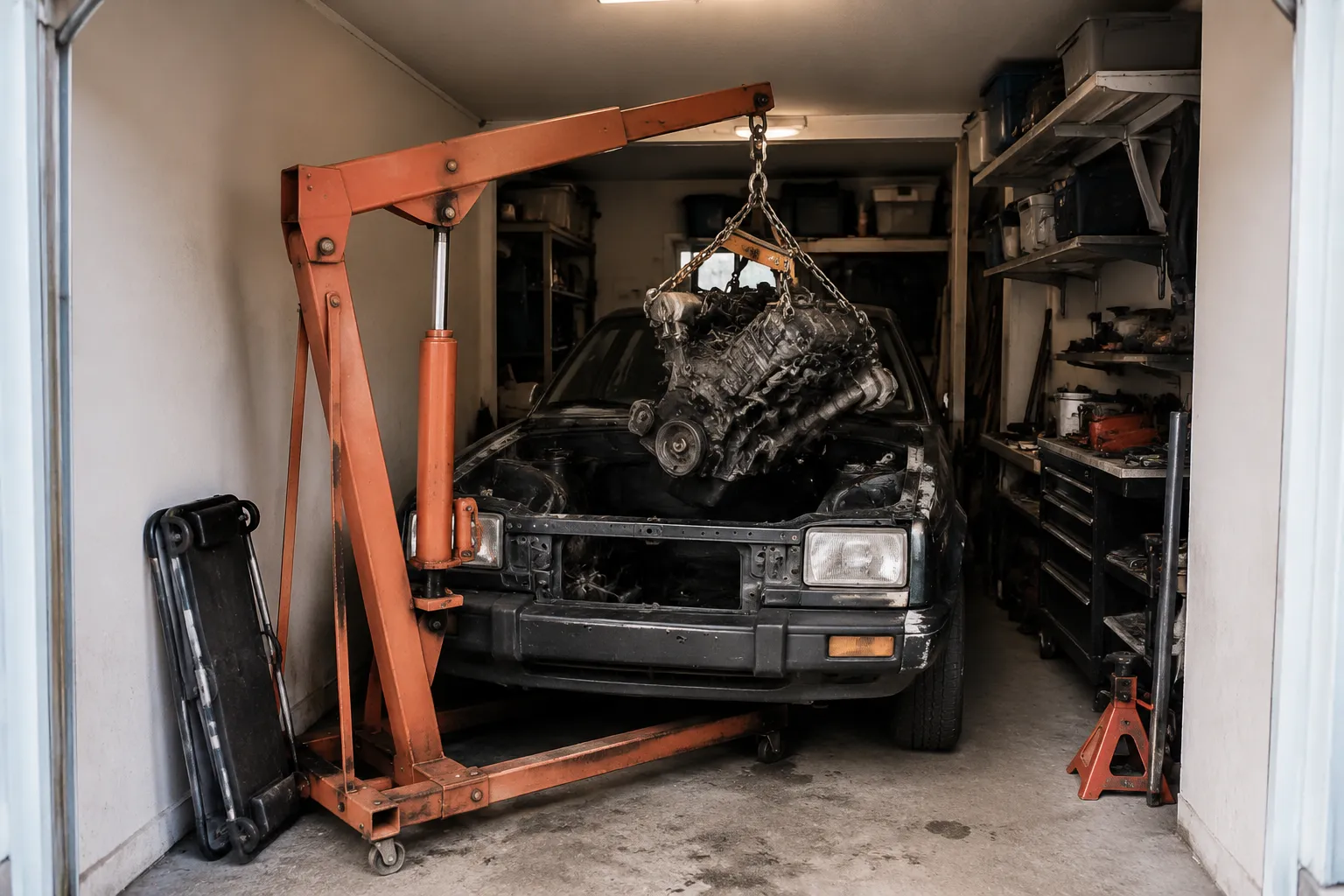
The two-ton floor jack sits in the corner of the garage like a piece of furniture a person forgot they bought. It has been there for three years, its handle propped against the wall, its wheels sunk into the same patch of dust. The engine hoist, when it finally arrived, was a different matter. It came in a box that took two people to carry, and the first hour with it was spent not assembling the thing but rearranging the garage so the thing could exist in the same room as everything else.
Compact garages do not have a storage problem. They have a geometry problem. A single-car garage built in the 1950s is roughly 12 feet wide and 20 feet deep, which sounds workable until a person accounts for the workbench, the shelving unit, the freezer, the bicycles, and the inevitable collection of paint cans that nobody throws away. The engine hoist, or the shop crane as it is more accurately called, is a machine that demands floor space in every direction. Its legs spread wider than a person's wingspan. Its boom reaches forward like a fishing rod. And when it is not in use, it does not fold politely and lean against a wall. It sits there, occupying the same square footage as a small car, daring the homeowner to find a reason to put it outside.
The first decision a person faces is not which hoist to buy. It is whether the garage can physically contain one. This is a question of footprint, and the footprint of a typical 2-ton capacity shop crane is larger than most people expect. The legs on a standard unit spread to roughly 40 inches in one direction and 50 inches in the other. The base alone takes up a patch of floor the size of a coffee table. The boom, when raised to its highest position, adds another five feet of vertical reach. The whole assembly weighs somewhere in the neighborhood of 150 to 200 pounds, which means it cannot be casually relocated. Once it is in place, it stays in place until a person decides it is time to play a game of garage Tetris.
The honest truth about engine hoists in compact spaces is that the capacity rating matters far less than the leg spread. A 2-ton hoist with legs that open to 50 inches is useless in a garage where the only available floor space is a 36-inch gap between the workbench and the wall. The rated capacity assumes the load is centered between the legs. The moment a person tries to pick up an engine that is tucked into a corner or partially under a fender, the center of gravity shifts, and the effective capacity drops to something far less reassuring.
This is why the foldable and collapsible designs have become so popular in recent years. The folding hoist, with its articulating legs and pinned joints, offers a solution to the storage problem by reducing the footprint when the unit is not in use. A person can fold the legs inward, drop the boom down, and tuck the entire assembly against a wall in a space roughly the size of a floor lamp. The tradeoff is stability. A folding hoist with narrowed legs has a smaller stability triangle, which means the load capacity at full extension is reduced. The manufacturer's chart will show this plainly, but the chart is often ignored until the moment the engine starts swinging.
There is a reason professional shops use hoists with wide, fixed legs and heavy casters. The wide stance is not a design flaw. It is a safety feature. The engine block that a person is lifting weighs somewhere between 300 and 600 pounds for most passenger vehicles, and that weight shifts as the boom rises. A hoist with a narrow base will tip. It will tip slowly at first, then all at once, and the engine will not stay suspended in the air while the operator scrambles to adjust. The floor of a compact garage makes this worse because a person cannot simply step back. The workbench is behind the operator. The wall is six inches from the hoist's rear caster. There is nowhere to go when the load starts to lean.
The Clearance Problem Nobody Mentions
Most discussions of engine hoists focus on capacity and lifting height. The clearance problem is rarely discussed, because it only becomes apparent in a garage with a low ceiling or a car that is parked too close to the wall. The boom on a typical shop crane reaches maximum height at roughly 90 inches. A standard garage ceiling is 96 to 108 inches, so the math usually works. But the math changes when the hoist has to reach over the front of a car that is backed into a tight spot, or when the boom must clear the hood of a vehicle that sits higher than average.
The clearance issue is compounded by the fact that an engine is not lifted straight up. It is lifted on a curve. The boom arcs upward as the hydraulic ram extends, which means the load travels forward and up simultaneously. In a compact garage, that forward travel is the killer. The engine might need to come out and up, but the wall is right there. The workbench is right there. The shelving unit full of oil jugs is right there. The operator ends up lifting the engine just high enough to clear the chassis, then swinging it sideways to get it over the fender. That sideways swing requires lateral space that a compact garage simply does not have.
A person can work around this by using a load leveler, the simple bar that attaches between the hoist's hook and the engine's lifting points. The load leveler allows the operator to tilt the engine fore and aft, which is essential for clearing the firewall or the radiator support. But the load leveler adds height to the assembly. It adds a few inches between the engine and the hook, and in a garage where the boom is already grazing the ceiling, those inches matter. The engine ends up hanging lower than planned, and the operator ends up adjusting the hoist's height repeatedly, each adjustment requiring the boom to come down, the pin to be pulled, the ram to be pumped, and the pin to be reinserted. It is a slow, frustrating dance.
Casters That Fight Back
The casters on a shop crane are not the same as the casters on a furniture dolly. They are small, hard, and unforgiving. On a smooth concrete floor, they roll fine. On a garage floor with a slight slope, a crack, or a coating of oil, they behave like a shopping cart with a stuck wheel. The hoist resists movement in one direction and then suddenly jerks in another. When the hoist is carrying a 400-pound load, that jerk is a serious event.
In a compact garage, the floor is rarely flat. The center of the slab is usually slightly higher than the edges, a deliberate slope for drainage. A hoist parked near the wall sits on a slight incline, which means the load shifts toward the wall the moment it is lifted. The operator notices this as a subtle forward drift, a slow creep that requires constant correction. The correction involves pushing against a 200-pound machine that is carrying a 400-pound engine, which is a good way to strain a back or pinch a finger against the wall.
The better approach is to chock the rear casters before lifting. A couple of wooden wedges, the kind that come with cheap furniture, placed under the rear wheels will keep the hoist from rolling while the load is in the air. This is a small fix that makes a huge difference. It is also the kind of fix that a person only learns after the first time the hoist rolls forward unexpectedly, carrying an engine toward the front bumper of the car and then stopping with a metallic clunk that sends a chill down the spine.
The Legacy of the Cherry Picker
The design of the engine hoist has not changed much since the 1960s. The basic architecture, a wheeled A-frame with a hydraulic ram and a swinging boom, is so effective that manufacturers have not bothered to reinvent it. The so-called cherry picker design, so named because the operator picks the engine out of the bay like a piece of fruit, has remained essentially the same for six decades. The changes have been incremental: lighter materials, better casters, a few safety pins. The core geometry is unchanged because the core geometry works.
This is a point worth making to anyone who thinks a newer, more expensive hoist will solve the space problem. It will not. A newer hoist has the same footprint, the same leg spread, the same boom reach. The only real difference between a $200 hoist and a $600 hoist is the quality of the welds, the smoothness of the hydraulic ram, and the thickness of the steel. None of those features makes the hoist smaller. None of them makes it fit better in a tight garage.
What actually helps is a hoist with an adjustable leg width. Some models allow the legs to be pinned at a narrower setting for lifting lighter loads in tight spaces. The narrower stance reduces the stability, but it also reduces the footprint by several inches on each side. For a person working in a 12-foot-wide garage, those few inches can be the difference between the hoist fitting and the hoist being unusable. The tradeoff is real, and the operator must respect it. A hoist with legs set at the narrowest position should never be used at its full rated capacity. The math does not work. The center of gravity is too close to the edge of the stability triangle.
Working Around the Car Itself
The car in a compact garage is not parked in the middle of the room. It is tucked against one wall, leaving just enough space for a person to walk along the side. This means the engine hoist cannot approach the car from the front at a perfect 90-degree angle. It has to come in at an angle, which changes the geometry of the lift entirely. The boom has to reach farther, the load has to travel a longer path, and the hoist's legs have to straddle something they were not designed to straddle.
One technique is to pull the car out of the garage far enough to expose the engine bay. This is the obvious solution, and it works, but it only works if the driveway is long enough and the weather is cooperative. A person who has spent an hour removing the intake manifold and disconnecting the wiring harness does not want to stop and push the car back into the garage because it started raining. The alternative is to work with the car partially inside and partially outside, which means the hoist has to be positioned on the garage floor while the engine hangs over the threshold. This is doable, but it requires the hoist to be placed with its rear casters against the back wall and its boom extending out over the open garage door.
The most practical approach for a compact garage is to remove the engine from the side rather than the front. This is not the textbook method. The textbook method assumes the car is on a lift or in an open bay with room to maneuver. In a compact garage, the operator must think sideways. The hoist is positioned with its legs parallel to the car's fender, the boom swung 90 degrees so it points across the engine bay. The engine comes out sideways, with the load leveler tilted to clear the shock tower and the fender lip. This is a delicate operation that requires patience and a spotter, but it is the only way to remove an engine without pulling the car out of the garage entirely.
The Aftermath of the Lift
Once the engine is out and sitting on a stand, the hoist becomes a liability. It occupies the only open floor space in the garage. The car cannot be moved because the hoist is in the way. The workbench cannot be accessed because the hoist's boom is swung across the aisle. The operator must decide whether to disassemble the hoist and store it, or leave it in place and work around it for the duration of the project.
Disassembling a shop crane takes about 20 minutes. The boom comes off with two pins. The legs fold with two more. The hydraulic ram stays attached to the frame, but the whole assembly can be leaned against a wall. It is not elegant, but it is doable. The problem is that the disassembly and reassembly process eats into the actual work time. A person who is rebuilding an engine over the course of a weekend will assemble the hoist, use it, disassemble it, and then reassemble it three days later when the engine is ready to go back in. That is an hour of wasted time, but it is better than tripping over a 200-pound machine for a week.
Some people choose to leave the hoist assembled and simply push it outside between uses. This works if the driveway is level and the weather is dry, but it invites rust and theft. A shop crane left outside overnight is a magnet for anyone with a pickup truck and no conscience. The better play is to find a permanent parking spot for the hoist inside the garage, even if that spot is inconvenient. The spot behind the door, where the hoist tucks into the corner with its legs folded and its boom lowered, is the best option for most compact garages.
What the Compact Garage Actually Needs
The engine hoist market is full of options that are too big, too heavy, and too ambitious for a home garage. What a person with a compact space actually needs is a hoist with a modest capacity rating and a modest footprint. A 1-ton hoist with a shorter boom and narrower legs is often the better choice than a 2-ton unit that barely fits through the garage door. The lighter hoist is not a compromise. It is a tool that matches the space it occupies.
The other consideration is the hydraulic ram itself. A cheap ram will leak. It will bleed fluid down the cylinder, leaving a puddle on the garage floor and slowly losing lifting power. A person who lifts an engine once a year does not need a commercial-grade ram, but they do need one that holds pressure without constant pumping. The frustration of watching an engine slowly sink back down while a load leveler dangles is the kind of moment that makes a person swear off engine work entirely. A mid-range hoist with a decent ram is worth the extra hundred dollars.
The final piece of the puzzle is a set of heavy-duty straps. The chains that come with most hoists are clumsy and short. They work, but they scratch the engine and make it difficult to adjust the angle of the load. A set of four nylon straps with load-rated hooks is a cheap upgrade that makes the whole operation smoother. The straps wrap around the engine block and attach to the load leveler, allowing the operator to fine-tune the angle without wrestling with a chain that keeps catching on a bolt head.
A compact garage does not change the nature of an engine pull. It changes the choreography. The hoist still lifts, the engine still swings, and the operator still has to be careful with every move. But the space constraints force a level of planning that a person with a two-car garage never has to think about. Every tool has to have a home. Every lift has to be mapped out in advance. Every move has to be made with the knowledge that there is no room for error, because there is no room, period.
The engine hoist that finally fits in a compact garage is the one that gets used. It is the one that folds small enough to tuck behind the door, the one with legs that narrow to slip between the workbench and the wall, the one that a person is not afraid to drag out on a Saturday morning because the assembly process is quick and the footprint is manageable. It is not the biggest or the strongest. It is the one that works in the space that exists, not the space a person wishes existed.