
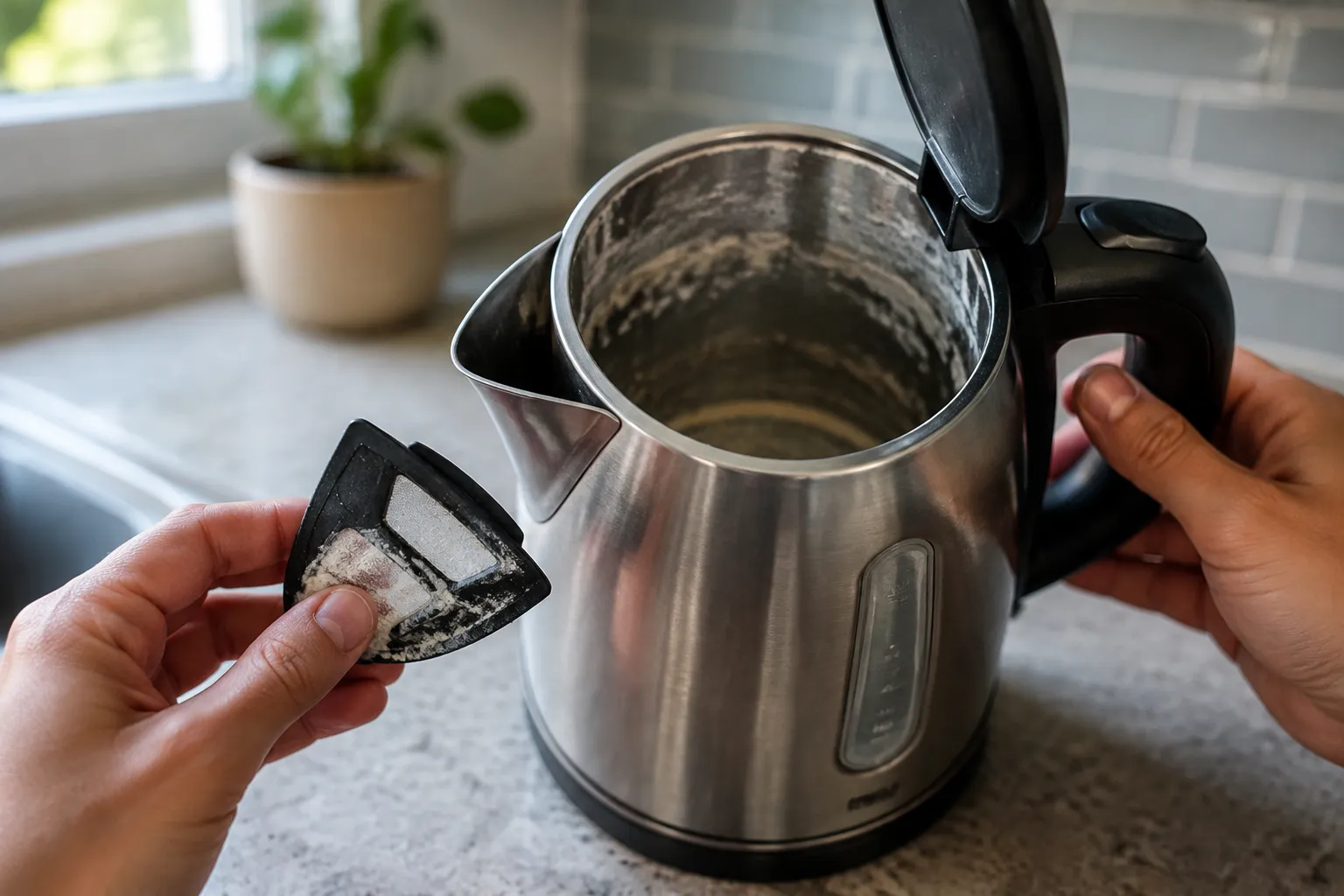
The white crust that builds up inside an electric kettle is not a mystery or a manufacturing defect. It is calcium carbonate, and it comes out of the tap. Hard water carries dissolved calcium and magnesium, and when the water boils, those minerals precipitate into the chalky scale that coats the heating element and floats in clouds of gray flecks. Every household with hard water fights the same quiet war against it, and most people are losing because they bought the wrong kettle or they clean it the wrong way.
The first thing to understand is that some kettles are built for hard water and some are not. A kettle with an exposed coil at the bottom is the worst possible choice. The coil gets hot fast, which means scale forms on it faster and bakes onto the metal. Once that happens, the scale is nearly impossible to remove completely, and the kettle starts taking longer to boil as the layer of calcium acts as an insulator. The water still gets hot, but the heating element works harder and harder to push heat through a crust that was never supposed to be there.
A flat, concealed heating element is better. The element sits underneath a stainless steel base plate, so the scale forms on a surface that can actually be cleaned. This design difference alone is worth paying for if the tap water in the area is known to be hard. A person moving to a new region should check the water hardness map before buying any kettle, because the difference between 50 parts per million and 300 parts per million is the difference between a kettle that lasts a decade and one that dies in eighteen months.
Why Vinegar Works and Why It Takes Time
The standard descaling advice is to boil a mixture of water and white vinegar, and that advice is correct, but it is usually delivered without the two details that actually matter. The first detail is concentration. A splash of vinegar in a full kettle does almost nothing. The solution needs to be roughly one part vinegar to two parts water, and it needs to fill the kettle enough to cover all the scale. The second detail is time. Boiling the solution loosens the scale, but the kettle should then sit for at least twenty minutes, preferably longer. The acetic acid needs contact time to dissolve calcium carbonate, and a quick boil-and-pour cycle only removes the top layer.
After the soak, the scale should come off in sheets or flakes. Some of it will be floating in the solution, and some will be clinging to the walls. A non-abrasive sponge handles the rest. Never use steel wool or a stiff scrub brush on a stainless steel kettle, because the scratches create microscopic crevices where scale can take hold again, and those scratches also make the surface harder to keep clean over time.
Citric acid powder is the more effective alternative. It dissolves scale faster than vinegar, it does not leave a vinegary smell that lingers for days, and it is cheap. A tablespoon of citric acid in a full kettle of water, boiled and then left to sit, handles even the worst scale buildup in a single pass. The crystals are available in most grocery stores in the canning section, and a small jar lasts for years. The tradeoff is that citric acid is slightly more aggressive, so it should never be left in the kettle for hours after the descaling is done. Rinse thoroughly, boil a full kettle of plain water, pour it out, and the kettle is ready for use.
The Filter Question and the Water You Pour In
Many electric kettles come with a mesh filter in the spout, and those filters catch the floating scale flakes so they do not end up in the cup. The filter is a useful piece of engineering, but it has a maintenance burden that manufacturers rarely mention. The filter itself accumulates scale, and if it is not cleaned regularly, it becomes a crusty plug that slows the pour and eventually blocks the spout entirely. The filter should be popped out and soaked in the same vinegar or citric acid solution as the kettle itself, ideally every time the kettle is descaled.
The more radical solution is to change what goes into the kettle in the first place. Filling the kettle from a filtered water pitcher or a countertop filter removes a significant portion of the calcium and magnesium before boiling. This does not eliminate the need for descaling entirely, but it stretches the interval between cleanings from every few weeks to every few months. The tradeoff is convenience. A person who fills the kettle straight from the tap saves a step, but that person is signing up for more frequent maintenance. A person who uses filtered water is paying for the filter replacements but spending far less time scrubbing scale.
There is also the question of whether the kettle should be emptied after each use. Leaving water sitting in the kettle does not cause scale to form faster, but it does allow the water to evaporate slightly, which concentrates the minerals. A kettle that is left half full for days on end will develop a ring of scale at the waterline that is harder to remove than the scale on the heating element. Emptying the kettle after each use, or at least pouring out the leftover water at the end of the day, is a small habit with an outsized effect on how often the kettle needs a full descaling.
What Happens When Scale Goes Untreated
The consequences of ignoring scale are not just aesthetic. A heavily scaled kettle takes noticeably longer to boil, sometimes twice as long, because the calcium layer acts as a thermal barrier. The heating element runs hotter to compensate, and that extra heat stress shortens the lifespan of the element. In extreme cases, the kettle will shut off before the water reaches a full boil, because the temperature sensor reads the heat of the element rather than the heat of the water. The water may be hot, but it is not boiling, and that matters for anyone making tea that requires a true rolling boil.
The scale also affects taste. Calcium carbonate does not have a strong flavor on its own, but it changes the mouthfeel of water and can mute the flavors in tea and coffee. A cup of tea made with heavily scaled water tastes flat, and the scale flakes that float into the cup are a textural nuisance that no amount of brewing technique can fix. For people who are serious about their morning coffee or afternoon tea, the kettle is not just a utility device. It is part of the brewing chain, and a scaled kettle degrades the final product.
There is also a safety dimension, though it is rarely discussed in the context of kettles. The scale that builds up on the heating element can cause the element to overheat, and overheating can trip the kettle's thermal fuse. When that happens, the kettle simply stops working. It does not catch fire or explode, but it does fail permanently. The repair is not worth doing; a new kettle costs less than the labor involved. So the choice is between spending twenty minutes on a vinegar soak every few weeks or buying a new kettle every year or two. The math is not close.
A Descaling Schedule That Actually Works
The right cadence for descaling depends entirely on water hardness, and the best way to determine that cadence is to look at the kettle. When a thin film of scale becomes visible on the base plate, that is the moment to descale. Waiting until the scale is thick and white means the buildup has already started to insulate the heating element. Descaling at the first sign of film is faster, easier, and gentler on the kettle than waiting for a thick crust.
For most households with moderately hard water, that works out to once a month. For households with very hard water, it can be every two weeks. For households with soft water, the kettle might go months without needing any attention. The visual check is more reliable than any calendar, because it responds to the actual conditions rather than a guess about them.
The descaling process itself should follow a consistent sequence. Empty the kettle. Add the vinegar or citric acid solution. Boil. Let it sit for twenty to thirty minutes. Pour out the solution. Rinse the kettle thoroughly. Boil a full kettle of plain water and pour that out to remove any lingering acid taste. Wipe the interior with a soft cloth. Reassemble the filter. Fill and use as normal. The entire process takes less than an hour, but most of that time is passive soaking, so the actual hands-on effort is about ten minutes.
Plastic, Glass, and the Material Decision
The material of the kettle body matters more than most people think when it comes to hard water care. Plastic kettles are the hardest to keep clean because the scale adheres to the slightly porous surface and the plastic itself can absorb odors from the vinegar used in descaling. A plastic kettle that has been descaled a few times can start to smell faintly of vinegar on every subsequent boil, and that smell can transfer to the water. Glass kettles are better for visibility, since the scale is easy to spot, but glass shows every water spot and mineral smudge, which some people find unsightly. Stainless steel is the most practical choice for hard water households because it is non-porous, it does not absorb odors, and it withstands repeated descaling without degradation.
The stainless steel grade matters at the margins. Cheaper kettles use a thinner gauge steel that can warp or discolor over time, especially if the kettle is frequently boiled dry or subjected to the heat of a descaling cycle. A thicker steel body handles the thermal stress better and resists the minor dents and dings that come from regular kitchen use. This is not a place to save money. A decent stainless steel kettle costs a bit more than a plastic one, but the plastic kettle will need replacing sooner, and the descaling experience will be worse the entire time.
The Descaling Products That Are Not Worth It
The specialty descaling products sold in kitchen stores and online are mostly a waste of money. They are usually just citric acid with a different label and a price that is five to ten times higher per ounce. The commercial descaler that comes in a bottle with a fancy dropper cap works exactly the same as the generic citric acid powder from the grocery store. The only advantage of the commercial products is that they come with instructions, and the instructions are essentially the same as the method described above. A person who can measure a tablespoon of citric acid does not need the commercial product.
The one exception is the descaler made specifically for kettles with a plastic body. Those products are formulated to be gentler on plastic, and they are less likely to cause the odor absorption problem that vinegar creates. But the better solution is to buy a stainless steel kettle in the first place and avoid the plastic problem entirely. The specialty products solve a problem that should have been prevented at the point of purchase.
The Boil-Dry Habit and Other Self-Inflicted Damage
Hard water is not the only enemy of an electric kettle. The boil-dry habit is worse. Running a kettle with no water inside heats the element to temperatures it was never designed to reach, and the thermal fuse trips almost immediately. Some kettles survive this once, but the element is weakened, and the next boil-dry event is likely to be fatal. The habit of filling the kettle before plugging it in, rather than after, prevents this failure mode entirely. It sounds obvious, but the number of kettles that die from being turned on while empty is surprisingly high.
Another self-inflicted wound is using the kettle to heat water for cooking pasta or boiling vegetables. The starch and minerals from food water leave residue that is much harder to remove than plain hard water scale. The kettle should be used for one thing only: heating water for beverages. Everything else shortens its life and complicates its maintenance.
The last habit worth breaking is scrubbing the inside of the kettle with soap. Soap residue is difficult to rinse fully from the interior, and even a small amount of leftover detergent leaves a film that affects the taste of the next boil. The interior of a kettle does not need soap. The boiling process kills bacteria, and the descaling process removes the mineral buildup. Soap in a kettle creates more problems than it solves.
The care of an electric kettle in a hard water home comes down to three commitments: buying the right material, descaling on a visible schedule, and avoiding the habits that cause damage independent of water chemistry. A kettle that gets that treatment will outlast its warranty by years. A kettle that gets ignored will die quietly, and the replacement cost will be a small tax on neglect.