
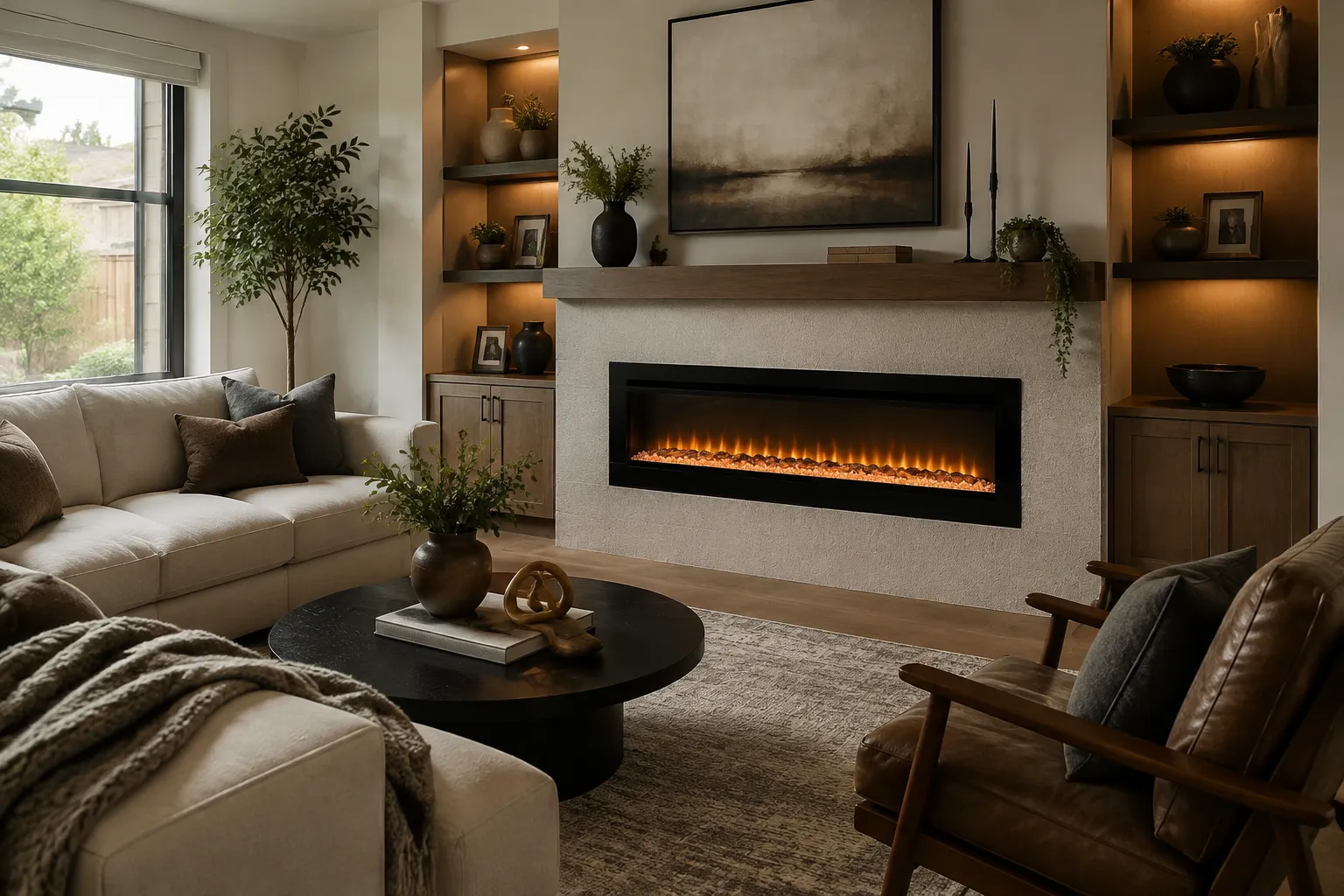
The electric fireplace is the most lied-about piece of furniture in the modern American living room. Manufacturers sell them as "heaters" with impressive BTU ratings, but the truth is that most of them are glorified space heaters with a light show attached. The real value of an electric fireplace has almost nothing to do with warmth and everything to do with how it anchors a room. Once a person stops pretending the unit is a serious heating appliance, the placement logic changes completely. The question stops being "where will this keep us warmest" and becomes "where will this look like it was always meant to be."
The units themselves sit in a strange category. They are not quite furniture, not quite fixtures, and not quite appliances. A wood-burning fireplace dictates the architecture of a room; the chimney has to go somewhere, the hearth has to clear the floor, the clearances have to be respected. A gas unit needs a vent and a gas line. The electric fireplace needs only a wall outlet and a decision. That freedom is exactly what makes placement so hard. When nothing is structurally required, every option stays open, and an open field of options tends to paralyze people into defaulting to the most obvious spot.
The Outlet Dictates More Than It Should
Most living rooms have outlets in predictable places: behind the sofa, near the ends of the walls, occasionally in a corner. The fireplace needs to be near one, and that single constraint quietly eliminates a lot of the "good" placements a person might dream up. A homeowner who wants the fireplace on the long wall opposite the sofa often discovers that the only outlet on that wall sits behind a bookshelf. The cord becomes a snake running across the floor, and suddenly the whole project smells like a dorm room.
Hardwiring solves this. An electrician can run a line into the wall behind the fireplace unit, and the cord disappears entirely. This costs money, usually a few hundred dollars depending on the run, but it is the single upgrade that separates a unit that looks installed from one that looks parked. For a built-in or recessed installation, hardwiring is practically mandatory. For a freestanding unit, the cord can often be tucked behind the legs or routed through a channel. Every placement decision below assumes the cord problem has been solved or can be solved, because the best placement in the world dies the moment a visible cord crosses the traffic path.
The Built-In Wall Niche Is the High-Water Mark
The most convincing electric fireplace installations are the ones that mimic real architecture. A recessed unit framed into a wall, with a wooden mantle above and a tile or stone surround, reads as intentional. The eye accepts it the way it accepts a built-in bookshelf or a window seat. This is the placement that makes guests squint and ask whether the thing is actually electric, which is the highest compliment the category can receive.
The wall niche works best when the fireplace becomes the midpoint of a longer composition. A common approach puts the unit between two built-in cabinets or shelving columns, so the fireplace reads as the center of a larger millwork assembly rather than a lone appliance floating on drywall. The proportions matter. A 30-inch-wide fireplace flanked by 18-inch shelves on each side creates a balanced 66-inch unit that feels custom. The shelves give the eye somewhere to land and give the owner somewhere to put things, which keeps the fireplace from becoming a dead zone.
Heights matter more than most people think. A fireplace centered at eye level from the sofa, meaning the flame sits roughly 45 to 50 inches off the floor, feels like a television. That is the wrong feeling. A real fireplace sits lower, with the firebox around 30 to 36 inches from the floor, so the flames dance near the ground and the heat source feels grounded. Installing the unit too high turns it into a wall-mounted screen, and the whole illusion collapses.
The Media Wall Tug-of-War
The most common mistake in electric fireplace placement is treating the fireplace and the television as competitors for the same wall space. Homes with an existing media wall, the long console with the TV mounted above it, face a genuine conflict. The TV wants to be at eye level. The fireplace wants to be low. They cannot both win on the same wall, and someone has to move.
A fireplace directly beneath a television creates a visual mess. Two glowing rectangles stacked vertically, one showing a sitcom and the other showing fake flames, compete for attention. The eye can't settle. The solution that works in practice is a fireplace in a flanking position, not beneath the screen. The unit goes on an adjacent wall, perpendicular to the TV, creating an L-shaped arrangement. The sofa stays angled or the room gets two distinct zones: one for watching, one for sitting by the fire. This works especially well in open-plan rooms where the living area flows into a dining space. The TV anchors the viewing side, the fireplace anchors the conversation side, and the room gains a center aisle between them.
When the fireplace absolutely must share the media wall, the honest answer is to put the TV above it and accept the compromise. The fireplace should be a low, wide unit, and the TV should sit as close to it as possible, with no more than 12 to 18 inches of space between them. The gap creates a floating look that reads as accidental. Closing the distance makes the pairing feel deliberate, like a built-in entertainment center that happens to include a fire.
The Corner as a Cozy Outpost
Corners get overlooked because they are awkward. Standard furniture doesn't fit well, the angles create dead space, and a room's corner often becomes a dumping ground for the plant that outgrew its spot. But a corner is the natural home for a small electric fireplace, especially in a room where the main walls are already claimed by a sofa, a console, or a window.
The trick is to use the corner deliberately, not apologetically. A triangular or angled media console that fills the corner, with the fireplace recessed into the center, creates a reading nook feel. Two armchairs angled toward the corner, each one facing the other with the fire between them, turns an unused corner into the coziest seat in the house. The fireplace becomes a focal point that pulls people toward it, which is the opposite of a dead corner.
Corner placement also solves the traffic problem. In narrow living rooms, a fireplace on the long wall eats into walking space. A corner unit sits out of the main flow, leaving the center of the room open. This is the right move for apartments and for living rooms that double as hallways, where the path from the entry to the kitchen runs right through the middle of the space. The corner fireplace gives the room a destination without blocking the route.
The Floating Mantle and the Furniture Question
A fireplace that hangs on the wall like a picture frame, with open space beneath it, changes the furniture math. A floating unit, whether it is a wall-mounted rectangle or a recessed box with a hearth that sits flush to the floor, invites a different kind of arrangement. The space below and beside the fire becomes available, and the room can breathe.
Floating units look best with low-profile furniture. A low sofa with a 15-inch seat height, a coffee table that sits close to the ground, and floor cushions or a pouf keep the eye low, which matches the low flame. Tall, bulky furniture next to a floating fireplace makes the unit look small and incidental. The contrast kills the effect.
For rooms that already have a traditional wood-burning fireplace but no desire to use it, an electric insert is the sleeper option. Most inserts fit into an existing firebox with minimal modification, and they solve the placement problem entirely because the placement is already decided. The chimney becomes a housing for the insert, the mantle stays, the hearth stays, and the room keeps its original architecture. The only real work is finding an insert that matches the firebox dimensions, and most major manufacturers make a range of sizes. This approach costs more than a freestanding unit, but it gives the homeowner the single most convincing electric fireplace possible, one that looks like it has been in the house for a hundred years.
What the Flame Should Face
The direction the fireplace faces matters more than the wall it sits on. A fireplace that faces the main seating area creates intimacy, the classic hearth arrangement. A fireplace that faces a walkway or a doorway becomes a glowing backdrop, ambient but not interactive. Both are valid, but they serve different rooms, and mixing them up is a common failure.
In a room where people sit and talk, the fire should face the seats. The sofa and chairs form a U or an L around the fire, and the heat, such as it is, radiates toward the people. In a room where the fireplace is meant to be seen from multiple angles, like an open-plan space visible from the kitchen and the dining table, the fire should face the longest sightline. The goal is to make the fire visible from wherever a person tends to stand, not to hide it behind a wingback chair.
One placement rule holds across every room: never put the fireplace where its back faces the main seating. The back panel of an electric fireplace is usually a flat, featureless slab of metal or plastic, and it looks unfinished. A person sitting on the sofa and staring at the back of a fireplace will feel like they are looking at the wrong side of a stage set. The fire has a front, and the front belongs to the room's center of gravity.
The Heat Is a Red Herring
People who buy an electric fireplace expecting it to warm a large living room are in for a disappointment. Most units put out roughly the same heat as a small space heater, somewhere in the range of 4,000 to 5,000 BTUs, which is enough to take the chill off a small room but not enough to heat a 400-square-foot open space. The flame effect is the product. The heat is a courtesy.
This matters for placement because it frees the owner from the worst placement of all: the fireplace in front of the sofa's coldest spot. A person who treats the unit as a heater will place it near the seating, then run it on high, then wonder why the room is still cold and the electric bill went up. The better approach is to place the fireplace where it looks best and treat the heat as a bonus for a small zone. A unit placed across the room, six or eight feet from the sofa, will still throw noticeable warmth to a person sitting close, and it will look far better than a unit jammed into a corner right next to the armrest.
Thermostat controls and remote sensors complicate this further. Some units have a thermostat that reads the temperature near the unit itself, which means the fireplace will cycle off long before the far side of the room reaches the set point. Others have a remote sensor that can be placed near the seating, which makes the heat feel more responsive. Anyone who actually wants warmth should check for the remote sensor feature before buying. Without it, the fireplace will keep the wall warm and leave the people cold.
The Scale Trap
Electric fireplaces come in sizes from 20 inches to over 70 inches wide, and the size has to match the wall, not the desire. A 50-inch unit on a 10-foot wall leaves 35 inches on each side, which is enough for a small side table but not enough for a bookshelf. A 30-inch unit on the same wall looks undersized and lonely, like a postage stamp on a door.
The rule of thumb that works: the fireplace should take up roughly one-third to one-half of the wall it sits on. A 40-inch unit on a 10-foot wall, which is 120 inches, lands right in the sweet spot. Anything larger starts to dominate, anything smaller gets lost. For a corner installation, the same math applies to the diagonal width of the corner, not the wall lengths.
The mantle and surround change the perceived size. A fireplace with a wide wooden mantle reads larger than its firebox alone, so the mantle can help an undersized unit fill a wall. Conversely, a unit with no mantle and a slim surround reads smaller, which is useful in a tight space where a bulky unit would overwhelm. The surround is the cheapest way to fix a scale problem, and it is the first thing to plan when the unit arrives.
The Room That Has No Obvious Wall
Some living rooms have no natural fireplace wall. The layout is a sea of windows, doorways, and open passages, and every flat wall is already spoken for. The electric fireplace in this room has to either float in the center, facing the sofa, or claim a sliver of wall between two openings.
A freestanding unit placed perpendicular to the wall, jutting into the room like a room divider, works in deep spaces. The fireplace becomes a visual break, with the sofa on one side and a console or shelving on the other. This placement is rare and can look odd if the unit is too tall, but a low, wide unit used as a room divider has a distinctly modern, intentional feel. The key is to place it far enough from the wall that it reads as a deliberate architectural element, not a piece of furniture that drifted.
The sliver of wall between two openings, a 36-inch stretch between a window and a door, is the classic overlooked spot. A small 26-inch unit fits perfectly, and the surrounding moldings frame it like a picture. This placement does not compete with anything, because the wall is too small for a TV or a large piece of art. The fireplace becomes the only thing, and it wins by default.
The Final Placement Is a Commitment
An electric fireplace is not a lamp. It does not get moved when the furniture gets rearranged. The cord, the weight, and the built-in nature of most units mean that once the fireplace goes in, it stays. That permanence is the reason placement deserves real thought, not just a glance at the nearest outlet.
The rooms where an electric fireplace works best are the ones where the owner committed to the placement. The fire sits low, flanked by shelves or a mantle, facing the seats, with the cord hidden. The rooms where it fails are the ones where the unit was treated as an afterthought, parked against the first open wall, glowing at nobody. The difference is not the price of the unit or the brand. It is the decision, made before the unit ever arrives, about what the fire is for and who it faces. A fireplace that looks like it belongs in a room stops being a fake fire and becomes the thing that makes the room feel finished.