
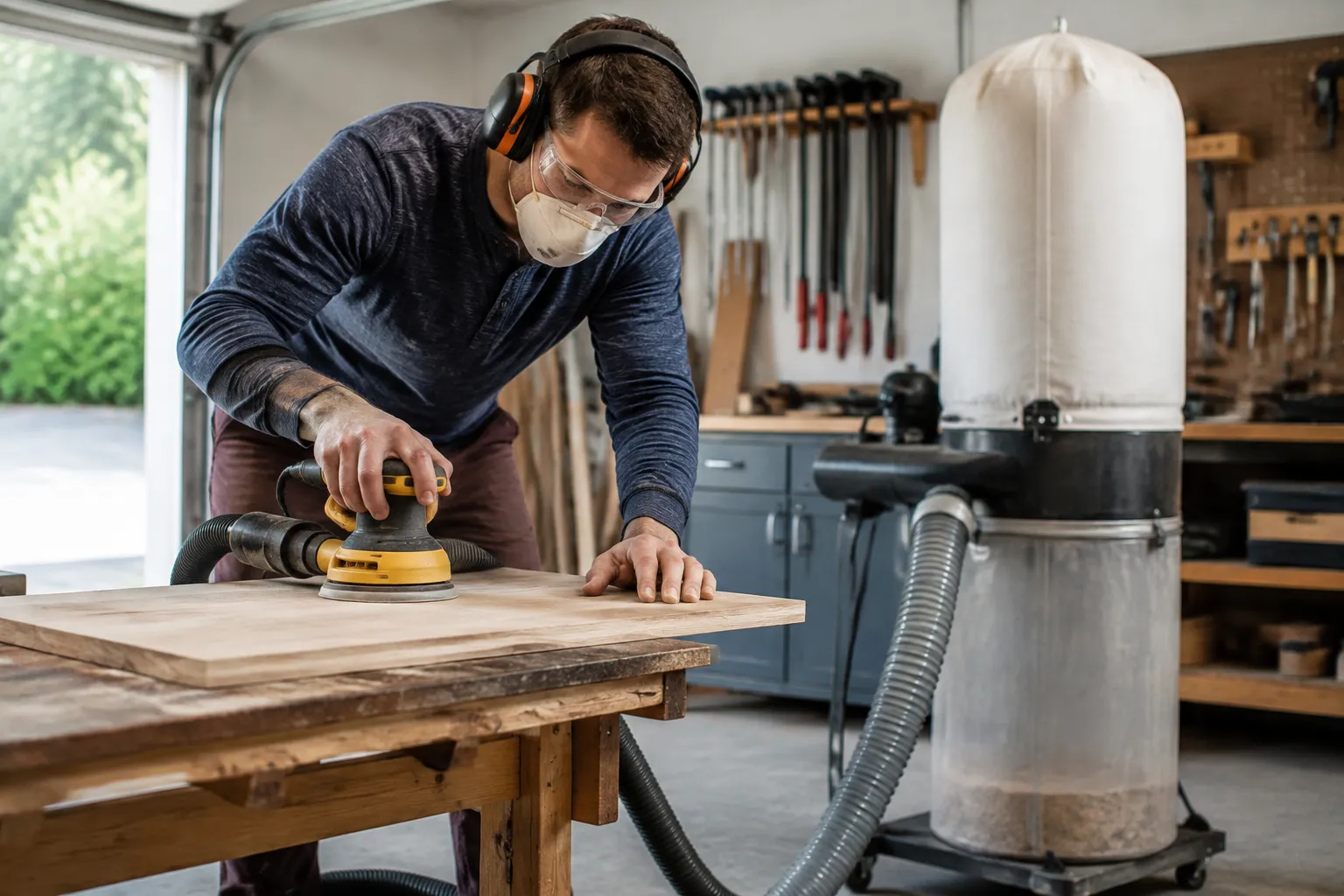
MDF dust is the reason many home garages have a permanent grey film on every horizontal surface. A person can wipe down the tool chest, sweep the floor, and blow out the corners, and the next sanding session leaves the same fine powder everywhere again. This is not a cleaning problem. It is a containment problem, and for anyone sanding in a garage attached to a house, it is also a health problem that gets ignored until the sinuses start complaining.
Wood dust is not a uniform substance. Coarse sanding with 60-grit on pine produces chips and shavings that behave like sawdust and mostly fall to the floor. The dangerous material is what comes off a random orbital sander using 120-grit or finer. That dust is light enough to stay airborne for minutes, fine enough to bypass the nose's filtering hairs, and sticky enough to cling to the sander's own pad, the workpiece, and everything downwind. A shop vac with a paper filter bag catches the big stuff and recirculates the rest straight back into the room.
The first question is not which dust collector to buy. It is whether the sander has a dust port at all, and whether that port connects to something that actually pulls air. Many sanders, particularly cheaper random orbit models, come with a cloth bag that does almost nothing. The bag fills with the coarsest fraction and lets the fine dust pour out the gaps around the motor housing. Replacing that bag with a vacuum hose connection is the single cheapest improvement available, and it changes the character of the work entirely.
What the Sander's Dust Port Actually Needs
A random orbital sander with a 5-inch pad moves a lot of air across the surface. The dust port on most sanders is a 1-1/4 inch or 1-1/2 inch fitting designed to accept a standard shop vacuum hose, and that fitting is the weak link. The sander's own fan, if it has one, is weak by design. The real suction has to come from an external vacuum, and the connection between the two needs to be airtight and short.
The practical reality is that a shop vac with a decent filter, connected directly to the sander with a short hose, captures perhaps 80 percent of the dust at the source. The remaining 20 percent escapes during the initial pass, when the sander touches down and the vacuum lags a beat, and from the gaps where the hose meets the port. That 80 percent capture rate is a massive improvement over the cloth bag, but it leaves enough dust in the air to settle on the car hood within an hour.
People who sand for more than a few minutes at a time graduate to a dedicated dust extractor. The difference is not suction power. A shop vac and a dust extractor can pull similar peak airflow. The difference is filter design. A dust extractor uses a HEPA filter as the final stage, and the filter is sized so that airflow does not drop as the filter loads. A shop vac's cartridge filter, even a good one, starts choking after a few hours of fine dust and requires frequent cleaning. The dust extractor keeps pulling the same volume for months.
For the home garage, the honest recommendation is a mid-range dust extractor with a 2-inch hose and an adapter down to the sander's port. This does not mean buying a Festool. Several manufacturers sell units in the 300 to 500 dollar range that handle sanding dust admirably. The important features are a HEPA-rated filter, a manual filter cleaning mechanism, and a hose that does not kink when bent. The hose diameter matters because the sander's 1-1/4 inch port is a bottleneck already; stepping down from a 2-inch hose to the port is fine, but starting with a 1-1/4 inch hose is not.
The Problem with the Two-Stage Separator
A dust separator, the cyclone bucket that sits between the tool and the vacuum, is standard advice for garage workshops. For sanding dust, that advice is mostly wrong. A cyclone separator excels at removing chips and shavings from the airstream before they reach the filter. Sanding produces almost no chips. It produces fine powder that a cyclone only partially captures, and the powder that makes it through is exactly the fraction that plugs a filter fastest.
Worse, the additional hose length and fittings that a cyclone requires create turbulence and pressure drop. Every extra foot of hose and every joint reduces the airflow at the sander's pad. The result is a system that looks impressive but captures less dust at the source than a simple shop vac with a HEPA filter and a short hose. The cyclone has its place in a shop that planes, joint, and table-saws rough lumber. For sanding, it is a step backward.
A simpler approach works better. Connect the sander directly to a dust extractor with the shortest hose that reaches the workbench. Empty the extractor's collection bag when it is half full, and clean the filter according to the manual. The dust lands in the extractor's bag, not on the floor, and the filter stays unclogged for a satisfyingly long time.
Ambient Air Filtration as the Backup Layer
Even with a dedicated extractor on the sander, some dust escapes. The sander lifts off the work to check progress, the edge of the pad catches a corner and throws a puff, and the workpiece gets flipped over with dust on the underside. This escaped dust is why a dedicated ambient air filter, hung from the garage ceiling, earns its place. These units recirculate the room air through a pleated filter, and the difference in air quality after ten minutes of running is dramatic.
The home garage has a particular problem that professional workshops do not. The door to the house is usually nearby, and the HVAC system shares return air between the garage and the living space. Dust that settles on garage shelves, tools, and the car's interior finds its way inside on shoes and clothing. An ambient filter running during and after sanding reduces the dust load that would otherwise migrate. It also keeps the garage itself from becoming a dusty storage space where everything needs a wipe-down before use.
The right size for a two-car garage is a unit rated for 300 to 400 square feet, run on a timer for at least an hour after the sanding stops. Smaller filters exist and cost less, but they run longer and noisier to achieve the same effect. The one-time cost of the larger unit is offset by not replacing the small filter's more frequent filter changes.
The Workbench Setup That Keeps Dust Out of the Operator's Face
Dust collection at the sander and the room is only half the story. The work surface itself matters. Sanding on a flat bench with the workpiece in front of the operator sends the dust cloud forward and upward, straight into the breathing zone. Raising the workpiece to a comfortable height and angling it slightly so the sander's exhaust blows away from the operator changes the exposure dramatically. A simple solution is a sanding block with a built-in dust port, which captures the dust at the point of contact and directs it toward the vacuum.
For larger panels, a workbench with a downdraft table is the gold standard. The table has a perforated top and a plenum underneath connected to a vacuum or dust extractor. The workpiece rests on the perforated surface, and the dust gets pulled down through the holes as the sander passes. This approach captures nearly all the dust from flat sanding and is especially effective for finishing work where the surface must be perfectly clean before applying a coat.
Building a downdraft table is a weekend project. A sheet of 3/4-inch plywood with a grid of 1/2-inch holes, a shallow box underneath, and a 2-inch port on one end connects to the dust extractor. The hole pattern does not need to be perfect. A 75 percent open area works fine, and the dust extractor's airflow through the holes creates enough downward velocity to catch the fine powder.
Why the Cloth Bag Is a False Economy
The cloth dust bag that ships with most sanders is not a dust collection system. It is a delay mechanism. It holds back the largest particles and lets the finest dust escape through the weave of the fabric, which is exactly the wrong fraction to release. A person who sands for ten minutes with a cloth bag creates a dust haze in the garage that takes hours to settle. The bag also fills quickly, and the moment it is half full, the airflow through it drops, which makes the sander run hotter and the dust escape faster around the edges of the bag.
Replacing the cloth bag with a vacuum hose adapter is a fifteen-minute modification that turns a mediocre sander into a reasonably clean tool. The adapter is a simple plastic fitting that replaces the bag and matches the sander's port. The vacuum does the work. The sander's own dust collection becomes irrelevant because the vacuum pulls through the same path.
The one tool that defeats almost every dust collection effort is the detail sander, sometimes called a mouse sander. Its triangular pad covers a small area, and the vacuum port on most models is a tiny fitting that loses airflow quickly. The result is a tool that sprays dust in an arc across the workbench. For corners and edges, a better approach is to use a small scraper or a hand sanding block with a folded piece of abrasive, and accept that this work produces dust that the ambient filter and a settling period will handle.
The Respirator Is Not Optional Equipment
No dust collection system captures everything, and the fraction that escapes is the fraction that causes the most harm. A well-fitted N95 respirator, worn for the entire sanding session and for fifteen minutes afterward while the fine dust settles, is the difference between a hobby and a health hazard. The disposable masks sold at hardware stores work if they seal against the face. A person with a beard will not get a good seal, and for that situation a half-face respirator with replaceable filters is the practical answer.
The respirator is not a substitute for dust collection. It is a complement. The two work together: the extractor removes the bulk of the dust at the source, the ambient filter cleans the air after the fact, and the respirator protects the operator during the moments when dust is inevitably in the air. Skipping any one of the three leaves a gap that the other two cannot fully close.
For finish sanding, where the goal is a clean surface for a coat of oil or varnish, the respirator matters in a different way. The operator is bending over the workpiece, directly in the path of the sander's exhaust. Even with a downdraft table, the first few passes eject dust sideways before the airflow catches it. The respirator makes the difference between sneezing brown dust later and finishing the coat without a single speck landing on the wet surface.
A Cheap Setup That Works, and the Upgrade Path
The minimum viable dust collection for a home garage costs under 150 dollars and works better than most people expect. A shop vac with a HEPA-rated cartridge filter, a 1-1/4 inch hose, and a sander adapter captures the majority of the dust at the source. This setup has two flaws. The filter loads faster than a dust extractor's, and the operator has to clean it more often. The second flaw is that the shop vac is loud, loud enough that wearing hearing protection becomes necessary for the whole session.
The upgrade path is a dedicated dust extractor with a 2-inch hose, a HEPA filter, and a manual filter cleaning mechanism. The price jump is significant, but the improvement in dust capture and the reduction in noise make it worthwhile for anyone who sands for more than an hour at a stretch. The dust extractor's larger hose also opens the door to connecting other tools, a belt sander, a circular saw with a dust port, an oscillating multi-tool, all of which benefit from the same suction.
The final piece of the system is the floor. A garage floor collects the dust that settles, and sweeping it with a broom just puts the fine fraction back into the air. A shop vac with a floor nozzle, or a dedicated floor sweeper that attaches to the same dust extractor, removes the settled dust without recirculating it. This is the detail that separates a garage that feels clean from one that merely looks clean.
The Real Measure of Success Is the Filter
After a full afternoon of sanding, the dust extractor's filter tells the truth. A system that works produces a filter that needs cleaning, a collection bag that is full, and a garage where the air clears noticeably within the hour. A system that fails produces the same grey film on every surface, a sander that feels hot to the touch, and a vague sense that something is still wrong. The difference is visible in the filter's pleats.
People who sand in their home garage often focus on the tool itself. The sander, the abrasive discs, the workpiece, the finish. Dust collection is the unglamorous support system that never gets celebrated but determines whether the project feels like a satisfying afternoon or a lingering cough for the next two days. The garage is not a professional workshop, but the air quality inside it does not have to be worse than a professional's. The right combination of source capture, ambient filtration, and personal protection makes the difference, and it is a difference anyone can feel on the first try.