
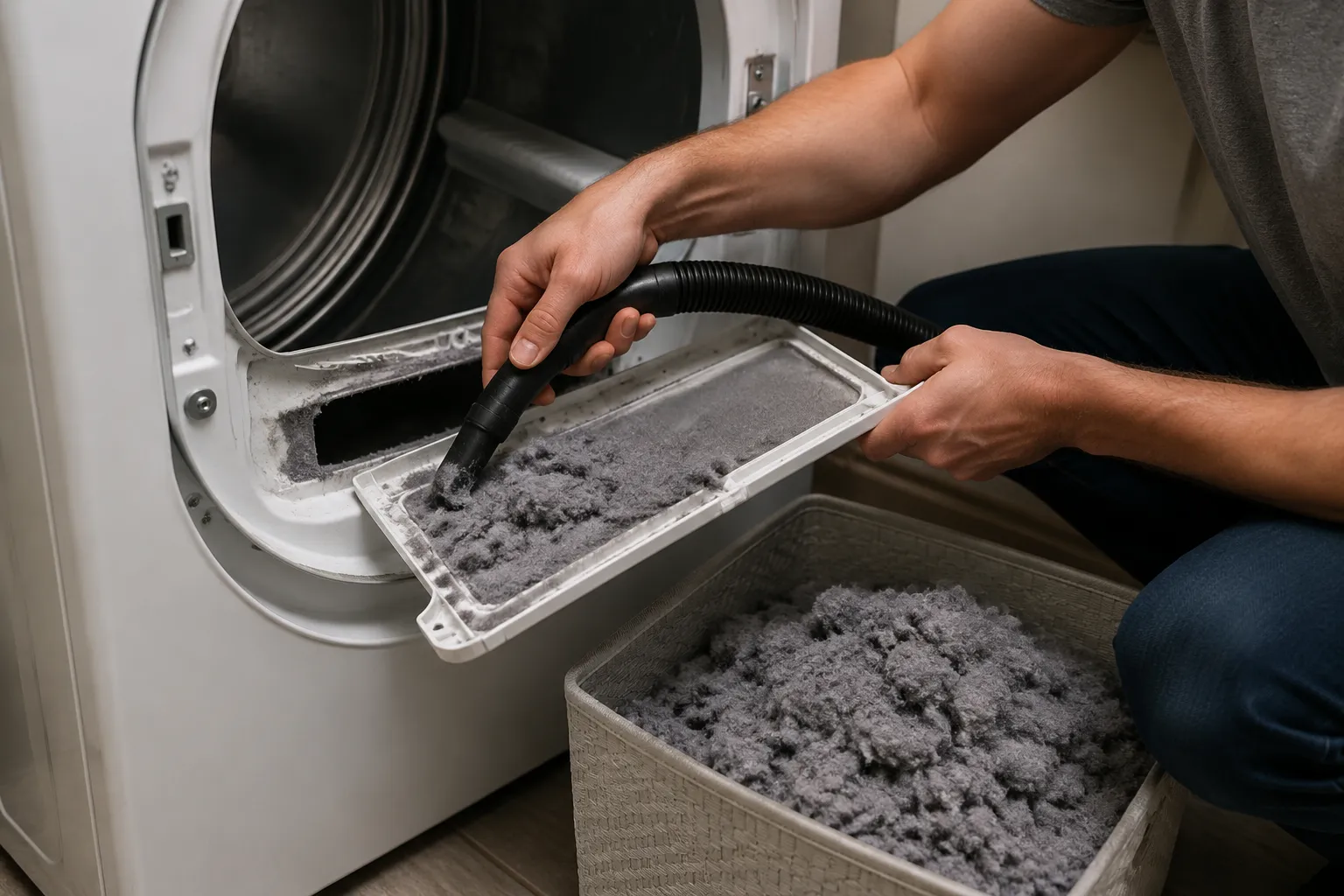
The fluff that collects on a dryer screen is not debris. It is a pile of concentrated fuel with a head start. Cotton, polyester, and human skin cells dry to a papery consistency at temperatures that regularly exceed 130 degrees Fahrenheit, and the resulting mat of fibers ignites easier than nearly anything else in a typical American home. The Consumer Product Safety Commission has attributed thousands of residential fires to dryer vents over the years, and while exact numbers shift with each reporting cycle, the mechanism is not in dispute. Lint blocks the screen, the screen slows the airflow, the heating element keeps firing, and the temperature climbs until something gives. The entire sequence takes months to set up and about ninety seconds to finish.
Most people clean the lint screen because it shortens drying time, not because they are afraid. That is the wrong motivation, and it leads to the wrong habits. A person who views lint removal as a performance tweak will do it when the load comes out damp. A person who views lint removal as a fire-prevention ritual will do it every single time, even when the dryer finished an hour ago and the screen looks nearly empty. The difference sounds cosmetic. It is not.
The screen is only half the job
The visible screen catches the big pieces. Behind it, past the filter housing and into the vent run, a finer dust accumulates that no amount of screen-flicking will ever touch. This is the lint that escapes the trap, and it is the lint that actually kills people. It coats the inside of the metal duct in a soft, gray fur that narrows the passage inch by inch. Airflow drops. Heat builds. A spark from the motor or a hot spot in the heater coil finds the fluff and the whole duct becomes a fuse running straight into the wall.
The most common setup in American homes is a 4-inch metal duct running from the dryer to an exterior wall cap. The straight-line distance might be six feet, but with a tight laundry closet, the installed reality is usually a corrugated aluminum tube that bends twice and gets crushed behind the machine. Every corrugation is a trap. Every compression point is a choke. The flexible metal ducts that builders love because they are cheap and easy to route are the same ducts that collect lint in their ridges and refuse to let go.
Cleaning the screen is a daily act. Cleaning the duct is a seasonal one, and it is the one that actually matters. A person who has never pulled the dryer away from the wall and looked at the back of the machine has not done the job. A person who has never removed the duct from the exhaust port and run a brush through it has only been guessing.
What a full duct actually looks like
During a routine maintenance pass on a mid-2000s dryer, the first pull of the duct from the exhaust port revealed a blockage that had reduced the opening to the size of a pencil eraser. The lint was not loose. It had packed itself into a dense, felted plug that required a screwdriver to break apart. The dryer had still been running. It had still been drying clothes, just slowly, and the machine had been running hot enough that the exterior of the drum was warm to the touch long after the cycle ended.
That is the danger of gradual buildup. Nothing fails all at once. The dryer takes four minutes longer per load, then six, then ten. The laundry room gets a little warmer. The clothes come out with a faint baked smell that most people blame on the fabric softener. The system degrades so gently that the warning signs are indistinguishable from normal household drift, and by the time the machine trips its thermal cutoff and stops heating entirely, the duct has been a fire hazard for months.
Brushes for this job cost under thirty dollars. A proper kit includes a flexible rod, a brush head, and a connector that attaches to a drill. The process takes twenty minutes and leaves a person kneeling on a concrete floor with a pile of gray dust that smells like a campfire. That dust is the proof that the job was worth doing.
The dryer itself needs a strip-down
The duct is the highway. The dryer cabinet is the origin point, and lint collects inside it in places a person would never think to look. The exhaust housing behind the drum is the worst offender. Lint that slips past the screen gets pulled by the airflow into this cavity, where it settles on the heating element housing and the motor bracket. Over years of operation, this accumulation can reach an inch thick. It is invisible from the outside. The only way to see it is to remove the front panel or the rear service cover, depending on the model.
This is not a job for everyone. It requires a screwdriver, a vacuum with a hose attachment, and a willingness to look at the guts of a major appliance. But for a person who owns a home and plans to keep the dryer for more than a few years, learning the basic disassembly is one of the highest-value skills in the house. Videos of the specific model show where the screws hide. The process takes an hour the first time and twenty minutes every time after.
The payoff is concrete. The first time the cabinet comes off, the vacuum hose pulls out enough lint to fill a grocery bag. The dryer runs quieter, the clothes dry faster, and the machine stops smelling like a furnace when it cycles off. The difference is not subtle. It is the difference between a device that is working and a device that is barely surviving.
The vent cap is the forgotten endpoint
At the other end of the duct, where the exhaust exits the house, sits a flap of metal or plastic that is supposed to swing open when the dryer runs and close when it stops. Bird nests, wasp nests, and simple years of weather can jam this flap permanently. When the flap is stuck closed, the dryer cannot exhaust at all. The air has nowhere to go, so it backs up into the machine, and the machine runs hotter and hotter until it shuts down or worse.
Checking the exterior vent cap takes thirty seconds. A person walks outside, looks at the wall or roof penetration, and confirms the flap moves freely. In winter, frost can freeze the flap shut. In spring, a bird can build a nest right behind it. The fix is usually a gentle push with a finger or a quick scrape with a putty knife. That is the entire job, and it is the most overlooked step in the entire lint-prevention sequence.
The exterior vent also serves as a diagnostic tool. If the flap barely opens when the dryer is running, the duct is clogged. If the flap stays open after the dryer stops, the duct is full of warm, moist air that will condense and promote mold. A healthy vent cap opens fully, lets a strong, dry puff of warm air escape, and snaps shut with authority. Anything less is a message.
When to replace the duct entirely
Rigid metal duct is the gold standard. It is smooth, it does not crush, and it cannot be kinked into a dead stop. But many homes, especially those with laundry rooms added in a basement remodel or a closet conversion, use the flexible foil or plastic ducts that fold like an accordion. These ducts are sold in hardware stores as universal replacement parts, and they are universally bad for permanent installation. The ridges catch lint. The flex points wear through. The plastic versions can melt if the dryer exhaust gets hot enough.
Building codes in most jurisdictions now require rigid or semi-rigid metal duct for dryer installations, but code compliance only applies at the time of construction or major renovation. A home built in 1998 with a foil duct in the wall is still running that same foil duct. Replacing it requires cutting into the wall, which is a bigger job than most people want to undertake. The realistic alternative is to clean the interior of that flexible duct aggressively and often, or to reroute the duct along the exterior of the wall where it can be inspected and replaced in an afternoon.
For a person facing a long, convoluted duct run, replacement is not a luxury. A 25-foot duct with four 90-degree bends will always clog faster than a 6-foot straight run. The physics are simple: every bend creates a low-pressure zone where lint drops out of the airstream and settles. The only real fix is to shorten the run, and the only way to shorten it is to move the dryer closer to an exterior wall or install a periscope-style vent that routes upward instead of sideways.
The habit that beats every tool
Tools matter, but habits matter more. The most effective lint-prevention practice in the world costs nothing and takes five seconds: clean the screen before every load, not after. Doing it before the load means the screen is always empty when the dryer starts. Doing it after the load means the screen sits overnight with a warm, damp mat of lint on it, which is a perfect breeding ground for mildew and a tempting snack for a curious pet. The before-load habit also catches the second screen that many dryers have in the lint housing, a smaller mesh filter that people often miss entirely.
A person who cleans the screen before every load will notice something quickly. The second load of the day produces less lint than the first. The third produces less than the second. The screen is not pulling less material; the dryer is simply running on a clear airway, so the same amount of lint gets pushed through rather than recirculated and re-deposited. A clean screen is not just a fire-safety measure. It is the difference between a dryer that works and a dryer that merely spins.
The deeper habit is the seasonal inspection. Mark a calendar date, the first Saturday of the month that the clocks change, or the day the smoke detector batteries get swapped. On that day, pull the dryer out, disconnect the duct, run a brush through it, and check the exterior flap. Ten minutes of preventive work on a Saturday morning replaces the hours of cleanup and the risk of a visit from the fire department on a random Tuesday night.
Smoke detectors are the backstop, not the plan
Every laundry room needs a smoke detector, and most have one. But a smoke detector in the laundry room is a last line of defense that only works if the fire is already burning. The lint fire that starts inside the dryer duct smolders for a long time before it produces enough smoke to trigger an alarm. It heats the metal duct, it heats the wall cavity, and by the time the alarm sounds, the fire has usually moved past the smolder stage into active flame. The detector gives a family enough time to escape. It does not give them enough time to save the house.
A better backstop is the thermal cutoff that most dryers have built into the heating element assembly. This small device trips when the exhaust temperature exceeds a safe threshold, cutting power to the heater before the machine can cook itself. It resets automatically after the dryer cools, which means a person can have a failing vent and never know it. The dryer just runs slower and hotter and trips the cutoff repeatedly, and the owner eventually blames the clothes or the cycle settings. The cutoff is a circuit breaker, not a maintenance schedule.
Paying attention to temperature is the only real defense. When the dryer keeps shutting off mid-cycle, when the clothes come out hotter than they used to, when the laundry room feels like a sauna, the vent is failing. These symptoms are not quirks. They are the dryer saying, in the only language it has, that the airflow is gone and the heat has nowhere to go.
The cost of ignoring the problem
Replacing a dryer costs $600 to $1,200. Replacing a wall that caught fire costs five figures. The gap between those numbers is the price of a lint brush and an hour of time once a year, and the choice between them is not a financial calculation. It is a decision about whether a person treats the dryer like a tool or like an appliance. A tool gets maintained. An appliance gets used until it breaks.
The evidence of the difference is on the floor of every laundry room that has ever had its dryer pulled away from the wall. The gray dust, the matted clumps, the faint smell of burnt fabric that lingers on the back of the machine. That is the proof of neglect, and it is also the proof that the neglect is fixable. The dryer is one of the few major appliances in a home that will literally tell its owner when it is in danger. It runs longer. It runs hotter. It smells. The only question is whether anyone is listening.