
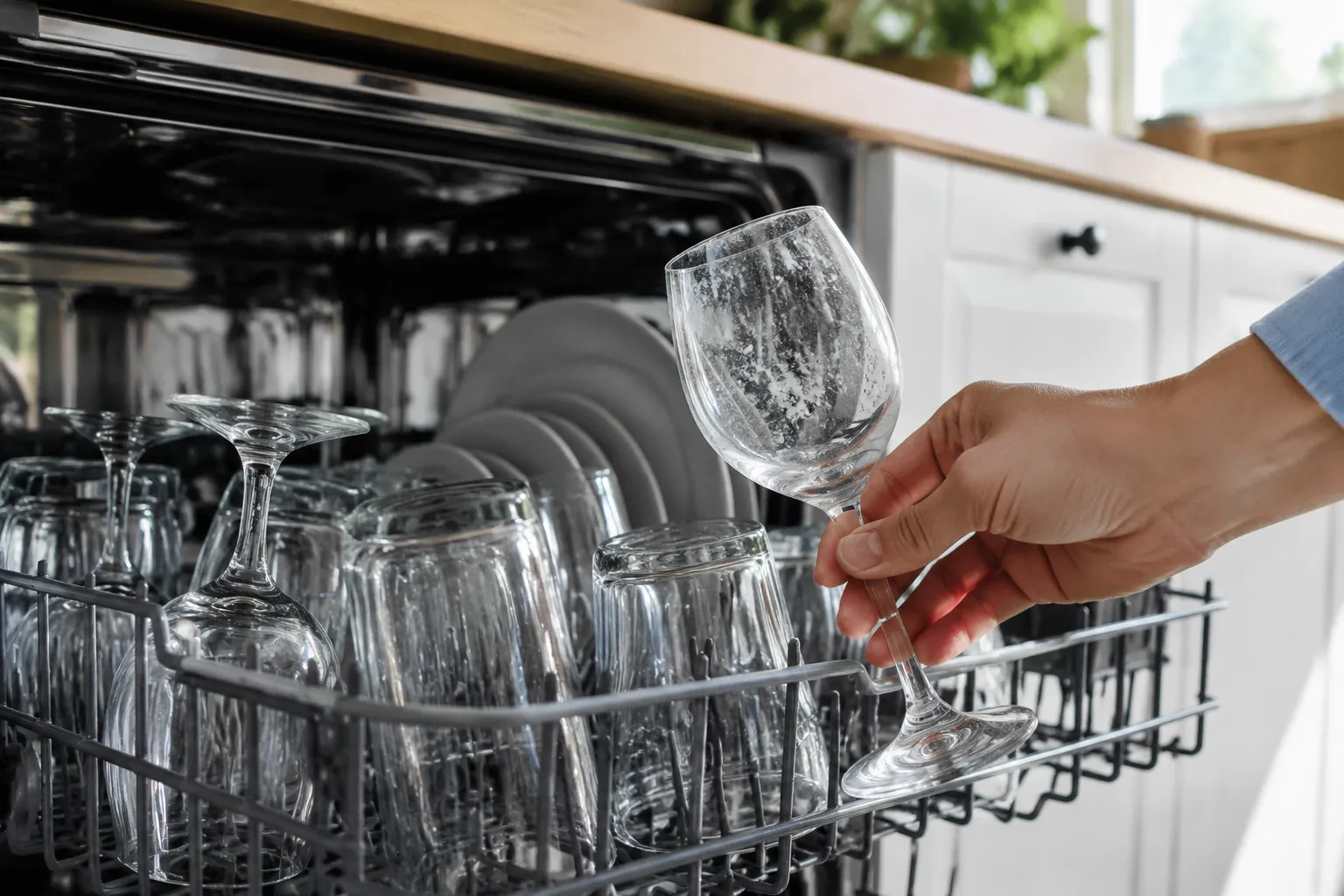
Hard water leaves behind a chalky film on glassware that feels rough to the touch and looks worse under light. Rinse aids help, but they only do so much when the water coming into the machine carries dissolved calcium and magnesium at levels high enough to wreck a clear glass finish. The problem is not the dishwasher. The problem is what the dishwasher pumps over the dishes, and the fix requires changing how the machine treats that water, not just adding another bottle of something to the rinse cycle.
Most people first notice trouble on the glasses, because glass shows everything. A white haze builds after a few cycles. Sometimes it looks like a stain that refuses to budge. Sometimes it feels gritty. The glass is not actually dirty in the normal sense. The minerals in the water have precipitated out during the heated dry cycle and left a crust behind. Detergents, even the good ones with citric acid or other chelating agents, cannot always hold those minerals in suspension long enough to rinse them away.
A Water Softener Is the Only Real Cure
No amount of detergent chemistry will fully compensate for feed water that measures 10 or 15 grains per gallon of hardness. The machine can be clean, the detergent can be fresh, the rinse aid can be full, and the glasses will still come out spotted or filmed. The mineral load is simply too high for the wash chemistry to handle. The practical answer is an ion-exchange water softener plumbed into the home's supply, and it fixes the problem at the source.
Softened water changes the entire wash environment. The dishwasher uses less detergent to get the same result, the glasses dry without streaks, and the interior of the machine stops accumulating scale on the heating element and the spray arms. People who install a softener often notice the difference on the very first load. The glasses come out looking like they did when the machine was new. That result is not a minor improvement; it is a categorical change in performance.
The catch is that a whole-house softener is not a casual purchase. It requires space, plumbing, and ongoing maintenance in the form of salt refills. For a homeowner, it is an easy long-term decision. For someone renting, it is usually off the table entirely. Renters are stuck working around the water they have, which means the rest of the advice here matters most to them, though even owners with softeners will occasionally need the targeted fixes below.
Rinse Aid Is a Dose of Chemistry, Not a Gimmick
Rinse aid does not prevent hard water from entering the machine, but it does change what happens when the water sheets off the glass. The active ingredient in most rinse aids is a surfactant that lowers the surface tension of the water. Instead of beading up into droplets that dry into spots, the water spreads into a thin film and runs off. Fewer droplets mean fewer mineral deposits left behind after the dry cycle.
The mistake many people make is setting the rinse aid dispenser to minimum and forgetting it. The setting needs to be turned up as the hardness of the water increases. A person on moderately hard water should start around the middle of the dial and adjust upward after inspecting a few loads. The proper setting is the one that leaves glasses clear and dry. If the glasses come out wet with droplets, the setting is too low. If there is a faint blue tint on plastic parts, it is too high.
Rinse aid is cheap relative to the frustration it removes. A bottle lasts months and costs a few dollars. Yet a surprising number of households skip it entirely, treating it as an optional extra rather than a required input. For hard-water homes, it is as essential as detergent. Running a dishwasher without rinse aid on hard water is like driving with the parking brake on and wondering why the car feels sluggish.
Detergent Choice Matters More Than People Think
Powder, gel, and tablet detergents behave differently in hard water, and the differences become obvious on glass. Powders and gels rely on builders like sodium carbonate and sodium citrate to sequester minerals. Tablets often pack in even more of these agents, along with a glass-protective polymer, precisely because they are formulated for the worst-case water. A tablet is usually the right call for a hard-water household.
That said, tablets need to be placed in the dispenser, not tossed loose into the tub. The dispenser releases the tablet at the optimal moment in the wash cycle, after the pre-rinse has flushed away loose food. A tablet thrown into the bottom of the machine dissolves during the pre-rinse and gets dumped before the main wash even starts. This single habit change fixes a load of persistent film issues for people who assumed their detergent was defective.
Another consideration is the finish on the glass itself. Etched or frosted glassware has a porous surface that traps minerals more readily than smooth glass. There is no detergent that will keep etched glass perfectly clear in hard water. The best a person can do is reduce the mineral load with rinse aid and hope the film stays light enough to clean by hand. Some glasses are simply incompatible with hard water, and no chemistry will change that.
The Machine Itself Needs Periodic Descaling
Hard water does not only attack the glasses. It builds up inside the dishwasher too, coating the spray arms, the filter, and the heating element with scale. A machine that looks clean on the outside can be struggling on the inside, with clogged spray-arm nozzles that reduce water pressure and uneven coverage. The glasses then come out dirty because the wash action has degraded, not because the water is hard.
Running an empty cycle with a descaling product every few months is the direct remedy. Citric acid powder, available cheaply in the canning section of most grocery stores, works as well as the branded descalers. Three or four tablespoons of citric acid in the detergent dispenser, a hot wash cycle, and a second rinse is enough to dissolve the scale that has accumulated in a typical household machine. The difference in performance is noticeable after the first descaling.
Neglecting this maintenance has a compounding effect. Scale builds on scale. The heating element becomes less efficient, so the water does not get as hot. The water temperature drops, which reduces the detergent's effectiveness. The spray arms push less water with less force. The machine slowly becomes worse at its only job, and the owner blames the detergent or the glasses instead of the thick white crust inside the sump.
A Filter Clean Keeps the Minerals From Redepositing
Most modern dishwashers have a self-cleaning filter that grinds food particles, but many also have a secondary filter screen that catches larger debris. Hard water minerals do not get ground up. They precipitate and settle in the bottom of the tub. If the filter is clogged with a mix of food residue and scale, the wash water recirculates that gritty slurry over the glasses. The result is a film that looks like hard water but is actually recirculated grime.
Pulling the filter assembly out and rinsing it under hot tap water once a month takes under a minute. A soft brush helps dislodge the scale that sticks to the mesh. The owner's manual shows where the filter is located and how it comes apart. This is the cheapest maintenance a person can do, and it is the one most often skipped because the filter is out of sight and the consequences are gradual.
The glasses will not sparkle after a single filter cleaning if the spray arms are also clogged. The spray arms should come off too. The nozzles are small, and scale can block them one by one. Soaking the arms in a dilute citric acid solution clears the openings and restores the spray pattern. This is a 15-minute job that should be part of the same monthly routine as the filter rinse.
Wash Temperature Changes the Deposition Rate
Hard water minerals are more likely to precipitate out of solution as the water temperature climbs. The heated dry cycle is the worst offender. The air inside the tub gets very hot, the water on the glass evaporates, and the minerals that were dissolved in that water are left behind as a crust. A lower heat-dry setting, or turning the heat dry off entirely and letting the glasses air-dry, reduces the film by a meaningful margin.
Air-drying leaves glasses wetter for longer, which annoys some people, but the trade-off is cleaner glass. The water droplets that remain are mostly mineral-free because the minerals stayed dissolved until the water evaporated. A person who opens the door at the end of the cycle and pulls the racks out a few inches gets most of the drying benefit without the intense heat that bakes the minerals on.
The wash temperature itself matters less than the dry temperature. A hot main wash helps the detergent work, and the minerals stay in solution while the water is moving. It is the static, evaporating water in the dry phase that causes the spotting. Some machines have a sensor that extends the dry cycle until the dishes reach a certain temperature, which makes the problem worse on hard water. Disabling that sensor or choosing the shortest dry option helps.
The Vinegar Trick Needs a Caveat
Putting a bowl of white vinegar on the top rack and running a cycle is a popular home remedy for hard-water film. The acid does cut through mineral deposits, and the glasses come out looking better. The caveat is that vinegar can damage the rubber gaskets and seals in the machine over time. The acetic acid is harsh on the elastomers that keep the door watertight. A person should not make vinegar rinses a weekly habit.
Citric acid is the safer alternative. It is a dry powder, it dissolves completely, and it does not attack the rubber parts the way vinegar does. It is also cheaper per use. A bag of citric acid that costs a few dollars lasts for many descaling cycles. The only reason to use vinegar instead is convenience, because it is already in the pantry, but the long-term cost of a degraded door gasket is far higher than the price of a bag of powder.
Neither vinegar nor citric acid should be added while the dishwasher is full of dishes. The acid loosens scale, and that loosened scale lands on whatever is in the machine. The correct method is an empty tub, a clean filter, and the acid in the detergent cup. The machine gets cleaned, and the glasses are not in there to catch the fallout.
The Final Inspection After Every Cycle
A person who checks the glasses as they come out of the machine, rather than waiting until the next load to discover the film, can catch problems early. A faint haze on the bottom of a glass is the first sign that the rinse aid setting has drifted or the filter is starting to clog. Catching it after one cycle is cheaper and faster than stripping a month of accumulated film off every glass in the cabinet.
The strip is another matter. Glasses that have built up a heavy mineral layer over many cycles need a manual soak in hot vinegar or citric acid before they will come clean in the dishwasher. No amount of machine chemistry will remove a crust that has been baked on by dozens of heated dry cycles. The glasses soak for an hour, the film wipes off with a sponge, and the dishwasher can keep them clean from that point forward, provided the underlying water problem is addressed.
That is the full sequence. Soften the water if possible. Turn up the rinse aid. Use a good tablet in the dispenser. Descale the machine and clean the filter on a schedule. Skip the heat dry when the film is stubborn. The glasses come out clear because the minerals never get a chance to settle, and that is the only measure that counts.