
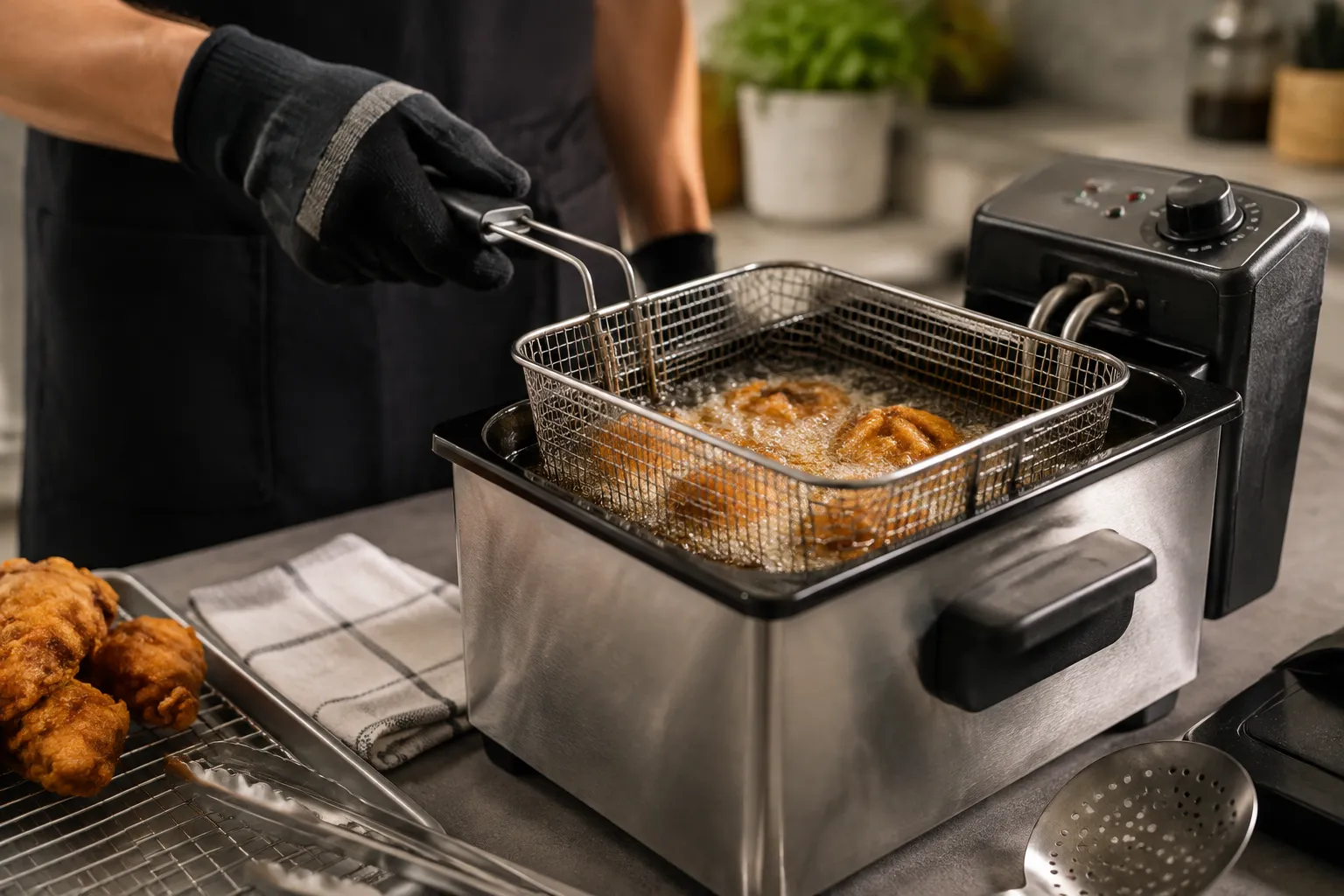
Frying oil at 350 degrees Fahrenheit behaves nothing like boiling water. Water bubbles and splashes and makes itself known. Oil sits there, deceptively calm, shimmering like a smooth surface, while holding enough thermal energy to cause third-degree burns in under a second. That single fact, the quiet violence of hot oil, should govern every decision a home cook makes around a deep fryer. Most safety advice focuses on the dramatic moments, the grease fire, the dramatic splash, but the real danger is the mundane ones, the distracted reach across the counter, the wet utensil, the overfilled basket.
The home deep fryer occupies an odd space in the kitchen appliance hierarchy. It is not quite a tool for everyday cooking, nor is it a specialty gadget that gets used twice a year. People buy them for state fair nostalgia, for fish and chips Fridays, for the occasional batch of doughnuts. The machine sits in a cabinet for months, then gets hauled out for a holiday or a birthday, and that is precisely when accidents happen. A person who fries once a month operates with less practiced caution than a professional who does it daily.
The Water Problem Is the Only Problem
Every serious fryer accident traces back to water meeting oil. The physics are unforgiving. Water is denser than oil, so it sinks to the bottom of the pot, where it hits the heat source, flashes to steam instantly, and expands by a factor of roughly 1,600. That expansion hurls hot oil upward and outward in a violent eruption that catches faces, arms, and chests. This is not a theoretical concern. This is the mechanism behind most serious home frying injuries.
The obvious culprit is dropping wet food into the basket, but the less obvious ones matter just as much. A damp towel used to wipe the rim of the pot. A lid with condensation on its underside. A person who washes the basket and does not dry it completely before refilling the oil. Even a wet finger that drags along the edge of the pot can cause a small, painful spatter.
The fix is a habit, not a checklist. Food should be patted dry, then rested on a wire rack for a few minutes, then patted again. Battered items are a separate category; the batter itself contains water, but it holds together and fries predictably. The danger is loose moisture, the surface water on a raw chicken wing or a handful of onion rings that have been sitting in a bowl of ice. Ice is water. Ice in a fryer is a small explosion.
One practical rule helps more than any other: keep a dry towel dedicated to the fryer. It lives next to the machine, never touches raw food, and only ever handles the basket handle, the pot rim, and the outside of the unit. That way, there is never a question of whether the towel is dry. It simply is.
Temperature Control Keeps Oil From Becoming Fire
Oil does not ignite at a fixed temperature, but it does reach a point where it breaks down, smokes heavily, and becomes a serious fire hazard. Most cooking oils used for deep frying, canola, peanut, vegetable, have a smoke point somewhere between 400 and 450 degrees Fahrenheit. A home deep fryer set to 375 degrees with a working thermostat stays safely below that. The danger arrives when the thermostat fails, when the oil is old and full of food particles that lower its smoke point, or when a person turns the dial to maximum and walks away.
An unattended pot of oil heating toward its smoke point is the single most dangerous object in a home kitchen. The oil will not burst into flame the moment it smokes. It will smoke, then smoke more, then the smoke itself becomes flammable, and then the surface of the oil catches with a rolling, expanding fire that moves fast. The window between first heavy smoke and full ignition can be a matter of seconds or minutes depending on the oil and the heat level.
A reliable, instant-read thermometer is not optional equipment. The dial on a cheap fryer can drift by twenty degrees or more, and the thermostat on a well-used unit can stick. Checking the oil temperature with an independent thermometer before adding food is a two-second action that removes all guesswork. For those who fry often, keeping the fryer on a dedicated counter circuit is another layer of protection; the machine draws a lot of power, and a shared outlet with a toaster oven or coffee maker can trip a breaker at the worst possible moment.
The Basket Fill Line Is a Physical Limit
Every fryer basket has a marked or implied fill line, and the line exists for a reason that has nothing to do with portion control. When food is submerged in hot oil, it releases steam and displaces oil upward. Overfill a basket by a third, and the oil level rises enough to spill over the rim of the pot. That spill runs down the side of the machine, pools on the counter, and finds the heating element or an open flame on a stove burner.
There is also the matter of how much food can be fried at once without crashing the oil temperature. Dropping a full basket of cold, wet food into a pot of oil at 375 degrees will drop the oil temperature by a hundred degrees or more. The food absorbs oil, comes out greasy and pale, and the cook, frustrated, turns up the heat to compensate. That is how oil gets overheated and how fires start. Frying in smaller batches, half a basket at most, keeps the temperature stable and the oil below its danger point.
Food that is crowded also sticks together, and separating it mid-fry with a metal spatula or tongs can tear the crust and release moisture into the oil. The better approach is patience. Let the first batch finish, let the oil come back up to temperature for a minute or two, then start the second batch. This is not a time-saving technique. It is a safety protocol that happens to produce better food.
Where the Machine Sits Changes Everything
The placement of a deep fryer in a kitchen is usually an afterthought. It gets pushed to the back of the counter, near the wall, maybe under a cabinet. That location is a problem. A fryer needs clearance on all sides, including above. Steam and oil vapor rise from the pot, condense on the underside of a cabinet, and drip back down, sometimes into the oil, sometimes onto the counter. The heat from the machine can also damage laminate and warp wood over time.
The ideal spot is the center of a clear counter, at least six inches from the wall, with nothing hanging above it. The cord should not dangle over the edge where a child or a pet could tug it. The machine should sit on a flat, stable surface; a wobbling fryer is a tipped-over fryer waiting to happen.
Counter height matters too. A fryer placed on a low counter invites a child to reach up and grab the basket handle. A fryer placed too high, on a tall shelf or a microwave cart, puts the pot at face level where steam burns are more likely. The practical sweet spot is a standard kitchen counter, a surface where the cook can see into the pot without leaning over it.
Old Oil Is a Safety Issue, Not Just a Flavor Issue
Used oil behaves differently than fresh oil. Every frying session introduces food particles, moisture, and heat stress that break down the oil's molecular structure. The smoke point drops, sometimes dramatically. A batch of oil that once handled 375 degrees without complaint might start smoking at 340 after several uses. The oil also gets thicker and foamier, and foaming oil is oil that is close to boiling over.
Filtering oil after each use extends its life, but it does not restore it. A good rule of thumb is to replace oil after three to five uses, or sooner if it has a stale smell, darkens significantly, or foams when heated. Some cooks keep a log of how many batches they have fried, which sounds obsessive but is actually practical. Oil is cheap relative to a trip to the emergency room.
Disposing of old oil is another safety step that gets skipped. Pouring hot oil down the drain is a plumbing disaster. Pouring it into a plastic trash bag is a spill hazard. The honest method is to let the oil cool completely, pour it back into its original container or a sturdy jug, and dispose of it with regular trash or at a local recycling drop-off. Some municipalities accept used cooking oil for biofuel, and a quick search will confirm what is available nearby.
The Fire Extinguisher Is a Last Resort, Not a Plan
A grease fire in a fryer cannot be put out with water. Water will sink to the bottom of the pot, flash to steam, and spray burning oil across the kitchen. Flour, sugar, and other dry powders can create a dust explosion. The only effective responses are a Class B fire extinguisher or a metal lid that can smother the flames by cutting off oxygen.
Every household with a deep fryer should have a Class B extinguisher within reach of the appliance, not in a cabinet or a pantry across the room. The extinguisher should be inspected annually, and every adult in the household should know how to use it. The acronym PASS, pull the pin, aim at the base, squeeze the handle, sweep side to side, is simple enough to remember in an emergency.
The even better response is prevention through vigilance. A person who stays in the kitchen while the fryer is on, who keeps the pot covered when not actively frying, and who turns the heat off the moment something goes wrong will never need the extinguisher. The machines that cause fires are the ones left running while the cook answers the door, takes a phone call, or steps outside for a cigarette.
Cooling Down Is Part of the Process
When the last batch comes out of the oil, the cook's instinct is to leave the fryer to cool on its own and deal with it later. That is fine, as long as the machine is unplugged first. An unplugged fryer cannot accidentally turn back on, and a fryer that is off but still hot is far less dangerous than one that cycles its heating element on and off as it cools.
The oil should be left in the pot until it reaches a safe temperature, generally below 200 degrees Fahrenheit. Moving a pot of hot oil, even a few inches, invites a catastrophic spill. A person who tries to hurry the process by carrying the pot to the sink is taking a risk that no shortcut justifies.
Children and pets should be kept away from the cooling fryer. The oil stays dangerously hot for a long time; at 300 degrees, it can still cause severe burns. A fryer that looks cool to the touch on the outside can have oil inside that is still simmering. The safest cooling protocol is simple: unplug, cover, and leave the machine alone for at least an hour, preferably two.
When the oil is finally cool, the cleaning begins. The basket and pot should be washed with hot, soapy water and dried completely before being stored. Any residual moisture in the pot, even a few drops, will be a violent surprise the next time the fryer is used. The machine itself should be wiped down, the exterior dried, and the cord coiled loosely, never wrapped tightly around the unit, which can stress the wiring over time.
The deep fryer is a forgiving machine that punishes carelessness. Every rule in this article comes down to one principle: respect the oil, because the oil does not care who is standing near it. A cook who treats the fryer with the same wariness as a power tool, who checks temperatures, dries food, watches the basket, and never leaves the machine alone, will make excellent fried food for years without incident. The cook who treats it like just another kitchen appliance is the one who learns the hard way why the rules exist.