
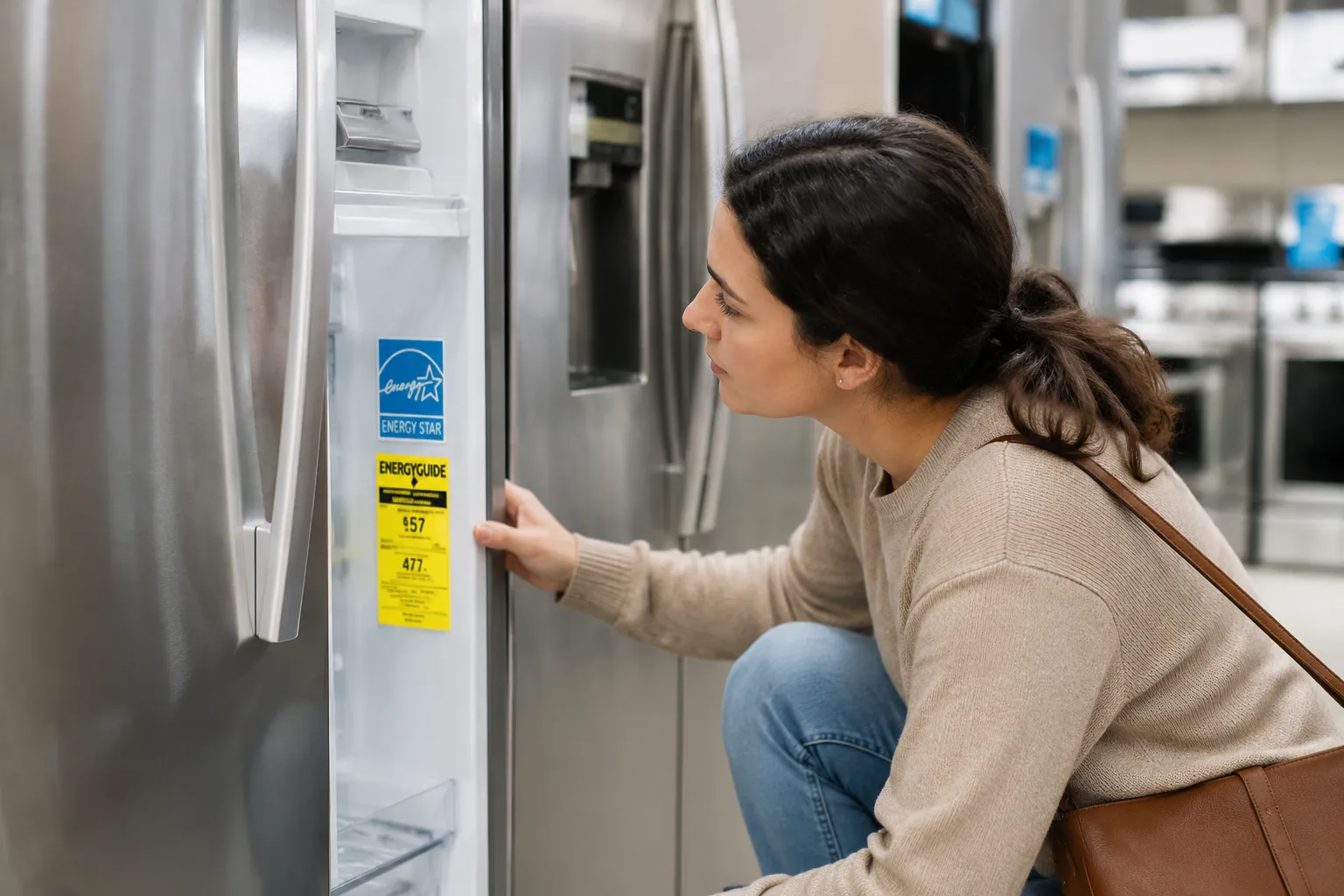
The yellow tag taped to the front of a refrigerator is one of the smallest pieces of government paperwork most people will ever read, and one of the most misunderstood. Energy Star is a voluntary program run by the Environmental Protection Agency, which means a manufacturer chooses to submit a product for testing. That choice matters. It means the label is not a baseline safety rating. It is a marketing claim backed by a testing protocol, and the gap between those two things is where the confusion lives.
The sticker itself looks simple. A blue star, the words "ENERGY STAR," and a number that tells a shopper roughly what the appliance will cost to run for a year. But the number only makes sense if a person understands what it is comparing. The test used to generate that number is standardized, which is good. It is also decades old in its assumptions, which is a problem for anyone buying a refrigerator in 2025 and expecting the label to reflect how a modern household actually lives.
Here is the first thing to understand: the annual cost figure on the label assumes a specific usage pattern. For most appliances, that pattern was set when the test procedures were written, and those procedures have not always kept pace with how people cook, cool, and clean now. A refrigerator test assumes a certain ambient room temperature, a certain number of door openings, and a certain internal temperature setting. Change any of those, and the real-world cost shifts. Not by a little. By a lot.
Take the refrigerator test. The standard procedure runs at an ambient temperature around 70 degrees Fahrenheit, which is reasonable for a kitchen that is actively climate-controlled. But a garage fridge sits in a space that might hit 90 degrees in July. That unit will run far more often than the label suggests, and the annual cost estimate becomes fiction. The label never tells a buyer that its math depends on a temperate, air-conditioned room. The small print on the tag references the test procedure, but nobody reads that far.
The Difference Between a Rating and a Rebate
The Energy Star mark serves two masters, and buyers need to know which one is talking. The first master is the federal government's testing regime, which sets minimum efficiency standards that every appliance must meet to be sold legally. Energy Star sits above that floor. A product earns the star by beating the federal minimum by a specific percentage, which varies by product category. The second master is the utility company. Many states offer rebates for Energy Star purchases, and those rebates are funded by ratepayers. The sticker is the ticket to that money.
This is where the label gets tactical. A shopper who walks into a store with a rebate form in hand is not just comparing efficiency. They are comparing how much money comes back at the end of the transaction. A slightly less efficient model might cost less upfront, but the rebate on the Energy Star model can close the gap. Sometimes it closes it completely. Sometimes it flips the math entirely, making the pricier, more efficient unit the cheaper purchase on day one.
But rebates change. They are set by state legislatures and utility commissions, not by the EPA, and they get funded and defunded on a schedule that has nothing to do with appliance technology. A rebate that exists in March can be gone by June when the funding runs out. The label does not mention this. The retailer does not mention this. A buyer who assumes the rebate will be there next month is making a bet, not a calculation.
What the Test Actually Measures
Every product category has its own test procedure, and each one contains assumptions that deserve scrutiny. For dishwashers, the test assumes a specific number of place settings and a specific soil level. It also assumes the machine is running on the normal cycle, not the heavy-duty cycle a family might use for baked-on casserole dishes. The energy number on the label reflects the most efficient setting, which is not always the setting a person actually uses.
Clothes washers get even stranger. The test measures energy consumption for a standard load, but it does not measure the energy used to heat the water. It assumes the water heater is doing that work, which is technically true but not helpful to a shopper trying to estimate their total utility bill. A washer that uses less water will also use less hot water, which means the real savings show up on the gas or electric bill for the water heater, not on the washer's own label.
The dryer situation is more honest, but only because the technology is simpler. Energy Star does not certify most dryers because the test showed that vented electric dryers all perform within a narrow range of efficiency. The energy is going into heat and tumbling, and short of a heat pump, there is not much to improve. Heat pump dryers, which recycle heat, do get the label. They also cost more upfront and take longer to dry clothes. The label will tell a buyer the long-term energy cost is lower. It will not tell them their towels will take an extra forty minutes to dry.
The Number That Never Gets Talked About
The cost estimate on the label is an annual figure, usually listed as a dollar amount per year. But that number is calculated using a national average electricity price. The actual price per kilowatt-hour varies wildly across the country. A household in Louisiana paying 12 cents per kilowatt-hour will see a different savings than a household in Hawaii paying 40 cents. The label uses the national average, which means the annual cost figure is wrong for almost everyone. It is a middle point that fits nobody exactly.
This is not a conspiracy. It is a simplification, and the EPA is open about it if a person digs into the fine print. But the practical effect is that shoppers compare the yellow tags against each other and assume the difference between a $50 annual cost and a $65 annual cost is real. The difference is real, but the scale is not. The actual gap will be larger in a high-electricity-price state and smaller in a low-price state. The ranking between models stays the same, but the dollar value of choosing the efficient model changes with geography.
Smart appliances add another layer. A connected refrigerator with a display screen draws power even when nobody is looking at it. The test procedure for refrigerators predates the widespread inclusion of always-on screens and internet connectivity, and the energy draw from those features is not always captured in the base test. Some manufacturers have adapted the test to include the extra load. Others have not. The label cannot tell a buyer which situation applies to a specific model, because the label only reports the result, not the method.
The Real Math Happens Over a Decade
Here is the calculation worth doing before walking into a store. An Energy Star refrigerator might cost $150 more than a bare-bones model that meets only the federal minimum. The energy savings might be $40 per year. That is a payback period of roughly four years, which is shorter than the expected lifespan of the appliance. Over fifteen years, the efficient model saves $600, minus the upfront premium. That is a real return.
But the same math does not work for every category. A small countertop appliance with an Energy Star label, like a room air conditioner, might carry a premium that takes eight years to recover. Many room air conditioners do not last eight years. The label does not tell a buyer how long the product is expected to function. It only reports the energy use. A rational shopper should consider whether the product will survive long enough for the savings to materialize.
The other part of the math is the usage pattern. A second refrigerator in the basement that gets opened once a day will never pay back an efficiency premium, because it simply does not run enough for the difference to matter. A family that runs the dishwasher twice a week will see less benefit than a family that runs it daily. The label assumes a certain level of use. The annual cost figure is an average, not a prediction. A household that uses less than the assumed amount is throwing money away on the premium. A household that uses more is getting a bargain.
The Certification Is Not Forever
The Energy Star specification gets updated roughly every few years. The EPA tightens the requirements, manufacturers adjust their product lines, and the label gets harder to earn. This means a model that earned the star in 2019 might not qualify in 2024, even if the product itself is unchanged. The retailer can keep selling the old stock, but the label on the box is from a previous generation of the standard.
This creates a weird buying dynamic. A shopper comparing a 2024 model and a 2021 model might see the Energy Star mark on both, but the 2024 model had to clear a higher bar to earn it. The label itself does not indicate which version of the specification was used. A knowledgeable buyer has to look up the model number and check the EPA's database, which lists the qualification date and the specification version. Most people will not do this. The result is that an older, less efficient design carries the same visual badge as a newer, more efficient one, and the label does nothing to distinguish them.
The database is the better tool anyway. The EPA maintains a public list of every certified product, searchable by category, and it includes the precise energy use figures, not just the rounded annual cost on the sticker. A person who takes ten minutes to cross-reference a few model numbers will get a far more accurate picture than anyone reading the tags on the showroom floor. The label is a teaser. The database is the full story.
What the Label Does Not Say
Energy Star says nothing about durability. An appliance can be extremely efficient and still break down in three years. The label is silent on repairability, on the availability of replacement parts, on the cost of service calls. A shopper can buy the most efficient washing machine on the market and discover, five years later, that the control board costs more than the machine is worth. The efficiency saved money on the electric bill. The repair ate all of it and then some.
The label also says nothing about features that affect real-world energy use beyond the test. A refrigerator with an ice maker and a water dispenser uses more energy than the same model without them, because the ice maker has its own heater and the dispenser requires extra insulation and a water line. The test procedure accounts for these features, but the annual cost figure on the label is for the exact configuration tested. A buyer who adds an ice maker at the point of sale might be getting a model that was never tested in that configuration. The label on the floor model might not match the label on the delivered unit.
Reading the Fine Print on the Tag Itself
The yellow EnergyGuide tag, which appears on most major appliances, is separate from the Energy Star mark. The EnergyGuide is required by the Federal Trade Commission. The Energy Star mark is voluntary. Many shoppers assume they are the same thing. They are not. The EnergyGuide shows the annual operating cost and a range of costs for comparable models. The Energy Star mark is a certification that sits on top of that. A product can have an EnergyGuide tag without having the Energy Star mark. A product cannot have the Energy Star mark without the EnergyGuide, because the underlying testing is the same.
The range on the EnergyGuide tag is useful in a way the star is not. It shows where a specific model falls among its peers. A model near the bottom of the range is efficient. A model near the top is not, even if it technically carries the star. The range gives context. The star gives a binary yes or no. Context beats binary when the goal is saving money.
The other fine print is the test date. The EnergyGuide tag lists the test procedure and the date it was used. A shopper who checks the date can tell whether the efficiency claim is current or based on an older protocol. A tag with a test date from five years ago might reflect a product that has not been updated since. The efficiency has not changed, but the comparison range might have shifted. Older tags are not wrong. They are just dated.
A Practical Sequence for the Store
The most useful habit is to ignore the annual cost figure entirely and focus on the range and the relative position. A model that sits at the bottom of the range is the most efficient in its class, regardless of the dollar amount. The dollar amount will vary by region, but the ranking will not. That ranking is the durable piece of information. The dollar figure is weather and utility rates and usage patterns all mixed together, and none of those apply to a specific household.
Next, compare the payback period across two specific models, not across the category. Take the price difference and divide by the annual energy cost difference. That gives a simple number of years. If the number is under five, the efficient model is worth it, assuming the appliance lasts that long. If the number is over eight, the efficient model is a luxury, not an investment. The label gives the energy cost difference. The price tag gives the upfront difference. The math is arithmetic, and it takes about thirty seconds.
Finally, check the rebate situation before going to the store, not after. A quick search of the state utility commission website or a call to the local power company will reveal whether a rebate exists, how much it is, and whether the funding is still available. That rebate changes the payback math. It can turn an eight-year payback into a three-year payback overnight. The label will never show this. The rebate is external to the sticker, and a shopper who ignores it is leaving money on the table.
The Energy Star label has done more good than harm. It pushed manufacturers to make meaningful efficiency gains over two decades, and it gave consumers a simple signal in a category that was previously opaque. But the label is a tool with a specific use. It is a comparison tool, not a prediction tool. It tells a shopper which model is better than another model. It does not tell a shopper how much their own bill will change. The difference between those two questions is the difference between a smart purchase and a hopeful one.