
October is when the deck furniture covers come off for the last time, and the question of where to put them becomes suddenly urgent. For six months they sat on the chairs and the table, doing their job, invisible. Now they are wet, bulky, and covered in the brown residue of oak leaves. The garage is full. The shed was reorganized in April and there is no room. The basement stairs are narrow. This is the moment most people discover that they never actually planned for the storage of the thing that protects their stuff.
The covers are the awkward middle child of outdoor living. Nobody buys a patio set and thinks about the cover. The cover is an afterthought, a box from Amazon ordered in a panic before the first hard frost. And because it was an afterthought, it gets no storage space of its own. The result is a predictable annual ritual: the cover gets stuffed into a trash bag, shoved behind the lawn mower, and pulled out in April looking like a crumpled tarp that lost a fight.
There is a better way, but it requires admitting that the problem is real. A good deck cover for a standard eight-seat table with a fire pit in the middle weighs somewhere around twelve to fifteen pounds when dry. When wet, that number climbs to twenty-five or more. It is not a thing you can fold neatly and tuck into a drawer. It is a thing you have to manage.
The Folding Problem Is the Real Problem
Most storage failures start at the fold. The covers are made of heavy woven polyethylene or vinyl, materials that do not fold. They crumple. They crease. The creases become weak points over the winter, and by spring the cover is cracking along the same fold line it cracked along the year before. The storage advice that matters most is not about the shelf or the bin. It is about how the cover is folded before it goes anywhere.
The correct method is the roll, not the fold. Lay the cover flat on a clean surface, inside out so the dirty exterior is on the inside. Fold the edges in toward the center like a letter, then roll it from one end to the other, tightly, like a sleeping bag. The roll distributes the wear across the entire surface instead of concentrating it along sharp creases. A rolled cover takes up less space than a folded one, and it does not develop the hard ridges that crack.
One caveat: the cover must be fully dry before rolling. This seems obvious, but the number of people who roll a damp cover into storage and find a black, mold-speckled mess in April is high enough to mention. A damp cover rolled tight is a petri dish. Give it a day of sun and air on the grass before it goes anywhere near a bin.
The Vacuum Bag Move for the True Space Crunch
Once the cover is rolled, the next question is compression. A rolled cover for a large table measures roughly thirty inches long and ten inches in diameter. That is a lot of volume for a garage wall. Vacuum storage bags, the same ones used for winter comforters, solve this neatly.
The cover rolls into the bag, the air gets sucked out with a standard household vacuum, and a fifteen-pound monster compresses into a flat slab about the size of a large pizza box, maybe four inches thick. One person can slide it onto the top shelf of a garage cabinet or under a bed in the guest room. The compression also keeps the cover cleaner, since it is sealed away from dust and rodent activity.
The downside is that vacuum bags are not free, and the large ones cost real money. The upside is that they work, decisively, and they take the emotional weight out of the task. A cover that compresses into a manageable slab stops being a chore and becomes a routine. Some people use the same bag year after year, and the zipper holds up fine as long as the bag is not overstuffed.
The Overhead Hook System That Everyone Forgets
Garage ceiling space is the most underused real estate in the average home. The walls are cluttered with shelves and pegboards, the floor is taken up by bikes and the lawn mower, and the ceiling sits there, empty, holding nothing but a single light bulb. A pair of heavy-duty hooks, rated for fifty pounds each, mounted into the ceiling joists, changes the entire storage equation.
The rolled cover hangs horizontally across the hooks, up and out of the way. It takes up zero floor space and zero shelf space. The ceiling is the last place people look, which means it is the last place they fill. A garage with a nine-foot ceiling can easily store four or five covers this way, plus the chair cushions in a separate hanging bag.
The hook system works best when the cover is rolled, not folded, because a roll hangs evenly and does not sag in the middle. Folded covers draped over a hook develop a permanent bend. The roll also makes it easy to grab with one hand and carry out to the deck in the spring.
The Cushion Bag That Does Double Duty
Chairs with cushions complicate everything, because the covers are not the only soft thing that needs storage. The cushions themselves are bulky, and the standard advice is to buy a dedicated cushion storage bag. That advice is fine, but a better approach is to combine the two jobs into one system.
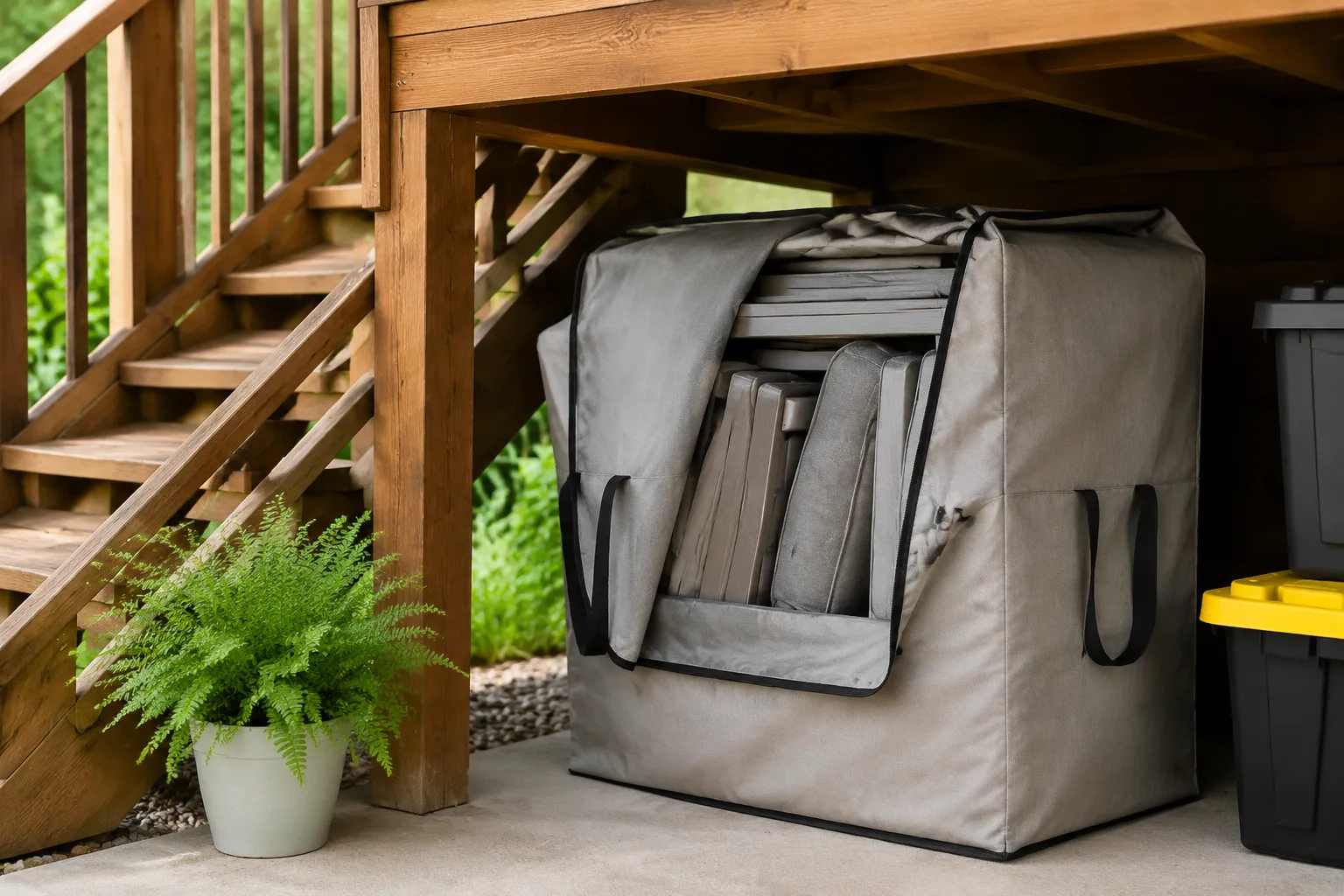
Stack the cushions flat, four or five high, and lay the rolled cover on top of the stack. Then pull a large drawstring storage bag over the whole thing, one of those bags meant for storing patio furniture in the off-season. The bag holds the stack together, the cover rides on top, and the entire unit slides into the corner of the garage or under a workbench.
This works because the cover and the cushions are used together and retrieved together. Nobody wants to make two trips to two locations in April. One bag, one trip, one place in the garage. The bag also protects the cushions from dust and from the occasional mouse that wants to nest in the foam.
The Small-Table Solution: One Bin, Everything Inside
For people with a small bistro table or a single bench, the storage problem is different. The cover is smaller, maybe five pounds, and it does not need a massive system. It needs a bin. A single 18-gallon plastic tote, the kind sold at any hardware store for under fifteen dollars, holds the cover, the two small cushion sets, and the umbrella if it comes apart.
The trick is to roll the cover and stand it upright in the bin, then fill the space around it with the cushions, also rolled or standing on edge. Do not lay things flat in the bin. Flat stacking wastes vertical space and makes it impossible to find anything without digging. Upright packing means every item is visible when the lid comes off.
Label the bin with a permanent marker on the lid and on one side. The label should say what is inside, not just "patio" but "bistro cover and cushions, back deck." A person should be able to read the label from three feet away without bending down. This one detail, the label, is what separates a system from a pile.
The Drying Rack That Prevents the Whole Mess
Before any of these storage methods work, the cover has to be dry. On a rainy November day, that is not automatic. A cover pulled off the table in a downpour is heavy, dripping, and covered in wet leaves. The temptation is to drape it over the deck railing and hope for a sunny day that never comes.
The practical solution is a folding drying rack, the kind used for laundry, placed in the garage or the basement. The cover drapes over the rack, spread out as much as possible, and the air circulates around it. A small space heater or a dehumidifier in the garage speeds the process up to a few hours. This takes up floor space for a day, but it keeps the cover from being stored wet, which is the single biggest cause of premature cover death.
The rack folds flat when not in use, which means it stores easily behind a door or against a wall. Spend twenty dollars on a sturdy metal rack and the annual wet-cover problem stops being a problem. The cover dries overnight, rolls up in the morning, and goes into its bin or bag by noon.
The Rodent Problem No One Mentions
Every storage method is undermined by the same silent enemy. Mice love deck furniture covers. The covers are made of thick, warm, chewable material, and they get stored in exactly the places mice prefer: dark corners of the garage, low shelves, the space under the basement stairs. A rolled cover is a mouse apartment building, ready-made, with insulation included.
The defenses are simple but non-negotiable. Anything stored on the floor gets chewed. Anything stored on a shelf or a hook, at least eighteen inches off the ground, has a much better chance. Anything sealed in a plastic bin or a vacuum bag is effectively protected, since mice can chew through fabric but struggle with rigid plastic.
Mothballs or cedar blocks placed inside the storage bin are the traditional deterrent, and they work, with the caveat that the smell clings to the cover and the first warm day on the deck comes with a faint whiff of camphor. A better option is a few dryer sheets tucked into the roll, which mice dislike and which leave behind a fresher scent.
The April Test for a Cover Worth Storing at All
Storage is wasted effort if the cover is already on its last season. A cover with cracked seams, fading that has turned it stiff, or a surface that no longer sheds water is not worth the space it takes up. The rule of thumb is simple: if the cover leaked last season, it will leak next season. The material does not heal.
The honest move is to throw it away in October and buy a replacement during the off-season, when prices drop. A new cover costs less than the combination of a ruined cushion set, a moldy deck table, and the frustration of a spring discovery. The storage of a broken cover is the storage of a mistake.
This is the part that changes the whole system. The people who struggle with cover storage every year are not struggling with space. They are struggling with the wrong cover, or an old cover, or a cover that was too flimsy to protect anything. The right cover, bought new, folded correctly, rolled tight, and stored on a hook or in a bin, takes up half the space of the old one and lasts twice as long. The space problem is usually a quality problem wearing a disguise.
The One-Shelf System for the Entire Deck
For the person with a full deck of furniture, the cleanest system is a single dedicated shelf in the garage, four feet wide and two feet deep, installed at head height. Everything that belongs to the deck lives on that shelf: the rolled covers standing on end, the cushion bags, the umbrella in its sleeve, the small bin of hardware for the table that loses a bolt every year.
The shelf becomes a ritual boundary. In October, everything from the deck moves to the shelf. In April, everything from the shelf moves back. Nothing lives on the floor, nothing gets mixed in with the gardening tools, nothing gets lost behind the snow blower. A person can look at the shelf in January and know exactly what is there, without digging through a single box.
This system costs about forty dollars in shelf brackets and a good piece of plywood, and it takes one afternoon to install. The payoff is that the annual deck transition goes from a two-hour wrestling match to a twenty-minute chore. The covers come off, dry on the rack overnight, roll up in the morning, and stand on the shelf until spring. That is the whole job.
The shelf is not exciting. It is not clever. It is a boring, permanent answer to a boring, annual problem. That is exactly why it works. The covers stop being a seasonal crisis and start being a routine, like taking out the trash or changing the furnace filter. The deck gets put to bed in October and wakes up in April without drama, and the person who owns it spends a little less time each year fighting with a wet tarp and a little more time sitting on the furniture it protects.