Kitchen hygiene discourse usually centers on raw chicken and sponges, leaving the board underneath the action as an afterthought. That is a mistake with real consequences. A cutting board is a piece of food-contact equipment, and it accumulates more biological material, across a wider surface area, than almost any other item in the kitchen. The habits around it, not the board itself, determine whether it is a safe work surface or a petri dish with a handle.
Most home cooks adopt a single-board policy: one wooden board for everything, rinsed with hot water and left to dry. That system fails at the exact moment it is tested. The same board that held a handful of herbs or a ripe tomato later hosts raw chicken, and the fibers of the wood retain moisture and juices in ways that a quick rinse does not touch. This is not a materials problem, it is a protocol problem. The wood can be perfectly fine. The habit is what is defective.
The Color-Coded Board System Is Not Snobbery
Commercial kitchens solved this decades ago with color-coded polyethylene boards: red for raw meat, yellow for cooked meat, green for produce, white for dairy. The system exists because cross-contamination is not a theoretical risk. A chef who slices raw poultry on a board, wipes it with a cloth, then uses the same surface for salad is gambling with a dozen diners. The colors make the rule physical. The board itself announces its job.
Home kitchens do not need four boards, but the principle translates. A household needs a dedicated board for raw animal protein and a separate one for everything else. That is the minimum viable division. The produce board can handle vegetables, bread, herbs, and fruit. The meat board should never touch anything that will be eaten without cooking. This single rule eliminates the most dangerous failure mode in home kitchens, which is the salad that gets dressed on the same surface that just held raw chicken.
The second board does not need to be fancy. A thin polyethylene sheet costs less than a decent bottle of olive oil and stores in a cabinet slot. The investment is trivial. The habit of reaching for the right board takes about a week to form, and after that it becomes as automatic as turning on the tap.
Wood versus Plastic, and Why the Debate Misses the Point
Wood and plastic both get cited as the safer material, and both sides have plausible arguments. Wood is naturally antimicrobial in some studies, but it also absorbs moisture and develops knife scars that harbor bacteria. Plastic is non-porous and dishwasher-safe, but it can develop deep grooves that become impossible to clean properly. The material science is genuinely mixed, and the literature does not declare a clear winner for home use.
The deciding factor is not the material, it is the maintenance. A well-maintained wood board is safe. A neglected plastic board is not. A warped, knife-scarred, bleach-stained plastic board that goes through the dishwasher every night can still harbor bacteria in its grooves. Conversely, a wood board that gets oiled twice a month and hand-washed immediately after use is a perfectly safe surface. The debate about material is a distraction from the real variable, which is whether the board gets cleaned properly and regularly.
For a home cook, the practical choice is simpler: buy a board that is thick enough to stay flat and smooth enough to keep clean. A flimsy plastic board that bends and flexes during use develops stress cracks. A thin wooden board that warps in the dishwasher becomes a permanent home for moisture. A quarter-inch poly board or a one-inch hardwood board, either one, works fine if it is treated with basic respect.
The Hot Water and Soap Sequence That Actually Works
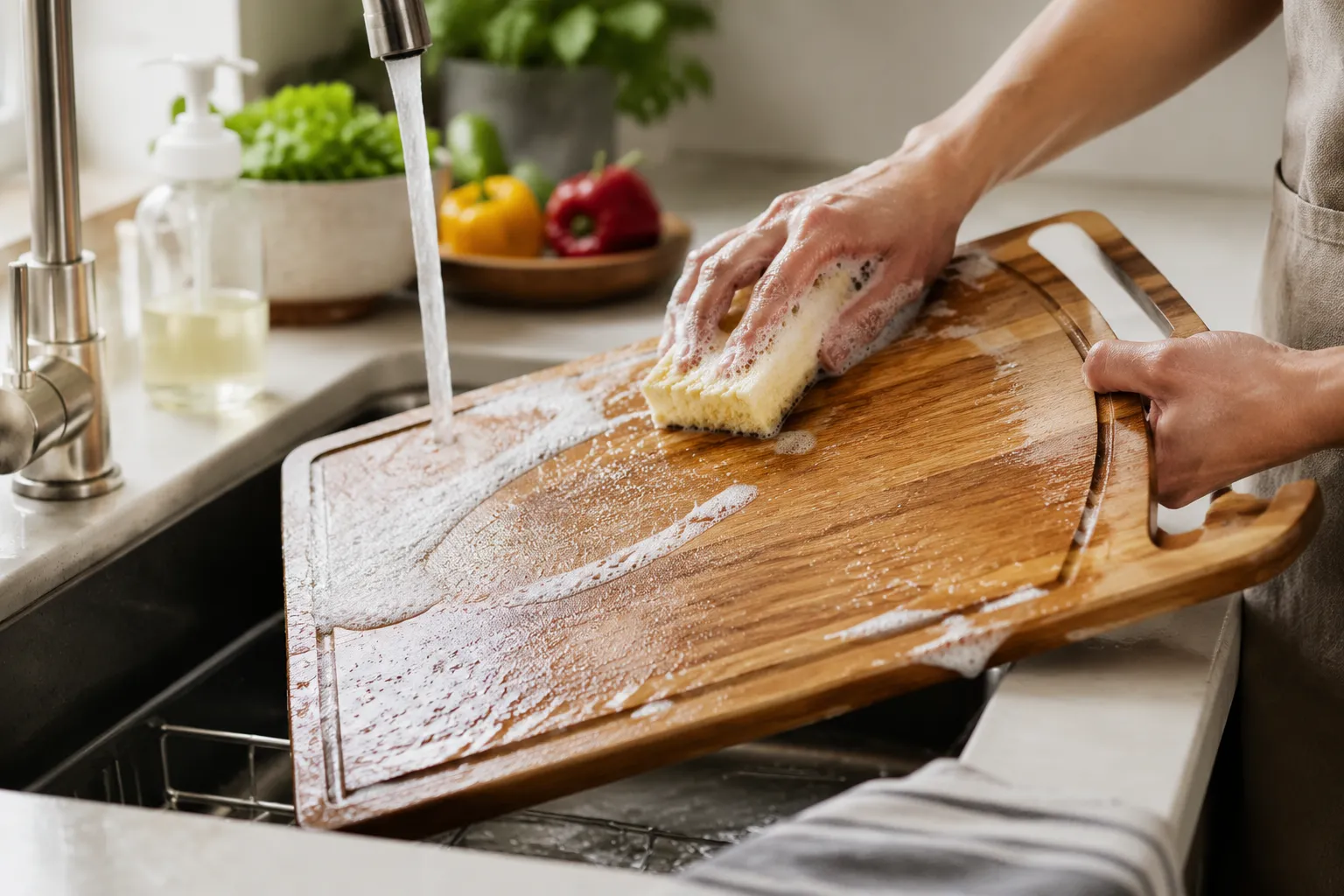
The standard home procedure, a quick rinse under warm water, does not remove fat-soluble residues. Bacteria embed themselves in the thin film of oil left by raw meat, and that film requires soap to break down. A board needs to be washed with dish soap and hot water, scrubbed with a brush or sponge, and then rinsed thoroughly. That is the baseline. Anything less leaves a residue that supports bacterial growth.
The sequence matters as much as the products. Soap first, scrub, then a hot rinse. Many cooks scrub with soap and then rinse with lukewarm water, which leaves soap residue and does not fully clear the board. Hot water, as hot as the hands can tolerate or hotter with a sprayer, is the correct final step. The heat helps evaporate residual moisture and prevents the soap from leaving a film.
Drying is the step almost everyone skips. A board left to air-dry in a rack is fine, but a board left face-down on a counter, or stacked with another board while still damp, is a moisture trap. The bottom of a wood board, in particular, absorbs water from the counter and develops a gray, mildewed patch. Standing a board on its edge to dry takes two seconds and prevents the most common form of board rot.
The Bleach Dilution That Kills Without Ruining the Board
For raw meat, a simple soap-and-water wash is not enough. The standard food-service practice is a dilute bleach solution: one tablespoon of unscented bleach per gallon of water. This is a well-established public guideline, and it is one of the few cleaning tasks in the kitchen where a precise ratio actually matters. Too strong, and the bleach damages the board and leaves a chemical residue. Too weak, and it does not disinfect.
The procedure is straightforward. After washing with soap and hot water, apply the bleach solution to the board, let it sit for a few minutes, then rinse thoroughly and dry. This is not necessary for a board that only touched vegetables, but it is the correct protocol after raw poultry, pork, or ground meat. A spray bottle with the diluted solution kept under the sink makes the habit painless.
Hydrogen peroxide is a popular alternative, and it works, but it is more expensive and less stable than bleach. The bleach solution costs pennies per use and is the standard in every professional kitchen. There is no reason to reinvent this particular wheel.
The Knife Scar Problem Nobody Mentions
Every cut leaves a groove in the board. These grooves are invisible to the eye, but they are deep enough to hold moisture and bacteria. A board that is heavily scored, one that has the texture of a well-worn cutting surface, is far harder to clean than a smooth board. The grooves protect bacteria from soap and rinse water.
This is where the material debate gets practical again. Plastic boards get deep, ragged grooves quickly, especially with a sharp knife. Wood boards compress and seal over time, which means the grooves are shallower and less hospitable to bacteria. A wood board that is sanded or resurfaced every couple of years stays smooth and clean. A plastic board that is heavily scored needs to be replaced. There is no way to sand a plastic board back to smoothness that is worth the effort.
A board with deep, visible grooves is a hygiene liability regardless of material. The rule of thumb is simple: when the board feels rough or looks scored, it is time to either sand it (wood) or throw it out (plastic). A smooth board is a cleanable board.
Oiling Wood Boards, and the One Thing That Ruins Them
Wood boards need oil. The oil seals the fibers, prevents moisture absorption, and stops the board from warping or cracking. Food-grade mineral oil is the standard choice, and it is cheap and available at any hardware or kitchen store. The habit is to oil a new board several times in the first week, then once a month thereafter. The oil should be applied generously, left to soak in for a few hours, and then wiped off.
The one thing that ruins wood boards is the dishwasher. The combination of hot water, strong detergent, and the drying cycle strips the oil, warps the wood, and opens up cracks that permanently compromise the board. No wood board, no matter how well-made, survives the dishwasher intact. This is not an opinion, it is a physical fact about wood and water.
Hand-washing a wood board takes thirty seconds. The habit is to wash it immediately after use, dry it with a towel, and stand it on edge. A board treated this way lasts for decades. A board run through the dishwasher lasts a few months, and then it becomes a harborer of bacteria in hidden cracks.
The Garlic and Onion Smell Transfer, Solved Without a Second Board
Alliums leave a stubborn odor in wood boards. The smell is not a hygiene problem, it is an aesthetic one, but it is persistent enough to make cooked food taste faintly of yesterday's onion. The standard fix is to rub the board with a cut lemon or a paste of coarse salt and water, let it sit briefly, and rinse. This works, but it does not address the root cause, which is that the board is absorbing strong aromatic compounds.
A better solution is to reserve one side of a double-sided board for alliums and strong aromatics, and the other side for neutral foods. Many wood boards are double-sided, and most cooks use both sides interchangeably. Making a habit of using one side for garlic, onion, and fish, and the other for bread, fruit, and herbs, prevents the transfer without any extra cleaning. The smell stays on the side that was used for aromatics, and the neutral side stays clean.
This is a small habit with an outsized effect. It takes a moment to remember which side is which, and it completely eliminates the problem of a fruit salad that tastes like garlic.
The Board That Should Be Thrown Out Today
Every kitchen has one. The board with the deep crack running through the middle, or the warped board that rocks instead of lying flat, or the plastic board that has a permanent gray stain and a texture like sandpaper. These boards are past saving, and keeping them is a genuine hygiene risk. Cracks and warps create crevices that neither soap nor bleach can reach, and the bacteria that colonize those crevices are not affected by any amount of surface cleaning.
The test is simple. A board that cannot lie flat on the counter, or a board with a visible crack, or a board that feels rough to the touch, is done. Replacing it costs less than a restaurant meal. Keeping it costs nothing today, but it is a chronic risk every time it is used. The decision to finally throw out a compromised board is one of the most underrated hygiene habits in the kitchen, and it is the one that most people delay for years.