
The vent hose behind a clothes dryer is the least glamorous piece of infrastructure in the average home. It is a gray, ribbed plastic snake that collects lint, blocks airflow, and occasionally catches fire. Most people ignore it until the dryer starts taking two hours to dry a load of towels. That slow dry is not a minor annoyance. It is the first sign that the vent is clogged, and a clogged vent is the direct cause of thousands of home structure fires every year. The fire statistic is well documented by the federal government, but the numbers read as abstract until one considers that the ignition source is usually the same lint that already covers the floor of the laundry room. The machine heats up, the airflow stalls, the lint in the hose reaches combustion temperature, and the fire travels the path of least resistance, which is the path full of fuel.
What makes this particularly maddening is that the fix is so boring. It involves a screwdriver, a vacuum attachment, and about twenty minutes of kneeling on a hard floor. The reason people skip it is not laziness, exactly. It is that the vent is out of sight, and the consequences are deferred. There is no visible grime on the kitchen counter, no expired food in the fridge. The hose sits behind a heavy appliance, and the failure mode is invisible until it is dramatic. This piece is not a comprehensive home maintenance manual. It is a focused look at the specific checks that matter most, and some of them are counterintuitive.
The Lint Trap Is a Decoy
Every laundry room has the little mesh screen that slides out of the dryer door. People clean it, mostly, because that is the part that is obvious. The screen catches the big stuff, the gray clumps that would otherwise land on clothes. But the screen is a coarse filter. It stops about half of what the dryer produces. The rest, the fine dust and the microscopic fibers, blows straight through the mesh and into the exhaust hose. Over months, that fine dust accumulates inside the ribbed walls of the vent. The ridges of the hose, which exist to keep it flexible, are exactly the kind of surface that grabs lint and holds it.
The lint trap, in other words, is doing its job poorly on purpose. It is designed to catch the visible lint so that the machine appears to be working. Meanwhile, the hidden lint accumulates in the duct, and the dryer runs less efficiently with each cycle. A dryer that used to finish a load in forty-five minutes will slowly drift to sixty, then ninety. The user adjusts. They set a timer, they switch loads earlier, they shrug about the extra time. The adjustment masks the problem. The vent is not failing catastrophically. It is degrading incrementally, and the human brain is terrible at noticing incremental degradation.
The Twenty-Dollar Test That Tells the Truth
There is a cheap, reliable way to check whether the vent is actually moving air, and it does not require taking the machine apart. An anemometer, which is a small handheld device that measures airflow speed, costs about twenty dollars online. A person holds it at the exterior vent opening, the one on the outside wall of the house or on the roof, and turns the dryer on. A healthy system pushes air at a speed that is easily measurable. A clogged system pushes a weak, pathetic breeze that the anemometer catches instantly.
Even simpler is the old piece of tissue paper trick. Hold a sheet of toilet paper over the exterior vent opening. If the dryer is running and the paper sticks to the vent or flutters hard, the airflow is adequate. If the paper barely moves, the vent has a restriction somewhere between the drum and the outside wall. This test is not perfectly accurate, because a leak in the duct can let air escape before it reaches the exterior, but it is a good first pass. The cost of the test is one sheet of toilet paper. The cost of skipping the test is, potentially, a house fire.
The tissue paper test is worth doing on a warm day, when the dryer has been off for a few hours. The reason is that a hot dryer can mask a partial clog. The heat creates buoyancy, and the air rises through the hose even when the flow is weak. A cold test reveals the true mechanical state of the system. The fan is pushing, and the only thing that moves the air is the fan. If the fan cannot overcome the resistance of the lint, the paper barely moves.
The Ribbed Plastic Hose Is the Worst Choice
Most dryers are connected to the wall with a flexible, ribbed plastic hose. This hose is cheap, easy to install, and universally recommended against by every fire safety organization and every dryer manufacturer. The ribs catch lint like a comb catches hair. The plastic is flammable. The hose kinks easily, and a kink is a complete blockage that the user cannot see. The manufacturers even put a label on the box warning that the hose is for single-use installation only, which is a strange instruction for a product that people expect to last as long as the appliance.
The better option is a semi-rigid metal duct, which has smooth walls and does not collapse under its own weight. It costs a few dollars more at the hardware store and requires a bit more care to install, because it does not bend around corners as easily. But the smooth metal surface does not accumulate lint the way the plastic ribs do, and it does not burn. For households that are serious about maintenance, the switch from plastic to metal is the single most impactful change. It does not eliminate the need for cleaning, but it slows the buildup dramatically.
The flex duct that is sold with a thin foil finish on the outside is not much better than the plastic. The foil is a veneer over the same ribbed inner structure, and the ribs still grab lint. The only genuinely acceptable flexible option is the fully smooth metal hose, which is more expensive and harder to bend. It is available, but most people do not know it exists, because the big box stores put the ribbed options at eye level and push the metal version to the top shelf.
The Outside Wall Is the Forgotten End
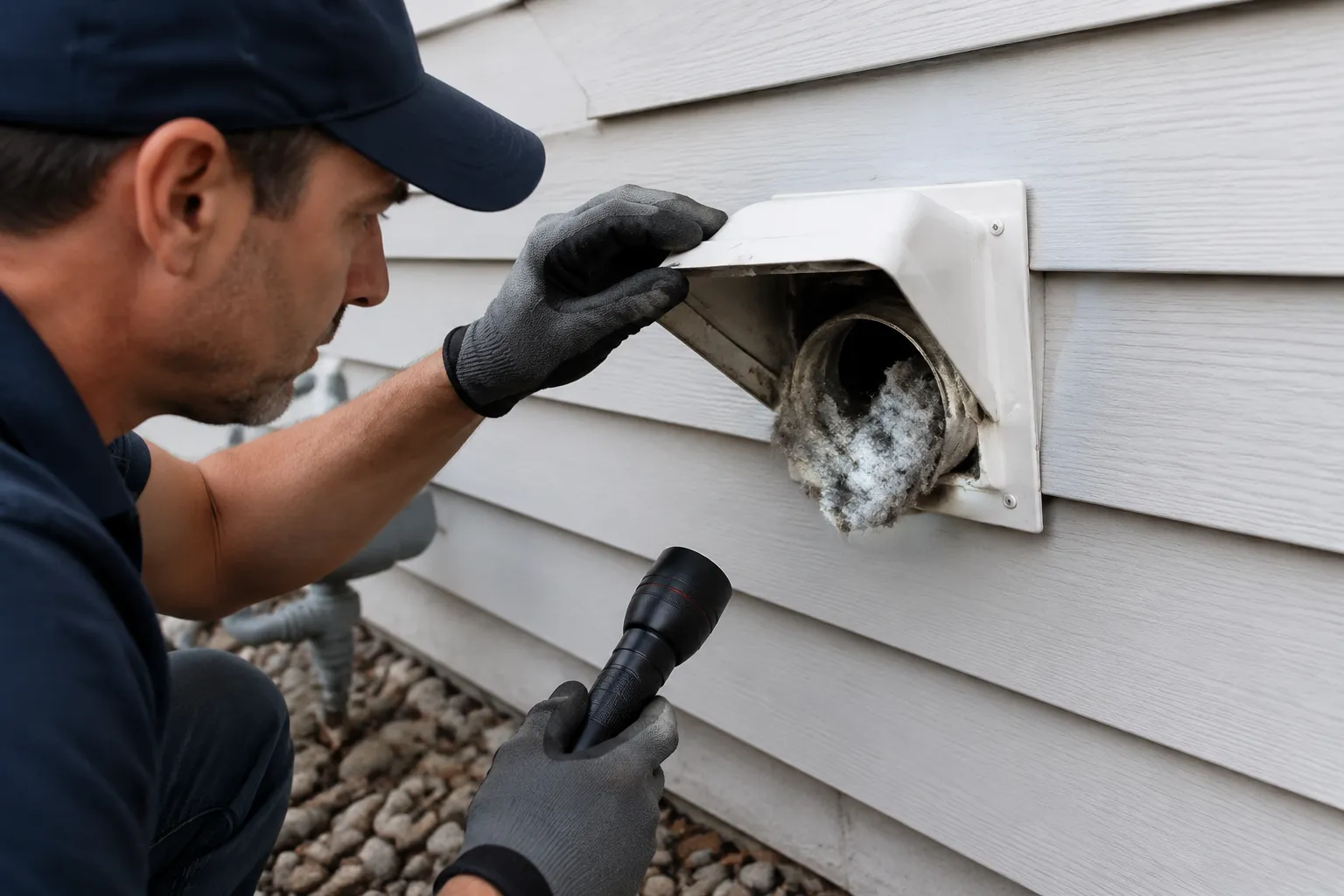
People who do clean their vent hose, and they are rare, almost always do it from the dryer side. They pull the hose off the back of the machine, vacuum out the lint, and reattach it. This is good, but it misses the second half of the system. The exterior vent cap, the little flap on the outside wall, has its own lint trap. It catches the debris that makes it all the way through the hose, and it collects it right at the exit. If that flap is stuck shut, or if the screen behind it is clogged, the entire system backs up.
The exterior cap gets clogged from the outside too. Birds and rodents occasionally nest right behind the flap, because it is a warm, dry cavity that opens to a sheltered wall. In some regions, the vent becomes a hive for wasps. A homeowner can clean the inside of the hose perfectly, and the airflow will still be restricted because a wad of grass and twigs is blocking the exit. The exterior check is a five-minute task that requires only a ladder and a flashlight. It should be done every six months, and practically nobody does it.
The Long Run to the Roof Is a Different Problem
In many homes, the dryer is not on an exterior wall. It sits in a central laundry room, and the vent runs horizontally through the floor joists or up through a chase to the roof. These long runs are the most dangerous configuration in residential drying. The lint has more surface area to stick to, more bends to collect at, and no gravity to help it out. A vertical run to the roof is less prone to clogging than a long horizontal run, but it is harder to clean because the user cannot reach either end easily.
The code limit for dryer duct length is part of the manufacturer's installation instructions, and it is usually around twenty-five feet of equivalent length, where each bend counts as several feet of straight pipe. Most people have no idea what these numbers mean, and they simply install the dryer wherever the plumbing happens to be. A vent that runs thirty feet with two bends is out of spec, and it will clog no matter how diligent the owner is about cleaning. In those cases, the best solution is not more maintenance. It is a vent booster fan, which is a small fan installed inline in the duct that pushes the air along the long run.
The booster fan is a controversial device among inspectors, because it can be installed incorrectly and make things worse. But for a long run, it is the difference between a dryer that finishes in forty minutes and one that runs for two hours. The fan should be installed near the dryer, not at the exterior, and it must have its own lint trap before it. This is a job for a professional, not a DIY project, because the wiring and the placement requirements are specific.
The Disconnect Switch That Saves a Life
There is a small metal tab on the back of most dryers, near the exhaust outlet, that is meant to be pulled out when the machine is cleaned or serviced. It is not a maintenance part. It is a safety feature that prevents the dryer from turning on while a person is working inside it. The tab interrupts the door switch circuit, so the drum will not spin even if the door is closed. It is a simple piece of metal, and it is universally ignored until something goes wrong.
When a person is cleaning the vent hose, the dryer should be unplugged from the wall and the gas line should be shut off, but many people skip these steps and simply pull the hose off the back while the machine is still connected. If the dryer is accidentally turned on by someone else in the house, or if a child presses a button, the machine can start spinning with the hose disconnected, which turns the laundry room into a blower of lint and dust. The tab does not prevent that. The tab only prevents the drum from turning when the door is open. The real protection is the unplugged cord and the locked breaker.
The Gas Dryer Ignition Hazard
Gas dryers have an additional failure mode that electric dryers do not. The gas burner ignites inside a combustion chamber, and that chamber needs a steady supply of oxygen and a route for the exhaust gases to escape. When the vent is clogged, the exhaust cannot escape, and the combustion gases, including carbon monoxide, can back up into the laundry room. The dryer still runs. The clothes still dry, but slowly. The room slowly fills with a gas that cannot be seen or smelled, and the occupants feel sleepy and headachy without knowing why.
Carbon monoxide detectors are required in most homes, but they are often placed in hallways and bedrooms, not in the laundry room. By the time the detector in the hallway goes off, the concentration in the laundry room is already significant. The fix is the same as the fix for lint buildup: keep the vent clear. But the stakes are higher, because a slow leak of combustion gas is a silent, gradual poisoning rather than a dramatic fire. The tissue paper test is not enough for a gas dryer. A person should also run the dryer and hold a hand near the connection point between the dryer and the vent hose, feeling for any air escaping around the clamp.
The Cleaning Schedule That Actually Works
The standard recommendation is to clean the vent hose once a year. That is reasonable for a household that does three loads a week. For a large family that runs the dryer daily, the interval should be six months. The cleaning itself is not a full project. It requires pulling the dryer away from the wall, which most people can do without disconnecting the power if the cord is long enough, and removing the hose from the back of the machine. A vacuum with a long crevice attachment can reach a good part of the way into the hose, but the better tool is a vent cleaning brush kit, which has a flexible rod and a brush head that fits inside the duct and spins to scrape the walls.
The brush kit costs about thirty dollars and pays for itself in the first use, because it pulls out lint that a vacuum alone cannot dislodge. The ribbed walls of a plastic hose hold the lint tightly, and the brush is the only tool that gets into the grooves. After brushing, the vacuum should be run through the hose again to catch the loosened debris. The exterior cap should be opened and cleaned at the same time. The whole process takes about an hour, and it is the most boring hour of home maintenance a person will spend all year. It is also the hour that prevents the dryer from catching fire while the family sleeps.
The Dryer Itself Hides Lint Too
The vent hose is not the only place where lint accumulates. The dryer's internal housing, the space between the drum and the outer shell, collects lint that escapes the drum. Some dryers have a removable front panel or a top that lifts, and behind that panel is a layer of gray fuzz that has built up over years. This lint is just as flammable as the lint in the hose, and it sits directly next to the heating element. A dryer that is clean on the outside can be full of combustible debris on the inside.
Professional dryer vent cleaning services exist because the internal cleaning is not a simple DIY task. They use rotary brushes that attach to power drills and snake through the entire duct system, and they have cameras to inspect the interior walls. For a household that has never cleaned the vent, hiring a professional once is a good baseline, because the technician can identify problems that a homeowner would not see. The service costs between one and two hundred dollars, depending on the region and the complexity of the vent run. It is a lot to pay for something invisible, but it is cheaper than a roofing repair or a fire restoration.
The deeper point is that the dryer vent is a system, not a single part. The lint trap, the hose, the exterior cap, and the internal housing all work together, and a failure in any one of them creates the same result: restricted airflow, rising heat, and a growing pile of fuel. The people who check only the lint trap are treating a symptom. The people who check the whole path are treating the disease. The distinction is not academic. It is the difference between a machine that runs for twenty years and a machine that runs for twenty minutes before the smoke alarms go off.
The next time the dryer takes a little longer than it used to, the response should not be a shrug and a longer timer setting. It should be a trip outside with a piece of tissue paper. The house will still be standing in the morning, which is the only metric that really counts.