
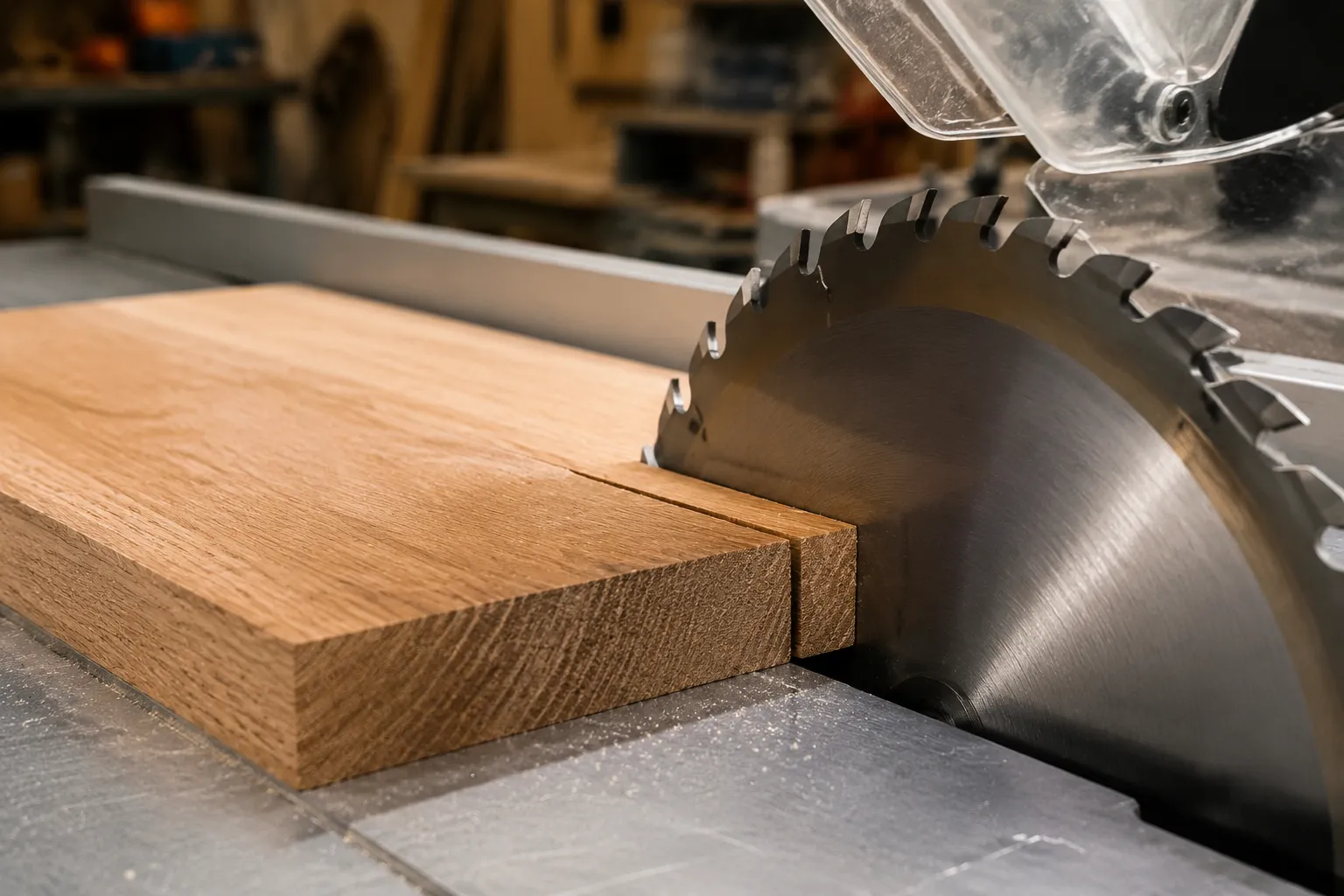
Kerf is the first thing a woodworker should understand about a blade, and it is almost never the first thing they learn. The width of the cut, the thickness of the material the blade removes, determines the fit of a joint, the stress on a saw motor, and the amount of sawdust on the floor. A thin kerf blade and a full kerf blade can produce the same shiny cut surface, but they behave like different tools entirely. Most hobbyists discover this after buying a cheap thin kerf blade, ripping a few boards, and wondering why the saw sounds like a jet engine winding down.
The term itself comes from the old English word for cutting, and it has been used for centuries to describe the slot left by a saw. On a circular saw blade, the kerf is measured across the carbide teeth, not the body of the plate. Because the teeth are set slightly outward or are wider than the steel plate, the kerf is always wider than the blade body. That difference is what prevents the blade from binding in the cut. The plate needs clearance to pass through the wood, and the teeth provide it. A blade with zero set would pinch, overheat, and eventually throw the workpiece back at the operator.
What confuses people is that kerf is not a standardized number across manufacturers. A 10-inch blade might have a kerf of 0.098 inches, 0.125 inches, or anywhere in between. The same nominal blade size from two different companies can remove noticeably different amounts of material. This matters most when cutting dados or tenons, where the width of the cut is the entire point of the operation.
The Two Camps: Thin Kerf and Full Kerf
Thin kerf blades generally measure under 0.100 inches for a 10-inch blade, while full kerf blades sit around 0.125 inches or wider. The difference sounds trivial, a hair under one thirty-second of an inch, but it changes the physics of the cut. A thin kerf blade removes less material, which means the saw motor works less hard. A 15-amp circular saw or a 3-horsepower table saw can rip thick hardwood with a thin kerf blade without bogging down. The blade also produces less sawdust, which is a nice side benefit for anyone who hates cleaning the shop.
Full kerf blades remove more material, which creates more friction, more heat, and more resistance. They require more power to push through the same board. In exchange, they offer greater stability. The thicker carbide tips and wider body resist deflection and wobble, especially under heavy feed pressure. Full kerf blades stay truer in demanding cuts, which is why professional cabinet shops often prefer them for production work. The cut quality is also marginally better, because the wider tooth has more carbide to hold an edge and the blade body is stiffer.
For a person running a jobsite saw with a universal motor, thin kerf is the practical choice. Those saws struggle with full kerf blades in dense material, and the result is a slower feed rate and a burned edge. For a person running a cast-iron cabinet saw with a 3-horsepower motor, the power difference is negligible, so the stability of a full kerf blade wins.
Why Kerf Affects Joint Accuracy
Kerf becomes a joint problem the moment a person starts cutting tenons, box joints, or any joinery where the width of the slot determines the fit of the mating piece. A tenon that needs to fit into a dado cut at 0.75 inches will not fit if the blade removes 0.098 inches per pass and the setup is off by a single pass. The woodworker makes five passes, measures the slot, and finds it a hair too narrow. The temptation is to force the joint together, which cracks the workpiece or leaves a gap.
A full kerf blade makes this problem easier to manage because the wider cut is more forgiving. The difference between a 0.125-inch kerf and a 0.098-inch kerf means the difference between a slot that fits a tenon with a light tap and one that needs a mallet. Anyone who has spent an afternoon cutting test joints knows the frustration of sneaking up on a fit with a thin kerf blade, taking a pass, measuring, taking another pass, and overshooting by a couple thousandths.
There is also the matter of stacking blades for dado cuts. A stacked dado set uses two outer blades and a set of chippers to reach a specific width. The kerf of the outer blades sets the minimum width, and every chipper adds to it. With a thin kerf outer blade, the minimum slot is narrower, which is useful for fine joinery but means more chippers are needed to reach a common width like 0.75 inches. Each chipper adds its own runout and potential for wobble, so the wider the stack, the rougher the bottom of the cut.
The Motor Load Tradeoff
Saw motors are rated for a certain amount of continuous load, and kerf directly affects that load. A thin kerf blade reduces the amount of material the teeth must cut, which means the motor draws fewer amps and runs cooler. This is not a theoretical benefit. A person ripping 8-quarter white oak with a full kerf blade on a 1.75-horsepower saw will hear the motor strain and feel the saw slow down. Switching to a thin kerf blade, the same cut happens at a steadier speed with less effort.
The tradeoff is that thin kerf blades flex more under lateral pressure. The thinner plate has less resistance to side forces, so a person pushing a board at an angle, or feeding too aggressively, can deflect the blade and produce a cut that is not square. This shows up as a slight curve in the cut, often called a washboard effect or a wavy edge. The problem is worse on saws with a less rigid arbor or a worn trunnion, where the blade can wander even without aggressive feeding.
Full kerf blades do not have this problem to the same degree. The thicker plate and larger carbide tips resist deflection, which is why they are preferred for joinery cuts where squareness is critical. A person can push a full kerf blade hard and trust that the cut stays straight. The cost is the added load on the motor, which is why full kerf blades on underpowered saws produce burned edges and a noticeable drop in blade speed.
Blade Body Thickness and Plate Stability
Kerf is not the same as plate thickness, and conflating the two leads to poor purchasing decisions. The plate is the steel body of the blade, and it is always thinner than the kerf. On a full kerf blade, the plate might be 0.093 inches thick while the teeth bring the cut to 0.125 inches. On a thin kerf blade, the plate might be 0.071 inches thick with teeth that cut to 0.098 inches. The difference in plate thickness is small, but it has an outsized effect on stability.
A thinner plate is more susceptible to heat expansion. When the blade gets hot, the steel expands, and if the expansion is uneven, the blade can develop a slight dish or wobble. This is why thin kerf blades need to be kept sharp. A dull thin kerf blade generates friction, which generates heat, which makes the blade less stable, which accelerates the dulling process. It is a downward spiral that ends with burns on the wood, a rough cut surface, and a blade that needs to be replaced rather than resharpened.
Some thin kerf blades are made with a thinner plate but a reinforced shoulder, where the carbide tips sit on a slightly thicker section of steel near the rim. This design helps with stability, but it cannot fully compensate for the reduced stiffness of the thin body. A person cutting sheet goods or ripping softwood will never notice the difference. A person cutting thick hardwood or feeding at an angle will feel it immediately.
Cutting Capacity and Depth of Cut
Kerf affects the maximum depth of cut on a table saw, and this is a detail that surprises people. The blade's kerf determines how wide the slot is in the throat plate, but the depth of cut is limited by the blade diameter and the arbor position. However, a thin kerf blade can be used on a smaller saw to cut thicker material because the reduced resistance allows the motor to maintain speed. A 10-inch saw with a thin kerf blade can often rip a 3-inch thick board that would stall the same saw with a full kerf blade.
The practical effect is that thin kerf blades extend the capability of smaller saws. A person with a portable table saw, a job site saw, or a compact circular saw can cut material that would otherwise require a bigger machine. This is the main reason many woodworkers keep a dedicated thin kerf ripping blade in the shop, even if they prefer full kerf blades for joinery. The thin kerf blade is the workhorse for rough dimensioning, and the full kerf blade comes out for the cuts that need to be precise.
There is a limit to this benefit. A thin kerf blade that is too thin for the application can chatter, especially in a saw with a large arbor flange or a worn bearing. The blade flexes, the cut wavers, and the result is a surface that looks like corduroy. This is rare with quality blades, but it happens. The solution is not to buy the thinnest blade available, but to match the kerf to the saw's power and the material being cut.
Sawdust Volume and Dust Collection
Kerf directly influences how much sawdust a cut produces. A full kerf blade removes about 25 percent more material than a thin kerf blade, depending on the specific widths, and that material ends up on the floor, in the dust collector, or in the air. For a single cut, the difference is trivial. For a day of ripping, the difference is a full bag of sawdust. For a shop with a small dust collector, the difference is a filter that clogs sooner and a collector that loses suction.
Thin kerf blades also produce a slightly different sawdust profile. The chips are smaller and lighter, so they are easier for a dust collector to pull through the hose. Full kerf blades produce larger, heavier chips that can settle in the hose and cause blockages, especially in setups with a lot of horizontal runs. This is a minor consideration, but it becomes relevant for anyone who has spent an afternoon unclogging a dust hose with a broom handle.
There is also the matter of the slot in the zero-clearance insert. A zero-clearance insert is cut with the blade that will be used for the job, and the kerf of that blade determines the width of the slot. Switching from a thin kerf blade to a full kerf blade without changing the insert leaves a wider opening that does not support the workpiece around the blade. The wood can dip into the slot, and the cut quality degrades. A dedicated insert for each kerf width is the clean solution, but many shops live with the compromise.
Carbide Geometry Changes the Equation
The design of the tooth itself matters as much as the kerf width. A thin kerf blade with a triple-chip grind tooth profile can cut cleaner than a full kerf blade with a flat-top grind. The kerf sets the width, but the tooth geometry sets the quality of the cut. A person shopping for a blade should look at both numbers, not just the kerf specification.
Thin kerf blades often use a slightly different tooth angle to compensate for the reduced stability. The hook angle, the rake angle, and the clearance angle are all tuned to make the blade cut aggressively without grabbing. A well-designed thin kerf blade cuts smoothly and leaves a clean edge. A poorly designed thin kerf blade, often found at the budget end of the market, reacts to the reduced plate stiffness with chatter and a rough finish.
This is where the brand premium becomes worth it. A premium thin kerf blade with a stabilized plate, quality carbide, and precise grinding outperforms a cheap full kerf blade in every category except price. The cheap blade might be thicker, but the geometry is inconsistent, the carbide is poor, and the plate is not tensioned properly. The result is a cut that wanders, burns, and dulls quickly.
Reading the Blade Label Correctly
The kerf specification is usually printed on the blade plate, sometimes with the letters K or KERF next to a decimal number. It is also listed in the product description online. The number to look for is the kerf width, not the plate thickness. Some manufacturers list both, and it is easy to mistake the plate thickness for the kerf. A blade with a plate thickness of 0.071 inches and a kerf of 0.098 inches will cut a wider slot than the plate thickness suggests, because the teeth are set outward.
Another common mistake is assuming that a blade advertised as "thin kerf" is always thinner than a blade marked "full kerf." The terms are not strictly regulated. One brand's thin kerf blade might measure 0.095 inches while another brand's thin kerf blade measures 0.110 inches. The only reliable way to know the actual kerf is to measure it. A caliper on the carbide teeth gives the true number, and it takes about ten seconds. This is worth doing before cutting the zero-clearance insert, because the insert is cut to that exact width.
Measuring the kerf also reveals something about the blade's condition. A used blade that has been sharpened multiple times will have a slightly narrower kerf, because the sharpening process grinds the faces of the teeth and can reduce their width. If the kerf shrinks too much, the plate may no longer clear the cut, and the blade will bind. This is another reason to replace blades that have been sharpened several times rather than pushing them through another cycle.
The Saw Itself Sets the Limit
The arbor size and flange diameter on a saw place a hard limit on which kerf widths work well. A saw with a small flange, common on compact circular saws, does not support the blade as well near the arbor. A thin kerf blade on this type of saw can flex because the unsupported area near the arbor is larger relative to the blade. A full kerf blade is stiffer and tolerates the small flange better. This is why some tool manufacturers recommend against thin kerf blades on their compact saws, and the recommendation is not just a way to sell more accessories.
A saw with a large flange, common on cabinet saws and sliding miter saws, supports the blade closer to the teeth and reduces flex. A thin kerf blade on this type of saw is a reasonable choice, especially for ripping. The stability comes from the flange, not the blade plate, so the thin kerf blade performs closer to a full kerf blade. The motor still gets the benefit of reduced load, which means the saw runs cooler and the cut is smoother.
For a miter saw, the kerf matters less for motor load and more for the quality of the cut. A miter saw makes short cuts across the grain, so there is less resistance and less heat. A thin kerf blade cuts a clean crosscut as long as the tooth geometry is right. The main consideration is the width of the slot in the saw's fence and table insert. A thin kerf blade leaves a narrower slot, which supports the workpiece better on both sides of the cut.
The one place a thin kerf blade should not be used is a radial arm saw. These saws pull the blade through the cut, and the downward and outward forces can deflect a thin plate easily. The result is a cut that is not square and a blade that can climb or grab. A full kerf blade is the right choice for a radial arm saw, and most manufacturers of these saws specifically warn against thin kerf blades in the manual.
The Last Few Thousandths
Woodworkers who obsess over kerf eventually start measuring the slot left by every blade they own. The habit starts after a frustrating session of cutting dados that came out a few thousandths too narrow, and it ends with a notebook full of dimensions for every blade in the shop. This is not overkill. The difference between a snug joint and a loose joint is often less than the width of a human hair, and the kerf is the variable that controls it. A person who knows the exact kerf of each blade can cut a tenon to fit on the first attempt, without test pieces and without guesswork.
The cost of this knowledge is a caliper and a few minutes of measuring. The benefit is cuts that fit, joints that hold, and a shop that runs quieter because the saw is not straining. Kerf is not a glamorous topic, and no one buys a blade because of it. But it is the dimension that connects the blade to the material, and it deserves more attention than the shiny coating on the plate or the number of teeth on the rim.