
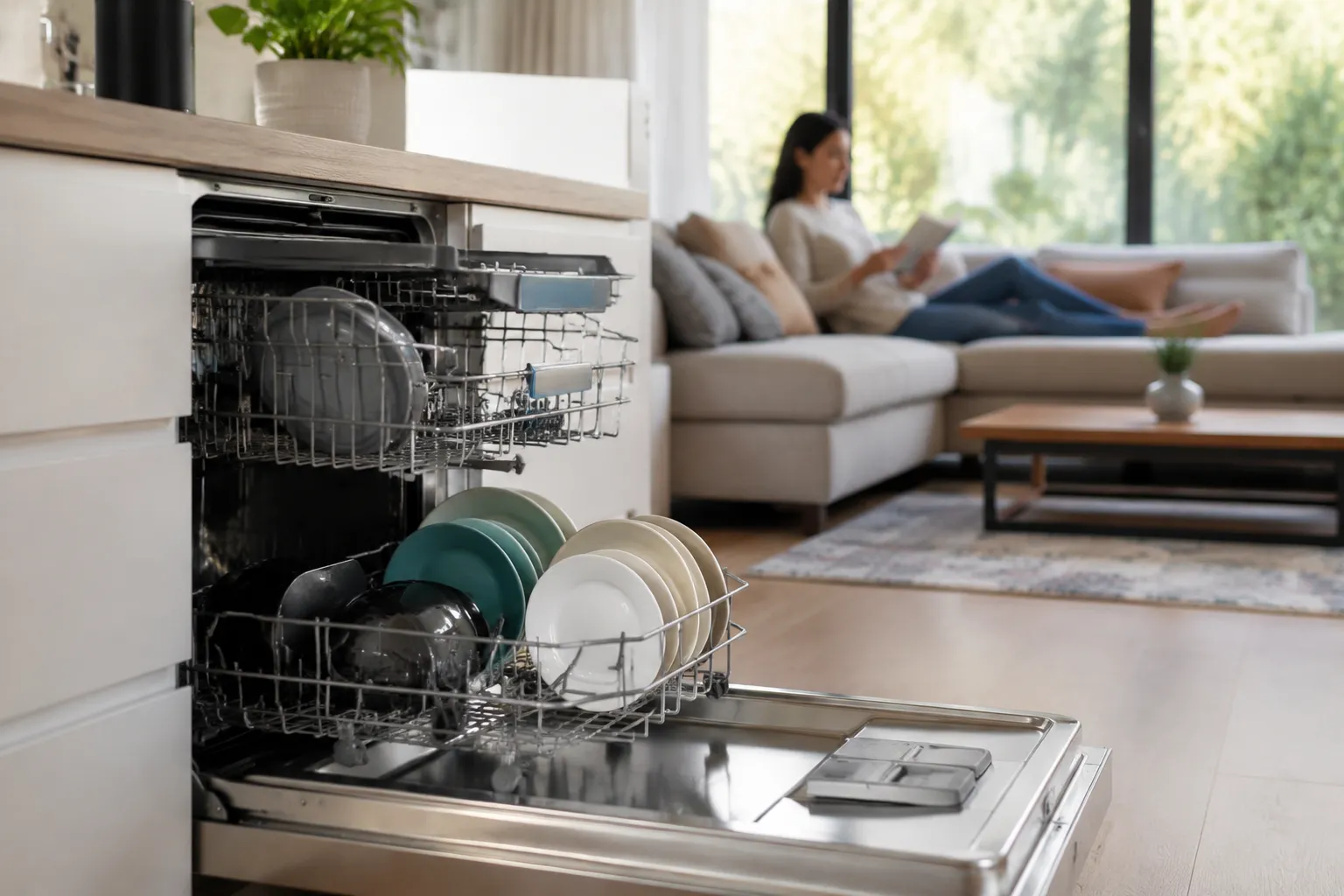
The decibel rating on a dishwasher box is the most lied-about number in home appliances. Manufacturers print figures like 44 dBA and 42 dBA in bold type, and then the machine arrives and sounds like a small animal being fed through a wood chipper. The gap between the spec sheet and the lived reality is wider for dishwashers than for almost any other purchase, because the number is measured in a laboratory with the machine mounted on a concrete slab, not sitting inside a hollow kitchen cabinet in a room with hard floors and bare walls. In an open-plan home, that gap becomes the whole problem.
Open-plan living has turned the dishwasher into a public performer. The machine no longer hides behind a closed kitchen door, muffled by a hallway and a set of walls. It sits in the same acoustic space as the sofa, the dining table, and the home office corner. A quiet dishwasher in a closed kitchen is a luxury. In an open plan, it is a necessity, because there is nowhere for the noise to go. Sound bounces off the open ceiling, reflects off the hard floor, and arrives at the couch with almost no attenuation.
The first thing to understand is that the dBA number is a starting point, not a promise. Two machines rated at 44 dBA can sound completely different in the same room. One might emit a low, steady hum that fades into the background. The other produces a higher-pitched whine with a periodic clunk every time the spray arm reverses. Human hearing is more sensitive to certain frequencies, so a machine with a lower peak volume but an annoying tonal character will feel louder than a machine with a higher overall reading and a smooth, broadband sound. The rating is an average, and averages hide a lot of bad behavior.
What the Numbers Actually Mean in a Real Room
A rating of 44 dBA is roughly equivalent to a quiet library or moderate rainfall. That is the theory. In practice, the machine is running in a room with a refrigerator humming at 35 dBA and an HVAC system blowing at 40 dBA, and the dishwasher needs to be audible above that baseline. A difference of 4 or 5 dBA is perceptible, but a difference of 10 dBA is perceived as roughly twice as loud. So the jump from 48 dBA to 38 dBA is not a small improvement. It is the difference between needing to pause a conversation and not noticing the machine is on.
The cheaper machines cluster in the high 40s and low 50s, and those are genuinely loud. A dishwasher at 50 dBA in an open-plan room will dominate the space. People will raise their voices. The television gets turned up. The machine becomes the center of the room in a way that is deeply unpleasant. Stepping up to the mid-40s helps, but the real transformation happens in the high 30s and very low 40s. That is the territory where the dishwasher stops being an event and starts being background texture.
There is a catch, though. The quietest machines cost more, and the price difference is not small. A 38 dBA dishwasher from a major brand runs several hundred dollars more than a serviceable 48 dBA model. For an open-plan home, that premium is worth paying, because the alternative is living with a noise that interrupts every single evening for the next ten years. A dishwasher is a decade-long purchase. Amortize the extra cost over ten years and it works out to pennies per day to not have to shout over the rinse cycle.
The Hidden Culprits: Spray Arms and Drain Pumps
The dBA rating measures overall sound pressure, but it does not tell a buyer where the noise comes from. The biggest offenders in modern dishwashers are the wash pump, the drain pump, and the spray arm rotation. The wash pump runs during the main cycles and produces a steady hum. The drain pump kicks in several times per cycle and is often louder and more abrupt. The spray arms create a periodic whoosh and a clicking sound as they hit their stops.
Quiet machines address all three. They use inverter motors that ramp up and down smoothly instead of slamming on and off. They wrap the pump housing in sound-dampening material. They add insulation to the door, which is the largest panel and the one facing the living area. The best machines also use a redesigned spray arm that rotates more slowly and with less mechanical impact. These are not marketing gimmicks. They are engineering changes that cost real money and make a real difference.
One specific feature matters more than most buyers realize: the drain cycle. In many machines, the drain pump is the loudest single event in the entire wash. It sounds like a small motor struggling to push water through a pipe, and it happens at least twice per cycle. The quietest machines use a drain pump that is mounted with vibration isolation and runs at a lower speed for longer, rather than a high-speed burst. That changes the character of the noise from a whine to a low hum.
How the Machine Is Mounted Changes Everything
A dishwasher's noise is transmitted two ways: through the air and through the cabinet structure. Airborne noise is what the dBA rating measures. Structure-borne noise is the vibration that travels through the mounting brackets into the surrounding cabinets, which then act like a giant speaker cone. Two identical machines can sound different in two different homes because one is installed properly and the other is not.
The installation matters enormously. A machine that is not level will vibrate. A machine whose mounting brackets are torqued too tight will transfer vibration directly into the countertop. A machine that touches the adjacent cabinets on either side will rattle them. The instruction manuals all say to leave a small gap between the dishwasher and the surrounding cabinetry, and most installers ignore that. The result is a machine that sounds louder than it should, because the cabinets are amplifying the vibration.
There is also the matter of the floor. A dishwasher on a concrete slab is quiet. A dishwasher on a wooden subfloor over a crawlspace has more resonance. The machine's feet can be adjusted, and some models have rubber isolation pads that reduce transmission. But the single most effective installation fix is simply ensuring the machine is level and not wedged against the surrounding cabinetry. That costs nothing and can reduce perceived noise by a noticeable margin.
The Difference Between a Delay Start and a Real Quiet Machine
Some buyers try to solve the open-plan problem by running the dishwasher at night, using the delay start feature. This is a workaround, not a solution. The machine still makes the same noise; it just makes it at a time when fewer people are around to hear it. But in an open-plan home, the bedrooms are often on the same level as the living space, separated by a thin wall or a half-flight of stairs. The noise travels. The sleepers suffer.
Also, the delay start does nothing about the daytime cycles. A load of dishes accumulates over a day, and the machine needs to run at some point. Running it at 2 a.m. because it is too loud to run at 7 p.m. is an admission that the machine is not fit for the space. The quiet machines do not require this compromise. They run whenever they need to run, and the room keeps functioning.
There is a practical detail worth knowing about the quietest machines: they take longer. A 38 dBA dishwasher often has cycle times of two and a half to three hours, because it uses lower pump speeds and longer soak periods to achieve the same cleaning result with less noise. That trades time for silence, and in an open-plan home, that is usually a fair trade. The machine runs in the background while people read, watch television, or eat dinner. Nobody notices it, and nobody cares how long it takes.
What to Look For in the Spec Sheet
When comparing models, the dBA number is the first filter, but it should not be the only one. Look for the wash pump motor type. Inverter motors are quieter and more reliable than traditional motors. Look for the insulation. Some manufacturers advertise their sound package, including the thickness of the door insulation and whether the base of the machine is sealed. Look for the number of spray arms and the placement of the drain pump. A machine with the drain pump mounted on the side or rear, rather than directly under the tub, will typically be quieter.
The most useful thing a buyer can do is ignore the marketing and listen to the machine in a real showroom. Big-box stores usually have a few models wired up and running. Stand in front of them and listen for the tonal character, not just the volume. A machine that hums at a low frequency will fade into the background. A machine that whines or clicks will not, regardless of what the decibel meter says.
One more spec worth checking is the cycle count and the noise rating on each cycle. Some machines advertise a quiet number for the normal cycle but have a heavy cycle that is significantly louder. In an open-plan home, the heavy cycle will get used, because pots and pans accumulate. Check the noise rating for the heaviest cycle, not just the most flattering one.
The Real-World Test That Matters
The honest test for an open-plan dishwasher is not whether it is quiet in a laboratory. It is whether a person can sit on the couch, six meters away, with the machine running, and forget it is on. That is the standard. A machine that passes that test is worth a significant premium. A machine that fails it is not worth the money at any price, because it will be a constant, irritating presence in the room where people actually live.
The quietest dishwashers pass that test with room to spare. At 38 dBA, the sound is a soft, steady wash that blends into the ambient noise of a home. At 44 dBA, it is audible but not intrusive. At 48 dBA, it starts to compete with conversation. Above that, in an open plan, it dominates.
There is one more consideration that rarely appears in reviews, and it is the one that matters most over time: the machine's noise profile does not stay constant. A dishwasher with a cheap wash pump will get louder as the bearings wear and the seals dry out. A machine with an inverter motor and a well-designed pump will hold its noise level for years. The quietest machine on day one might not be the quietest machine on day 1,000. Build quality is the invisible spec that determines whether the silence lasts.
A person buying for an open-plan home is not buying a dishwasher. They are buying the absence of a dishwasher, the ability to run the machine without the room turning into a construction site. That absence costs money, and it is worth every cent of it. The alternative is a decade of turning up the television and apologizing to guests when the rinse cycle starts.