
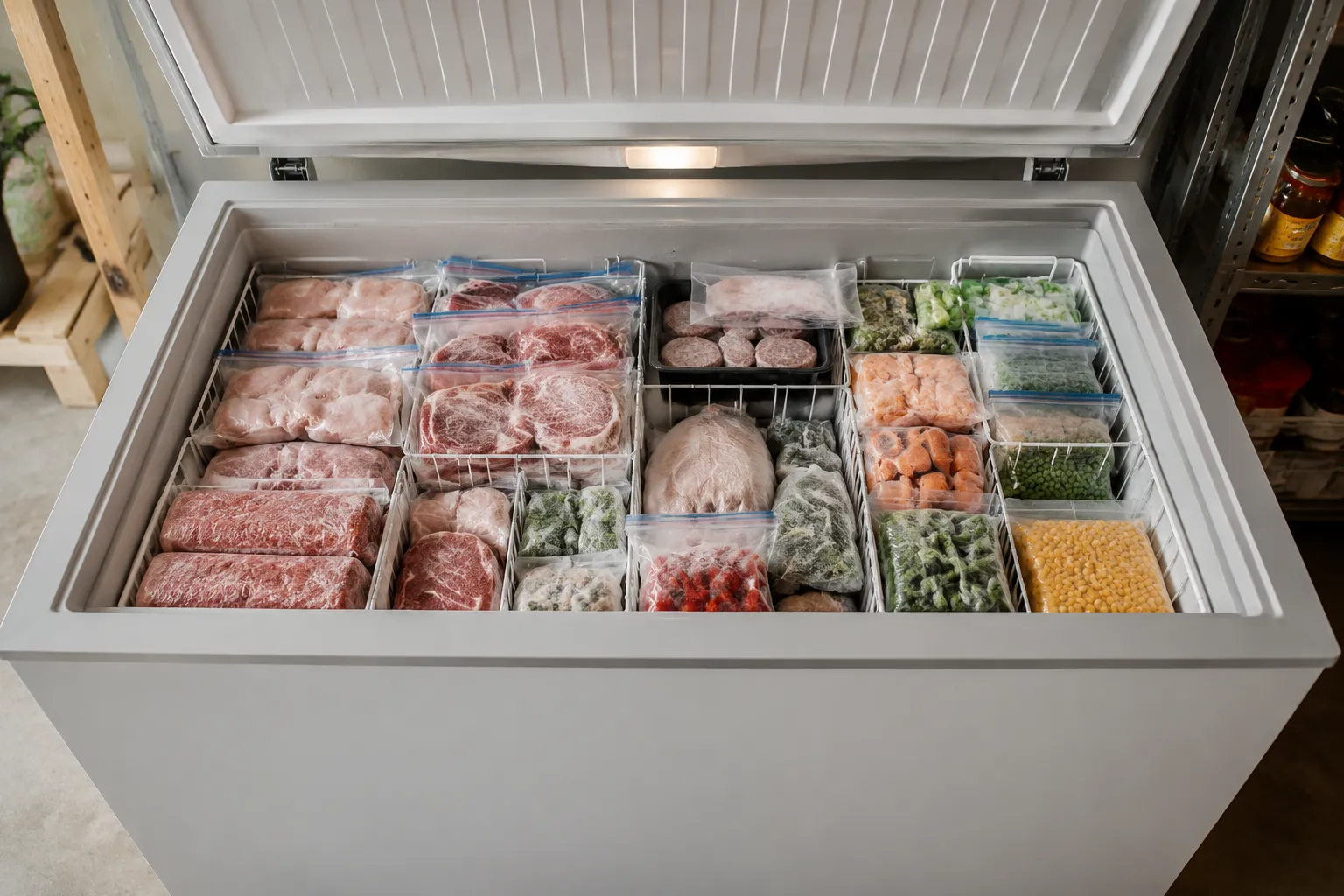
Bulk buying without a plan is how a chest freezer becomes a mausoleum. The 25-pound bag of chicken thighs goes in on Sunday with the best intentions, and by March it is a solid, unidentifiable block at the bottom of a glacier of frost, buried under the remnants of a pork shoulder that was supposed to become carnitas. The problem is rarely the freezer. The problem is that most people load it the way they load a car trunk before a move: everything goes in, nothing gets labeled, and the stuff they actually needed is always at the bottom.
There is a better way, and it starts with accepting that a chest freezer is a system, not a pit. The people who run these things well treat them like a small warehouse, with zones, a manifest, and a strict policy about what gets in. The people who run them badly treat them like a cave. The difference shows up in the grocery bill, the amount of food thrown out, and the number of times dinner requires a hammer and a lot of profanity.
The case for bins over loose stacking
The single most effective change a person can make is to stop putting food directly into the freezer and start putting it into bins. Clear plastic bins, the kind sold for pantry organization, change the entire physics of the situation. Loose bags slide, tumble, and migrate to the bottom. Bins create walls. A bin of chicken, a bin of ground beef, a bin of vegetables, a bin of bread. Each category stays put, and each bin can be lifted out wholesale when the contents need sorting.
This matters most on the bottom of the freezer, which is where the cold air sinks and where food disappears. A person who opens the lid, sees a bin labeled "Pork" and another labeled "Breakfast," can make a decision in seconds. A person who sees a chaos of white butcher paper and plastic bags has to dig, and digging is how frost forms, how items get pushed aside, and how a perfectly good pork loin is discovered, freezer-burned and sad, eleven months later.
Bins also solve the "I forgot it existed" problem. The human brain cannot remember what is buried under six inches of frozen peas. The human brain can remember that the blue bin is the beef bin, and that the beef bin has been getting low. Out of sight is out of mind, but out of sight inside a labeled bin is at least a category a person can check in ten seconds.
Why the wire basket is a quiet hero
While bins handle the floor, wire baskets handle the top layer. Most chest freezers come with a single shallow basket that slides along the rim, meant for small items that get lost in the depths. That basket is usually used for popsicles and forgettable odds and ends. It deserves better.
The top basket should hold the items a household uses most often. Breakfast sausage, the bag of shrimp for Friday night, the container of homemade stock that gets pulled for weeknight soups. The logic is simple: the most frequently accessed food should require the least amount of digging. A person should not have to kneel, lean in, and rearrange a frozen landscape to retrieve a bag of frozen corn. The corn lives on top, in the basket, where a single hand can grab it.
Some freezers allow for stacking two baskets, and the second basket, placed lower, can hold backup proteins and less frequent items. The key is to resist the urge to fill the basket with junk. The basket is prime real estate. It should never hold the bag of ice that just sits there for six months, because nobody ever needs ice at 9 PM on a Tuesday in February.
Labels with a date and a weight, not just a name
Writing "Chicken" on a freezer bag is a start, but it is not enough. The label needs a date and an approximate weight or portion count. "Chicken, 2 lb, Feb 14" is a complete sentence. "Chicken" is a mystery. When a person is deciding what to cook on a Thursday, the difference between knowing there are two pounds of thighs and knowing there is "some chicken somewhere" determines whether the meal happens or the family orders pizza.
A cheap label maker helps, but a permanent marker and masking tape work fine. The trick is to label before the food goes in, not after. Once the food is frozen, the surface is too frosty for tape to stick, and the marker smears on plastic. Labeling is a five-second task at the counter, not a heroic effort at the open freezer door with cold air billowing out.
For ground beef and other items that get frozen flat, the label goes on the outside of the freezer bag before the meat goes in a single layer on a sheet tray. After the meat freezes solid, the flat packages stack like books in the bin. That stacking method is the difference between a bin that holds eight pounds of beef and a bin that holds four, because the air between the lumpy packages is wasted space.
The raw and cooked separation rule
A chest freezer needs a clear line between raw proteins and ready-to-eat food. That line is not a suggestion. Raw chicken juice leaking onto a container of cooked chili is a food safety risk that no amount of reheating can fully neutralize, because the contamination happened before the chili was ever reheated. The system should keep raw meat in the bottom bins, on the floor of the freezer, and cooked food in the top basket or on a separate side.
This rule also applies to meals prepared for later. A batch of lasagna that was fully cooked and then frozen should sit above the raw ground beef, not below it. In a chest freezer, gravity works against a person. The drips go down. Keeping the cooked food elevated above the raw food is a simple physical answer to a problem that is mostly about physics.
A manifest on the lid beats a memory in the head
Every well-run chest freezer has a manifest. This is a piece of paper, taped to the inside of the lid or stuck to the front of the freezer with a magnet, that lists what is inside. It is not a fancy spreadsheet. It is a running list, updated every time food goes in or comes out. A person opens the lid, sees the list, and knows exactly what is available without moving a single bag.
The manifest should be organized by category, matching the bins. "Beef: 3 packs ground, 1 roast. Chicken: 2 packs thighs, 1 pack breasts. Pork: 1 loin, 1 pack chops." When a pack of ground beef comes out for Tuesday's chili, the list gets a line through it or a quick edit. The discipline is the hard part. The list is useless if it is only updated once a month on a whim.
When a household gets a good deal on a bulk purchase, the manifest is where that deal becomes visible. The 20 pounds of chicken at 99 cents a pound is only a good deal if it actually gets eaten before it gets freezer burn. The manifest keeps that 20 pounds in front of the household's face, which means the amount of waste drops and the actual savings per meal go up.
The first-in, first-out rotation that nobody enjoys
Freezer management is a queue. The oldest food should always be at the top, or at the front, so it gets used first. This requires a small habit that feels tedious but pays off enormously: when a new batch of chicken goes into the bin, it goes to the bottom, pushing the older packages up. New bread goes behind the older loaf. The new milk, if a person freezes milk, goes behind the old carton.
Most people skip this step because it feels like extra effort at the moment of putting groceries away. But the cost of skipping it is that the food which has been in the freezer longest is always the hardest to reach, which means it is always the last to be eaten, which means it is always the thing that gets thrown out when the freezer defrosts in the spring. The rotation is not a nice-to-have. It is the entire point of having a freezer instead of just buying food fresh every week.
Plan the defrost before the frost wins
A chest freezer that runs frost-free is a luxury. Many chest freezers are not frost-free, and the ice builds up on the walls like a cave getting smaller. That frost is not just annoying. It is an insulator. It coats the coils, makes the compressor work harder, and eats into the usable space. A freezer with an inch of frost on every wall holds noticeably less food than the same freezer recently cleaned.
The solution is to schedule a defrost before the ice becomes a problem, and to use the bins to make the defrost easy. When the day comes, the bins come out in order and go into coolers or a spare refrigerator. The freezer gets unplugged, the ice melts, the walls get wiped down, and the freezer goes back on. The whole operation takes an hour if the bins are doing their job. Without the bins, the defrost becomes an archaeological dig, sorting through a frozen midden of unidentifiable packages.
Doing this twice a year, once in late spring and once in late fall, aligns with the natural rhythm of bulk buying. The spring defrost clears out the winter stockpiles. The fall defrost makes room for the holiday roast and the bulk meat purchases that come with cooler weather. The schedule keeps the freezer from ever becoming a crisis.
What actually belongs in a chest freezer, and what does not
Not everything bulk-purchased belongs in a chest freezer. A chest freezer is for things that freeze well and for things that will actually get used. It is not a home for the 10-pound bag of salad greens that sounded healthy at Costco and will be a soggy, wilted disaster after one freeze-thaw cycle. It is not a home for the gallon of milk that nobody will drink, because milk takes up an enormous amount of space for a fairly cheap item that can be bought fresh.
The best candidates for chest freezer storage are proteins bought on sale, homemade stock and soups, bread and baked goods, and vegetables that were blanched and frozen at peak season. Butter, cheese, and cooked beans also freeze well. The common thread is that these items freeze without a meaningful loss of quality, and they are things a household uses regularly enough to justify the space.
A person should also think about the cost of the electricity. A chest freezer full of food holds its temperature better than an empty one, because the frozen food acts as a thermal mass. An empty chest freezer is an energy hog, running constantly to cool nothing. In practical terms, this means a chest freezer should be either mostly full or unplugged. A half-full chest freezer is the worst of both worlds: wasted energy and wasted space.
The 15-minute weekly audit that prevents a catastrophe
Once a week, take fifteen minutes and do a quick audit. Open the lid, check the manifest against reality, and move anything that has been in there longer than three months to the top basket so it gets used. This weekly check is the difference between a freezer that is a working tool and a freezer that is a black hole.
The audit does not require emptying the freezer. It requires looking at the bins, seeing what is full and what is low, and making a rough plan for the week ahead. If the beef bin is full but the chicken bin is empty, the next grocery trip shifts toward chicken. If the vegetable bin is overflowing, the meal plan for the week includes a lot of stir-fries and soups. The audit is a planning session, not a cleaning session.
Households that do this weekly find that the chest freezer becomes a genuine money-saving tool rather than a place where money goes to die. The savings from bulk buying only materialize when the food is eaten. A freezer full of food that gets thrown out in June is not a bargain. It is a tax on disorganization.
The last word on this is simple. A chest freezer rewards the people who respect its limits and its systems. The bins, the labels, the manifest, and the weekly audit are not fussy homemaking rituals. They are the mechanics of not wasting money. Anyone who has ever pulled a rock-hard, frost-encrusted mystery from the bottom of a freezer and thrown it in the trash knows the price of skipping the system. The fix is not a bigger freezer. The fix is a better plan.