
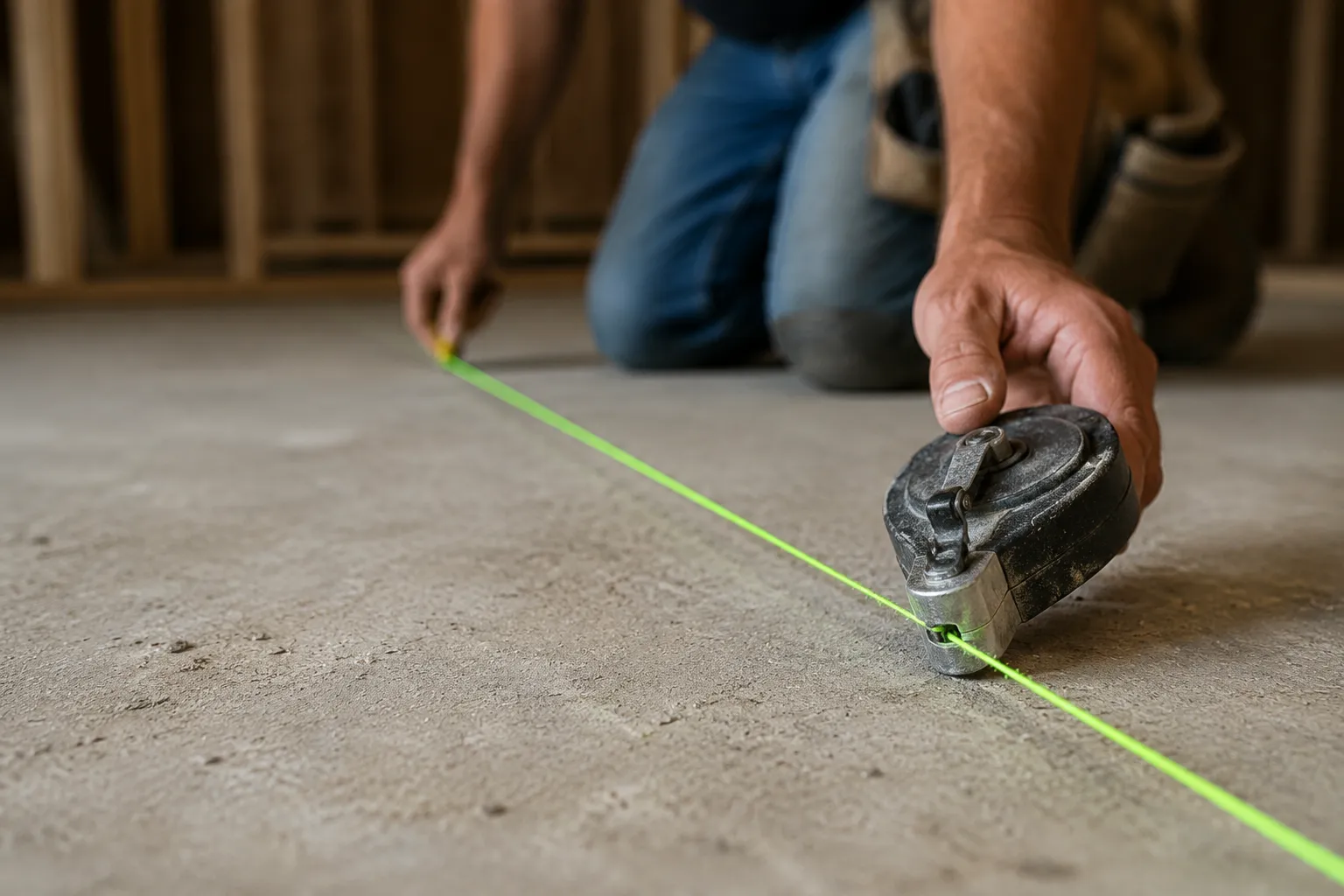
Chalk line snaps are the cheapest precision tool in construction, and the most abused. A forty-dollar reel can lay out a layout that misses by half an inch over forty feet, not because the tool is bad, but because the person swinging it treats the snap like swinging a jump rope. The chalk line is not complicated. It is a string, a reel, some chalk dust, and a hook. Yet a good snap depends on a set of small physical decisions that most crews never stop to think through, and the difference between a sloppy line and a true one shows up everywhere downstream: in the cabinet run, in the tile pattern, in the steel stud layout that somebody has to shim around later.
The first thing to understand is that a chalk line is two tools in one. It is a marking instrument, sure. But it is also a straightedge with a memory. The string holds a straight line between two points only if the line is pulled taut and lifted straight up off the surface before the snap. People who snap a line by dragging the string across the floor, or by snapping it while it lies flat against the surface, are not marking a line. They are marking a blur. The chalk transfers in a band that can be an eighth of an inch wide or wider, and that band becomes the reference for everything that follows.
The Physics of the Snap Itself
When the string is lifted and released, it whips down and strikes the surface along its entire length at nearly the same instant. That impact deposits chalk in a crisp line. If the string is not lifted, or is lifted unevenly, different parts of the string hit at different times and with different force. The chalk smears. A person can see this happen in real time on a dusty plywood subfloor: the line starts sharp, fades in the middle, then sharpens again near the anchor point. That fade is not a chalk problem. It is a technique problem.
The lift height matters more than most people think. Lifting the string only an inch or two off the surface produces a weak snap with poor chalk transfer. Lifting it eight to ten inches produces a harder strike, but it also introduces a risk: the string can drift sideways while it is being lifted, especially if the person is holding the reel at an angle. The line then snaps in a slight curve, or worse, in a bow that is only visible over long distances. The string must be lifted straight up, perpendicular to the surface, and pulled straight down for the snap. Any lateral force at the moment of release bends the line.
The best technique, in practice, is a two-handed approach. One hand holds the reel at the starting point, with the thumb pressing the string against the surface to keep the anchor from walking. The other hand walks the string out to the far end, pulls it taut past the mark, then lifts it straight up a few inches and lets it go. The snap should come from the wrist and forearm, not from a full-arm yank. A controlled snap deposits more chalk in a tighter line than a violent one. The goal is speed with consistency, not force.
Where Most People Lose Accuracy: The Hook
The hook on the end of a chalk line is the weak point in the entire system. Most hooks are a simple L-shaped piece of steel that hooks over the edge of a board or into a nail head. That works fine when the edge is crisp and the hook seats fully. But on a floor, a slab, or a wall, there is often no edge to hook onto. The hook gets held down by a foot or a weight, and holding it down by foot introduces a variable: the foot moves. Even a quarter-inch shift in the hook position between setting the line and snapping it throws the entire line off.
The fix is to establish a solid anchor point before the string is even pulled. On a wood subfloor, a drywall screw driven at the starting mark gives the hook something positive to catch. On concrete, a small nail tapped into a joint or a piece of tape with a mark on it works. On a wall, a helper holding the hook against the mark with a finger is better than a foot, because a finger can feel the hook seat against the mark and hold it there with consistent pressure. The anchor is not a detail. It is the entire reference. If the anchor moves, the line is a lie.
The hook itself also wears out. The sharp inside corner that seats against a board edge gets rounded after years of use, and a rounded hook seats differently under tension. A hook that has been bent, either by dropping the reel or by hooking it onto something heavy, will not sit square. The result is a line that is consistently off by a few millimeters in the same direction. A person who uses the same reel for years can develop a persistent error that they never notice, because the error is the same on every snap and looks like a consistent reference. The line is wrong in exactly the same way every time, and the work built off it carries that error forward.
Chalk Quality and the Dust That Lies
Chalk comes in a few colors, and the color choice is not cosmetic. Blue chalk is the standard for most work, but it is also the hardest to see on some surfaces and the easiest to smear on damp or oily wood. Red chalk is used for layout that must stand out against blue, but red is harder to remove and can bleed through paint and thin finishes. White chalk is nearly invisible on light surfaces and is best reserved for dark materials like roofing felt or black pipe. A person who snaps a line in the wrong color for the surface is creating a readability problem that will cost time later, when the line has to be found again.
Moisture is the quiet killer of chalk lines. Chalk is a powder, and powder that absorbs moisture clumps. A clumped line snaps as a series of dashes and dots instead of a solid line, because the chunks of chalk do not transfer evenly. The reel should be kept dry, and chalk should be refilled from a sealed container, not from a bag that has been sitting open in a truck bed. On a humid job site, a reel that sits in the sun all morning can build up internal condensation, and the first snap of the afternoon will be weak and patchy. A few shakes of the reel before the first snap, and a test snap on a scrap piece, are worth the ten seconds they cost.
The amount of chalk in the reel matters too. A reel packed tight with chalk deposits a heavier, wider line. A reel running low deposits a thin, faint line that is easy to lose on textured surfaces. The right amount is somewhere in between: enough to coat the string completely, but not so much that the line lands as a fat band. Most reels have a fill port and a small window to check the level. Checking it before starting a layout is faster than snapping a line, finding it faint, and re-snapping it with the risk of a double line that misleads the eye.
Long Lines Need a Different Approach
Anything over about ten feet introduces problems that short snaps do not have. The weight of the string itself causes sag in the middle, even when the line is pulled taut. A thirty-foot line pulled by hand will droop in the center by an inch or more, and the snap will bow. This is not a defect in the reel. It is gravity. The standard fix is to snap the line in segments: set the anchor, pull the string tight, and lift at a point halfway down the line instead of at the far end. This divides the span and reduces sag. A person can also use a helper to lift the string at the midpoint, which distributes the lift and keeps the line straighter.
For longer layout work, some crews use a laser to establish the end points and then snap a line between them, using the laser only to set the marks and the chalk line to carry the reference across the full distance. This hybrid approach is faster than pulling a tape measure across a long span and more accurate than trusting the eye. The chalk line becomes the transfer tool, not the measurement tool. The laser sets the truth, and the chalk line delivers it to the surface.
Another long-line issue is wind. A breeze that is barely noticeable at ground level will catch a thirty-foot chalk string and push it sideways by a quarter inch. The person snapping the line feels the resistance in the string and often pulls harder, which increases the sag. The fix is to snap with the wind at the person's back, or to have a helper hold the string down at intervals to break the span into shorter, less wind-affected segments. On a genuinely windy day, some layout work is best postponed, because every snap becomes a battle against the weather.
The Double-Snap Trap
The most common error in chalk line layout is not a bad first snap. It is the second snap. A line that comes out faint or slightly crooked gets re-snapped, and the second snap rarely lands exactly on the first. The result is two parallel lines, a few millimeters apart, and the eye has to guess which one is real. This is worse than a single faint line. The brain will pick either line, or a point between them, and the work will drift.
The discipline is to treat every snap as final. If the line is wrong, wipe it off completely before re-snapping. On wood, a damp rag removes chalk. On concrete, a wire brush or a broom does the job. On drywall, a fresh coat of compound or a quick sanding removes the old line. Re-snapping over a bad line without cleaning it first is a guarantee of confusion. The second line should land exactly on the first, and the only way to know that is to start from a clean surface.
A related problem is the pencil mark that ends up beside the snapped line. When a person snaps a line between two pencil marks, the line should pass exactly through the center of both marks. But the chalk line is a physical string, and it can land beside the pencil mark if the string was pulled to one side of the mark instead of through it. The habit of placing the string directly over the pencil mark, then sighting down the length of the string to confirm the alignment before snapping, catches most of these errors. The ten seconds of sighting saves a re-snap.
Reel Maintenance Nobody Does
A chalk line reel is a simple mechanical device, and it needs simple maintenance. The string wears out. After months of use, the string gets frayed, stretches, and loses its ability to hold chalk. A frayed string snaps irregularly because the fibers catch on each other. A stretched string measures long, because the effective length of the line changes under tension. The string in a reel should be replaced periodically, and it is a five-minute job that most people never do. Instead, they buy a new reel, which is fine, but the old reel could have been restored for the price of a spool of string.
The internal chalk reservoir also needs cleaning. Over time, chalk dust packs into the gears and the winding mechanism, making the reel stiff and hard to crank. A reel that is hard to crank encourages the user to leave the string out instead of winding it back, which leaves the string exposed to moisture and dirt. A stiff reel is a signal. It means the chalk has packed down and needs to be loosened with a screwdriver or a thin rod, or the reel needs a full disassembly and cleaning. Ten minutes of preventive maintenance keeps the reel working for years.
The hook also deserves attention. A hook that is bent can often be straightened with pliers, but a hook that has lost its temper is a lost cause. The metal becomes soft, and the hook will bend again under the first real tension. Replacement hooks are available for some reels, and a reel with a replaceable hook is worth buying for that reason alone. The hook is the part that touches the work, and the part that touches the work is the part that wears out first.
The Case for a Second Reel
Serious layout work justifies owning two reels. One reel holds blue chalk for general marking, and the other holds red chalk for reference lines that must not be confused with the working lines. The color distinction is not a luxury. On a complex layout with intersecting lines, the eye needs to sort the references instantly. A person who has to stop and think about whether a line is a centerline or an edge line is a person who is losing time and risking errors. Two reels, two colors, and a rule about which color means what eliminates the guesswork.
The second reel also serves as a backup when the first reel runs out of chalk mid-layout. Stopping to refill a reel in the middle of a long run breaks the rhythm and invites mistakes. A fully loaded second reel sitting in the truck is cheap insurance. The cost of a basic reel is less than the cost of redoing one cabinet run or one tile row.
Snapping on Vertical Surfaces
Vertical layout, on a wall or a stud face, uses the same physics but a different technique. Gravity fights the string, pulling it down and away from the surface, so the string must be held in contact with the wall at both ends and at several points in between. A person snapping a vertical line often pulls the string tight and lets it go, only to find that the line lands below the intended mark because the string bowed downward before it hit. The fix is to hold the string against the wall with the free hand at the midpoint, then snap. The string strikes the wall in a straight line instead of a drooping curve.
On a wall that is not perfectly flat, which is most walls, a vertical snap will skip across hollows and leave gaps in the line. This is not a technique failure. It is the surface. A person should expect the line to be broken and should mark the gaps with a pencil by extending the line across them with a straightedge. The chalk line gives the reference, and the pencil makes it continuous. Trying to re-snap a vertical line to fill a gap is the same trap as the double-snap on a floor: the second snap drifts, and the line becomes two lines.
The chalk line is a tool that rewards respect. It is simple, but it is not forgiving. A person who treats it as a toy, or as an afterthought, gets exactly the layout they deserve. A person who understands the anchor, the lift, the chalk, and the snap gets a line that is true, and a true line is the foundation of everything that follows. The line is the first thing drawn and the last thing checked. It deserves the care that a final check would receive, because the final check only confirms what the first line already decided.