
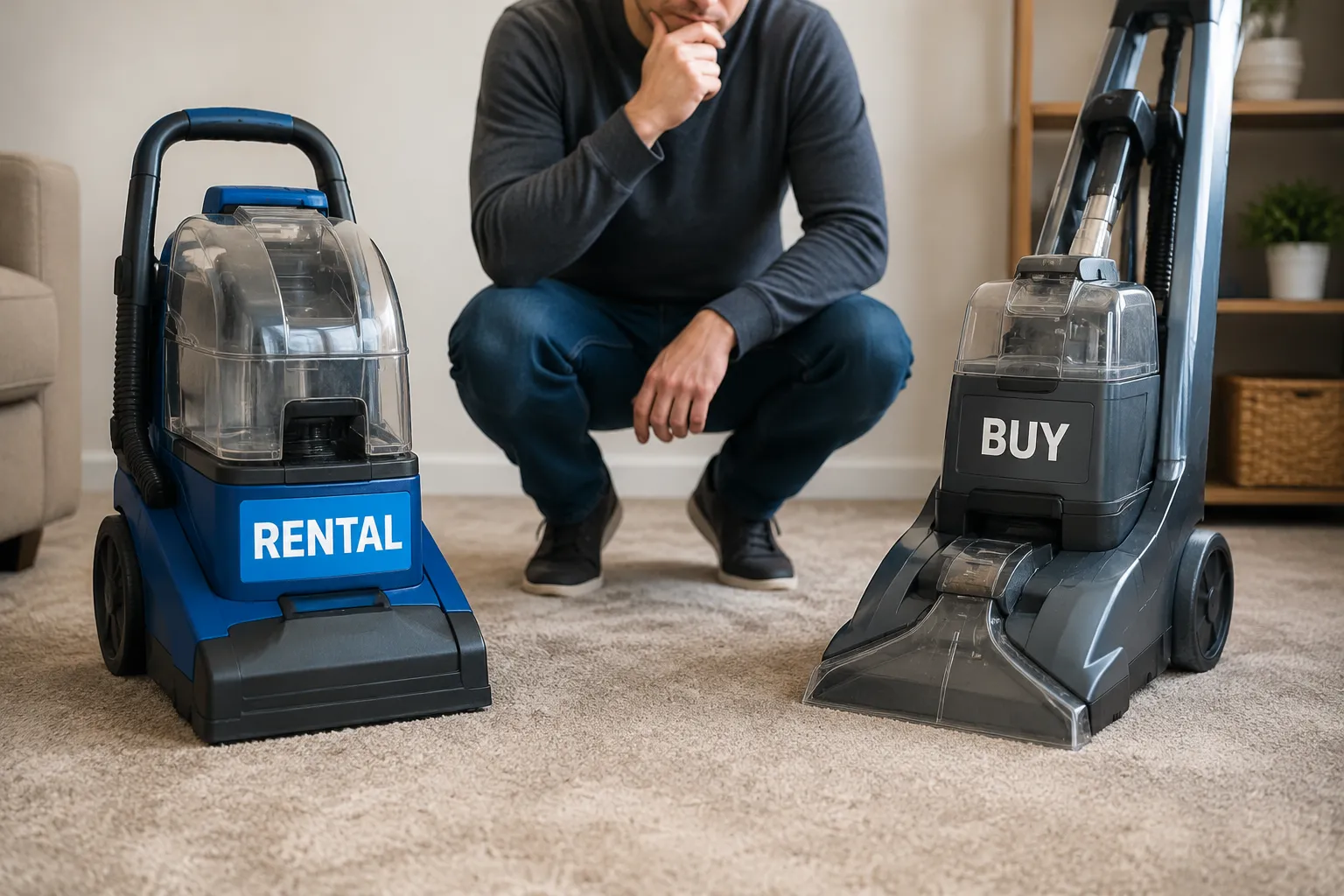
The default assumption most people carry into the carpet cleaning aisle is that renting a machine is the financially sane choice. The logic feels airtight: a rental costs forty bucks for an afternoon, while a purchased machine runs several hundred dollars and then sits in a closet for eleven months. The math looks obvious. The math is also incomplete, because it ignores what actually happens to a rented machine over the course of a single Saturday in a lived-in house.
Rental units are workhorses, but they are workhorses that have been ridden hard by every person in the neighborhood with a shedding dog and a toddler who found a juice box. The plastic is scuffed, the hoses are patched with tape, and the brushes carry a faint smell that no amount of hot water seems to fully erase. None of that makes the machine unusable. It does mean the person renting it is accepting a specific set of risks that the purchase price never captures.
The Rental Math That Nobody Calculates
The advertised rental price, usually around thirty to forty dollars for twenty-four hours, covers the machine alone. The cleaning solution is sold separately, and the additive packs are priced like printer ink. A single session with a decent premixed solution and a defoamer runs another fifteen to twenty dollars. The total lands somewhere near sixty dollars for one pass at the living room and hallway.
That figure is fine if the carpet needs one pass. The trouble begins when the first pass reveals that the water coming back up is still brown, which happens on any carpet that has gone more than a year without cleaning. The rental counter charges for the full day regardless of whether the machine is used for three hours or twelve, so the second pass costs nothing extra in rental fees. It costs another hour of hauling furniture and another tank of hot water. The real expense is time, and the rental model charges that expense at the worst possible rate.
There is also the question of what counts as an afternoon of work. A single room with moderate traffic takes about forty-five minutes of actual machine time, plus setup and tear down. A whole house takes the better part of a day, and that day has to be scheduled around the rental window. The machine must be back by the store's closing time, which means the last pass on the stairs happens at 4:30 while the person doing the work keeps one eye on the clock and the other on a wet corner that needs another few strokes.
What a Rental Machine Actually Feels Like
Anyone who has used a rental unit knows the weight distribution is wrong. The tank sits high, the handle angles awkwardly, and the whole assembly wants to tip forward when the tank is full. A person of average height ends up bent at the waist, pushing a machine that feels like it is actively resisting the task. The brushes spin fast enough to scrub, but the suction is often inconsistent, leaving a carpet that looks clean and feels damp for two full days.
The suction issue is the real problem. A rented machine has been dropped, banged against doorframes, and operated by people who did not read the manual. The seals wear out, the hose connections loosen, and the vacuum motor loses its edge. The result is a carpet that is cleaner than before but still holds a surprising amount of dirty water deep in the fibers. That remaining moisture is not just uncomfortable to walk on. It carries the loosened dirt back down as it dries, which is why rental-cleaned carpets sometimes look dingy again within a week.
None of this is a reason to avoid renting. It is a reason to understand that the rental experience is a gamble on maintenance. Some machines are fine. Others are barely functional. The counter staff at a big box store does not know which one is sitting in the cage, and asking them to check the seals on a machine that has been returned by three other customers that morning is not a realistic request.
The Purchase Price and the Hidden Savings
Buying a machine means accepting a different set of terms. A decent residential unit, something from Bissell or Hoover in the 150 to 250 dollar range, costs more than four rentals. The break-even point lands around the fourth or fifth use, assuming the owner already has the cleaning solution on hand. Most people who buy a carpet cleaner use it twice in the first year and then forget about it until a pet has an accident or a child spills something that dries into a crust.
The quiet advantage of ownership is not the cost per use. It is the lowered barrier to action. A person who owns a machine can spot-clean a stain the moment it happens, without planning a trip to the store, without checking the rental return time, without maneuvering a borrowed appliance through the front door. The machine lives in the hall closet. Dragging it out takes ninety seconds. That convenience changes behavior, and changed behavior is what keeps carpet from reaching the state where a full rental session is needed in the first place.
An owned machine also allows for the two-pass method done properly. The first pass applies solution and scrubs. The second pass, with the solution tank empty and plain hot water in the reservoir, rinses the fibers. Rental schedules rarely allow for this luxury, because the rinse pass takes nearly as long as the wash pass. Owners do it routinely, and the difference shows in how long the carpet stays bright.
The Weight of a Machine in a Small Home
Storage deserves more consideration than it gets. A carpet cleaner is a bulky object with an awkward footprint, and it does not stack well with anything else. People in apartments or houses without a dedicated utility closet are making a real trade when they buy one: the machine occupies floor space that could hold a fan, a step stool, or boxes of seasonal decorations. In a 700-square-foot apartment, a carpet cleaner is a permanent piece of furniture with a single seasonal purpose.
This is where the rental argument regains its strength. For a person with one small rug and no pets, a rental every eighteen months is the correct answer. The machine never needs to be stored, never needs filter replacements, never needs its belts checked. The rental counter absorbs all of that. The owner walks in, pays the fee, and walks out with a machine that does the job adequately for a day.
The calculus shifts hard for anyone with a house of wall-to-wall carpet, a dog that sheds year-round, or a child who eats crackers on the floor. That household will use a machine more than four times over the life of the carpet, and every use after the fourth is money saved. The storage problem is real, but it is solvable with a shelf or a corner of the garage. The convenience problem is not solvable with a rental.
The Solution That Makes the Decision
The cleaning chemical is the part of the equation that gets the least attention and matters the most. Rental stores sell their own brand of solution, usually a soapy mix that foams aggressively and requires careful measurement. The foam is a problem because it fills the recovery tank and reduces suction. A person who uses too much rental solution spends the afternoon stopping to dump foam and refill with water, and the carpet still comes out with a slight residue that attracts dirt faster than a clean fiber would.
Owned machines accept the same aftermarket solutions, and the better ones work without the foam issue. A good enzyme-based cleaner breaks down organic soil rather than just suspending it in water. The difference in results is visible within a day. The rental-machine user sees a carpet that looks fine when wet and vaguely dusty when dry. The owner who buys a real solution and follows the dilution ratio sees a carpet that stays brighter for months.
The solution cost also points toward ownership for the frequent user. A bottle of quality concentrate runs fifteen to twenty dollars and does the whole house three or four times. The rental-store packets cost five to seven dollars per use and are often the same generic formula regardless of brand. Over five uses, the owner has paid for the machine difference in chemicals alone.
The Middle Path That Most People Ignore
There is a third option that sits between renting and buying, and it deserves more attention than it gets: the used market. Carpet cleaners are among the most frequently resold appliances on Facebook Marketplace and Craigslist, because people buy them for a single project, use them twice, and then list them for a fraction of the retail price. A machine that sold new for 220 dollars appears used for 60 to 80 dollars, often with a bottle of solution and a few spare belts thrown in.
A used machine carries the risk of hidden wear, but carpet cleaners are simple devices. The motor either works or it does not, and the hoses are replaceable for a few dollars online. The buyer can test the suction before handing over cash by filling the tank with water and running the machine for thirty seconds. If it picks up water cleanly and the brushes spin, the machine will likely perform for years. The resale value also holds, since a used machine bought for 70 dollars can be sold again for 50 dollars after two years of use.
This path makes the most sense for the household that is unsure about its frequency of use. The buyer gets the convenience of ownership without the retail price, and if the machine sits unused for a year, the financial loss is small enough to shrug off. The carpet cleaner becomes a tool with a realistic cost, not a major purchase that demands justification.
The Real Question Is the Carpet
The decision between renting and buying is ultimately a decision about what the carpet is worth to the household. A rental is a transaction that treats carpet as a surface to be maintained at minimum viable cost. It is the right choice for renters, people with one or two low-traffic rooms, and anyone who cleans carpet on a schedule dictated by the calendar rather than by visible dirt.
Buying, new or used, is a commitment to the idea that carpet is an asset worth protecting. The owner who keeps a machine in the closet is the same person who changes the HVAC filter on schedule and wipes down the baseboards. The machine is not a purchase. It is a household habit made physical, and the habit is what keeps the carpet from ever reaching the state where a rental becomes necessary.