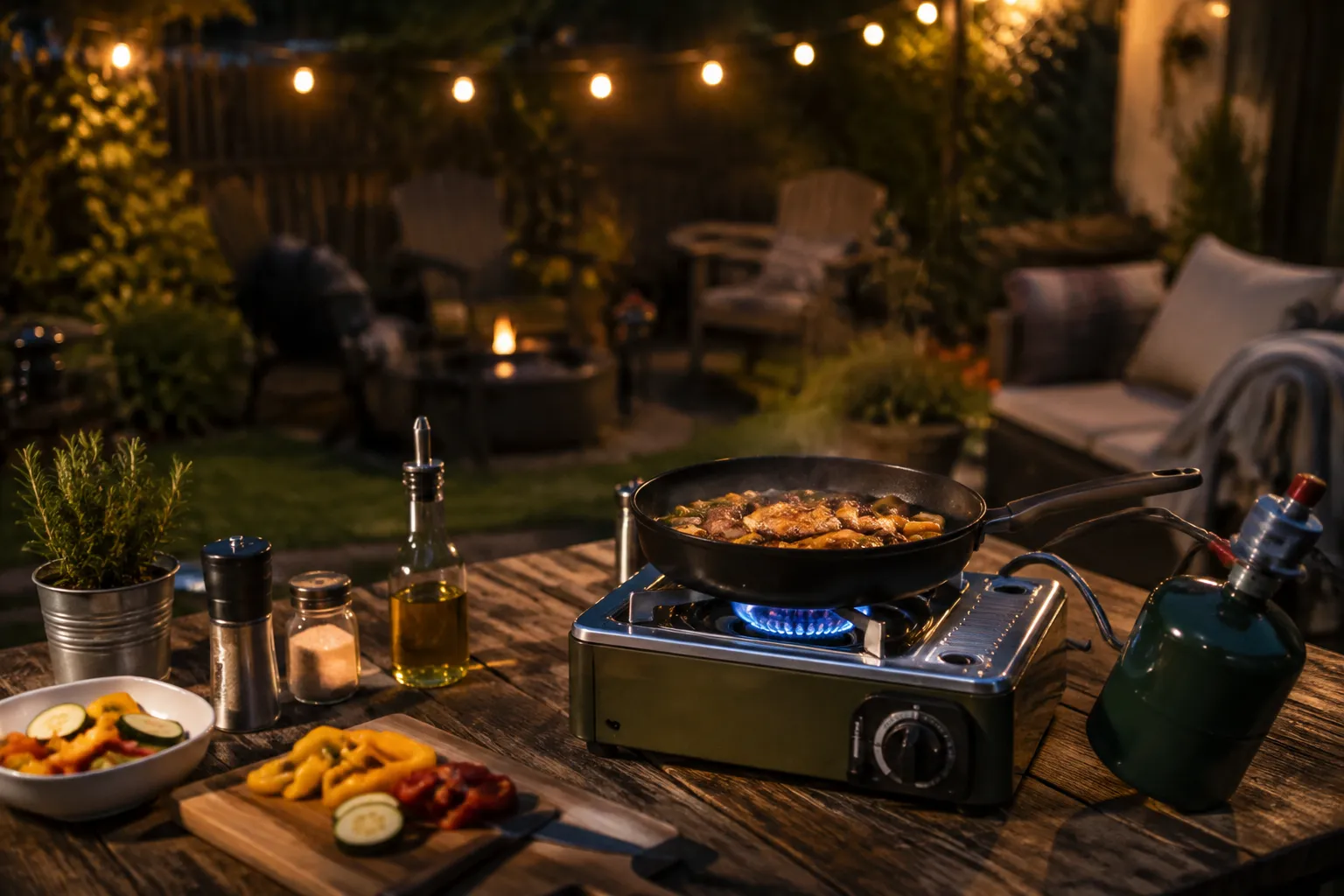
The backyard camping stove has become the most liberating piece of cooking equipment most people own and never use. A person will spend a hundred dollars on a compact two-burner, take it on three trips, and then let it sit in the garage while the grill rusts under its cover. That is a waste of a perfectly good flame. The camping stove, with its tiny footprint and brutal efficiency, is actually better suited for a Tuesday night dinner than a weekend in the mountains.
The argument for moving the stove from the duffel bag to the patio is simple: control. A camp stove runs on regulated propane or butane, which means the flame is consistent, adjustable, and immediate. A charcoal grill takes forty minutes to come to temperature and another twenty to calm down. A camp stove clicks and burns at full strength in seconds. The modern backyard cook has been trained to worship the grill, but the grill is a blunt instrument. The camp stove is a scalpel.
Why the Backyard Needs a Small Flame
The standard backyard setup suffers from an all-or-nothing problem. Firing up a large gas grill for two burgers feels wasteful, and lighting a chimney of charcoal for a single skillet of vegetables feels like a ritual that demands a reward. The camping stove solves this by being small enough to make a modest meal feel intentional. A person can boil water for pasta, sear a piece of fish, or reduce a pan sauce without committing to the spectacle of a full grill session.
There is also the matter of heat output. Most two-burner camp stoves push somewhere between 10,000 and 20,000 BTUs across both burners. A typical backyard grill runs 30,000 to 60,000 BTUs but distributes that heat over a much larger surface. The camp stove concentrates its energy into a small pan. That concentration is exactly what a person wants for a quick sear on a steak or a fast boil for corn. The stove does not just replace the grill for small jobs; it outperforms it.
The other quiet advantage is cleanliness. Cooking outdoors with a camp stove keeps grease and splatter out of the kitchen, but it also keeps the mess off the grill grates. A person can cook a sticky teriyaki glaze or a messy pan of nachos and simply wipe down the stove's surface with a rag. There is no scraping, no wire brush, no burnt-on residue that requires a deep clean the next morning.
Choosing the Right Stove for the Patio
Not every camping stove earns its place on the patio table. The tiny backpacking canister stoves, the ones that screw directly onto a butane cartridge, are too tippy for a skillet and too weak for anything beyond boiling a cup of water. The sweet spot is the classic two-burner suitcase stove, the kind that folds into a metal briefcase with a latch. These stoves have a wide base, a windscreen, and enough surface area to hold a twelve-inch pan without wobbling.
When picking a stove for backyard use, stability matters more than packability. The stove will not be strapped to a backpack, so the weight and folded dimensions are irrelevant. What matters is the distance between the burners and the size of the cooking grate. A stove with a narrow grate will struggle with a wide pot. A stove with burners too close together will not allow two pans to cook at the same time. The best backyard camp stove is the one that feels like a miniature kitchen range, not a survival tool.
Fuel type is the other decision. Propane is the easiest to find and the most predictable in cold weather, which matters less on a summer patio but still matters for storage. Butane is quieter and often cheaper, but it performs poorly below freezing. For a backyard stove, propane wins. A person can keep a spare green canister in the shed and never worry about running out mid-meal.
The Skillet Meal That Beats the Grill
The classic test for any backyard cooking setup is the steak. On a grill, a steak cooks over radiant heat with the flames licking the grates. On a camp stove with a cast-iron skillet, the steak cooks in its own fat with direct contact. The difference is profound. The skillet version develops a crust that is even, dark, and deeply savory, while the interior stays pink and tender. The camp stove makes this possible because it holds a steady temperature without the wild swings of a grill fire.
There is a technique to this that matters. A cast-iron skillet should be preheated on the camp stove until it is just shy of smoking. The steak goes in with a high smoke-point oil, and the cook resists the urge to move it for a full three minutes. The flame stays at medium-high, not roaring, and the fat renders into the pan. When the steak is flipped, the second side needs less time. The final step, basting with butter and thyme, is where the camp stove shines. The flame is small enough to control, so the butter browns without burning.
The result is a steak that tastes like it came from a high-end restaurant kitchen, not a backyard. The camp stove allows the cook to manage the heat with a level of precision that a grill cannot match. The grill has its place for large cuts and indirect cooking, but for a single steak, the skillet on a camp stove is the better tool.
A Wok on a Whisper-Lite Burner
Stir-fry is the other dish that transforms on a camp stove. The high-output backpacking stoves, the ones that roar like a jet engine, are often dismissed as too aggressive for real cooking. In the backyard, that aggression becomes an asset. A proper stir-fry needs intense heat to sear vegetables quickly and keep them crisp. A home kitchen stove rarely delivers that heat. The backpacking stove, with its focused flame and minimal distance to the pan, gets close.
A flat-bottomed carbon steel wok sits directly on the stove's burner. The flame wraps around the wok's curved sides, and the cook tosses the ingredients with a quick wrist motion. The vegetables hit the hot surface, sizzle violently, and come out bright and crunchy. The sauce, a mix of soy, rice vinegar, and a touch of sugar, goes in at the last minute and coats everything in a glossy sheen. The entire process takes under eight minutes, which is faster than ordering takeout.
The one caveat is that the single-burner backpacking stove needs a solid, level surface. A camp table or a sturdy wooden board across two sawhorses works well. The stove itself is small, so a person should not place it directly on the grass or any surface that might catch a stray spark. Cooked properly, the stir-fry from a camp stove has a smoky char that a kitchen wok cannot reproduce without a dedicated wok burner.
Griddle Cakes and Breakfast Outside
Breakfast on a camp stove is the closest thing to a diner experience a person can make at home. The flat griddle, a rectangular steel plate that fits over both burners, turns the two-burner stove into a short-order cooktop. Pancakes, eggs, bacon, and hash browns all cook simultaneously, and the griddle's even heat distribution means nothing burns while the cook is tending to something else.
The griddle method is simple. The stove heats both burners to medium, and the griddle sits on top until a drop of water dances and evaporates. Bacon goes down first, rendering its fat across the surface. The pancakes follow, and the eggs cook in the residual grease. The flavor of bacon fat in the pancake batter is the kind of accident that becomes a family tradition.
The camp stove griddle setup also handles the other classic outdoor breakfast: the breakfast burrito. A person can scramble eggs, fry chorizo, and warm tortillas all on the same surface. The burritos get wrapped in foil and handed out to whoever is waiting. The stove's portability means breakfast happens wherever the morning sun lands, not in a dark kitchen.
The Boil That Takes Five Minutes
Corn on the cob, shrimp, or a pot of salted water for pasta all benefit from the camp stove's raw power. A high-output stove can bring a gallon of water to a rolling boil in under six minutes, which beats most home ranges. The secret is the stove's ability to deliver maximum BTUs directly to the pot's bottom without losing heat to the surrounding air.
One overlooked use is the summer seafood boil. A large stockpot on a two-burner camp stove can handle small potatoes, sausage, corn, and shrimp in one pot. The stove sits on a picnic table, and the pot bubbles away while the cook tosses the ingredients in stages. The whole meal gets drained and dumped onto a newspaper-covered table. The camp stove makes this possible because it brings the cooking surface to the gathering, eliminating the back-and-forth between kitchen and yard.
For the person who hosts often, the camp stove becomes a second kitchen. The main oven handles the roast, while the camp stove on the patio manages the sides. This parallel cooking cuts total dinner time in half and keeps the kitchen from turning into a steam bath on a hot evening.
The Flattop for Fajitas and Philly Sandwiches
The griddle top mentioned earlier deserves its own meal. Fajitas on a camp stove griddle produce a sound and a smell that bring people running. Strips of flank steak marinated in lime and cumin hit the hot surface and sear immediately. The onions and peppers cook alongside, softening and charring at the edges. The whole thing gets served directly from the griddle with warm tortillas and a pile of toppings.
The Philly cheesesteak is another griddle classic. Thinly sliced ribeye, shaved onions, and provolone cheese come together on the flat surface. The meat browns in its own fat, and the cheese melts into the crevices. The assembled sandwiches get pressed on the griddle until the bread is toasty and crisp. This is not a dish that works well on a grill. The griddle's flat surface is essential for the meat to sear without falling through the grates.
The camp stove griddle also handles the mundane but useful task of reheating leftovers. A slice of pizza, a pile of fried rice, or a few spring rolls all crisp up beautifully on the flat surface. The stove's even heat revives food without the sogginess of a microwave.
Paella and the One-Pan Feast
The paella pan is wide, shallow, and demands a heat source that covers its entire surface. A home range often struggles to heat the pan's edges, leaving the rice undercooked at the perimeter. The two-burner camp stove, with both burners lit, covers the pan's width and delivers even heat across the entire base.
Making paella outside on a camp stove is a performance. The rice sizzles in olive oil, the saffron threads steep in warm stock, and the shrimp and chorizo nestle into the grains. The socarrat, the crispy caramelized crust at the bottom, forms when the heat drops to low and the pan sits undisturbed for the final minutes. The camp stove's precise low setting makes this crust possible without burning.
The same pan works for a jambalaya or a pilaf, any one-pan rice dish that benefits from a wide, even-heated surface. The cleanup is a single pan, and the dish feeds a crowd. This is the camp stove at its most ambitious, and it proves that the tool is not just for hot dogs and canned beans.
Rules for Cooking with Propane in the Yard
Safety around a camp stove is straightforward but worth stating plainly. The stove should sit on a flat, stable, non-combustible surface. A concrete patio, a brick paver, or a metal camp table all work. A wooden picnic table can work too, but a person should place a heat shield or a trivet between the stove and the wood. The stove's legs get hot, and the surface underneath takes on heat that can char a table over time.
Wind is the main enemy. A stiff breeze can blow out a small flame or make it uneven, so the stove should be positioned with its back to the wind. Many two-burner stoves come with built-in windscreens, but a person can improvise with a piece of aluminum foil folded into a shield. The stove should sit at least three feet from any structure, and a person should keep a fire extinguisher or a bucket of water nearby, though the small propane canisters are unlikely to create a serious fire if handled with basic care.
The propane canister connection deserves attention. The threads should be snug but not over-tightened, and the valve should be checked for leaks by applying soapy water to the connection point. Bubbles mean a leak, and a leak means the stove should be turned off and the connection reseated. After cooking, the valve on the canister should be closed tightly, and the hose or regulator disconnected for storage.
A Stove for the Shed, Not the Shelf
The camping stove deserves a permanent spot in the backyard, not just a place in the gear bin. A person can hang it on a hook near the patio or store it in a weatherproof box under the grill station. The cost of a good two-burner stove is around the same as a single fancy grill accessory, and it opens up a wider range of cooking than any single-purpose gadget.
The stove changes the rhythm of outdoor cooking. Instead of planning around a big fire, a person can step outside and make dinner on a whim. The stove is ready in the time it takes to walk to the shed and carry it to the table. The flame lights on the first click, and the pan heats in a minute. The meal happens quickly, cleanly, and with a focus that the grill never provides.
The next time the weather turns mild and the evening feels like it deserves something cooked over fire, the camping stove is the tool that delivers. The grill will always have its place, but the small stove in the corner of the patio is the one that makes a Tuesday night feel like an occasion. The backyard is a better kitchen with it.