
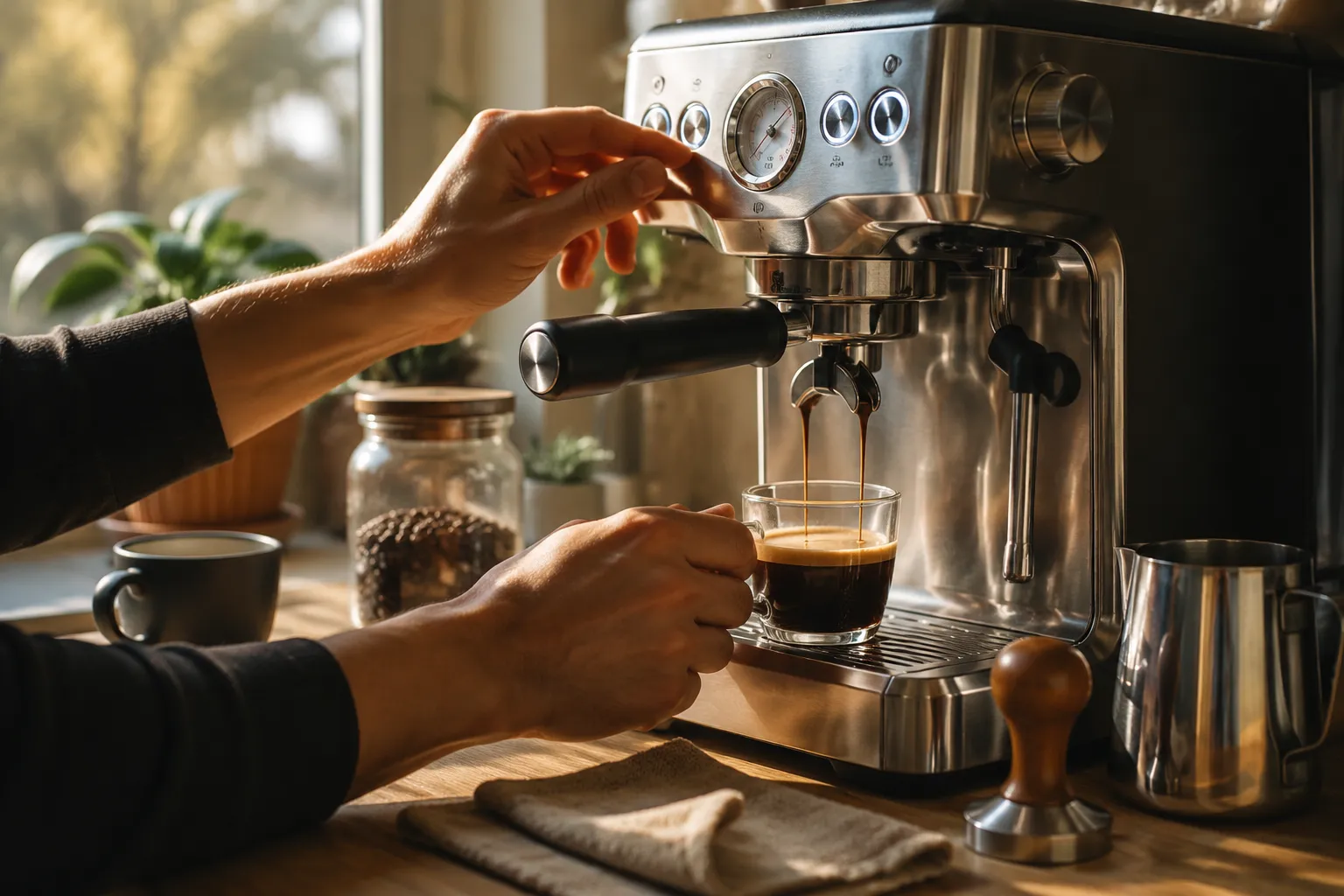
There is a small window of time, roughly between the first sip of coffee and the moment the brain fully engages with the day, where a person decides whether the morning will be a struggle or a sequence of small, manageable victories. For anyone who owns a decent espresso machine, that window is also the daily negotiation with a piece of equipment that demands consistency, patience, and a willingness to accept that most of the variables are in the machine's hands, not the operator's.
The most common failure of the home espresso routine is treating it like a single event rather than a sequence. The person who wakes up, stumbles to the machine, and immediately grinds beans into the portafilter is setting up for a mediocre shot. The machine needs time to reach thermal stability, the grinder needs a moment to clear stale grounds from the previous day, and the person needs to be honest about whether they have actually woken up enough to taste anything.
A reliable routine is not about speed. It is about removing the tiny decisions that trip up a sleepy mind. The goal is to build a sequence so predictable that the hands do the work while the brain catches up.
The Machine Wakes Up First
The espresso machine should be the first thing turned on, even before the water for anything else. Most home machines, especially the heat exchanger and single boiler designs, need anywhere from fifteen to thirty minutes to bring the group head and portafilter to a stable temperature. Many machines advertise a faster warm-up time, but the metal in the group head is the real indicator, not the light on the front panel.
A cold portafilter acts as a heat sink. When cold water hits the grounds, the extraction temperature drops, and the shot comes out sour and thin. The standard workaround is to lock the empty portafilter into the group head during warm-up so the metal heats along with the machine. This costs nothing and takes two seconds, but it changes the shot quality more than any bean upgrade ever will.
While the machine warms, the grinder deserves attention. Most home grinders retain a small amount of stale coffee from the previous day in the chute and between the burrs. The first dose of the morning grinds through that stale material, and it ends up in the basket. The fix is simple: run a small amount of fresh beans through the grinder and discard them before dosing the actual shot. A few grams of waste is a cheap price for a clean start.
The water in the machine's reservoir is another overlooked element. In areas with hard water, the mineral buildup inside the boiler and lines changes the machine's behavior over time. A routine that includes a quick check of the reservoir level and a mental note of the last descale date prevents the slow decline in temperature stability that comes from scale acting as an insulator.
The Dose, Not the Grind Size, Is the Anchor
When a shot tastes wrong, the instinct is to adjust the grind size immediately. That instinct is the enemy of a reliable routine. Grind size is the most sensitive variable on the machine, and changing it by a hair can swing the shot from bitter to sour. The better approach is to lock the dose first.
The dose is the weight of ground coffee in the basket. For a standard double basket, that number usually sits between 18 and 20 grams, but the exact number depends on the basket's capacity. The routine should include a scale, not because weighing is fussy, but because volume in the basket changes as the beans age and the grind settles. A basket that looked full yesterday might be underdosed today.
Weighing the dose out to the tenth of a gram is unnecessary. A stable routine tolerates small variations, and chasing precision at the 0.1 gram level adds stress without improving the cup. The practical goal is to hit the target dose consistently, within a few tenths of a gram, so that when the shot needs fixing, the fix is identifiable.
Once the dose is locked, the grind size becomes the adjustment tool. If the shot runs too fast and tastes sour, grind finer. If it runs too slow and tastes bitter, grind coarser. But only change one variable at a time, and only change it by a small increment. Changing dose and grind simultaneously makes it impossible to know what fixed the shot, and that brings the whole routine back to guesswork.
Distribution and the Flat Bed of Grounds
Most of the channeling problems in home espresso come from an uneven bed of grounds. Channeling is the term for water finding a path of least resistance through the puck, and it results in a shot that is simultaneously over-extracted and under-extracted, sour in one sip and bitter in the next. The cause is often simple: the grounds are clumped in the basket, and the user taps the portafilter to settle them, which creates a dense spot in the center.
The fix does not require expensive tools. A simple distribution technique involves tapping the side of the portafilter with the palm to settle the grounds evenly, then leveling the surface with a finger or a flat tool. The goal is a flat bed of coffee before the tamper ever touches it. A flat bed compresses evenly, and an evenly compressed puck extracts evenly.
The tamper itself is a simple tool, but the force matters less than people think. A consistent, level tamp is the goal, not a maximum-force tamp. Pressing down with the strength of a hydraulic press does not improve extraction; it only makes the routine harder to repeat. The routine should include the same tamping motion every time, using the same hand position, so that the pressure is consistent from shot to shot.
Some machines come with tools that look like small plastic combs or spinning distributors. These can help, but they are not a substitute for the basic skill of making a flat bed. A person who masters the flat bed can pull a good shot with a $20 tamper; a person who skips distribution will struggle even with a $200 tool.
The Shot Timer as a Diagnostic, Not a Stopwatch
The shot timer on a machine or scale is often treated as a countdown to a target number, usually 25 to 30 seconds. This is a misunderstanding. The timer is a diagnostic tool that helps identify what went wrong, not a stopwatch that ends the shot automatically.
A shot that hits the target volume too fast, say 36 grams in 15 seconds, is under-extracted. The grind is too coarse, or the dose is too low, or the water is not hot enough. A shot that dribbles out 36 grams in 45 seconds is over-extracted. The grind is too fine, or the dose is too high. The timer gives the user a clue about which variable to adjust.
The routine should include watching the stream, not just the timer. A good shot starts with a few dark drops, then transitions to a thin, steady stream the color of honey, then begins to blond, turning pale yellow and watery, at which point the shot should be stopped. That visual cue is more reliable than any timer setting.
Stopping the shot by weight, rather than by volume, is a more reliable method. A scale under the cup that stops the shot at a target yield, usually a 1:2 ratio of coffee to liquid, removes the variable of crema, which is mostly gas and adds misleading volume. Crema makes a shot look bigger than it is, and a person counting milliliters will consistently pull longer shots than intended.
Milk as the Second Routine
For milk drinks, the espresso shot is only half the equation. The milk steaming routine deserves its own sequence, and it should happen after the shot is pulled, not before. Steaming milk before pulling the shot is a common error, because the milk sits and separates while the espresso finishes. The texture of properly steamed milk degrades within thirty seconds, so the shot should be in the cup before the steam wand touches the pitcher.
The steaming routine starts with fresh, cold milk. Whole milk steams more predictably than skim or plant-based alternatives, because the fat and protein content creates a stable microfoam. The pitcher should be filled no more than halfway, leaving room for the milk to expand during aeration.
The wand should be positioned just below the surface of the milk, creating a gentle hissing sound, not a loud gurgle or a silent deep steam. The hiss is the sound of air being incorporated into the milk. Once the pitcher feels warm to the touch, the wand is submerged deeper to create a rolling vortex that mixes the foam into the milk. The final temperature should be around 150 degrees Fahrenheit, which is the point where the pitcher becomes too hot to hold comfortably for more than a few seconds.
The single most common mistake in home milk steaming is overheating. Milk that exceeds 160 degrees loses its sweetness and develops a cooked flavor that no amount of espresso can mask. The routine should include the hand-on-pitcher temperature check as a backup to any thermometer, because the hand learns the feel faster than a person reads a gauge.
The Wipe and the Flush
The routine does not end when the cup is full. The clean-up sequence is the part that determines whether tomorrow's shot will be as good as today's, and it is the step most often skipped by people who are in a hurry to leave for work.
The steam wand needs an immediate wipe with a damp cloth to remove milk residue, followed by a quick purge of steam to clear the internal tip. Leftover milk dries into a crust that is difficult to remove and imparts a stale flavor to the next batch. The purge takes two seconds and prevents a ten-minute scrubbing session later.
The portafilter should be knocked out and rinsed with hot water immediately after the shot. The spent puck, when knocked into the knock box, leaves residue in the basket. That residue, if left to dry, clogs the holes and restricts flow on the next shot. A quick rinse under the group head's hot water tap, which on most machines is just the water that comes out when the pump runs with the basket in place, clears the spent grounds and preheats the basket for the next use.
The group head itself benefits from a blind backflush, especially on machines with a three-way solenoid valve. A blind basket, which is a solid disc with no holes, is placed in the portafilter, and the pump is run for a few seconds to force water back through the group and clear coffee oils from the internal valve. Cafiza, a cleaning powder designed for this purpose, cuts through the oils that plain water cannot. A weekly backflush with cleaner, plus a daily water backflush, keeps the machine tasting neutral rather than grassy or rancid.
The Grinder Is the Quiet Variable
Many people upgrade their espresso machine while keeping the same grinder, expecting the machine to fix what the grinder cannot deliver. This is the most expensive mistake in home espresso. The grinder determines the particle size distribution, and a machine with inconsistent burrs produces a mix of fine and coarse particles that extract unevenly, no matter how careful the rest of the routine is.
A reliable morning routine includes a check of the grinder's hopper. Beans left in the hopper for days go stale, and stale beans produce a flat, hollow shot no matter how well the extraction goes. The ideal is to store beans in an airtight container and dose the hopper with only the amount needed for the morning. This is impractical for some households, but the compromise is to buy beans in smaller quantities and accept that the last few days of a bag will not taste like the first few.
The grinder's burrs also wear over time. A home user grinding a few shots a day will get years of consistent service, but a person who drinks multiple milk drinks daily should have the burrs inspected annually. Worn burrs produce a wider particle distribution, which shows up as shots that are simultaneously bitter and sour, with no adjustment fixing the problem.
Accepting the Routine Takes Days to Build
The mistake of the first attempt at a routine is trying to perfect every element on day one. A person who weighs the dose, times the shot, measures the yield, checks the temperature, and adjusts the grind all in a single morning will be overwhelmed by the number of variables. The brain cannot hold all of that information at 6 a.m.
The better approach is to lock down one variable at a time. Start with the dose, weighing it consistently for a week until the hands know what 18 grams feels like in the basket without looking. Then lock the yield, running the shot until the scale reads the target weight, watching the stream as it transitions from dark to blond. Then adjust the grind, changing it by one small increment and tasting the result. Over two weeks, the routine becomes internalized, and the hands perform the sequence without conscious thought.
The result is a morning where the machine works with the person, not against them. The first cup is ready in the time it takes to toast bread, and the taste is consistent enough that it stops being a surprise and starts being a baseline. That baseline is the real achievement of a reliable routine: not a perfect shot every time, but a good shot every time, with the energy left over to notice when something needs adjusting before the cup suffers.