
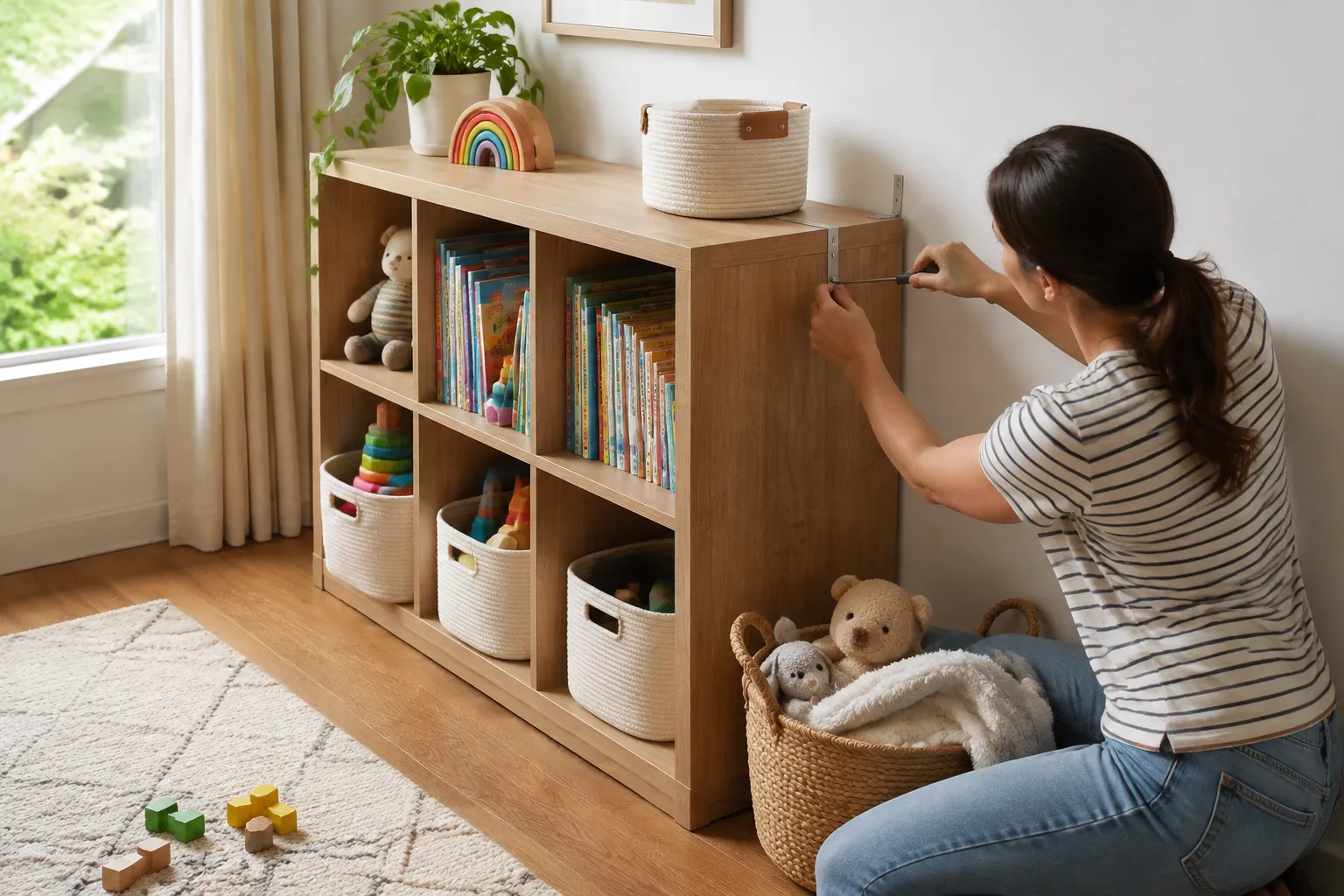
The first time a parent sees a child hang from a bookshelf, the math changes instantly. That moment, usually around age two or three, converts a piece of furniture into a liability. A shelf that looks perfectly stable at rest is a different object entirely when 30 pounds of curious human being uses it as a climbing frame. The bookshelf itself has not changed. The household has.
Children do not pull bookshelves over with malicious intent. They pull themselves up, reach for a toy on the top shelf, or use the frame as a support while learning to stand. The weight of the shelf, the distribution of books, and the quality of the floor all matter less than the simple physics of leverage. A tall, narrow bookcase full of heavy hardcovers can tip with surprising ease when a child applies force at the top edge. The center of mass shifts, the moment arm lengthens, and the whole unit rotates toward the floor.
Furniture tip-over injuries are a known hazard in homes with small children, and the numbers are serious enough that pediatricians and safety organizations have spent years trying to get the message out. The scale of the problem is described in general terms because precise annual figures vary by source and year, but the pattern is consistent: hundreds of children are injured each year in the United States, and a smaller number die. The common thread in nearly every case is that the furniture was not anchored.
The Hardware That Actually Does the Job
Anti-tip straps and brackets come in two basic flavors: the kind that screws into the wall and the kind that sticks. The screw-in kind works. The adhesive kind works until it does not, and when it fails, it fails completely.
A proper anti-tip strap is a length of heavy nylon webbing with a metal bracket at each end. One bracket attaches to the back of the bookshelf, the other to the wall stud. The strap should be as short as possible while still allowing the shelf to sit flush against the wall. A long, loose strap defeats the purpose, because the shelf has to travel several inches before the strap catches, and by that point momentum is already doing its work.
Brackets, which are rigid L-shaped pieces of metal, offer a more permanent solution. One leg screws into the wall, the other into the top of the bookshelf. The installation is less forgiving than a strap, since the bracket must line up exactly with both the stud and the shelf frame, but the result is a connection that feels absolutely solid. A shelf anchored with brackets does not move when pushed. It feels like part of the house.
The adhesive straps sold in the same section of the hardware store are a different proposition. They promise tool-free installation and no damage to walls, and they deliver on both promises right up until the moment they let go. Adhesive fails slowly, then suddenly. The glue softens in heat and humidity, the surface beneath it shifts with seasonal changes, and the tape peels away from painted drywall with a quiet, unremarkable detachment. The shelf stands there looking perfectly normal, and then a child leans on it and the whole thing comes down.
Finding the Stud Behind the Drywall
Wall construction is the quiet variable in every anchoring job. A stud finder is the right tool, but a magnet works surprisingly well for locating drywall screws, which are always driven into studs. Running a strong neodymium magnet across the wall until it clicks onto a screw head gives up the stud location without any batteries or calibration drama.
Once the stud is found, the drill does the rest. A pilot hole prevents the wood from splitting, and a 2.5-inch wood screw gives plenty of bite. The bracket or strap anchor goes in, and the connection is permanent. For homes with plaster walls or metal studs, the job gets more complicated, and a toggle bolt is the fallback. Toggle bolts spread their weight across a wider area of drywall, but they are not as strong as a screw buried in a stud. The difference rarely matters for a bookshelf that is doing its job, but it matters enormously when a child is hanging from the top edge.
Rental housing complicates the picture. Landlords frequently forbid drilling into walls, and many parents accept the risk rather than risk their security deposit. The workaround is a furniture strap that attaches to the wall with a screw anyway, then patching the hole on move-out. A quarter-inch hole in drywall is a two-minute fix with spackle and a putty knife. The alternative is a bookshelf on top of a child, which is not fixable with spackle.
Why the Top Shelf Is the Dangerous One
The books that make a shelf worth having are the ones that create the danger. Heavy art books, complete encyclopedias, dense hardcovers with glossy pages, these are the volumes that anchor a bookshelf to the floor through sheer weight. A low, wide shelf full of heavy books at the bottom is stable almost by accident. The same books on the top two shelves turn the furniture into a pendulum waiting for a push.
The fix is to arrange books with weight distribution in mind before anchoring anything. Heavy books belong on the bottom shelves, close to the floor. Lighter paperbacks and children's books can live higher up. This is not about preventing tip-over entirely, since a determined child can topple almost anything, but about raising the threshold of force required to make the shelf move. A shelf with 40 pounds of books at the base and 10 pounds at the top is dramatically harder to tip than the reverse.
There is also the question of what sits on top of the shelf. A decorative vase, a framed photo, a stack of board games, all of it adds weight above the center of mass and increases the leverage a child can apply. The safest arrangement keeps the top surface nearly empty, or at least limited to objects light enough that they cannot contribute meaningful momentum to a tip. A child climbing a bookshelf is not stopped by the weight of a small plant. The plant just becomes a second projectile.
The Anchoring Job That Takes Ten Minutes
The actual work of anchoring a bookshelf is short. Measure the distance from the top of the shelf to the floor. Mark the corresponding height on the wall. Find the stud. Drill a pilot hole. Screw in the bracket or strap anchor. Pull the shelf away from the wall, attach the other end of the strap to the shelf frame, and push the shelf back into place. The whole sequence takes less time than deciding to do it.
The part that takes longer is the decision itself, because anchoring a bookshelf is an admission that the house contains a small person capable of climbing. That admission is uncomfortable. It means accepting that the cheerful chaos of a family home includes a genuine physical hazard, and that the hazard can be neutralized with a screwdriver and a piece of hardware that costs less than a paperback. The avoidance is not about time or money. It is about not wanting to think about the worst case.
Parents who have already anchored their shelves tend to describe the process in the same terms: they wish they had done it earlier, it took less time than assembling the shelf itself, and they checked every other tall piece of furniture in the house within a week. The bookshelf is rarely the only tall thing in a room. Dressers, wardrobes, media consoles, and freestanding cabinets all present the same tipping risk. Once the bookshelf is secured, the rest of the room looks different.
The Furniture That Comes with Anchors Included
A growing number of furniture manufacturers now include anti-tip straps in the box with new bookshelves and dressers. The inclusion is a response to years of safety campaigns and a handful of high-profile recalls. The straps are often the same hardware sold separately at hardware stores: nylon webbing, metal brackets, wood screws. The difference is that the consumer does not have to go out and buy the strap, which removes one small barrier.
The catch is that the included strap only works if it gets installed, and many parents skip the step because the furniture goes into a room that feels finished. The shelf looks complete. The books go on. The room is beautiful. The strap sits in the hardware bag, unopened, in a drawer somewhere. Manufacturers could make anchoring mandatory, but they cannot make installation mandatory. The gap between the product and the practice is where the risk lives.
Secondhand furniture is a different story. A bookshelf from a garage sale or a hand-me-down from a relative almost never comes with anchoring hardware, and it often comes with no instruction manual at all. The parent receives a perfectly good piece of furniture that is also a completely unsecured climbing structure. The fix is the same, but the mental hurdle is higher, because the shelf did not arrive with the expectation of installation. It just showed up and looked useful.
What an Anchored Shelf Feels Like
There is a tactile difference between a secured bookshelf and an unsecured one. An unanchored shelf gives slightly when pushed. It rocks, just a fraction of an inch, and the books shift audibly. An anchored shelf does not give at all. It is solid, immovable, locked to the wall in a way that feels entirely different under the hand. That solidity is the goal, and it is verifiable in about two seconds of pushing.
The test that matters most is the one nobody wants to perform: a child grabs the top edge of the shelf and pulls. On an anchored unit, the shelf stays put, the child's feet come off the floor, and the child either climbs up or lets go. The strap does its job invisibly. On an unanchored unit, the shelf tips, the child falls with it, and the books rain down. The difference between those two outcomes is a few minutes of work and a few dollars of hardware.
Home safety checklists usually mention anchoring as one item among many, alongside cabinet locks, outlet covers, and gate installations. The comparison undersells the stakes. A cabinet lock prevents a mess. A bookshelf anchor prevents a crushing injury. The other precautions reduce the chaos of raising a small child. This one reduces the likelihood of a trip to the emergency room.
The Corner Case Nobody Mentions
Bookshelves in corners get skipped more often than shelves on flat walls, because the corner seems safer. Two walls meet, the shelf sits snugly between them, and the geometry feels like it provides natural support. In practice, the corner provides almost no additional stability. The back of the shelf is still a flat plane, and the side walls do not grip the frame. A child pulling on the front edge of a corner shelf tips it just as easily as a shelf in the middle of a wall.
The same logic applies to bookshelves pushed against a wall on carpet versus a wall on hard flooring. Carpet adds a little friction, but the added grip is minimal compared to the force a climbing child can generate. The anchoring hardware does not care about the floor surface. The bracket or strap transfers the load to the wall, which is the only part of the system that is truly fixed.
Tall, narrow bookshelves, sometimes called barrister shelves or ladder shelves, are the highest-risk category. Their proportions make them visually appealing and spatially efficient, and those same proportions make them easy to tip. A shelf that is 72 inches tall and 24 inches wide has a tall, thin footprint that a child can exploit by pulling from the top. These shelves need anchoring more than any other piece of furniture in the house, and they are often the ones sold without any mention of it.
The Habit That Outlasts the Baby Phase
Anchoring a bookshelf is usually framed as something parents do for toddlers, then outgrow once the children reach school age. The assumption is that a seven-year-old is too big to climb furniture, and a ten-year-old is too sensible. The assumption fails in both directions. Older children climb shelves to reach items placed high, and they do it without thinking. A teenager rearranging a room can pull a tall bookcase over without meaning to. The hazard does not expire at a certain age.
The anchored shelf also survives moves. The bracket stays on the wall, and the shelf goes to the new house with a fresh bracket in a new location. The hardware is inexpensive enough that buying new is always an option, and the installation is quick enough that the second time takes even less time than the first. The habit of anchoring becomes part of setting up a room, like leveling the furniture or making sure the doors open properly.
A bookshelf that cannot fall over is not just a safer piece of furniture. It is a better one. The person who loads it with books, the child who grows up beside it, and the guests who stand near it all get to treat it as a permanent part of the room rather than a precarious stack waiting for an excuse. The wall connection changes the character of the object. A secured shelf is furniture. An unsecured one is an accident waiting for the right child to come along.