
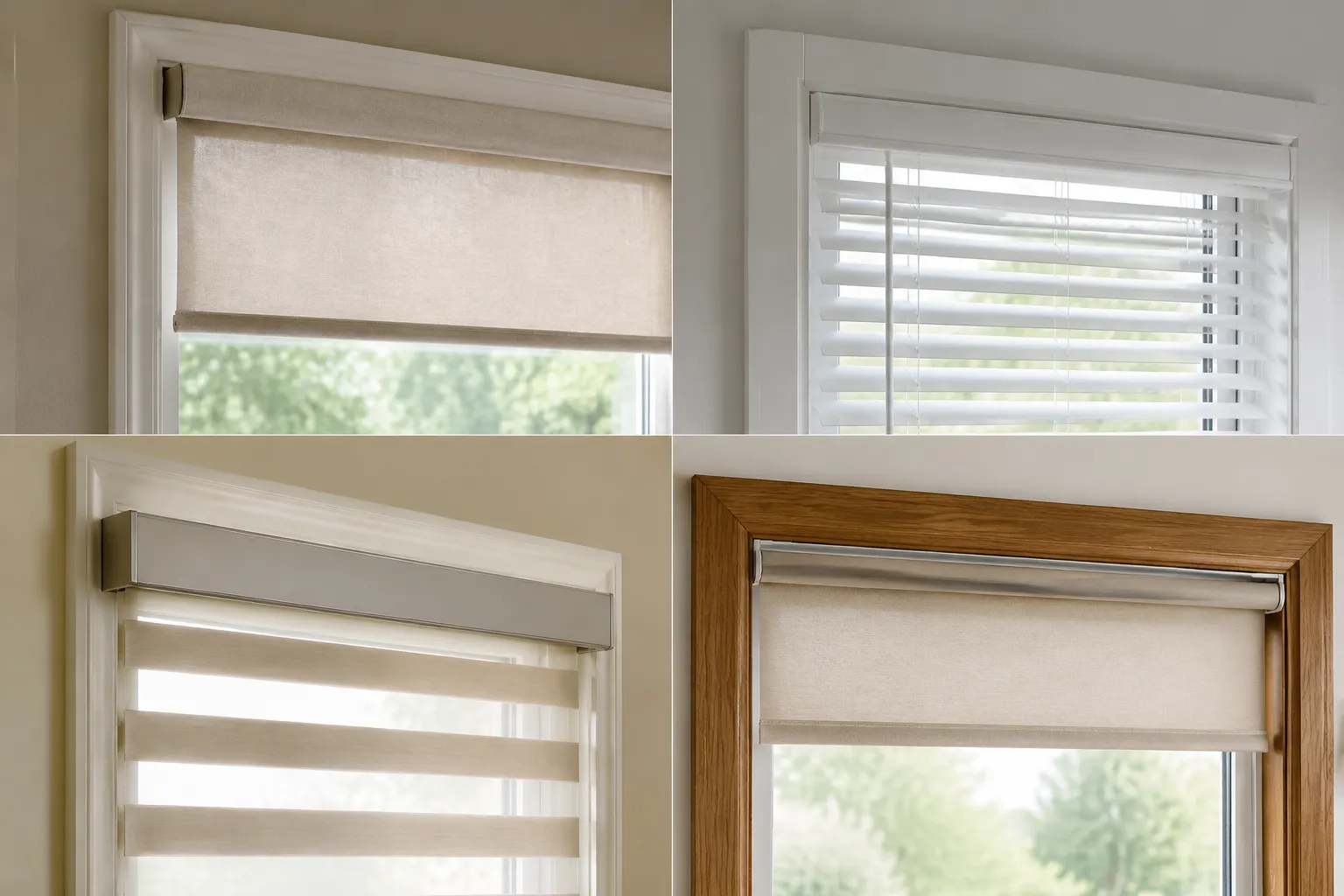
The most common instruction in any window treatment forum is also the least useful: "just mount the blinds outside the frame." It sounds simple. It sidesteps every depth problem, every protruding crank, every warped jamb. But an outside mount changes the whole character of a window. The blind becomes a rectangle floating on the wall, and unless the proportions are right, it looks like a sticker. There is a reason so many rooms with outside-mounted blinds have a strange, unfinished quality around the edges. The hardware is doing the work the frame should be doing.
Inside mounts are the opposite. They tuck the blind into the window's own architecture, so the treatment reads as part of the building rather than an add-on. That is why nearly every professional installer will push for an inside mount whenever the frame allows it. The clean lines, the shadow gap around the headrail, the way the slats sit flush with the glass: it all looks considered. But frames are rarely cooperative. Shallow jambs, sloped sills, and out-of-square openings all conspire against a perfect fit. The real skill in buying blinds is not knowing what looks good in a showroom. It is knowing which mounting method survives contact with an actual window.
The depth problem that decides everything
Before anything else, measure the depth of the frame's inside ledge. This single number eliminates more blind options than any other factor. A standard mini blind headrail needs about 2 inches of depth to sit comfortably inside a frame. Cordless mechanisms, which hide the lift system inside a bulkier headrail, need closer to 2.75 inches. If the frame gives less than that, the blind will stick out past the trim or press awkwardly against the glass.
Shallow frames are everywhere. Older homes, particularly those built before the 1970s, often have trim that is purely decorative, with the actual window jamb recessed only an inch or so. Vinyl replacement windows are also notorious for shallow pockets. When the depth comes up short, the standard advice is to go outside mount. That is often the right call, but there is a middle path: a tension-mounted or spring-loaded blind that clips onto the top of the frame without screws. These work in frames as shallow as half an inch, because they do not need to fit a headrail inside. The trade-off is that they only work with cellular shades and light-filtering fabrics, not with slatted blinds. A person who wants wood or aluminum slats in a shallow frame has no choice but to go outside.
When an inside mount is the only honest option
A bay window changes the math entirely. The angled sections of a bay are usually joined with mullions that have almost no flat face for mounting hardware. An outside mount on a bay window requires careful mitering of the blind's bottom rail to match the angle, and most people discover this only after ordering a straight blind and watching it gap at the corners. Inside mounts on bay windows are easier to get right, because each section is measured and mounted independently. The small gaps where the sections meet are barely noticeable.
French doors present a similar case. The door frame is typically shallow and the glass runs nearly edge to edge. An outside mount on a French door means the blind hangs over the trim, and every time the door swings, the bottom rail knocks against the jamb. An inside mount, even a shallow one, keeps the blind within the door's silhouette. Manufacturers now offer special low-profile headrails for exactly this situation, and they are worth hunting for. They cost a bit more, but they prevent the constant clatter of a blind that was never meant to move.
The out-of-square frame and the valance cover-up
Measure the width of a window at the top, middle, and bottom. If those three numbers differ by more than a quarter of an inch, the frame is out of square. An inside-mounted blind cut to the widest measurement will bind at the narrow point. Cut to the narrowest, and it will rattle. This is where a valance becomes more than decoration. A valance is a fabric or metal box that sits over the headrail and hides the mounting brackets. It also hides a multitude of sins, including a headrail that had to be cut slightly small to fit an irregular frame.
Many buyers skip the valance to save money, then wonder why their inside mount looks crooked. The valance is not about aesthetics. It is the structural cover that lets a blind fit a frame that was never perfectly square. For any window where the top and bottom widths differ, order the valance. It is the difference between a blind that looks custom and one that looks like it fought the window and lost.
Outside mounts need the hardware to disappear
An outside mount's biggest problem is not the blind. It is the brackets. Every outside mount requires two or three metal brackets screwed into the trim or the wall above the window. Cheap brackets are silver and bulky, and they stick out from the headrail like ears. On an inside mount, nobody sees the brackets because they are tucked inside the frame. On an outside mount, they are fully exposed, and they will ruin the look of an otherwise fine blind.
The solution is to order outside mounts with color-matched brackets. Most major manufacturers offer this at a small upcharge, and it is always worth it. A white bracket on white trim disappears. A silver bracket on white trim reads as a mistake. For wood blinds, the bracket finish should match the stain, not the hardware. This is a detail that shows up in photographs and in person, and it is the single easiest way to make an outside mount look intentional.
There is also the question of projection. Outside mount brackets come in standard and extended sizes. Standard brackets hold the blind about an inch off the trim. Extended brackets push it out 3 inches or more, which is necessary when a window crank handle protrudes past the frame. A person with a crank window who orders standard brackets will watch the blind bow outward every time they try to close it. Measure the crank's reach before ordering. That handle is a hidden variable that turns a clean install into a frustrating one.
Cellular shades and the inside mount exception
Cellular shades behave differently from slatted blinds in one important way: they do not need to rotate, so they can hug the glass much more closely. This makes them the best choice for frames with unusual depth, especially those with angled sills or protruding window stops. A cellular shade mounted inside a frame with only 1.5 inches of depth will still function, because the shade's headrail is slimmer than a mini blind's and the fabric hangs straight down without needing clearance to tilt.
This is also where cordless operation shines. A cordless cellular shade has no hanging strings to tangle, which matters in a shallow frame where a cord would rub against the glass or the stop. The lift mechanism is a simple push-and-hold on the bottom rail. For bedrooms and living rooms with shallow frames, a cordless cellular inside mount is often the most practical option available, and it looks clean because the fabric fills the frame edge to edge.
When the frame is not there at all
Casement windows that crank outward have no flat inside ledge to speak of. The frame is essentially the glass and a thin metal or vinyl edge. Inside mounting is impossible. The standard move is an outside mount with extended brackets to clear the crank. But there is a better option that few people consider: mounting the blind directly to the sash itself. Some manufacturers offer clip-on brackets that attach to the top of the operating sash. This lets the blind swing open with the window, which is a significant advantage for a casement that gets opened regularly.
The downside is weight. A clip-on mount works well for light aluminum or vinyl blinds, but a heavy wood blind will pull the clips loose over time. For casement windows that need wood slats, the outside mount with extended brackets is the more durable choice, even if it means the blind stays put while the window swings behind it. A person who opens their casements often should favor the clip-on system. A person who rarely opens them should go with the extended outside mount and not worry about the gap.
The recessed window and the illusion of depth
Some window frames are deep for a reason. A thick wall with a recessed window creates a natural pocket, often 6 to 8 inches deep. This is the ideal scenario for blinds, because it allows for layering. A person can mount a blackout cellular shade close to the glass and a decorative sheer or drapery panel on the outer edge of the recess. The blind does the work; the fabric does the softening. This layering is impossible on a shallow frame, and it is one of the few situations where an inside mount is not just practical but luxurious.
For these deep pockets, consider mounting the blind at the inner edge, closest to the room, rather than against the glass. This creates a shadow gap behind the blind that gives the window a recessed, architectural feel. It also keeps the blind's cords and mechanisms away from the cold glass, which reduces condensation in winter. The measurement is the same as a standard inside mount, but the placement shifts. It is a small decision with a noticeable effect on how the room feels.
The valance rule for outside mounts
Outside mounts have their own valance logic. On an inside mount, the valance covers the headrail within the frame. On an outside mount, the valance is the visual anchor that ties the blind to the wall. Without it, an outside-mounted blind looks like a piece of paper taped over the window. With it, the blind reads as a deliberate architectural element. This is not a matter of taste. It is a matter of proportion. The valance adds visual weight at the top of the window, which grounds the blind and prevents it from floating.
For outside mounts, the valance should be ordered to the full width of the blind, not the window. This is a common mistake. A person measures the window, adds 2 inches on each side for overlap, and then orders a valance that matches the window width instead of the blind width. The result is a valance that looks like it belongs to a smaller blind, with the headrail peeking out at the edges. The valance must match the headrail width exactly, which means ordering it as part of the blind package rather than as an afterthought.
A final note on the bottom rail
Every blind has a bottom rail, and the weight of that rail determines how well the blind hangs. A lightweight aluminum blind with a thin bottom rail will sway in a draft and flutter at the edges. A wooden blind with a solid bottom rail stays put. This matters more for outside mounts, because the blind is exposed to air movement on all sides. An inside mount is somewhat protected by the frame; an outside mount has no such shelter.
When ordering an outside mount, ask the manufacturer whether a heavier bottom rail is available. Many offer a "snap-in" bottom rail upgrade that adds weight without changing the blind's look. It is a minor specification that most buyers never consider, but it separates a blind that hangs like a curtain from one that hangs like a shade. The difference is noticeable in a room with any airflow, and it is the kind of detail that makes a person wonder why the previous blind always looked slightly off. Now they know.