
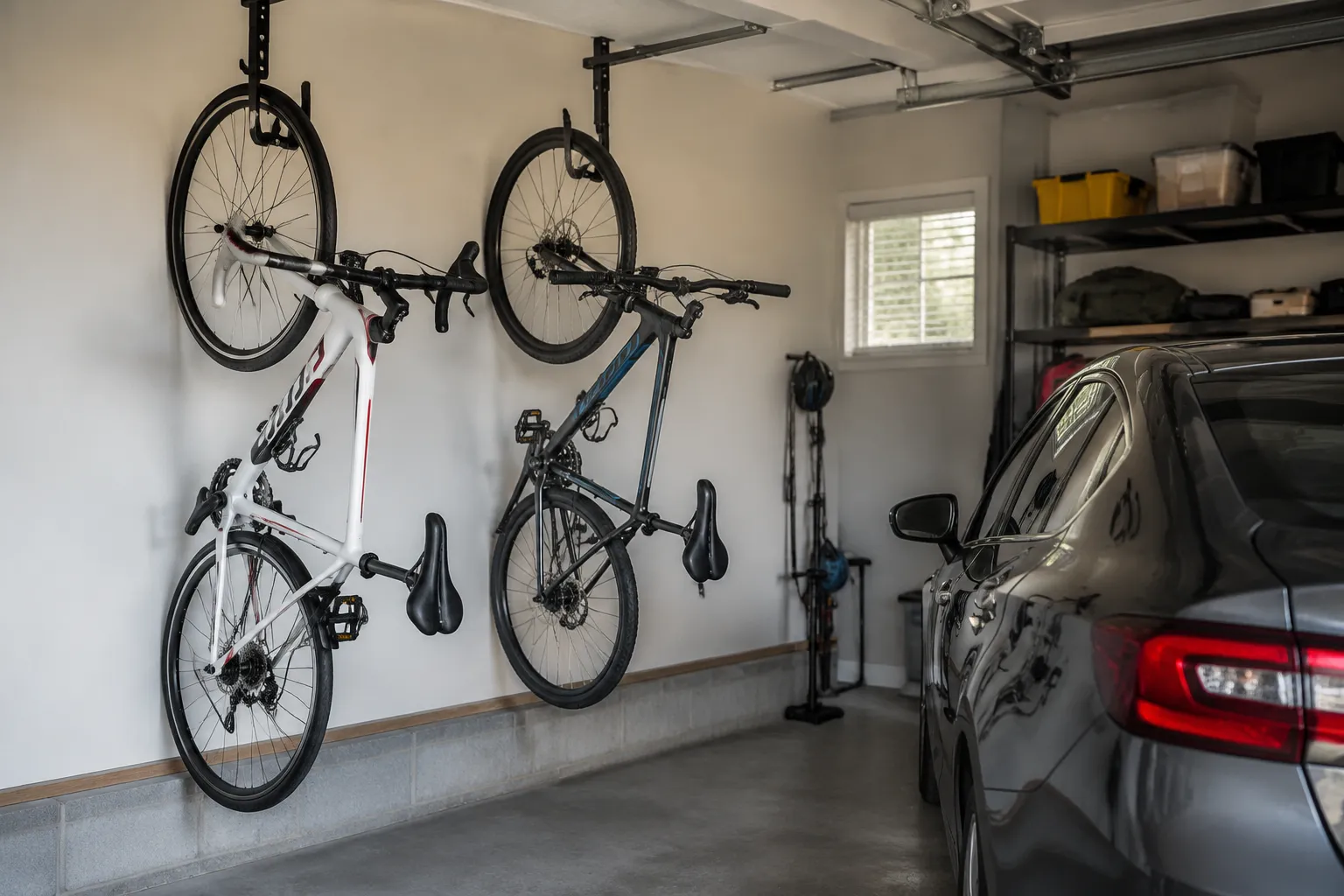
There is a particular geometry problem that shows up in garages and narrow carports everywhere, and it has nothing to do with the car. The car fits fine. It is the bicycle, leaned against the wall or parked in front of the hood, that turns every trip into a slow dance of negotiation. The parking brake goes on, the door opens a careful crack, and the person extracts themselves sideways while trying not to knock the handlebar into the fender. The bike hanger is the unglamorous answer to this daily friction, a piece of hardware that does not get much thought until the moment it stops working.
Vertical bike storage is not a new idea. The basic premise, hanging a bicycle from its front wheel so it occupies a footprint roughly the size of a doormat, has been around in various forms for decades. What has changed is the quality of the execution. The market is now full of hangers that range from genuinely clever to dangerously flimsy, and the difference matters more than most buyers expect.
The Two-Point Problem
A bicycle hung by its front wheel is a pendulum with a very long arm. The center of mass sits somewhere around the bottom bracket, which is roughly two and a half feet below the contact point where the tire meets the hook. That means the hanger has to resist both the static weight of the bike and the dynamic forces of a person walking past, brushing against the rear wheel, or closing the garage door with a bit too much enthusiasm.
The cheap hangers, the ones stamped from thin sheet metal and coated in a glossy finish that flakes off within a season, fail at this job in consistent ways. The hook opens up under load, or the angle of the bend is too shallow to hold the tire properly, or the mounting plate flexes enough that the whole assembly sways when the bike is hung. A swaying bike is a falling bike, and a falling bike takes paint off the car door on the way down.
The better designs treat the hanger as a structural member, not an afterthought. A forged or thick-gauge steel hook, a welded joint instead of a folded tab, and a mounting plate that distributes load across several fasteners rather than concentrating it on one. These are the details that separate a hanger that lasts a decade from one that ends up in the recycling bin after eighteen months.
The Tire Width Question
Road bike tires come in at around 23 to 28 millimeters. Mountain bike tires run from 2.2 to 2.5 inches, which translates to roughly 56 to 64 millimeters. Fat bikes, the ones with the comically wide tires, go from 3.8 inches up to 5 inches. A hanger designed for a skinny road tire will grip a fat bike tire about as well as a fork holds a grapefruit.
The geometry of the hook face is the critical variable. A narrow V-shape works for road tires but lets a wide mountain bike tire sit too deep, putting pressure on the sidewall rather than the tread. A wide, shallow dish shape handles the fat tires but lets a skinny road tire wobble around inside the pocket. The best hangers use a curved profile that approximates the arc of a tire's cross-section, cradling the rubber rather than pinching it.
There is also the question of rim width. Modern mountain bike rims are substantially wider than their road counterparts, and the hanger hook needs clearance around the rim's edge. If the hook is too shallow, the rim catches on the back of the hanger when the bike is lifted into place, which makes the whole operation feel clumsy and risks scratching the rim's braking surface.
Mounting Hardware Is the Real Spec
The hook itself gets all the attention in the product photos, but the mounting system is where the engineering either holds up or falls apart. A hanger attached to a wooden stud with a single lag screw will eventually work itself loose, especially in a garage that experiences temperature swings and vibration from the door opener. The screw backs out a quarter turn at a time, the hanger develops a list, and the bike hangs at a slight angle until one day it doesn't.
Solid installations use at least two fasteners per hanger, spaced several inches apart to resist rotation. The mounting plate should sit flush against the wall, which means it needs a flat back and a design that accounts for drywall curvature at the stud. Some hangers ship with plastic anchors for drywall mounting, but a bike hanging from drywall anchors alone is a risk that no careful person should accept. The load is dynamic and the leverage is significant. A stud is the only honest answer.
For a person with a concrete or block wall garage, the problem changes entirely. The hanger needs masonry anchors, and not the cheap plastic expansion sleeves that strip out when over-torqued. A proper installation uses wedge anchors or sleeve anchors rated for shear loads well above the weight of the heaviest bicycle. The hanger manufacturer almost never includes these in the box, which means the buyer has to source them separately or make do with whatever the local hardware store stocks.
The Ceiling Mount Alternative
Wall hangers solve the floor-space problem but leave the bike exposed at shin height. A person walking through a dark garage can still clip the pedals or the rear derailleur. Ceiling mounts, which lift the bike up and out of the walking path entirely, solve that issue but introduce their own complications.
A ceiling hoist uses a pulley system with a rope or strap that raises the bike horizontally. This works well for people with high ceilings and a willingness to do a bit more work on each use. The hoist has to be anchored to the ceiling joists, and the bike hangs at a height that is out of the way but still reachable. The tradeoff is that lifting a 30-pound bike with one hand while managing the rope with the other takes practice. The first few attempts produce a swinging, creaking mess.
Fixed ceiling hooks, in contrast, require the rider to lift the bike overhead and mate the wheels with the hook in one motion. This is a two-hand operation that involves reaching above shoulder height while holding a bike that wants to swing. For a taller person in a garage with generous clearance, it is manageable. For someone of average height with a low ceiling, it becomes a test of upper body strength and patience.
The wall hanger remains the better compromise for most people because it puts the bike at a height that is easy to reach and the motion of hanging feels natural. The key is placing it high enough that the wheels clear the car's bodywork when the door is open, but low enough that the handlebar is still accessible without a step stool.
Spacing and the Multiple-Bike Household
One hanger is easy. Two hangers introduce the question of spacing, and this is where most garage layouts go wrong. Bicycles hung vertically from the front wheel have a rear wheel that arcs outward as the bike swings into its natural hanging position. The rear wheels of two adjacent bikes will collide if the hangers are mounted too close together.
The rule of thumb is to space the hangers at least the width of the handlebar plus a few inches. Most drop bars measure 40 to 44 centimeters across, which means a spacing of about 20 inches between hanger centers is the practical minimum. The bikes will still touch if one of them has wide mountain bike bars, so giving each hanger a bit more room is worth the loss of wall space.
Staggering the hangers vertically changes the dynamic. Mounting one hanger six inches higher than the next allows the bikes to overlap slightly without the handlebars colliding. This arrangement also makes better use of a garage wall that has a window, a breaker panel, or a shelving unit in the middle of the run.
The Kids' Bike Problem
Children's bikes have smaller wheels, which means the front wheel is shorter and the bike hangs lower. A hanger mounted at a height that works for an adult's road bike will leave a child's bike dangling with its rear wheel dangerously close to the floor. The fix is to mount the child's hanger higher, which makes it unreachable for the child, or to accept the low position and plan around it.
Some hangers address this by offering an adjustable hook that slides up and down on a vertical track. These designs are useful for households where the bike collection changes over time, but they add cost and complexity. A simpler approach is to use a hanger with a deeper hook, which lifts the front wheel higher relative to the mounting point and raises the entire bike a few inches.
There is also the matter of training wheels, which make the rear of the bike wider and more likely to catch on adjacent objects. The training wheels themselves are usually fine, but the plastic guards on some models extend past the tire and create a snag point. Hanging a bike with training wheels can require a bit of angling to get it into the hook cleanly.
Rust and the Coastal Garage
Garages near the coast have a specific problem that inland buyers rarely consider. Salt air corrodes cheap zinc plating within months, and the corrosion products, the white powdery stuff that forms on the surface, transfer onto the tire and the rim. The hanger becomes a source of grime that requires regular cleaning.
Stainless steel hangers exist but cost two to three times as much as their coated steel counterparts. For a person who parks a car in a coastal garage and wants the bike off the floor, the premium is justified. The alternative, a powder-coated steel hanger with a sacrificial zinc finish, works for a few years before the coating fails at the edges and the rust sets in.
One overlooked detail is the rubber or vinyl coating on the hook itself. The coating protects the rim from scratches but also traps moisture against the metal. In a humid garage, the coating can stay damp for days after a rainy ride, accelerating corrosion beneath the surface. A bare metal hook with a separate rubber pad, or a hook with a thick, molded plastic sleeve that can be removed and dried, is a better long-term choice.
Installation Height and the Reach Factor
The height of the hanger determines how easy the bike is to hang and retrieve, and most people mount them too low. A bike hung from the front wheel has its center of gravity well below the hook, so the bike swings naturally into a stable vertical position. The rear wheel rests against the wall if the hanger is mounted close enough, which adds stability but also means the bike's drivetrain is rubbing against whatever is on the wall.
A practical mounting height puts the hook at about eye level for the tallest person who will regularly use it. This allows the rider to lift the front wheel straight up and settle it into the hook without bending over or stretching awkwardly. For a person of average height, that translates to a hook center of roughly 68 to 72 inches from the floor. The rear wheel will be about 18 inches off the ground, which clears most obstacles and keeps the bike out of the way of the car door.
The wall material matters as much as the height. A hanger mounted to drywall without a stud will pull out under a heavy bike. A hanger mounted to a hollow block wall with plastic anchors will fail when the anchors fatigue. The installation is only as strong as the connection between the hanger and the structure behind it.
The Load Rating Reality
Manufacturers list load ratings on their hangers, and the numbers are almost always optimistic. A hanger rated for 50 pounds might hold a 30-pound bike fine, but the rating is typically based on static load with the hook oriented perfectly. Real-world use involves the bike being dropped onto the hook, yanked sideways when the rider is in a hurry, and left to sway as the garage door opens and closes. The effective load can spike to several times the static weight.
A wise buyer ignores the rating and looks at the cross-section of the metal. A hook made from 3/16-inch steel rod is going to be stronger than one made from 1/8-inch rod, regardless of what the label claims. The bend radius matters too; a sharp bend concentrates stress and is more likely to crack over time.
Electric bikes changed the load equation entirely. A typical commuter e-bike weighs 50 to 70 pounds, and some of the cargo models push past 80. Hanging an e-bike from its front wheel puts a tremendous amount of stress on the rim and spokes, which are often not designed for that kind of point load. The hanger itself might hold, but the wheel will not. Anyone with an e-bike should seriously consider a floor stand or a platform-style rack instead of a wheel-hanging hook.
The Garage Door Opener Conflict
A bike hanger mounted directly below the garage door opener's rail creates a permanent collision hazard. The door opens, the rail mechanism moves down, and it hits the top of the bike's handlebar or saddle. This happens slowly and loudly, and the first time it happens produces a scratch on the bike frame and a dent in the opener's housing.
The fix is to map out the full travel path of the door mechanism before drilling any holes. A hanger placed even a few inches outside the rail's path is safe, but a hanger directly beneath it is a disaster waiting for a distracted day. This is the kind of detail that only shows up after installation, which is why it deserves attention in the planning phase.
Some garages have a low ceiling where the door rail is only inches from the wall. In that configuration, the wall hanger has to mount below the rail, which puts the bike's handlebar at shin height. The alternative is to mount the hanger on an adjacent wall and accept that the bike will be closer to the car than ideal.
A Final Thought on the Hook Itself
The best bike hangers share one trait: they disappear into the background. A good hanger holds the bike securely, does not scratch the rim, and does not require a second glance to verify that everything is still in place. The hanger that draws attention to itself, through creaking, wobbling, or visible rust, is a hanger that is already failing.
The purchase decision comes down to a few honest questions. Is the bike heavy enough to need a reinforced hook? Is the wall surface solid enough to hold the mounting fasteners? Does the bike have tires wide enough to require a deep hook pocket? Answering those questions accurately, before buying, eliminates most of the disappointment that shows up in online reviews.
Garage space is precious, and the bicycle does not need to be part of the parking problem. A well-chosen hanger, mounted properly and positioned thoughtfully, turns a leaning bike into a wall fixture that frees the floor for the car and the walking path. The car door opens fully. The bike stays put. The morning commute starts without a single awkward sidestep.