
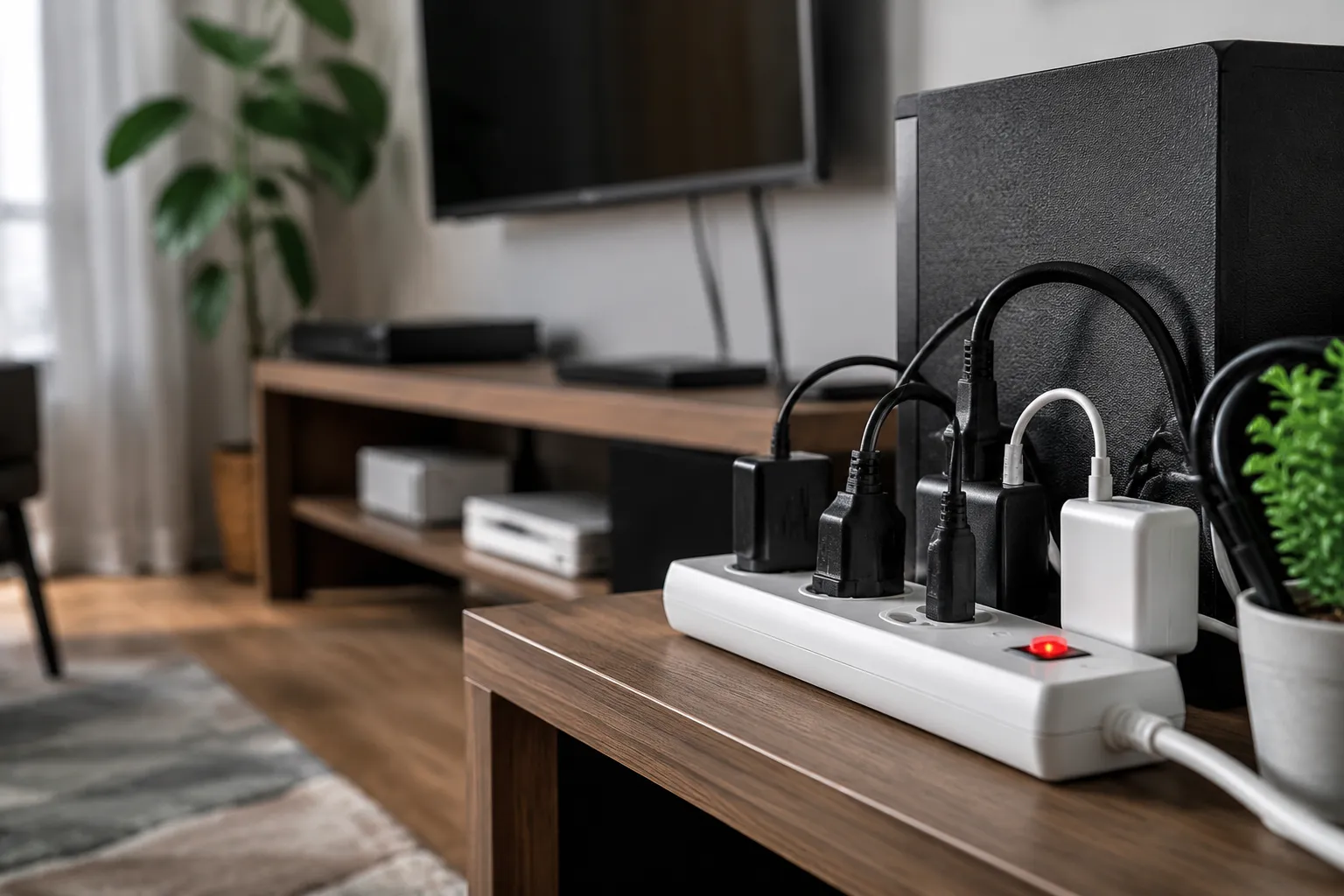
Surge protectors are the most boring purchase in home electronics, which is precisely why so many people buy them wrong. A person will spend $2,000 on a television and then plug it into a $9 power strip that technically has a surge protection rating printed on the box. The industry knows this. The packaging is designed to exploit it. The words "surge protection" appear in large friendly letters, and the fine print reveals nothing about whether the device can actually absorb a meaningful hit. This matters because the difference between a $15 protector and a $150 one is not marketing. It is the difference between a device that sacrifices itself to save your equipment and a device that quietly passes the damage straight through.
The core misunderstanding starts with what a surge protector actually does. A wall outlet delivers electricity at a nominal voltage, but the grid is not perfectly stable. Lightning strikes, downed lines, transformer failures, and even large appliances cycling on and off create voltage spikes. A surge protector sits between the wall and the equipment. It monitors the incoming voltage, and when it detects a spike above a safe threshold, it shunts the excess energy to the ground wire. The equipment connected to it never sees the full force of the spike. The protector absorbs what it can and redirects the rest. This is the entire job. There is no other job.
Here is the uncomfortable truth about the cheap units: they are not designed to fail well, and some of them are not designed to protect at all. The most honest way to judge a surge protector is by its joule rating, which measures how much energy the device can absorb before it dies. A basic strip might carry a rating of 400 to 600 joules. That sounds fine until a person considers what a nearby lightning strike delivers. A direct or near-direct strike can push hundreds of thousands of joules into a home's wiring. The protector takes what it can and dies. The question is whether it dies cleanly, cutting power to the equipment, or whether it dies while letting the rest of the surge continue downstream. The cheap ones often do the latter.
Nobody needs a joule rating that matches a direct lightning strike, because no consumer protector can handle that anyway. The protection strategy against lightning is not a surge protector. It is unplugging the equipment. The surge protector is there for the far more common events: the transformer hiccup, the neighbor's faulty wiring, the utility company's maintenance mistake. These events are survivable, but they require a protector with enough headroom to take the hit and enough quality components to respond quickly. A 600-joule strip connected to a $1,500 television is not protection. It is a false sense of security with a power switch attached.
The Difference Between Protection and Insurance
There is a useful distinction to draw between a surge protector and a connected equipment warranty. Many reputable manufacturers, including APC and Tripp Lite, offer connected equipment warranties on their higher-end models. If the protector fails and the connected equipment is damaged, the manufacturer reimburses the owner up to a stated dollar amount. This is a genuine benefit, but it is not the same thing as protection. A warranty is a promise to pay after the fact. Protection is a promise to prevent the damage in the first place. A person with a file server full of irreplaceable data does not want the reimbursement. They want the data to survive. The warranty is a nice backstop, but the joule rating and the clamping voltage are the actual protection.
Clamping voltage is the second number worth understanding. This is the voltage at which the protector starts to divert energy. A lower clamping voltage means the protector reacts sooner and lets less excess voltage reach the equipment. The standard for a decent protector is around 330 volts. Some budget units clamp at 400 volts or higher. The difference matters because many modern electronics have sensitive power supplies that begin to suffer at sustained voltages above their design limits. A protector that clamps at 330 volts gives the equipment a much cleaner ride than one that waits until 400 volts. The equipment might survive both events, but the power supply degrades slightly with each over-voltage episode. Over years, that degradation becomes failures.
Another important specification is the response time. Surges travel at nearly the speed of light. A protector needs to detect the spike and begin diverting it within nanoseconds. The good ones do this with metal oxide varistors, or MOVs, which are the components that actually absorb the excess energy. MOVs degrade with every surge they absorb. They get slightly weaker each time. A protector with a single MOV will die after one moderate surge. A protector with multiple MOVs distributes the load across several components, extending its life. This is why the physical size of a surge protector matters. A large, heavy unit likely has more MOVs and better thermal protection. A thin strip that weighs almost nothing has one MOV and a prayer.
What the Joule Rating Actually Means in Practice
The joule rating is the most quoted number and the least understood. A 2,000-joule protector can absorb roughly three times the energy of a 700-joule unit before dying. But the rating does not tell a person how many surges the device can survive. It tells the total energy it can absorb over its lifetime. A protector might use up 300 joules on one moderate surge and 800 joules on a larger one. Once the total reaches the rated capacity, the MOVs are spent. The protector is now a plain power strip. This is why the indicator light on a surge protector is so important. The light typically signals that the protection circuitry is still functional. When the light goes out, the protection is gone. The unit still passes power, but it no longer protects anything.
The failure of the indicator light system is that nobody checks it. A person plugs in the protector, sees the green light, and never looks at it again. Years pass. The light goes out during some distant storm surge. The person continues to run their entire home theater through a dead protector. The equipment is now running on raw wall power, completely exposed. The fix is simple and almost nobody does it: check the indicator lights on every protector in the house twice a year. Daylight saving time changes are a perfect reminder. If the light is out, replace the unit immediately. Do not keep using it as a power strip. That is a fire risk masquerading as a convenience.
The other failure mode is silent degradation. The light stays on, but the MOVs have absorbed repeated small surges and are operating at reduced capacity. There is no way for the consumer to know this. The only defense is to treat surge protectors as consumable items with a limited lifespan. A good rule of thumb is replacement every three to five years for units that see regular use, sooner if the area experiences frequent storms or power fluctuations. This feels wasteful. It is not. A $100 surge protector replaced every four years is $25 a year to protect thousands of dollars of electronics. That is the cheapest insurance a person can buy.
The Unfortunate Truth About Whole-Home Protectors
Whole-home surge protection is a legitimate upgrade. A licensed electrician installs a device at the main electrical panel that protects every circuit in the house. These devices are effective against surges that enter the home through the utility lines. They are the first line of defense, and they are genuinely worth the installation cost for a home with expensive electronics. The problem is that they are not a complete solution. Surges can also enter through cable lines, phone lines, and ethernet cables. A lightning strike near the house can induce current in these low-voltage lines and push it directly into a television, a router, or a computer connected to the network.
This is why a home with a whole-house protector still needs point-of-use protectors at the equipment. The two systems are complementary. The whole-house unit handles the big incoming surges from the utility. The point-of-use unit handles the smaller surges that sneak in through data lines and catches whatever the main unit misses. A person who installs one without the other has built a wall with a gap in it. The comprehensive approach, a whole-house unit plus quality point-of-use protectors at the most valuable electronics, covers the realistic threat model. A home with only point-of-use protectors is adequately protected for most situations. A home with only a whole-house unit is not.
The data line protection question deserves its own attention. Many surge protectors have ports for phone and ethernet cables. These ports are not decorative. They contain additional suppression components that protect the connected equipment from surges arriving through the data line. A person who connects a cable modem to a surge protector but leaves the coax cable running straight from the wall into the modem has skipped an entire attack vector. The same applies to ethernet connections. If a protector has the ports, use them. If the protector does not have the ports, a separate data line protector is available for less than $30. For anyone with a home office or a serious media setup, this is a mandatory purchase, not an optional one.
Why Price Is a Signal, Not a Guarantee
The price range for surge protectors is enormous, and the correlation between price and quality is real but not linear. At the low end, under $20, the units are mostly the same. They have small joule ratings, high clamping voltages, and minimal internal components. They are fine for a lamp and a phone charger. They are not fine for a television, a computer, or anything with a sensitive power supply. The mid-range, from $30 to $60, is where the value lives. These units have meaningful joule ratings, lower clamping voltages, multiple MOVs, and sometimes the connected equipment warranty. For most households, this is the sweet spot.
Above $100, the differences become about features rather than raw protection. Some units offer battery backup for uninterruptible power, which is a different product category entirely. A UPS is a surge protector that also provides temporary power during outages. For a desktop computer, a UPS is strongly recommended because an unexpected power loss can corrupt data and damage the hard drive. The UPS costs more because it contains a battery and an inverter. The surge protection circuitry in a UPS is usually comparable to a mid-range standalone protector. A person who buys a UPS for the battery backup is getting adequate surge protection as a bonus.
One category of protector deserves a specific warning: the cheap strip that labels itself as a surge protector but has a joule rating under 400. These units exist to capture the person who knows they should have surge protection but does not know the specifications. The packaging looks reassuring. The price is attractive. The protection is minimal. A person who buys one of these has spent money to achieve a false sense of security, which is worse than having no protector at all because the behavior changes. People with these strips leave expensive equipment plugged in during storms, confident that they are protected. The confidence is the actual danger.
The Installation Details That Matter
Even the best surge protector fails if it is installed incorrectly. The first rule is that a surge protector is only as good as its ground connection. A protector diverts excess voltage to the ground wire. If the outlet is not properly grounded, the protector has nowhere to send the energy. The unit might still pass power and the indicator light may still glow, but the protection is compromised. This is common in older homes with two-prong outlets that have been replaced with three-prong outlets without running a ground wire. A simple outlet tester, available for under $10, tells the owner whether the ground is functional. Every home with surge protectors should have one.
The second installation detail is the difference between a direct plug and a power cord. A surge protector that plugs directly into the wall outlet is best for preventing the unit from being unplugged accidentally and for keeping the cord length short. The problem is that a direct-plug unit can block the second outlet in a duplex receptacle. A unit with a power cord allows more flexibility in placement but introduces a length of unprotected wire between the wall and the protector. Neither option is inherently better. The choice depends on the layout of the room and the type of outlet available.
A third consideration is the daisy-chain problem. Surge protectors should never be plugged into other surge protectors. Some people do this to extend reach or to add more outlets. The practice degrades the protection and creates a fire hazard. The first protector absorbs a surge and may pass a portion of it to the second. The second absorbs what it can. The equipment at the end sees the remainder. The protection is not additive. It is a series of weakening filters. The fix is to buy a single protector with enough outlets for the equipment, or to run a second circuit to the location. Daisy chaining is a sign that the setup was never properly planned.
The final installation detail is the physical environment. Surge protectors should not be under rugs, behind furniture, or in enclosed spaces where heat builds up. The MOVs generate heat when they divert energy. The thermal protection in a quality unit shuts down the protector if it overheats, but only if the heat can dissipate. A protector buried under a carpet cannot dissipate heat. The risk of fire, while low, increases with heat buildup. A surge protector should be visible, accessible, and in open air. This also makes it easier to check the indicator light, which loops back to the maintenance point. Protection is a system, not a single purchase. The system includes the device, the installation, the grounding, and the habit of checking the status light. All four are required for the system to work.