
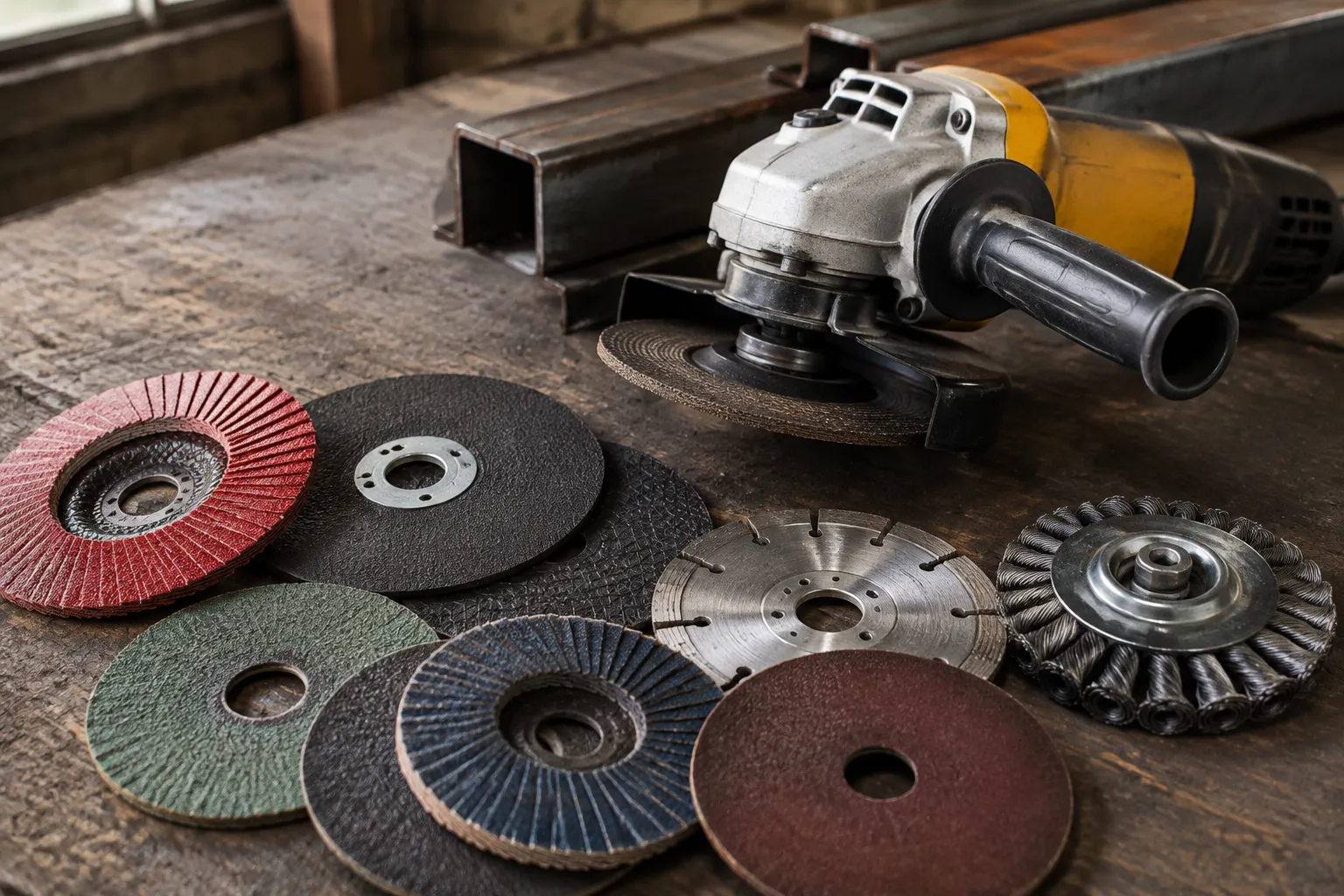
The first time a person stands in front of the disc display at a hardware store, the sheer variety looks like a conspiracy. Thin blades, thick wheels, wire cups, diamond segments, flap petals, all in different diameters and arbor holes. Most home projects only need two or three of these, and knowing which ones matter is the difference between a clean cut and a ruined workpiece, or worse, a disc that shatters at 10,000 rpm.
The angle grinder is a brutal, simple machine. It spins a disc at high speed and lets the operator hold it against metal, stone, or concrete. The disc is the entire personality of the tool. Swap the disc and the grinder changes from a cutting tool to a sanding tool to a stripping tool. This is why the disc selection matters more than the grinder itself.
Why the abrasive grit matters more than the brand
Most grinding and cutting discs are made from aluminum oxide, a sharp, hard mineral that fractures as it wears. This self-sharpening property is what keeps the disc cutting. When the grit dulls, the pressure of the work breaks it loose and exposes fresh edges underneath. Cheap discs use the same mineral but bond it poorly. The result is a wheel that glazes over, stops cutting, and generates friction instead of removing material.
A good bond is the difference. Resin-bonded discs hold the abrasive in place just long enough to work, then release it at the right moment. Manufacturers tweak this bond for different jobs. A hard bond lasts longer but cuts slower. A soft bond wears fast but stays aggressive. For home use, a medium bond in the middle of the range handles most steel and stainless work without fuss.
The other common abrasive is zirconia alumina, a self-sharpening grain that stays cool while grinding. It costs more and suits stainless steel and heat-sensitive alloys. For mild steel and general shop work, plain aluminum oxide is fine. The expensive grain only pays for itself when the work involves high alloy content or when overheating the metal is a real risk.
The standard grinding disc and what it actually does
The classic depressed-center wheel, usually 4.5 inches across and a quarter-inch thick, is the workhorse for metal removal. The depressed center, that slight dish shape, lets the operator get the flat face of the disc closer to the workpiece while keeping the grinder's body clear. These discs are rated for grinding, not cutting, and using one to slice through material is asking for trouble.
Rated speed matters. A 4.5-inch disc marked for 13,300 rpm matches the common grinder speed. Running a disc rated for lower speed on a high-speed grinder risks a catastrophic failure. The label on the disc and the label on the grinder need to agree. A person should check both before mounting anything.
Grinding discs remove material fast. They are for weld seams, sharp edges, rust scale, and shaping metal. The technique is to hold the disc at about a 15 to 30 degree angle and let the wheel do the work. Pressing hard does not speed things up. It overheats the metal and wears the disc unevenly. A light touch with steady movement produces a flatter surface and a longer-lasting wheel.
Home users often buy one grinding disc and use it for everything. That is a mistake. A grinding disc that has been used to cut a piece of rebar will have a worn, rounded edge that makes grinding awkward. Dedicated discs for each job keep the work predictable.
Thin cutting discs are a different animal
Cutting discs, sometimes called cut-off wheels, are usually 0.045 inches thick or less. They are not grinding tools. They are designed to slice through material with minimal material loss and minimal heat buildup. The thin profile allows the disc to cut fast, but it also makes the disc fragile. Side loading, twisting, or bending a cutting disc will crack it.
These discs come in two flavors: the plain flat wheel and the depressed-center version. The flat wheel is for straight cuts. The depressed-center cutting disc allows the nut to sit recessed, which is useful for getting into tight spots. For most home work, the flat disc is easier to control and less likely to bind.
Using a cutting disc correctly means letting the disc do the work. A person guides the grinder through the cut, but does not force it. Pushing hard makes the disc flex, which creates heat and increases the chance of breakage. The best cut is a steady, gentle pass, sometimes repeated several times for thicker stock.
There is also the question of what material the disc is meant to cut. A disc labeled for steel will not cut masonry well, and a masonry disc will wear down instantly on steel. The bond hardness and the abrasive type differ. Using the wrong one is not just inefficient, it is dangerous, because a disc designed for soft material can shatter when it hits something harder than expected.
Flap discs for smoothing and finishing
The flap disc is the most forgiving accessory a grinder can wear. It consists of overlapping layers of abrasive cloth mounted radially around a backing plate. As the outer layer wears down, the next layer takes over. This design provides a consistent cut throughout the life of the disc, unlike a grinding wheel that changes shape as it wears.
Flap discs come in grits from coarse to fine, and they serve double duty. A coarse flap disc at 40 grit removes material almost as fast as a grinding wheel, but leaves a much smoother finish. A fine flap disc at 120 grit produces a near-polished surface. This versatility makes them the best first purchase for a home shop.
The difference in performance comes down to the backing material. Fiberglass backing is standard and works fine for most metalwork. A cloth or film backing is more flexible and conforms better to curved surfaces. For flat work on steel plate, the standard fiberglass disc is the right choice. For tubing or rounded edges, the flexible backing follows the contour better.
Another variable is the flap angle. A flat flap disc presents the abrasive at a shallow angle for a smoother cut. A conical disc, where the flaps are angled outward, cuts more aggressively and covers more surface area. The conical shape is often preferred for weld removal because it reaches into the joint without gouging the surrounding metal.
Flap discs run cooler than grinding wheels. The open structure lets air flow between the flaps, which carries away heat. This matters for thin metal that can warp under sustained grinding, and for stainless steel that can become sensitized and lose corrosion resistance when overheated.
Wire wheels and cups for stripping and cleaning
Rust, paint, scale, and old coatings do not need abrasive grinding. They need to be knocked off the surface without removing the base metal. That is the job of the wire wheel. The steel bristles flex and scour the surface, lifting contaminants while leaving the underlying material mostly intact.
Wire wheels come in two basic configurations: the wheel that mounts on the arbor and the cup that mounts with a threaded hub. The plain wheel is for flat surfaces and reaching into corners with its edge. The cup shape lets the operator press the face of the brush flat against a large area, which is faster for stripping a whole panel.
The wire material makes a difference. Carbon steel wire is stiff and aggressive, good for heavy rust and thick paint. Stainless steel wire is softer and less likely to scratch, making it suitable for aluminum and softer metals. Brass wire is for delicate work on non-ferrous materials where any steel contamination would be a problem.
A wire wheel is not a tool for fine work. It leaves a textured, brushed surface. That is the point. But it is a fast way to clean a piece of metal before welding or painting. The biggest mistake with a wire wheel is pressing too hard. The bristles are meant to flick at the surface, not to be crushed against it. Heavy pressure bends the wires, reduces their effectiveness, and can throw bristles loose.
There is also the crimped versus knotted question. Crimped wire has a wavy shape that makes for a softer, more forgiving brush. Knotted wire is twisted into tight bundles, producing a much more aggressive cut. For heavy rust removal on structural steel, the knotted cup is the tool of choice. For lighter cleaning and paint stripping on sheet metal, the crimped wheel is safer and less likely to gouge.
Diamond blades for masonry, tile, and concrete
When the material is concrete or stone, abrasive discs wear out laughably fast. The answer is a diamond blade, which is not really a blade at all but a steel core with diamond segments brazed or sintered onto the edge. The diamonds do the cutting. The metal matrix that holds them wears away just fast enough to expose fresh diamond crystals.
Diamond blades are rated for wet or dry use. Dry blades have segmented rims with gullets between the segments to help cool the blade and clear dust. Wet blades need water to cool them and control dust. Home users should stick to dry-rated segmented blades for occasional cutting, since they do not require a water supply.
The bond hardness of a diamond blade matters for the material being cut. A soft bond is for hard materials like granite or cured concrete. The soft matrix wears quickly so the diamonds stay exposed. A hard bond is for soft materials like green concrete or brick, where the matrix needs to hold the diamonds longer. Using the wrong bond means either a blade that glazes over or one that sheds segments prematurely.
Diamond blades cut by grinding, not by sawing. The disc should be guided through the cut with a steady, sweeping motion, letting the diamonds do the work. Pushing hard on a diamond blade generates heat that can damage the steel core and cause the blade to wobble. A smooth, patient pass produces a cleaner cut and extends blade life.
One note on safety: diamond blades produce a lot of dust when cutting concrete. A person should wear a respirator, not just a dust mask. Silica dust is a serious hazard with long-term consequences. Wet cutting suppresses the dust, but for dry cutting, respiratory protection is non-negotiable.
The arbor size and the mounting nut
Most 4.5-inch angle grinders use a 7/8-inch arbor hole. Larger grinders, the 7-inch and 9-inch models, use a larger arbor, often 5/8-inch or 7/8-inch depending on the brand and the country of origin. Adaptor rings are available to fit discs with smaller holes onto larger arbors, but they are an extra point of failure and should be used with caution.
The mounting nut on an angle grinder is not just a piece of hardware. It is a safety component. It holds the disc in place and must be tightened properly. Most nuts are tightened with a pin wrench that fits into holes on the nut's face. Some newer grinders use a quick-release nut that can be tightened by hand and secured with a quarter-turn.
The correct tightening torque is not extreme. A snug fit is enough. Overtightening can distort the disc or make it difficult to remove later. The disc should be replaced if the arbor hole becomes enlarged or elongated from forcing the disc onto the grinder. A disc that does not sit flat is a disc that will wobble.
The specific discs a home shop actually needs
A well-stocked home workshop can get by with four types of disc. The first is a grinding disc, one or two in a medium grit like 36 or 60. The second is a cutting disc, a pack of the thin 0.045-inch wheels for slicing bolts, rebar, and sheet metal. The third is a flap disc, one coarse and one fine, for blending and finishing. The fourth is a wire cup for stripping paint and rust from larger surfaces.
Diamond blades are a specialty purchase. A person who cuts concrete once a year does not need one sitting in a drawer. Buy it when the job appears. The same goes for specialized discs like sanding wheels or felt polishing cones. These have narrow use cases and do not justify shelf space in a general-purpose toolbox.
The brand of disc is less important than the type and the condition. A mid-priced disc from a decent manufacturer will outperform a premium disc that has been sitting in a damp garage absorbing moisture. Store discs flat and dry, and inspect each one before mounting. A hairline crack or a chipped edge is reason enough to discard the wheel.
Discs are consumables. They are meant to be used up and thrown away. The occasional waste of a disc that was cut wrong or damaged in a drop is part of the cost of doing this kind of work. The danger comes from using a compromised disc to save a few dollars.
The unspoken danger of mismatched speeds
Every disc has a maximum operating speed printed on it. Every grinder has a no-load speed printed on its body. The disc's maximum must be higher than the grinder's no-load speed. When these numbers clash, the disc can come apart at speed, sending abrasive fragments across the room.
Larger grinders spin slower than smaller ones. A 9-inch grinder runs around 6,600 rpm, while a 4.5-inch grinder runs around 11,000 to 13,000 rpm. A disc designed for the larger grinder might be rated for 6,600 rpm. Mounting it on the smaller, faster machine is a recipe for disaster. The disc is not built to handle the higher peripheral speed.
The peripheral speed, not the rpm, is the real limit. A 9-inch disc has a larger circumference than a 4.5-inch disc, so at the same rpm the edge of the larger disc is traveling much faster. This is why larger discs are rated for lower rpm. The physics of centrifugal force does not care about the label on the grinder. It only cares about the speed at the rim.
Home users rarely think about this. They grab the disc that fits the arbor and start working. On a 4.5-inch grinder, almost any 4.5-inch disc will be rated for the grinder's speed. The problem appears when a person uses adaptors to mount smaller discs on larger grinders, or when they use a disc meant for a different class of tool. The safest habit is to use discs that match the grinder's size exactly.
Dust, sparks, and the working angle
Angle grinders throw sparks in a predictable direction. The guard is there to catch those sparks and direct them away from the operator. Removing the guard for better visibility is the worst trade in power tools. The sparks that hit a shirt or a face are the ones the guard was meant to stop.
The working angle of the disc changes with the task. For grinding, the disc meets the work at about 15 to 30 degrees. For cutting, the disc should be perpendicular to the work, with no tilting. For flap disc finishing, a flatter angle, near 10 degrees, gives the smoothest result. These angles are not arbitrary. They determine how the abrasive contacts the surface and how much material is removed.
Dust is a problem with every disc type. Metal dust from grinding is abrasive and gets into everything. Masonry dust is a respiratory hazard. A shop vacuum with a proper filter, positioned near the work, helps. A respirator is essential for anything beyond a few seconds of grinding.
Eye protection is mandatory. Grinding sparks and abrasive particles move at speed and have no regard for blinking. A full face shield over safety glasses is the sensible setup. The combination protects the eyes and the face from the stray disc fragment or the snapped wire bristle that can ping off the work.
The right disc for the job is only part of the equation. The right attitude, one that respects the speed and the violence of the tool, is the other part. A grinder is not a nuanced instrument. It does one thing at high speed, and the disc determines how that force is applied. Choosing well is the first step. Handling the tool with care is the rest.