
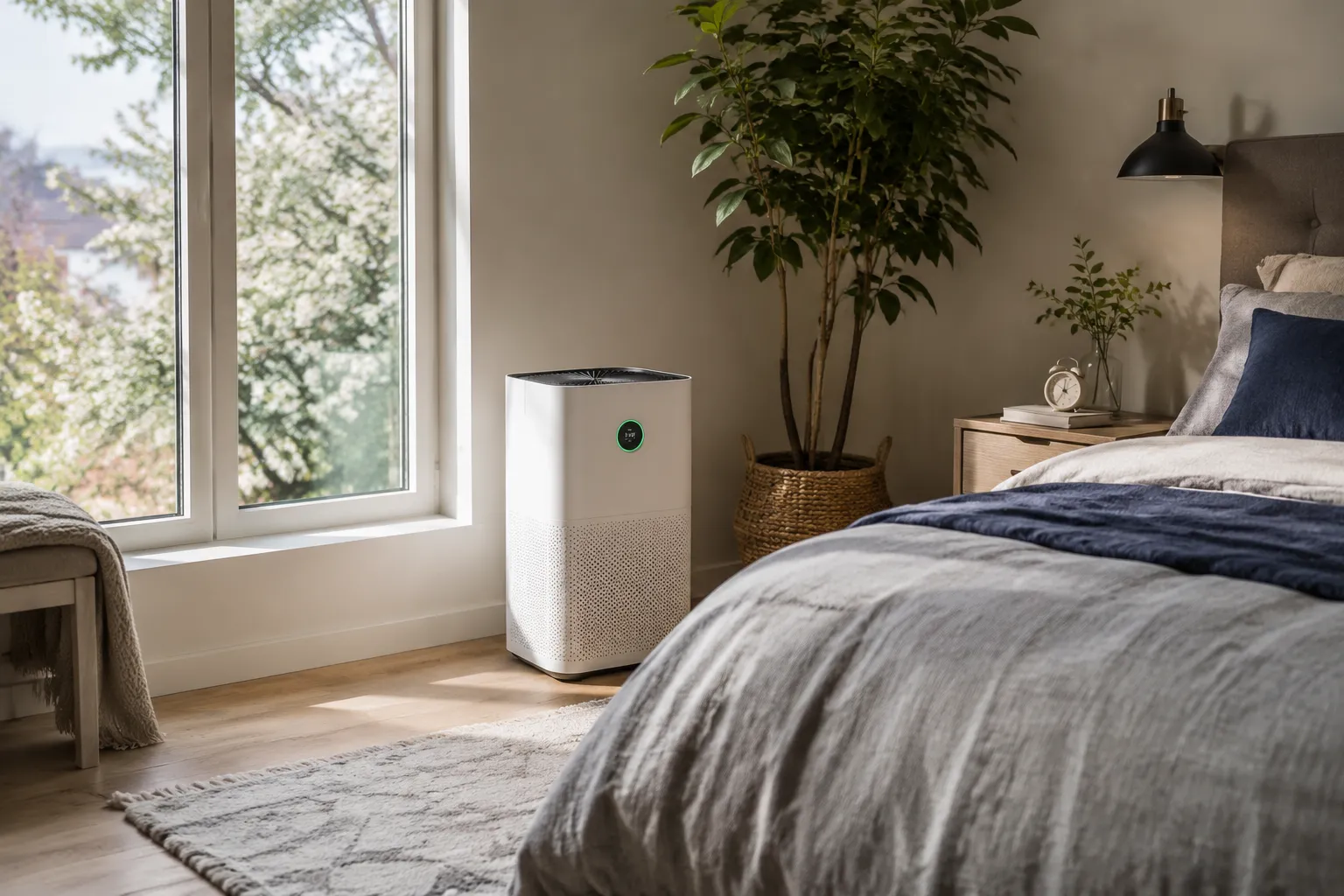
Allergy season rearranges a room. The vase gets moved so the box fan can sit on the nightstand. The stack of books migrates off the dresser to make space for a machine that hums through the night. People do this by instinct, placing the air purifier wherever it fits, and then they wonder why the bedroom still feels thick at dawn.
The placement matters more than the purifier itself. A $900 unit shoved into a corner behind the door performs worse than a $150 unit sitting in the open air where a person actually breathes. This is not a mystery of engineering. It is a failure of common sense, repeated every spring in thousands of bedrooms.
The Three-Foot Rule for Walls
Every air purifier on the market pulls air in from the sides and pushes clean air out the top. That is the standard layout. The intake vents wrap around the lower half of the machine, and the fan exhausts upward. When a purifier sits flush against a wall, the intake on that side gets choked. The machine still runs, but it pulls mostly from a four-inch gap of dead space instead of the open room.
Three feet of clearance on all sides is the number that keeps coming up in the manual, and it is a good number. That distance gives the intake enough room to draw air from the actual living space. In a cramped bedroom, three feet is not always possible. The next best option is to pull the machine at least a foot off the wall, which solves the worst of the problem without requiring a furniture rearrangement.
People who tuck a purifier tightly into a corner are wasting most of their money. The machine runs at full power, makes the same noise, and cleans a fraction of the air it could. The airflow physics are not forgiving. A corner creates two dead walls that the intake simply cannot pull from, and the resulting circulation pattern leaves the center of the room untouched.
Height Is a Compromise, Not a Rule
Manufacturers recommend placing purifiers on the floor, and that advice is mostly right, but it comes with an asterisk. Pollen and dust settle. They fall out of the air and land on carpets, rugs, and hardwood. A floor-level intake catches those particles as they drift down. That is the logic, and it holds up for most of the day.
But people sleep on beds, not floors. During the night, the breathing zone is roughly two to three feet above the mattress. A purifier on the floor has to pull the entire room's air volume downward to filter what a person is actively inhaling. It does this eventually, but "eventually" is not the same as "right now."
A nightstand placement puts the intake closer to nose level, which means faster relief for the person lying in bed. The tradeoff is that the machine now filters a smaller slice of the room. It cleans the air immediately around the bed very well and leaves the far corner of the room mostly alone. For allergy sufferers, that trade is usually worth it. The goal is not to clean the whole house. The goal is to create one pocket of air that does not make a person miserable.
The worst option is placing the purifier high up, on a shelf or a tall dresser. Dust and pollen are heavier than air movement can suspend them for long. They fall. A machine sitting six feet up is filtering air that has already been through the breathing zone, and it misses the particles that matter most. Keep it low or keep it close to the bed, not both, but never put it on a high shelf.
Bedrooms Need the Machine Pointed at the Bed
Bedrooms are where allergy season does its worst damage. A person spends seven to nine hours in one room, breathing the same air, and the body's allergic response ramps up overnight. Morning congestion and puffy eyes are not random. They are the result of eight hours of uninterrupted exposure.
The purifier should sit so that its output flows toward the bed. The clean air exiting the top of the machine creates a column that rises, hits the ceiling, and spreads out across the room. If that column lands on the bed, the sleeper gets the first pass of cleaned air. If the purifier sits on the far side of the room, pointed away from the bed, the air has to loop around the entire space before reaching the sleeper, and it picks up particles along the way.
A simple test tells a person whether the placement is right. Turn the machine on high and stand next to the bed. If a hand can feel a gentle current of air moving across the sleeping area, the placement works. If the air feels still, the machine is fighting the room's layout instead of working with it.
Living Rooms Require Raw Airflow, Not Placement Tricks
Living rooms have the opposite problem from bedrooms. They are bigger, they have more furniture blocking airflow, and they often connect to kitchens or hallways through wide openings. A single purifier in a living room is fighting an open floor plan, and placement tricks can only do so much.
The honest answer for a living room is that a person needs either a significantly larger machine or two smaller ones. One unit placed in the corner of a 400-square-foot great room will not clean the space within a reasonable time. The CADR rating on the box is measured in an enclosed test chamber, not an open-concept home with a ceiling fan running and a door to the patio cracked open.
When one machine has to do the job, it belongs near the seating area, not at the perimeter. The couch, the armchair, the spot where a person sits for three hours watching television, that is the pocket of air that matters. Put the purifier three feet from the main seating position, on the floor, with the top unobstructed. It will not clean the whole room perfectly. It will keep the breathing zone around the couch tolerable, and that is the realistic win.
People who place a purifier in a living room to "filter the whole space" are setting themselves up for disappointment. The machine is a point source. It cannot reach around corners or through the archway into the dining room. Match the machine to the zone, not to the entire downstairs.
The Open Door Problem
An air purifier in a bedroom cannot clean the entire house. This sounds obvious, but watch what happens during allergy season. Doors stay open, windows get cracked, and pets wander through. Every time a bedroom door opens, the room pulls in air from the hallway, which pulls in air from the living room, which pulls in air from outside. The purifier keeps up as best it can, but it is constantly processing new contaminants.
Closed doors make a meaningful difference. A purifier in a closed bedroom reaches its steady-state cleaning level faster and holds it. The room becomes a sealed chamber that the machine cycles over and over, and each pass removes more pollen and dust from the air. Open the door for thirty seconds and the process resets.
This is a behavioral fix, not a placement fix. But placement interacts with it. A purifier sitting right next to the door will pull hallway air directly into the room every time someone walks by. Moving it to the far wall, away from the door, gives the machine a chance to work on air that is already inside the space.
For people who keep doors open at night for a child or a pet, the purifier should sit in the path of the airflow, not off to the side. If the door opens into the room, the air from the hallway rushes in along that arc. Putting the machine in that path lets it catch the incoming contaminants at the point of entry.
Kitchens and the False Sense of Security
Kitchens are a special case because cooking generates particles that are not pollen. Frying, toasting, and broiling release fine particulates and grease into the air. An air purifier in the kitchen is not a replacement for a range hood. It is a secondary filter that struggles to keep up with the volume of particles a single searing pan produces.
Placement in the kitchen should prioritize the dining or breakfast nook area, not the stove. A purifier next to the range will pull in grease and smoke, clog its filter faster, and still fail to clean the air because the source is too close and too intense. Sitting it ten feet away, near where a person eats, gives the machine a fighting chance at keeping the meal zone breathable without drowning in cooking exhaust.
The filter will cost more to replace if the machine lives in the kitchen. That is a maintenance fact worth planning for, not a reason to skip the machine entirely.
Reading the Air, Not the Box
Most purifiers have one of two designs: a single side intake or a 360-degree intake. The single-side units pull air only from the front. They need to face the center of the room, with the back panel against the wall. The 360-degree units pull from all sides and can sit anywhere, but they need that three-foot clearance all the way around to function properly.
The cheap white plastic units with the hand-tightened filter door usually have a single intake. The cylindrical units with the wrap-around grill usually pull from all sides. Checking which design a person owns takes five seconds and changes where the machine should go. Treating them the same is how a lot of people end up with a machine that hums all day and does almost nothing.
The other reading is the filter itself. A machine that has been running for three months with a gray, dust-caked pre-filter is not cleaning anything. The placement can be perfect, but a clogged filter blocks the intake and the machine moves less air. Check the pre-filter monthly during allergy season. Vacuum it or rinse it if the manual allows. The machine is only as good as its intake.
The Window Draft That Undoes Everything
A room with a window cracked open is a room that will never be fully filtered. Fresh air is great for general health, but during peak pollen days, an open window is a direct pipeline for the exact particles the purifier is trying to remove.
When a window must stay open, the purifier belongs between the window and the person. The machine becomes a barrier that intercepts incoming pollen before it reaches the breathing zone. Place it on the floor, three to five feet from the window, facing the room. The draft comes in, hits the intake, and gets filtered before circulating.
This works poorly compared to a closed window, but it works better than any other arrangement. The purifier cannot win a constant battle against an open window. It can only hold the line close to the people in the room.
The Hallway Fallacy
Some people place a purifier in the hallway, thinking it will filter the bedrooms at either end. This is the most common placement mistake of the entire season. Hallways are transitional spaces. Nobody spends meaningful time there. The purifier cleans air that nobody breathes, and the bedrooms remain thick with allergens.
The hallway placement feels logical because it seems central. It is not. The machine does not create a pressure differential strong enough to pull air out of closed rooms. Even with doors open, the airflow is too weak to move clean air down a corridor and into a bedroom with any force. The machine simply filters the hallway over and over, which is a waste of electricity and filter life.
If a person can only afford one purifier, it goes in the bedroom, because that is where eight hours of the day are spent. The hallway gets nothing. If two purifiers are available, one in each bedroom beats one in the hallway plus one in the living room. The spaces where people sleep are the spaces that matter.
Seasonal Adjustments to the Same Room
Allergy season shifts the rules. In summer, with the AC running, the bedroom door stays closed and the purifier works in a sealed box. In spring, with the windows open in the evenings, the machine has to be repositioned closer to the window or the whole approach changes. A good placement in September is not necessarily a good placement in April.
The fix is to reassess the room once a month during peak season. Walk in, look at where the machine sits, and ask whether that position still matches how the room is being used. Furniture gets moved, window schedules change, and the machine should follow. A piece of tape on the floor marking the spot is not necessary. The machine should be moved freely, without ceremony.
People who set the purifier once and never touch it again are treating it like a lamp. It is not a lamp. It is a mechanical filter that has to adapt to the room's changing conditions. The best setup is the one that gets adjusted when the room changes. Allergy season is not static, and neither should the placement be.
By late May, the pollen count drops and the machine can go back to its permanent spot in the corner. But during the worst six weeks of the season, the purifier belongs where the breathing happens, not where the furniture layout looks neatest.
One last detail: the machine should be on a schedule that matches human activity. Running it all day in an empty house wastes filter life. Running it only at night misses the daytime accumulation of pollen that settles on surfaces and gets kicked up by footsteps. Set it to run on low during the day and high two hours before bedtime. The room will be clean when a person walks in, and the machine will have already done the heavy lifting.