
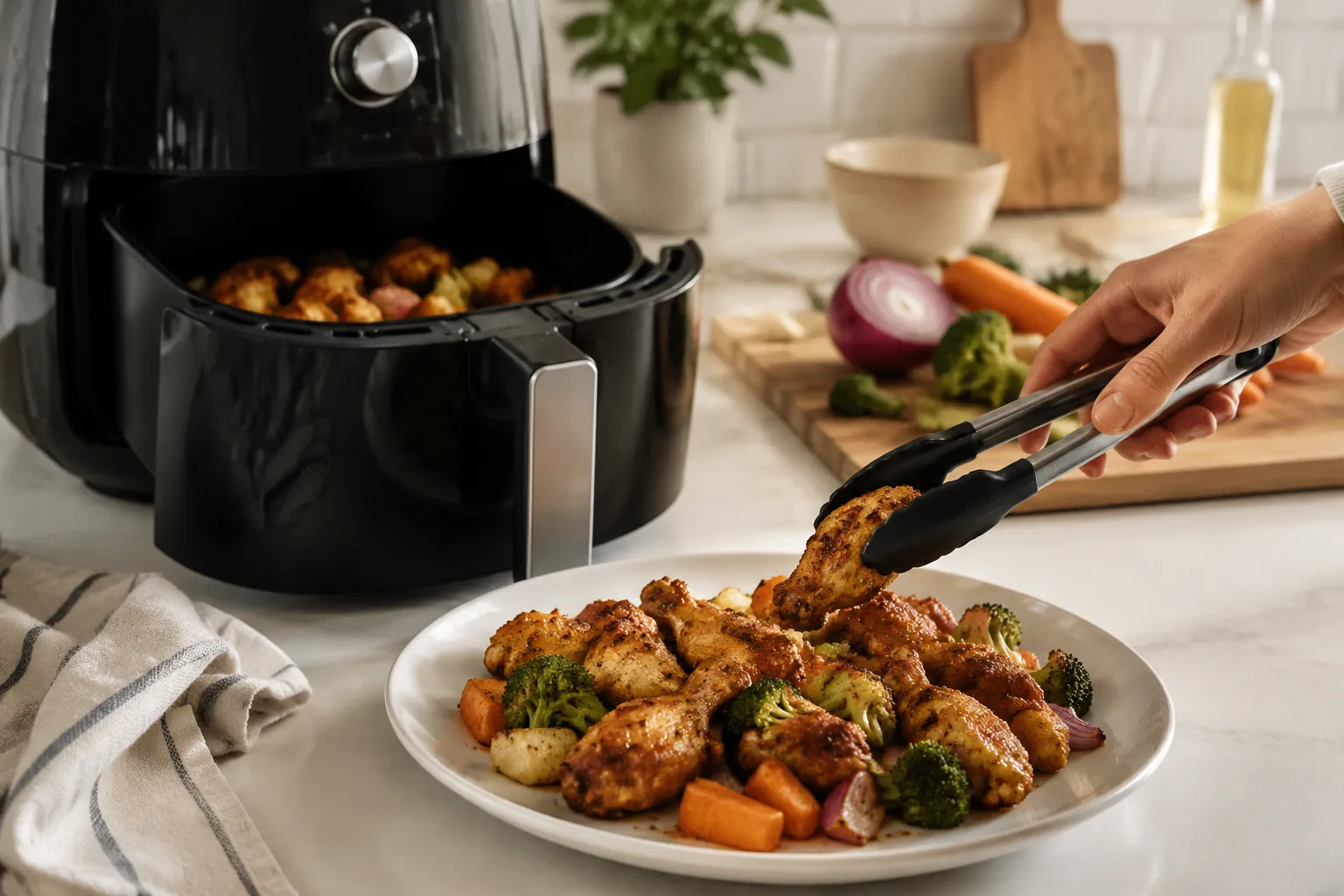
The air fryer has done something genuinely strange to the American kitchen: it has made people believe that hot, rapidly circulating air can replace oil altogether. The phrase "oil-free" sits right on the box, and plenty of cooking blogs repeat it like a mantra. But anyone who has taken a dry chicken breast out of a basket after twenty minutes knows the truth. The air fryer is not a no-oil appliance. It is a less-oil appliance, and the difference between those two ideas is where all the flavor lives.
The confusion is understandable. The whole pitch of the machine is that it fries without frying, that a basket of broccoli emerges with the same crisp edges as something from a deep fryer, minus the quart of bubbling fat. That promise breaks down the moment a person actually tries it. Plain vegetables, uncoated, come out leathery. Potatoes turn into chalky cubes. A chicken wing with nothing on it tastes like a sad, dry version of its former self. The machine is not broken. The expectation is.
The Mistake of Believing the Basket Does Everything
The air fryer is a convection oven with a fan that happens to be very enthusiastic about its job. That is all it is. It moves hot air around a small chamber at high speed, which means it removes moisture from surfaces faster than a regular oven does. That moisture removal is what creates crispness. It is also what dries things out. A piece of food with no surface fat or coating going into that chamber will simply have its water pulled out until it is tough and unpleasant.
This is why the oil-free promise is such a trap. Water and oil both sit on the surface of food, but they behave completely differently under heat. Water evaporates. Oil conducts heat and browns. A vegetable tossed in nothing but salt and pepper will steam from the inside and then shrivel. The same vegetable given a light coating of oil will brown, crisp at the edges, and hold its structure. The oil is not a workaround. It is the mechanism.
The goal, then, is not to eliminate oil. The goal is to use so little of it that the dish still counts as light, while getting all the texture benefits. A teaspoon of oil per serving is not a betrayal of the air fryer concept. It is the difference between the machine producing food that tastes like a compromise and food that tastes like a decision.
What a Small Amount of Oil Actually Does
There is a specific threshold where oil stops being a cooking medium and starts being a seasoning. That threshold is lower than most people think. For a full basket of vegetables, roughly a tablespoon of oil is enough to coat every surface, encourage browning, and prevent the food from sticking to the basket. That is about 120 calories spread across several servings. It is not the same as deep frying. It is not even the same as pan frying in a generous slick of fat.
The oil matters most for what it does to the surface. A tiny amount of fat helps the outside of the food reach the temperature where Maillard browning happens, which is around 300 degrees Fahrenheit. Without that fat, the surface stays cooler because water evaporates and carries heat away. The food steams. The food dries. The food tastes like a health food product that a well-meaning relative bought in 1997.
There is also the question of how the oil is applied. A person who pours a tablespoon of oil over a basket of vegetables and shakes it once will get uneven coverage. Some pieces will be slick, others dry. The better approach is to put the vegetables in a bowl, add the oil, and toss them until every piece has a faint sheen. This takes thirty seconds. It changes the outcome more than any setting on the machine.
The Foods That Genuinely Need Almost No Oil
Some foods genuinely do not need oil in the air fryer, and it is worth knowing which ones those are. Anything with a high fat content of its own will render that fat out and baste itself. Chicken thighs with the skin on, for example, will crisp up beautifully with nothing added. The skin releases its own fat, which then fries the skin from the outside. The same goes for bacon, sausage, and any cut of meat with visible marbling. These foods are the honest part of the oil-free claim.
Frozen foods are the second category. Frozen french fries, tater tots, and breaded chicken tenders come from the factory with a coating that already contains oil. That coating crisps in the air fryer without any additional fat. The results are often better than oven baking because the fan is more aggressive. A person can honestly call this oil-free, in the sense that no oil was added at home. The factory already handled that part.
Everything else falls into the middle zone. Fresh potatoes, vegetables, seafood, and most cuts of meat will all benefit from at least a thin coating of oil. The amount is small enough that the dish still feels light, but it is present enough to do the work. The air fryer cannot turn a dry piece of cod into something succulent. It can only preserve what is already there, and a whisper of oil is what preserves it.
A Technique for Crisping Without Drying
The single most useful trick for oil-free-leaning cooking is to think in stages. A piece of food that needs both a cooked interior and a crisp exterior will fail if it is blasted at full temperature the whole time. The outside burns while the inside stays raw, or the whole thing dries out trying to get the center done. The air fryer amplifies this problem because it is so aggressive at the surface.
The fix is to start at a lower temperature and finish hot. Potatoes, for example, can be cut into wedges, tossed with a small amount of oil, and cooked at 300 degrees until they are tender all the way through, which might take twelve minutes. Then the temperature goes up to 400 degrees for the final five minutes. The first stage cooks the inside. The second stage creates the crust. The total oil is still just a teaspoon or two per serving, but the texture comes out like something from a fryer.
This two-temperature approach also works for vegetables that need softening before browning. Cauliflower florets, Brussels sprouts, and carrots all benefit from a lower first pass. The lower temperature gives the interior time to become tender while the surface dries out slightly. The high finish then produces the caramelized edges that make roasted vegetables worth eating. Skipping the first stage produces a vegetable that is crunchy on the outside, raw in the middle, and not in a good way.
The Battery of Seasonings That Carry the Dish
When cooking with very little oil, seasoning becomes the entire point. A deep fryer adds flavor through the oil itself and the browning that comes with it. An air fryer with a teaspoon of oil needs help. That help comes from aggressive seasoning, and not just salt. A dusting of smoked paprika, a pinch of cayenne, a spoonful of garlic powder, or a squeeze of lemon after cooking can transform a basket of vegetables from austere to memorable.
The timing of the seasoning matters as much as the quantity. Salt and dry spices that go on before cooking will penetrate the surface and become part of the crust. A squeeze of citrus or a splash of vinegar belongs after cooking, when it can brighten the finished dish without being cooked away. Fresh herbs also work best after the heat is off. A handful of chopped parsley or cilantro thrown into the basket in the last thirty seconds will wilt slightly and release its aroma without turning into dried confetti.
There is also the matter of moisture management. Wet marinades are the enemy of air fryer crispness. A piece of chicken sitting in a soy sauce and honey mixture will steam in the basket, because the sugar and liquid create a sticky, moist surface that the fan cannot dry out fast enough. The better move is to pat the food dry before cooking, apply a thin layer of oil, and use a dry rub or a thick paste rather than a watery marinade. The flavor lands differently, but it lands.
Rethinking the Basket Liner Question
Perforated parchment liners and silicone mats have become popular accessories for the air fryer, and they deserve a moment of scrutiny. A liner that covers the holes in the bottom of the basket will block the airflow that makes the machine work. The food underneath the liner steams instead of crisping. The whole point of the basket design is that hot air circulates around and under the food. A liner that seals off the bottom kills that circulation.
Some liners are perforated and allow airflow, and those can help with cleanup without ruining the texture. But a person who wants the best possible result should skip the liner entirely and clean the basket afterward. A small amount of oil on the food is enough to prevent sticking, provided the basket is preheated and the food is dry on the surface. The extra minute of scrubbing is worth the difference in crispness.
The shaking habit matters more than the liner. Every five or six minutes, the basket should be pulled out and given a firm shake. This redistributes the food, exposes new surfaces to the fan, and prevents the pieces from steaming each other where they touch. A person who never shakes the basket is paying for a convection machine and using it like a still oven.
The Oil Sprayer That Changes Everything
The best purchase for air fryer cooking is not a bigger machine or a set of fancy accessories. It is a pump-style oil sprayer, the kind that holds a few ounces of oil and dispenses it as a fine mist. This simple tool solves the coverage problem that plagues most oil-free attempts. A single pump deposits a thin, even layer of oil across a wide surface. Two or three pumps cover an entire basket of vegetables with less oil than a person would use in a single careless pour.
The sprayer also makes it possible to oil food after it is already in the basket. A light mist over the top of the food, followed by a shake, coats everything without the need for a separate mixing bowl. This is the closest thing to a true oil-free experience, because the total oil can drop to a few grams per serving while the food still browns properly. The sprayer is not a gimmick. It is the single best tool for making the air fryer live up to its lighter-cooking promise.
One caution: the sprayer should be used with regular oil, not aerosol cooking sprays. The propellants and additives in canned sprays can leave a sticky residue on the basket that builds up over time and becomes difficult to remove. A pump bottle of olive oil or avocado oil sprays just as fine and costs less per ounce. It also gives the cook control over the exact amount going onto the food.
A Few Dishes That Prove the Point
Frozen french fries with a single spray of oil and a sprinkle of salt come out with nearly the same exterior crunch as restaurant fries, with a fraction of the fat. The fries are already coated from the factory, so the added oil is purely for browning. A batch of chickpeas, drained, dried thoroughly, tossed with a teaspoon of oil and a heavy dose of cumin and smoked paprika, turns into a snack that resembles roasted nuts more than anything from a can. The air fryer pulls the moisture out of the chickpeas and gives them a crackling shell that holds up for hours.
Salmon fillets, brushed with a tiny amount of oil and seasoned with salt and pepper, cook in eight minutes at 375 degrees. The exterior gains a crisp, golden crust while the interior stays medium-rare. No pan, no spatter, no oven preheat. The same fillet without oil comes out with a pale, rubbery surface that tastes like the fish was steamed. The oil is doing the work, and it is doing it invisibly.
The larger point is that the air fryer is a tool for restraint, not for denial. It cannot produce the same results as a deep fryer, and it was never going to. What it can do is produce food that is crisp, flavorful, and genuinely light, as long as the cook stops treating oil like a failure and starts treating it like an ingredient. A teaspoon of oil is not cheating. It is the difference between the machine working and the machine being a cabinet ornament.