
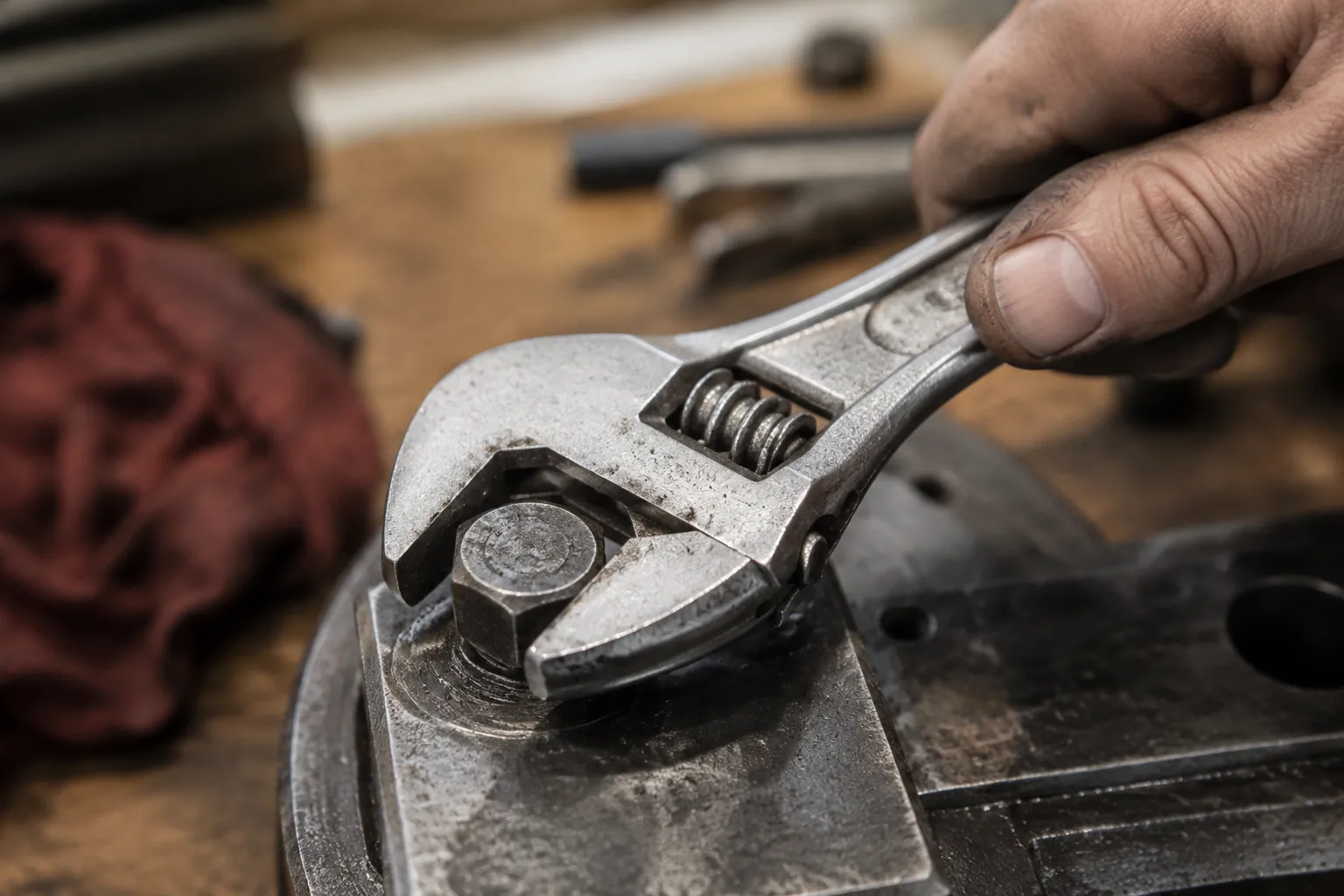
The crescent wrench, as it is often called, is a tool that most people buy twice. The first purchase is a matter of convenience, something grabbed off a pegboard because the price was right and the need was immediate. The second purchase happens after the first one has rounded off a few too many hex bolts, leaving the user with a drawer full of frustration and a new understanding of what a jaw actually does. The difference between the two purchases is rarely about the brand name stamped on the side. It is almost always about how the tool has been treated, and more specifically, how the mating surfaces of the jaws have been maintained.
The adjustable wrench is a precision instrument disguised as a brute. Cast into a shape that suggests it can hammer, pry, and twist with impunity, its actual working components, the two hardened faces that grip a fastener, are ground to specific tolerances and angles that determine whether the tool will hold or slip. The entire mechanism is a study in controlled slack; the worm gear, the rack, and the slide all work together to convert a twisting hand into a clamping force. But that force is only as good as the contact patch between the jaw faces and the flat sides of a bolt. Any deviation in that contact, any wear, any uneven surface, and the tool stops being a wrench and starts being a rounder of corners.
The fundamental problem with an adjustable wrench is that its jaw, unlike a fixed box-end or a socket, is suspended on a slide. This creates inherent play, a tiny amount of movement that increases as the components wear. When a person applies torque, the movable jaw tends to shift slightly, which changes the angle of attack on the fastener. Instead of pressing flat against the bolt's side, the jaws start to dig into the corner. This is the moment of rounding. It is not caused by the metal being too soft, but by the geometry of the grip collapsing under load.
Preventing that collapse starts with two habits that run completely against the grain of how most people use this tool. The first is to never, ever strain against the jaw. The second is to adjust the fit for the specific size of the fastener, not just until it looks close enough. A person who grabs any old wrench, slaps it on a nut, and leans on the handle is asking for failure. The tool is designed to be tightened, to have the worm gear snugged up so the jaw faces are in intimate contact with the work piece. A loose adjustment is the fastest path to rounding.
Yet even with perfect adjustment habits, the jaws will eventually lose their edge. The hardened steel of a good wrench is tough, but it is not immune to the abrasive forces of dirt, rust, and the micro-movements that occur during use. The keen edges of the jaw face, which are cut at a slight angle to bite into the work, become dull. The flat face develops a concave wear pattern, a subtle dishing that happens from years of pressure concentrated in the center. A person can feel this wear long before they see it; the wrench starts to feel as if it is slipping even on a brand new bolt.
The Filing Fallacy and the Hardness Problem
The common instinct to fix a worn jaw is to grab a flat file and take a few passes across the face. This is a mistake of the highest order. The jaw faces are hardened, often to around 40 to 50 on the Rockwell C scale, which is hard enough to withstand the pressures of gripping but still tough enough to avoid shattering. A standard hardware store file will skate across that surface without removing much metal, leaving behind a polished smear and a dulled file. To actually cut the steel, a person would need a carbide burr or a diamond file, and even then, they run the risk of ruining the heat treatment by generating excessive heat.
The hardening isn't just about wear resistance; it is about maintaining the precise geometry of the jaw. The faces are ground at a specific angle, usually with a slight offset so that the pressure is concentrated on the rear edge of the jaw near the throat. This is what gives the wrench its bite. When a person files the face flat, they remove that critical geometry, making the problem worse. The tool will then grip on the outer edge, which is the weakest point of the jaw, and rounding becomes even more likely.
Instead of filing, the proper maintenance is to clean the jaws thoroughly and then inspect them under a bright light. The enemy is not necessarily a dull face, but a face that has picked up metal transfer. When a wrench slips, it often deposits a thin layer of the softer bolt material onto the harder jaw face. This transfer, sometimes called galling, changes the effective size of the jaw opening and creates a rough surface that accelerates further wear on the next bolt it touches. The right response is to remove the transferred metal using a chemical solvent and a brass brush, which is softer than the steel jaw but harder than the transferred aluminum or mild steel.
Lubrication as a Defensive Layer
There is a school of thought that says a wrench should be kept bone dry to prevent slipping. This logic fails to distinguish between the gripping faces and the adjustment mechanism. The jaw faces should indeed be clean and dry, but the worm gear, the rack on the movable jaw, and the slide channel absolutely require lubrication. A dry mechanism creates friction, which translates into stickiness and premature wear. A person ends up over-tightening the adjustment to compensate for the gritty feel, which then puts excessive stress on the rack teeth.
The right lubricant is a light machine oil, not grease. Grease tends to collect dust and grit, forming a grinding paste that will wear down the slide surfaces over time. A few drops of oil, applied to the worm gear and the exposed edges of the slide, is sufficient. The oil seeps into the channel and keeps the moving parts gliding smoothly. This allows the user to make fine adjustments, to snug the jaw down to exactly the right dimension without having to fight the mechanism. A smooth adjustment means the jaw is more likely to be set correctly, which is the single biggest factor in preventing rounding.
Some manufacturers recommend a dry-film lubricant for the slide, which is a solid coating that reduces friction without attracting dirt. These are excellent for tools that live in a dusty environment, but they require periodic reapplication. For most home workshops and professional toolboxes, a simple oiling routine every few months is more than adequate. The key is to wipe off any excess so the tool doesn't drip oil onto the work piece, which can contaminate a clean surface or cause a wrench to slip in a gloved hand.
The Wrong Way to Use the Wrong Side
A specific habit that destroys jaw geometry faster than anything else is using the wrench as a hammer. The hardened jaws are brittle. A sharp impact can cause microscopic fractures along the edge, which then propagate under load. A jaw that looks perfectly fine to the naked eye can have a compromised edge that will suddenly give way and round off a bolt. The portable nature of the wrench makes it tempting to use as a drift or a light hammer, but the tool is simply not designed for that kind of shock loading.
Another destructive misuse is applying torque to the "open" side of the jaw, pushing the movable jaw away from the throat. The wrench is strongest when force is applied in the direction that presses the movable jaw toward the fixed jaw. Many wrenches have a directional arrow stamped on them to indicate the proper orientation. Pulling against the open side stresses the slide mechanism and the worm gear teeth, causing them to wear and loosen. A loose slide is a death sentence for the tool's precision, as it introduces that slack that leads to slipping.
The user should also avoid using extensions on the handle to gain more leverage. A longer pipe or cheater bar multiplies the force on the fastener, but it also multiplies the bending stress on the wrench frame and the jaw. The tool will flex, the jaw will open slightly under load, and the grip will fail. This is how a person ends up with a snapped frame and a stripped bolt. The adjustable wrench has a limit, and respecting that limit is a form of maintenance. It keeps the jaws from being distorted beyond their designed capacity.
Inspection Routines That Catch Wear Early
Regular inspection is a practice that separates the person who treats tools as investments from the person who treats them as disposable. The inspection should start with a visual check of the jaw faces. A straight edge, such as the back of a good metal ruler, can be held against the jaw face to check for flatness. If light passes through the center but not the edges, the jaw has developed a concave wear pattern. The tool is still usable for rough work, but it will no longer be reliable on a critical fastener.
The worm gear should also be checked for play. A person can grip the movable jaw and try to rock it back and forth along the slide. A small amount of movement is normal, but a distinct clunk indicates that the rack teeth or the gear are worn. This excessive play cannot be adjusted away. It requires the replacement of the slide and gear assembly, which is often not economical for a mid-range wrench. The best way to extend the life of this mechanism is to avoid excessive force on the open side of the jaw and to keep the mechanism clean.
For the user who wants to verify the jaw's actual gripping ability, a test on a known, undamaged bolt is the most direct method. The wrench should be set, snugged down, and torqued. If it slips or leaves shiny marks on the bolt's corners, the jaw needs attention. This test is also a good way to check the user's own technique, because the slipping is often the result of a loose adjustment rather than a worn jaw. Knowing the difference between a tool problem and a technique problem is essential to effective maintenance.
Storage and the Slow Rust Factor
Storage is the maintenance step that most people overlook because its effects are delayed. A wrench left in a damp drawer, or tossed into a bucket with other tools, will develop rust. The rust on the outer body is cosmetic, but the rust that forms in the slide channel is structural. It pits the finely ground surfaces, creating rough spots that impede the smooth movement of the jaw. Even worse, rust on the jaw faces changes their friction characteristics, making them more likely to slip on a bolt.
The solution is not to coat the entire tool in a thick layer of grease, but to keep it clean and dry. A light wipe with an oily rag after use is sufficient to create a barrier against moisture. For tools stored for long periods, a vapor-phase corrosion inhibitor, which is a small chip or a sachet that releases a rust-preventing vapor, can be placed in the toolbox. This is a cheap and effective way to protect the precision surfaces without leaving a sticky residue.
The most damaging storage practice is leaving the wrench clamped down tight at its maximum opening. This puts constant tension on the worm gear and the slide, causing a slight deformation over time. The tool should be stored with the jaw closed, or at least with a small gap, so that the spring tension is relieved. This simple habit prevents the slow, creeping set that makes a wrench feel loose even when it is adjusted correctly.
The Quality Threshold and When to Quit
There comes a point in the life of every adjustable wrench where maintenance ceases to be a matter of care and becomes a matter of economics. A wrench that has been abused for decades, with a bent frame, a stripped worm gear, and a jaw that rocks on its slide, cannot be saved. No amount of oiling or careful use will restore its precision. The honest assessment of the tool's condition is a necessary skill, as holding onto a worn-out wrench is a false economy that leads to damaged fasteners and skinned knuckles.
The cheap wrenches on the market, often with a cast frame that is not properly hardened, will wear out faster and are not worth the effort of maintenance. A good middle-ground approach is to spend a bit more on a reputable brand, usually one that offers a lifetime warranty, and then to maintain that tool properly. The warranty is a backstop for manufacturing defects, but it does not cover the wear caused by the user's habits. The onus of care is on the owner.
The real tell of a well-maintained adjustable wrench is the sound it makes. A tool with a healthy mechanism and a snug adjustment makes a clean, solid click when it seats onto a bolt. A worn tool makes a dull thud or a scraping sound. A person who listens to their tools can diagnose problems before they cause a failure. The click is the sound of the geometry doing its job, the hardened faces finding purchase on the flat sides of the fastener, the slide locked tight, and the user's force being transferred completely into the turn. When that click is gone, the wrench is just a piece of shaped metal, and the next bolt it touches is at risk.