
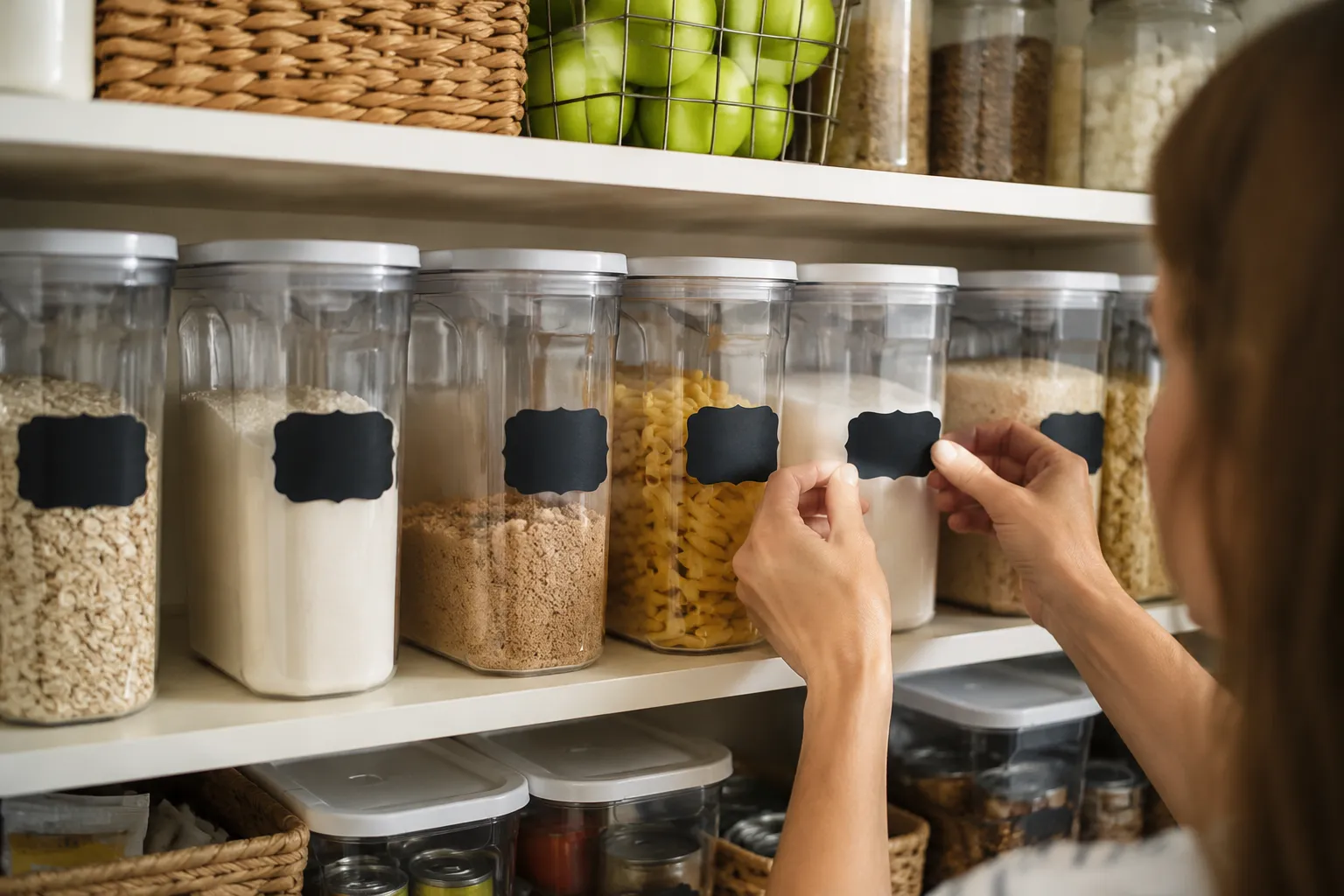
Most pantry organization advice collapses under its own ambition. A person buys three dozen matching glass jars, prints calligraphy labels for every grain and pulse, arranges everything by color or alphabet, and then abandons the system within three weeks when a bag of flour gets ripped open and poured into the wrong container. The failure is not a lack of discipline. The failure is that the system required too many decisions at the moment of action. A labeling system that survives contact with real life has to be simpler than the chaos it is meant to replace.
The system that actually sticks has exactly two rules. First, every container gets a label that names its contents in plain language. Second, every container has a designated spot that never changes. That is the entire architecture. No color coding, no QR codes, no inventory spreadsheet on the fridge, no monthly audit. Two rules, both of them dumb enough to follow at 7:00 a.m. while half asleep and trying to get coffee brewed before the kids wake up.
What makes this system work is not the labels themselves. It is the removal of choice. When a person finishes a bag of rice, they do not stand there wondering where the rice goes or which jar is the rice jar. The jar is labeled, and the label has not moved in six months. Refilling takes four seconds. The cognitive load of pantry maintenance drops to nearly zero, which is the only realistic way to keep a pantry organized for more than a single Instagram-worthy weekend.
Why the Fancy Systems Fail
The elaborate systems fail because they ask too much of the person who has to maintain them. A labeling system that requires a label maker, a printer, a laminator, or a steady hand with a chalk pen is a system that depends on a level of craft patience most people simply do not possess during a busy week. The act of creating a beautiful label is itself a barrier. When a container needs a new label at 6:45 p.m. on a Tuesday, nobody wants to fire up a label maker and scroll through font options.
There is also the problem of over-specification. A label that reads "Organic Basmati Rice, Long Grain, Imported, Best By March 2027" is a label that will be wrong within a month when the household switches to jasmine rice because the store was out of basmati. The label becomes a lie, and a person who sees a lie every time they open the pantry starts to distrust the entire system. The elegant solution is a label that says only "Rice." That label remains true no matter what kind of rice ends up in the jar.
Another failure mode is the decorative approach. Labels with fancy script, illustrated vegetables, or inspirational quotes turn the pantry into a curated aesthetic project. The problem is that aesthetics demand upkeep. A label that smudges, peels, or looks crooked after a month of use becomes an eyesore, and the person who cared about the aesthetic now has two jobs: maintain the food storage and maintain the beauty of the storage. Most people eventually choose to maintain neither.
The Materials That Actually Survive
The physical label matters more than most people expect. A paper label from a basic office label maker will curl and yellow within a few months, especially in a warm, humid kitchen. The label needs to survive occasional condensation, the odd splash of cooking oil, and the constant handling of jars that get pulled out and put back several times a week.
Two options hold up in real kitchens. The first is a simple adhesive label written with a permanent marker. This sounds too plain to be a solution, but a black Sharpie on a matte white label is legible, waterproof, and instantly editable. When the rice jar becomes the pasta jar, the label gets a fresh piece of tape over the old writing, or the old label gets peeled off and replaced in less than a minute. The permanent marker does not run, does not smear, and does not require charging, software, or a learning curve.
The second option is a chalk label sticker, the kind that comes in a roll and accepts either a chalk pen or a standard piece of chalk. These are slightly more forgiving because they can be wiped clean and rewritten many times. A chalk pen produces a crisp, legible line that reads well from across the pantry. The downside is that chalk labels require a deliberate wipe-and-rewrite step that a permanent marker does not. For most households, the permanent marker route wins on sheer speed.
Skip the engraved brass tags, the wooden discs tied with twine, and the custom ceramic tiles. Those are gifts, not tools. A pantry label needs to be replaceable in under a minute, and anything that requires unscrewing, untying, or carefully prying off is too slow for real life.
The Right Containers for the Labeling Job
Labels only work when they have a stable surface to live on. A label stuck to a flimsy plastic bag is worthless because the bag crumples, folds, and gets replaced every time the contents run low. The container is the partner to the label, and the container needs to be durable, transparent, and uniform enough that the label has a flat face to stick to.
Glass jars with airtight lids are the gold standard for dry goods. A person can see the contents through the glass, which means the label only has to confirm what the eye already suspects. That redundancy is a feature. When the flour jar is half full and the label says "Flour," there is no ambiguity. Glass does not stain, does not absorb odors, and cleans up in the dishwasher. Mason jars in the wide-mouth pint and quart sizes cover most pantry needs, and a set of twenty jars costs less than a single fancy pantry-organization kit from a boutique kitchen store.
Plastic containers with gasketed lids work too, and they are lighter and less breakable. The clear PET jars sold as bulk-storage containers are fine, but they should be checked for a detail that plagues many of them: a curved or textured front face that makes labels peel away from the surface. A flat-sided container is non-negotiable. A label needs to sit flush, or it will catch on neighboring jars and peel off within a week.
What matters more than the material is the shape. Tall, narrow containers waste vertical space in a shelf. Square or rectangular containers pack together without gaps, which keeps the pantry denser and reduces the chance of a jar toppling over when something is pulled from the back. Uniform containers also make the labels look consistent, which is a quiet psychological boost: a row of matching jars with matching labels reads as order, even when the pantry is actually one day away from a full restock.
What the Label Should Say, and What It Should Not
The label should say the common name of the thing, nothing else. "Flour" for all-purpose flour. "Sugar" for granulated sugar. "Oats" for rolled oats. If the household keeps both rolled oats and steel-cut oats, the labels become "Rolled Oats" and "Steel Cut Oats," which are still plain names. The moment a label starts carrying adjectives that do not help identify the contents, it becomes noise.
Do not put "use by" dates on pantry labels. That information belongs on the packaging of the food itself, not on the jar that will outlive many bags of food. A jar of sugar will be refilled a dozen times over its life, and a date printed on the jar will be wrong eleven times out of twelve. Similarly, do not label the jar with a brand name, a price, or a store name. Those details change, and a label that has to be edited loses its authority.
One useful addition is a small quantity line that gets updated when the jar is refilled. This works for households that like to know when they are running low. A strip of white tape on the side of the jar with a permanent marker notation like "half full" or a simple fill-level tick can serve as a reorder signal. This is an optional refinement, and it should be skipped if it feels like a chore. The core system does not depend on it.
Assigning the Spots That Never Change
The second rule, that every container has a permanent spot, is the half of the system that most people forget. Labels alone do not create order. A labeled jar that gets shoved onto any empty shelf, wherever it happens to fit, is a jar that will be impossible to find when needed. The spot is what gives the label its meaning.
The assignment should follow a simple logic based on frequency of use. Everyday items, the salt and pepper and cooking oil that get grabbed at every meal, live on the counter or on the front edge of the most accessible shelf. Weekly items, the flour and sugar and pasta, live at eye level. Monthly items, the backup bags of beans and the rarely used specialty grains, live on the top shelf or the back of the bottom shelf. This arrangement means the most-used items require the least reaching, which is the quiet reason the system survives: convenience reinforces the labels, and the labels reinforce the convenience.
The permanent-spot rule also solves the problem of the half-empty jar. In a chaotic pantry, a half-empty jar gets moved forward to make room for a new purchase, then forgotten. When the spot is permanent, the half-empty jar stays in place, and the restock goes into the same jar or into the spot that was already designated. The motion of the pantry becomes a simple loop: empty the jar, wash the jar, refill the jar, return the jar to its spot. The loop takes less than a minute and requires no thinking.
Starting the System Without a Full Kitchen Overhaul
The biggest mistake people make when adopting a labeling system is trying to label everything at once on a single ambitious afternoon. The energy runs out halfway through, the labels run out, and the pantry ends up half-labeled, which is worse than not labeled at all. The smarter path is to label in batches, one category at a time, over the course of a few weeks.
Start with the baking shelf, which usually holds the most powdery, confusable items. Label the flour, the sugar, the powdered sugar, the cornstarch, the baking soda, and the baking powder. That last pair is the single most valuable label in the entire pantry because those two white powders look identical and behave completely differently in a recipe. A person who has ever grabbed baking soda instead of baking powder will instantly understand the worth of a permanent label.
The second batch targets grains and pasta. Rice, quinoa, couscous, barley, and the different shapes of pasta all go into labeled jars. The third batch covers beans and lentils, which are easy to tell apart but benefit from labels when the jars are stacked or when the ambient light is dim. The fourth batch covers snacks and breakfast items: cereal, granola, nuts, dried fruit. Four sessions of twenty minutes each, spread over a month, produce a fully labeled pantry without a single exhausting marathon.
Each session follows the same rhythm. Empty the current shelf, wipe it down, look at what is actually there, and discard anything that has been sitting too long. Then place the jars in their permanent spots and write the labels. The whole shelf takes less than half an hour, and by the end of the month the pantry has transformed itself through small, repeatable efforts rather than one heroic purge.
When the Label Is Wrong, Change It Fast
The system stays honest only if the labels stay accurate. A jar that once held oats but now holds cornmeal needs a new label the same day the swap happens. A household that labels a jar "Rice" and then pours a bag of quinoa into it has introduced a small lie into the system, and lies accumulate. The correct response is not to wait until the weekend or until the next labeling session. The correct response is to grab the marker and the tape and fix it in the thirty seconds it takes.
This is why the permanent marker and the roll of blank labels must live in the kitchen, within arm's reach of the pantry. If the labeling supplies are in a drawer in the home office or buried in a craft bin, the thirty-second fix becomes a five-minute project, and the five-minute project gets postponed. A small basket or a zip-top bag with the marker, a roll of labels, and a pair of scissors can hang on the inside of the pantry door. The supplies are part of the system, not an accessory to it.
The Quiet Satisfaction of a Labeled Pantry
What eventually emerges is not just an organized pantry but a calmer one. The morning rush no longer includes a frantic search for the baking soda. The dinner prep no longer pauses while someone squints at a bag and guesses whether the contents are cumin or coriander. The pantry becomes a place where a person can find what they need without thinking, and that absence of friction is the real reward.
The system also changes how the household buys food. With labeled, transparent containers, it becomes immediately obvious what is running low. A quick glance at the shelf shows that the rice jar is a quarter full, the oats are nearly gone, and the flour needs a restock. The pantry starts to tell its own story, and the shopper can respond to what the pantry actually says instead of playing a guessing game with a stack of opaque bags.
There is a measurable difference between a pantry that has been arranged once for a photograph and a pantry that has been arranged for daily use. The first is a still life. The second is a working tool. The labeling system described here, the two rules and the cheap supplies and the thirty-second fixes, is built for the second kind. It is not beautiful in the way that a magazine spread is beautiful. It is beautiful in the way that a well-worn knife or a perfectly seasoned cast-iron pan is beautiful: it works, it lasts, and it makes every single trip to the pantry a little easier than the one before.